News Posts matching #Asus

Return to Keyword Browsing

ASUS Unveils Innovative New Cloud Computing Solutions

ASUS has unveiled a comprehensive suite of portable, multimedia, and productivity solutions that places it at the forefront of cloud computing. ASUS strives to offer optimized cloud computing experiences by harnessing innovation and a broad range of cloud-enabled solutions. Professionals can enhance their productivity with access to real-time applications while on the go. At home, the entire family can enjoy rich multimedia entertainment with cloud-optimized solutions and services.

ASUS Combines NVIDIA ION with USB 3.0 on New EeeBox

In ASUS' latest entry into its EeeBox series of nettops, the company adds support for USB 3.0, with the unit featuring two SuperSpeed USB 3.0 ports. The EeeBox EB1501U is about the shape and size of any variant in its series. It uses first-generation NVIDIA ION platform, with Intel Atom 330 dual-core processor, 2 GB of DDR2 memory, GeForce 9400M graphics, 320 GB hard drive, slot-in DVD writer, gigabit Ethernet, 802.11b/g/n WiFi, and a USB 3.0 controller. Other connectivity features include eSATA, USB 2.0, and display connectivity including HDMI and D-Sub.

ASUS ROG Matrix HD 5870 Further Detailed

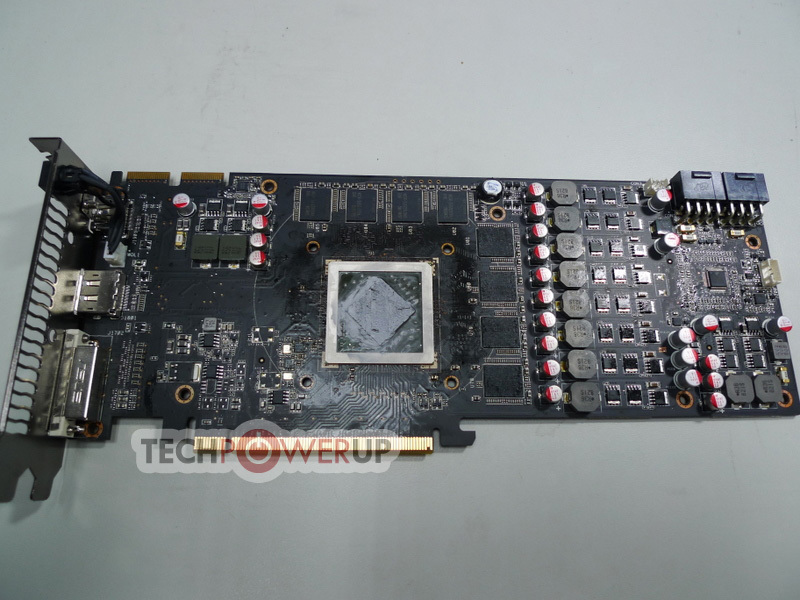
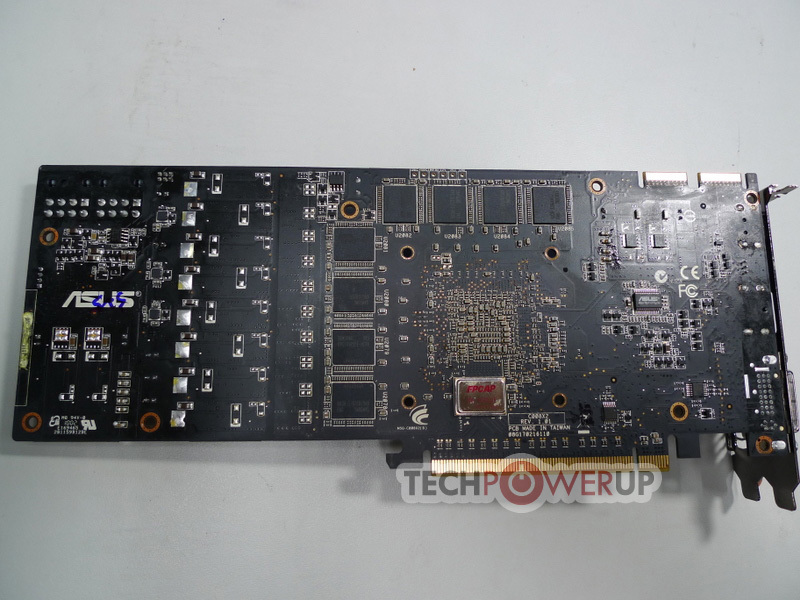
ASUS has been readying its Republic of Gamers (ROG) Matrix HD 5870 graphics card. Earlier, the card was pictured fully assembled. Sources shared pictures of the card taken apart, showing its PCB and cooling assembly from the inside, which tells us a lot about this card. To begin with, ASUS engineered this card from scratch, with its own PCB and cooler designs, and choice of components. The card comes overclocked out of the box, and also promises overclocking headroom higher than the reference design. It features 2 GB of GDDR5 memory. The PCB reveals a strengthened VRM. There is a 10-phase vGPU and 2-phase vMem, with independent voltage controllers. Power is drawn in from two 8-pin power inputs.

ASUS Unveils a Host of New Products for the Gaming Community

Gaming has evolved into a leading growth industry and dynamic motivator for the technology sector, as CeBIT 2010 further illustrates. It's a massively popular pastime drawing people, all united through thrilling entertainment. ASUS shares the passion, maintaining a tradition of ingenuity aimed at meeting the needs of gamers both with the hardcore Republic of Gamers brand (ROG) and powerful mainstream solutions. It seeks to innovate and introduce new exciting ways to enjoy gaming, believing it should be natural to take up rather than complicated.

ASUS Readies M4A89TD PRO Motherboard

At its displays at the ongoing CeBIT event, ASUS surprised many with a pair of Crosshair IV Series motherboards showing a renewed interest at the very high-end of the AMD platform. Incidentally, the company is also preparing a mid-range motherboard based on the AMD 890FX chipset, the M4A89TD PRO. The new board builds entirely on what the chipset has to offer with a slight addition of a two-port USB 3.0 controller. The AM3 socket is powered by a 10-phase VRM, supporting 140W CPUs. It is wired to four DDR3 DIMM slots with its own 2-phase VRM.

The 890FX chipset gives out two PCI-Express 2.0 x16 full-bandwidth slots, other expansion slots include an open-ended PCI-E 1.1 x4, a PCI-E x1, and two PCI slots. All six SATA 6 Gb/s ports the SB850 southbridge gives out are internal, an additional JMicron controller gives out IDE and eSATA. The board boasts of ASUS' "Core Unlocker" switch which simplifies unlocking disabled physical cores on some dual, triple, and quad-core chips. Other features include 7.1 channel audio, gigabit Ethernet, and USB 3.0 for connectivity. The M4A89TD PRO should be released around the time when AMD unveils its latest processors.

ASUS Announces M4A89GTD PRO Series Motherboards, Feature CPU Core Unlocking Switch

ASUS today launched the M4A89GTD PRO Series motherboard that delivers added core processing power by enabling the instant unlocking of latent AMD CPUs. Incorporating the latest AMD 890GX chipset with an advanced AMD graphics core, the M4A89GTD PRO Series also supports both ATI CrossFireX and Hybrid CrossFireX technologies. Combined with advanced rendering from the DX10.1 graphics API, the series offers spectacular visual output.

"By supporting both integrated and discrete graphics processing, the M4A89GTD PRO Series delivers enhanced graphics performance that will excite and impress both hardcore gamers and multimedia users," said Joe Hsieh, General Manager of ASUS Motherboard Business.

ASUS ROG Ares Graphics Card Benched

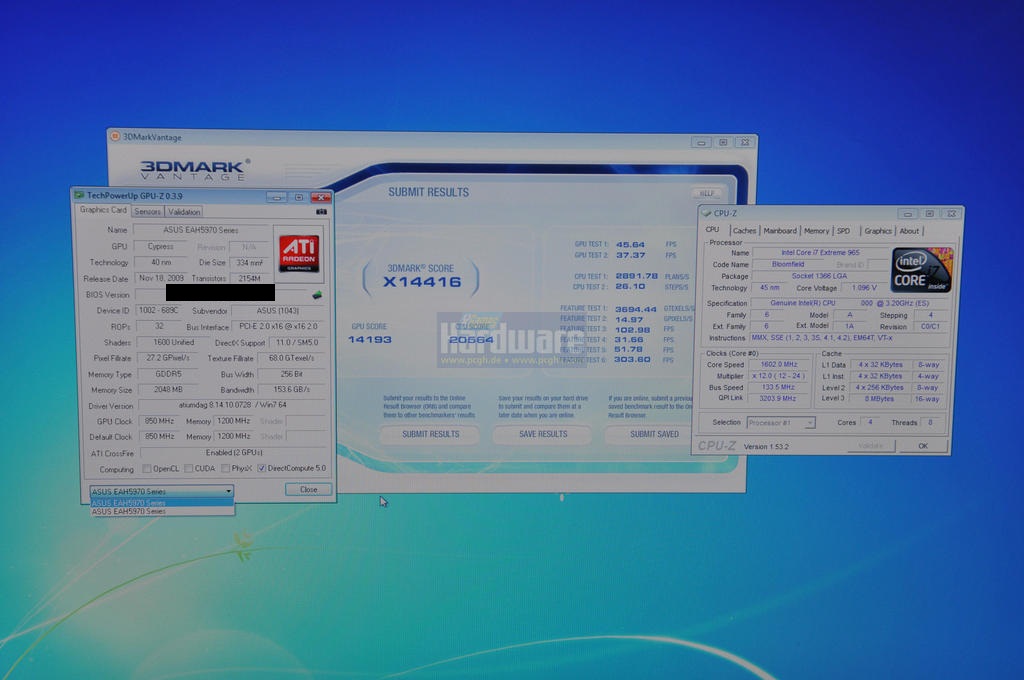
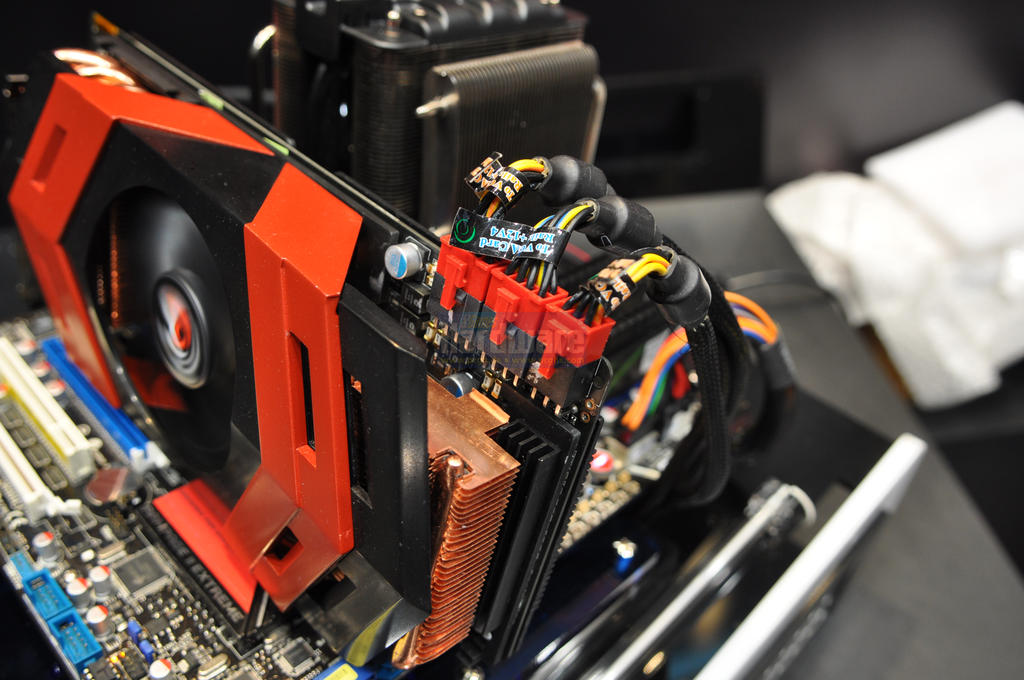
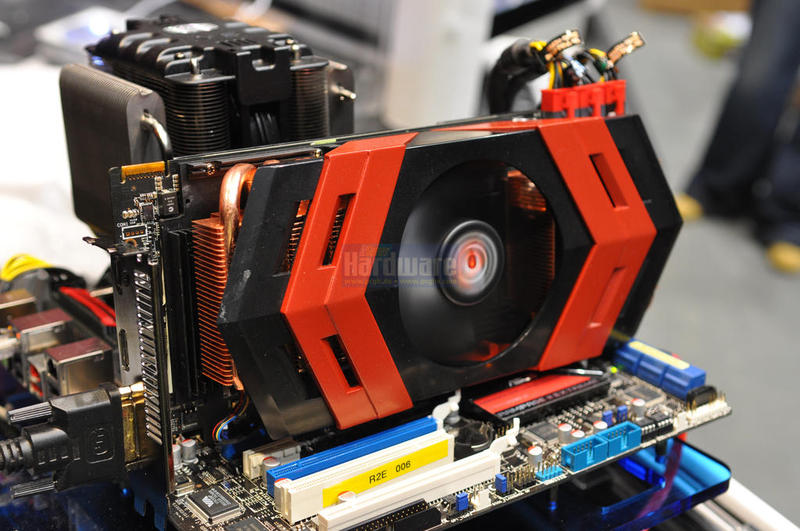
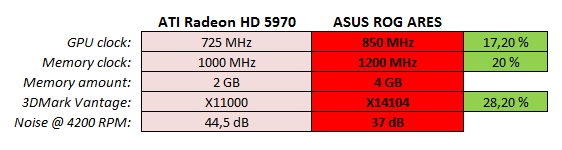
Here are some of the first pictures of a "living, breathing" ASUS ROG Ares graphics accelerator. This ASUS' latest creation packs two AMD Cypress GPUs running at 850 MHz (core), 1200 MHz (memory), with twice the amount of memory (2 GB per GPU, 4 GB total). It also packs an enthusiast-grade voltage circuitry that gives it an amount of overclocking headroom, as well as a complex cooling assembly.

At its CeBIT exhibit, ASUS also showed off the card's 3DMark Vantage score in the Extreme preset. The card secured a score of X14416, compared to a typical score of the reference Radeon HD 5970 to be around the X11000 mark. The bench was driven by an Intel Core i7 965 XE processor, ASUS Rampage II Extreme motherboard, and 6 GB of triple-channel memory. The ROG Ares should be out in a few weeks time. Its price and availability remain a mystery.

ASUS ROG Crosshair IV Formula and Extreme Motherboards Pictured

ASUS makes a return to the higher-end of the AMD platform with two motherboards in its elite Republic of Gamers (ROG) series, with the Crosshair IV Formula and Crosshair IV Extreme. Both motherboards are based on the AMD 890FX + SB850 chipset, and support socket AM3 processors. While the Crosshair IV Formula targets high-end gaming builds, the Crosshair IV Extreme goes all out to woo overclockers. The Crosshair IV Formula, to begin with, has six expansion slots, of which four are PCI-Express 2.0 x16 (operating at x8 when all are populated, or x16, NC, x16, NC), and two PCI slots. The SB850 southbridge gives out six SATA 6 Gb/s ports, while an additional controller gives out two 3 Gb/s ports (one being eSATA). The CPU is powered by a 10+2 phase VRM, with two phase memory power. Connectivity includes 8+2 channel audio with SPDIF connectivity, gigabit Ethernet, FireWire, eSATA, two USB 3.0 ports, and a number of USB 2.0 ports. The board supports the iROG feature, along with a host of other overclocker-friendly features.

The Crosshair IV Extreme, on the other hand, is probably the most complex motherboard for the AMD platform. Apart from overclocker-friendly features of the C-4 Formula, C-4 Extreme adds a wide range of electrical enhancements that include better power conditioning with Super ML capacitors, PWM circuitry, voltage measure points, ProbeIT feature, PCI-Express electrical control switches, iROG Bluetooth device control, physically redundant BIOS ROM chips, and a number of other features. The board itself is closer to being EATX sized. There are four PCI-Express x16 slots here too, but with 1U spacing between them. An open-ended PCI-Express 1.1 x4 and PCI make for the other slots. There are six SATA 6 Gb/s ports here, too, with additional SATA 3 Gb/s controllers, and connectivity largely identical to that of the C-4 Formula. We presume ASUS will release these two in late April, around the time when AMD rolls out its Phenom II X6 processors. Pictured in order (below) are the C-4 Formula and C-4 Extreme.

Images Courtesy: Tweakers.net, Lab501.ro

ASUS Makes Custom-Designed EAH5000 Series Graphics Cards Lineup Official

ASUS today launched the EAH5000 Series, a new range of self-conceived graphics cards boasting an innovative thermal design that enables extreme overclocking. This makes these cards the instant choice of discerning DIY PC buffs and champion overclockers everywhere.

For PC-building enthusiasts worried about cooling, ASUS EAH5850 and EAH5830 graphics cards feature DirectCU technology, with specially-flattened copper heat pipes that dissipate heat up to 20%* more efficiently during gameplay and enable up to 35%* quieter operation in idle mode.

The ASUS EAH5770 packs new CUcore technology, integrating a distinct copper rod weighing up to 5.8oz within the fan assembly to better absorb and disperse heat.

Sapphire Readies Custom HD 5970 with 4 GB memory, HD 5870 Eyefinity6, for CeBIT

Sapphire is readying a bundle of interesting new graphics products to be unveiled at this year's CeBIT event. Two such products that stand out include a non-reference design Radeon HD 5970 accelerator with 4 GB of GDDR5 memory (2 GB per GPU), and the HD 5870 Eyefinity6 2 GB. The HD 5970 model is particularly interesting, as its rival in the field, ASUS, will be showing off a similar accelerator called the ROG Ares "dual HD 5870" accelerator. Sapphire however, prefers to call its creation a custom Radeon HD 5970. It is expected to feature custom cooling, increased clock speeds (and probably overclocking headroom), and twice the amount of memory. There is a likelihood that Sapphire designs this along the lines of its high-end "Atomic" series that includes watercooling, and other exclusive features.

The other offering by Sapphire of course is the HD 5870 Eyefinity6. Probably sticking to AMD's reference design, the Eyefinity6 card is optimised for ATI Eyefinity setups with up to six physical displays. The card has six mini DisplayPort connectors, with which it can connect to each of its display heads. It features 2 GB of GDDR5 memory across a 256-bit wide interface. Using AMD Cypress GPU, it packs 1600 stream processors, 80 TMUs, and 32 ROPs. At the same event, Sapphire will show off several other of its new creations, such as the N450 netbook, Mini Projector 101, and mini-ITX form-factor motherboards supporting socket AM3.

ASUS ROG Ares PCB Pictured

A PCB shot of the upcoming ASUS ROG Ares dual GPU graphics accelerator made it to the media this day. The picture reveals what could be a very complex single-PCB dual-GPU board, with perhaps the strongest VRM to drive the CrossFire-on-board setup. The ROG Ares uses two AMD Cypress GPUs that run at high clock speeds, with even more overclocking potential on offer. The picture reveals that ASUS has made extensive use of digital PWM circuitry, giving each GPU a 4-phase vGPU, 2-phase vMem, and uncore phases. Each zone has its own voltage controller. Power is drawn in from three inputs: two 8-pin and a 6-pin, though the tracks show that the PCB is capable of using three 8-pin inputs. At source, the inputs are fused as a surge-protective measure.

Each GPU is wired to 16 GDDR5 memory chips, 8 on each side of the PCB. The PCB itself is roughly an inch taller than full-height addon-cards. Display connectivity includes one each of DVI-D, DisplayPort, and HDMI connectors. The lone CrossFire finger provides CrossFireX support with another Ares card - or probably other Radeon HD 5800 series products. ASUS in a statement says that all heat-producing components other than the GPU - VRM chips and memory - will be cooled by a copper heatspreader that covers almost all such components. Each VRM chip gets its own copper heatsink. These parts will be anodized in red for the black+red livery characteristic to the ROG series. Earlier, a CAD drawing of the cooling assembly made news.

ASUS Launches New Notebooks with NVIDIA Optimus Technology

ASUS is excited to be an NVIDIA launch partner in introducing the new NVIDIA Optimus technology for its latest range of notebooks in coming months. These include the powerful multimedia N Series, several slim and light U/UL Series models and versatile mainstream K Series notebooks.

The ASUS N Series notebooks represent the latest in mobile multimedia entertainment technology, combining optimized graphics performance and long-lasting battery life that will satisfy even the most discerning of multimedia fans. Its capabilities are due to the new NVIDIA Optimus technology, which intelligently monitors applications, and then summons the right amount of graphics performance for the job. It uses the discrete GPU for multimedia, games, and GPU computing applications, and integrated graphics for the Internet, emails and documents. It does so automatically and without the need for user intervention, delivering both convenience and a seamless computing experience for users on-the-go.

ASUS ROG Ares Specifications Surface

About a month ago, it surfaces that ASUS was working on a limited-edition extreme high-end graphics accelerator that uses two Radeon HD 5870 GPUs, in essence an overclocked custom-design Radeon HD 5970, called the Republic of Gamers (ROG) Ares. The Ares builds on the legacy of the ROG Mars. It uses two AMD Cypress GPUs with 1600 stream processors, each, core and memory clock speeds on par with that of the Radeon HD 5870 (850 MHz / 1200 MHz), and double the amount of memory (2 GB per GPU, 4 GB on the card).

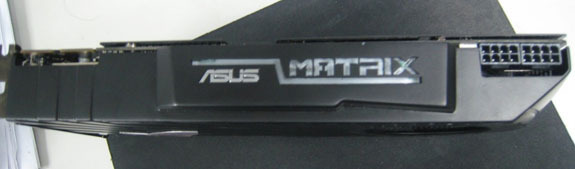
A CAD drawing of the Ares surfaced on Plaza.fi, which shows a single-PCB accelerator. The cooling design borrows a little from that of NVIDIA's second edition GeForce GTX 295, in having a centrally located blower that drives air onto copper GPU blocks on its either sides. The cooler assembly, however, seems much larger at 2.5 slots' thickness. ASUS also claims that the fan will be quieter on load than AMD's reference HD 5970 leaf-blower. A table given out lists its important specifications, which shows it to have the same clock speeds as the single-GPU Radeon HD 5870 (850/1200 MHz), versus those of the HD 5970 (725/1000 MHz), twice the amount of GDDR5 memory, and results of an internally conducted 3DMark Vantage benchmark which shows a 28.2% increment over the HD 5970 on the Ares. The card is powered by three PCI-Express power connectors (8-pin + 8-pin + 6-pin), and may have significantly higher power draw. It has also been designed for record-setting scores in graphics benchmark competitions. Being a limited edition product, we expect productions in the tens of hundreds only. If the price of ROG Mars is anything to go by, this one will be an expensive product, too.

ASUS Presents the Fastest, Most Chic Optical Drives Around

ASUS continues to lead in high performance optical storage devices with a full range of top quality products, from mainstay DVD-RW drives to Blu-ray Disc combos that have become the standard for high-end professional storage environments. Powered by USB 2.0 connectivity, the new ASUS SBC-06D1S-U and the ASUS SDR-08D1-U slim-type external optical disc drives are designed to provide optimized reading and writing capabilities. Both are tailored to discerning users keen on award-winning design, meticulous craftsmanship, enhanced multimedia capabilities and environmentally-savvy operation.

ASUS external slim drives are recognized worldwide for outstanding functionality and fetching looks. The SBC-06D1S-U sports the same progressive design philosophy that has garnered the company's range of optical drives prestigious accolades, including the iF Design Award 2010, the Taiwan Good Design Product Award and the Taiwan Excellence Award.

ASUS Launches ROG G73Jh Gaming Notebook

The new ASUS Republic of Gamers (ROG) G73Jh is like no other gaming notebook. Eschewing the flash and gimmicks typical of gaming notebooks, the G73Jh instead boasts an understated, subtly aggressive design inspired by a stealth fighter. At its heart lies the most powerful components available today, including the latest Intel Core i7 processor, DirectX 11-capable ATI Radeon HD 5870 graphics, and up to 8 GB of DDR3 system memory.

The G73Jh sports a striking angular design inspired by the iconic F-117 Nighthawk. Far from being merely cosmetic, every facet of the G73Jh's design reflects a conscious effort to improve the user experience. For example, the placement of all the heat and noise-generating components at the rear of the notebook and the implementation of a unique twin rear venting system keep the heat and noise as far away from the user as possible. The innovative placement of components also allows the palm rest to be exceptionally thin, just like a desktop keyboard. Furthermore, the keyboard plane is inclined 5 degrees, improving ergonomics and thus ensuring optimal comfort while gaming and typing.

ASUS Radeon HD 5870 MATRIX 2GB Graphics Card Pictured

ASUS' Republic of Gamers MATRIX series of graphics cards is getting a new member, the EAH5870 MATRIX. This model, based on the ATI Radeon HD 5870 GPU has high-end construction, cooling, and voltage regulators, out of the box higher clock speeds, overclocking headroom, and twice the amount of memory: 2 GB. The cooler and backplate design resembles that of ASUS' GeForce GTX 285 MATRIX.

The clock speeds on this card stand at 900 MHz (core) and 1225 MHz (memory, 4900 MHz effective). The card seems to have a stronger VRM circuit that supports higher clock speeds. It draws power from two 8-pin PCI-Express connectors. Display connectivity includes one each of DVI-D, HDMI, and DisplayPort.

Overclocker-friendly features may include ASUS' VoltageTweak software voltage control, a "safe mode" button that falls back to failsafe clock speed and voltage settings, among other things. There is no word on its availability, though we expect to learn more about this card at the upcoming CeBIT event.

ASUS Radeon HD 5870 TOP and HD 5850 DirectCu Pictured

ASUS is readying a new factory-overclocked, custom-design graphics card based on the ATI Radeon HD 5870 GPU, likely named the EAH5870-TOP. The company is also readying the Radeon HD 5850 based EAH5850 DirectCu. While the EAH5870-TOP is expected to have high out of the box clock speeds, a higher performance sporty-looking cooler, the EAH5850 DirectCu relies on a more function-centric cooler design that boasts of being 35% quieter and 20% cooler [than reference AMD cooler]. Further details, such as clock speeds are not known, but it is expected that ASUS will release these during CeBIT 2010, later this quarter.

Business PCs Arrive with New Intel Core vPro Processor Family

Intel Corporation today unveiled its 2010 Intel Core vPro processor family to meet the needs of businesses of all sizes for PCs with greater, more flexible performance, theft prevention and cost savings in a rapidly changing business computing environment. These and several other capabilities are at the heart of many new Intel-based business laptop and desktop computers beginning to roll out from computer manufacturers worldwide.

The Intel Core vPro processors arrive as business computing evolves with the emergence of video, Internet telephony, social networking and other heavyweight applications - in many cases running at the same time - making a computer's performance an even bigger priority.

AMD Announces ATI Radeon HD 5450 Graphics Accelerator

AMD today announced the introduction of the ATI Radeon HD 5450 graphics card, the latest addition to the award-winning line-up of ATI Radeon HD 5000 Series graphics cards. The ATI Radeon HD 5450 graphics card delivers a state-of-the-art HD multimedia and game experience at a value price. Sharing the same leading edge features found in the critically-acclaimed ATI Radeon HD 5800 Series - support for DirectX 11, ATI Eyefinity multi-display technology and ATI Stream technology - the ATI Radeon HD 5450 provides an uncompromising Microsoft Windows 7 experience.

ASUS Unveils the World's Lowest Radiation Motherboards

ASUS has set a new standard in total motherboard protection with the launch of the ASUS Protect 3.0 Design based on Xtreme Design, which helps protect the earth, systems, and users. Equipped with intelligent anti-radiation shielding, the technology lowers the generation and transmission of harmful radiation by up to 50%-offering the lowest electromagnetic emissions from a motherboard in the industry. This lowers the adverse health impact to users and delivers more stable system operations. Additionally, active anti-surge protection helps enhance component and system longevity. Protect 3.0 also includes the ASUS EPU (Energy Processing Unit) chip to reduce system-wide power consumption by up to 80.23%* and to ensure a more environmentally sustainable operation.

ASUS Designing Dual-HD 5870 Graphics Accelerator?

ASUS is known to toy with bleeding-edge technology to give out high-end products. Earlier, ASUS put two GeForce GTX 285 GPUs into one accelerator to give out a custom-design product that outperformed NVIDIA's dual-GPU GeForce GTX 295. According to o.v.e.r.clockers.at, ASUS might be doing something similar, this time around with AMD's Cypress GPUs in its Radeon HD 5870 avatar. It is said to be working on a dual-HD 5870 graphics card, codenamed "Ares".

While the dual-GPU Radeon HD 5970 uses full-featured AMD Cypress GPUs (with all its stream processors and memory bus width available), ASUS will attempt to use the one disparity between an HD 5970 and two HD 5870 to its advantage: clock speeds. The Cypress GPUs in HD 5970 feature lower clock speeds (725/1000 MHz core/memory) compared to the single Cypress GPU on the HD 5870 (850/1200 MHz). Electrical constraints are probably the reason behind this. It is likely that ASUS will use stronger VRM circuitry to power the two GPUs to run at higher speeds, while also providing some overclocking headroom.

AMD in a recent conference call to the press said that it didn't expect to see custom-design HD 5970-like accelerators till Q2 2010, although we don't infer there to be any sort of restriction in place, as was the case with NVIDIA and its GTX 295. Ares is likely named after the Greek God of warfare by the name. An apt successor to Mars (which also happens to be the name of the Roman God of war), ASUS' previous attempt at an extreme high-end graphics card of its own design.

3DMark Vantage World Record Feat Cracks P47002

A team of overclockers Sampsa and Stummerwinter set a new world-record score for 3DMark Vantage (Performance preset). The duo set the record using a test-bed made of Intel Core i7 975 Extreme Edition, four ASUS ATI Radeon HD 5870 in CrossFireX mode, 6 GB of Corsair Dominator GTX2, and the upcoming ASUS Rampage III Extreme motherboard to seat it all.

The Core i7 975 XE processor sailed through to 5508.9 MHz (27 x 204 MHz @ 1.664V, HTT on), with the memory running at 2040 MHz DDR (7-8-7-21). The four ASUS Radeon HD 5870 cards were hand-picked from a batch of 18 pieces. Core/memory speeds of 1325 MHz / 1300 MHz, were set. Catalyst drivers version 9.12 were used for the record feat.

The team achieved a 3DMark Vantage score of P47002, with a GPU score of 53,911 points, and CPU score of 33,949. To cool the machine, F1 EE & Tek 9.0 liquid nitrogen evapourators were used for the GPUs and CPU. The duo credit their success (besides their skills), to Kinc and Christian from ASUS and Thomas from Intel.

ASUS Eee Box EB1501 Gets Blu-ray Variant

ASUS' Eee Box EB1501 nettop released late last year got a Blu-ray variant with the EB1501-B0367. This variant has a slot-in Blu-ray drive, and is geared to be an aesthetic HTPC companion when paired with an external HDD. The Eee Box EB1501 is based on the NVIDIA ION platform, it which makes use of an Intel Atom 330 dual-core processor along with NVIDIA ION chipset. The chipset embeds GeForce 9400M graphics, which accelerates HD video, and can handle Blu-ray playback, and 1080p displays. Other specifications include 320 GB of storage, 2 GB of DDR2 memory, HDMI and D-Sub for display connectivity, WiFi, and Windows 7 Home Premium OS. It is expected to be priced at $620.

ASUS Rampage III Extreme 32 Megapixel high-res photo

According to ASUS the Rampage III Extreme is "Designed for those who know the Dark Art of Overclocking". It comes equipped with all features that overclockers dream of, and also has new stuff like ROG Connect for example.
The board supports CPUs for Intel Socket 1366, which means Core i7 including Gulftown (yes, I asked). As chipset Intel's X58 and ICH10R is used like on the Rampage II Extreme. ASUS has routed 32 PCI-Express 2.0 lanes to the PCI-E x16 slots, so you can either run x16+x16, x16+x8+x8 or x8+x8+x8+x8 - all without the added heat and latency of NVIDIA's nForce 200. As we hear this does make quite a difference in a 4x HD 5870 configuration for example. Major improvements have also been made to the power solution which is now 8-phase digital 250 - 1000 kHz. Of course support for USB 3.0 and SATA 6 Gb/s is included as well.
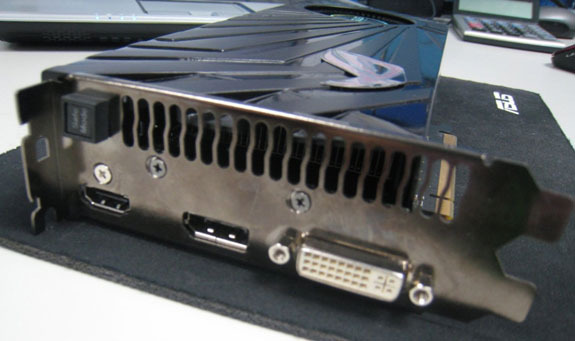

While exact details are not known, the price of the board will be "highest priced ROG" - my guess is around $400, with availability starting around the Gulftown launch which should be some time in March.

Big, big picture, about 5 MB, can be found here.

ASUS Displays Pine Trail Based Mini-ITX Motherboard

ASUS displayed its newest mini-ITX form-factor motherboard intended for use in nettops, at the ongoing CES event. The ASUS AT5NM10-I is based on Intel's new second-generation Atom processor platform. It makes use of the Atom D510 dual-core processor, aided by Intel NM10 chipset. The processor operates at 1.66 GHz, and supports single-channel DDR2 667 MHz memory. Due to the lowered thermal footprint of the chipset, ASUS used a single heatsink to cool both the processor and chipset. It provides two DDR2 DIMM slots to hold up to 4 GB of memory. The lone expansion slot is a PCI. Storage comes in the form of two SATA 3 Gb/s ports. Connectivity includes 6-channel audio, 10/100 Ethernet, four USB 2.0 ports on the rear panel, four by headers, D-Sub for display, serial and parallel ports, and PS/2. There is no word on the availability or price.
Return to Keyword Browsing
Nov 25th, 2026 23:43 CST change timezone

New Forum Posts

Popular Reviews

TPU on YouTube

Controversial News Posts