News Posts matching #Asus

Return to Keyword Browsing

ASUS Introduces the Ultra-Slim SDRW-08U5S-U External DVD Writer

ASUS today announced the SDRW-08U5S-U external DVD writer, a highly portable optical drive with the thinnest form factor in its class at just 13mm. Its design includes a built-in hidden stand that saves space and reduces clutter while enabling dual-stance horizontal and vertical placement. For data protection, ASUS integrates multiple security measures, with password controls and encryption alongside encoded file name functionality. The SDRW-08U5S-U ships in Mellow Metallic, Dusty Rose, and Bright Berry color options.

The SDRW-08U5S-U employs intricate engineering to achieve a very slender 13mm side profile. In addition to making it highly attractive, the form factor contributes to easy mobility and greater usability as the SDRW-08U5S-U can be effortlessly transported and placed, making it a perfect companion for Ultrabooks and other mobile devices.

ASUS Rolls Out its Radeon HD 7790 Lineup

ASUS kicked off its Radeon HD 7790 lineup with custom-design implementations based on its iconic DirectCU II cooling solution. The EAH7790 DirectCU II /OC, pictured below, ships in two variants, one with stock frequencies of 1000 MHz core and 6000 MHz memory; and an OC variant with 1075 MHz core, and 6400 MHz memory. The cards use the company's dual-slot, dual-heatpipe version of DirectCU II. Based on the 28 nm "Bonaire" silicon, the Radeon HD 7790 packs 896 stream processors, dual tessellation units, 56 TMUs, 16 ROPs, and a 128-bit GDDR5 memory interface holding 1 GB of memory; and a brand new dynamic-clock technology. The standard variant should be priced around $149.99, the OC variant could charge $10 more.

ASUS GeForce GTX 670 DirectCU Mini Smiles for the Camera

We got our first glimpse of ASUS' mini ITX-friendly GeForce GTX 670 DirectCU Mini a fortnight ago, when it was pictured installed. The older pictures didn't really provide us with a vanity of the card, until now. Pictured below, is the first press-shot of the 17 cm-long high-end graphics card. The picture reveals a swanky cooler shroud with gloss/matte accents, covering the main heatsink.

The main heatsink appears to be a combination of an aluminum base plate covering the memory chip and VRM, a copper vapor-chamber plate over the GPU, and a radially-projecting aluminum fin array. The contraption is ventilated by a fan unlike anything we've ever seen. Its impeller appears to be a hybrid between conventional top-flow fan, and lateral-flow blower. While ASUS won't tinker with the 6.00 GHz memory clock speed, the core is said to be clocked about 26 MHz higher than reference. Display outputs check out as dual DVI, HDMI, and DisplayPort. The company is expected to launch this card some time in April.

ASUS Rolls Out ROG Eagle Eye GX1000 Gaming Mouse

ASUS rolled out its first Republic of Gamers (ROG) branded input device, the ROG Eagle Eye GX1000 gaming mouse. Clad in brushed aluminum and ABS plastic, with a braided weave cable, the Eagle Eye GX1000 features a pseudo-ambidextrous design (side buttons only on its left side), with a total of six action buttons, a scroll wheel, and on-the-fly sensitivity control buttons.

The ROG Eagle Eye GX1000 features a weight compartment, with adjustable weighs in units of 5 g. Its dry weight (without any weights) is 150 g. Under its hood is an 8,200 DPI laser sensor, which can be lowered all the way down to 50 DPI. Overall, the mouse measures 128.5 x 65.5 x 43.5 mm. ASUS dropped in some groovy LED lighting for the scroll wheel, the sensitivity adjustment felt-touch surface (can coarsely display DPI setting), and its rear side. An ROG-branded mousepad is part of the package. Expect this one to be priced upwards of $100.

TechPowerUp GPU-Z 0.6.9 Released

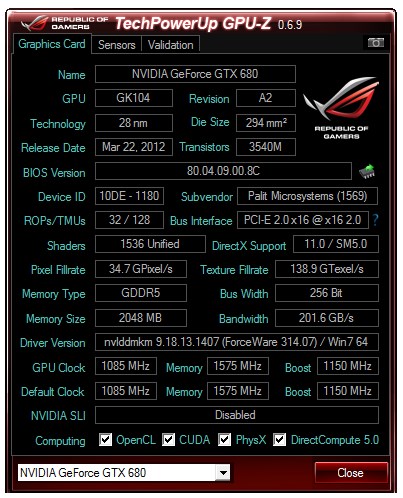
Just ahead of a skirmish between AMD and NVIDIA in the sub-$200 market segment, which could go down later this month, TechPowerUp released GPU-Z v0.6.9, with tested support for the two contenders: AMD Radeon HD 7790, and NVIDIA GeForce GTX 650 Ti with GPU Boost (refresh). In addition, the new GPU-Z version gets you support for Radeon HD 8870M, GeForce GT 415, and GT 750M. For GeForce "Kepler" family GPUs, DirectX feature-set value is fixed. A number of tool-tips are added to key window elements, such as vendor logo, vBIOS extraction, render test, and screen-capture.

DOWNLOAD: TechPowerUp GPU-Z v0.6.9 | GPU-Z v0.6.9 with ASUS ROG skin

The change-log follows.

ASUS Outs UEFI GOP VBIOS for its GeForce GTX 680 Graphics Cards

ASUS rolled out an optional video BIOS update for its GeForce GTX 680 graphics cards, which lends them GOP UEFI support, letting users take advantage of "Ultra Fast Boot" and "CSM disable" features. To use Windows 8 Secure Boot feature as intended, it's not enough that your PC motherboard supports UEFI, discrete graphics cards should support GOP (graphics output protocol) UEFI, as well. Very few graphics cards at the moment support it, and graphics card board vendors are making efforts on their side to add it.

ASUS' GOP UEFI VBIOS update ships as an executable that updates VBIOS from within Windows (provided it's being run with Administrator rights). ASUS tested the update only on its motherboards. Also, once updated to the UEFI-hybrid VBIOS, the graphics card can't be flashed back to the older legacy one. Risk takers can find the update here. Find more technical information at the source.

Corsair Unleashes Vengeance Extreme, the World's Fastest Rated PC Memory Kits

Corsair, a worldwide designer and supplier of high-performance components to the PC hardware market, today announced new Vengeance Extreme 8GB dual-channel DDR3 memory kits rated at 3000MHz, the world's fastest rated production PC memory kits. Fitted with low profile "racing red" heat spreaders, the new 2x4GB memory kits operate at 3000 MHz air-cooled, with latency settings of 12-14-14-36, at 1.65V. A Kingpin Cooling memory cooler is included for overclockers who want to use LN2 (liquid nitrogen) to reach memory speeds well beyond 3000 MHz.

The extreme-speed 3000 MHz rating of the Vengeance Extreme memory kits is the result of a rigorous internal four-stage hand-screening process performed by Corsair engineers. This process is passed by fewer than one in 50 memory ICs. Performance qualification is performed on select Intel Z77 based motherboards, including the ASUS P8Z77-I DELUXE and ASRock Z77 OC Formula. To hit their rated speeds, the modules require a 3rd Generation Intel Core unlocked processor with an Integrated Memory Controller capable of running 3000 MHz.

ASUS Releases the Touch-Powered ASUS VivoBook S500

ASUS is excited to announce immediate availability of the VivoBook S500 in North America. ASUS VivoBook S500 showcases an attractive, durable, and portable 15.6" design that includes a 3rd generation Intel Core processor for excellent multitasking performance, touch enabled high-definition display, ASUS SonicMaster audio, and hybrid SSD/HD drive options.

ASUS VivoBook S500 is designed with stylish aesthetics, true-to-life sound, and instinctive touch capabilities via the highly responsive multi-point HD touch panel or the oversized touchpad incorporating ASUS Smart Gesture technology. It is ideal for the increasingly cloud-based nature of computing with seamless connectivity options and a slim form factor for easy mobility. True 2-second instant on resume from sleep mode provides near-instantaneous access to Windows 8 and its energy-conserving design allows standby for up to two weeks.

ASUS Teases Trio of Z87-based Motherboards

Even as most motherboard vendors showed off at least half-baked versions of their socket LGA1150 motherboards based on the Intel Z87 Express chipset, supporting 4th generation Core "Haswell" processors; ASUS has been relatively mum. The company doesn't even have a motherboard booth at CeBIT, to begin with. The company did manage to release teaser pictures of three new motherboards, which lead its three consumer motherboard lines: Republic of Gamers (ROG), The Ultimate Force (TUF), and mainline (P9Z87?).

The teaser pictures reveal nothing more than the plaque printed on the center of the motherboard. The first picture below teases what could be P9Z87 Deluxe. Someone at ASUS loves M&Ms. The second picture teases TUF Gryphon Z87. It looks like ASUS had enough of the Sabertooth brand extension. The third picture, dissimilar from the others, is of a new innovation ASUS will introduce with its next ROG motherboard based on the Z87 chipset. It appears to be a device that plugs into one of the motherboard's headers. Probably an external overclocking module akin to EVGA EVBot?

TechPowerUp GPU-Z 0.6.8 Released

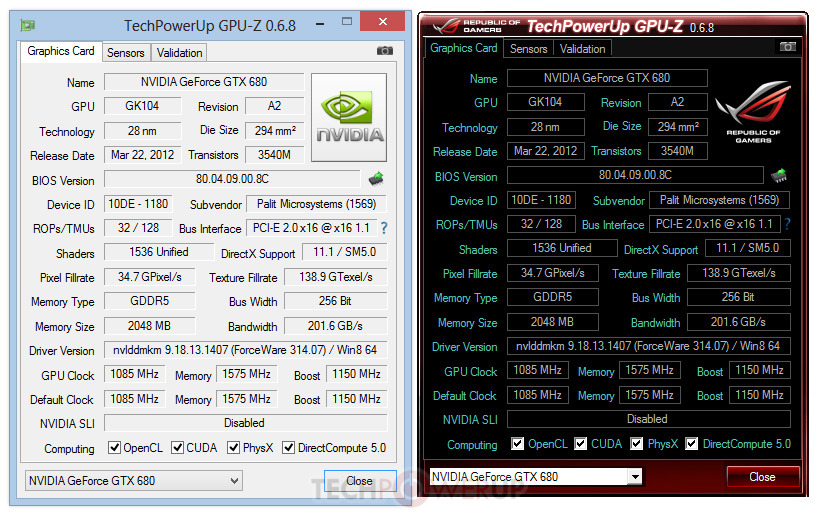
TechPowerUp announced version 0.6.8 of GPU-Z, the popular graphics subsystem information, monitoring, and diagnostic utility, which gives you detailed information about the installed graphics hardware, and lets you monitor key specifications in real-time, such as clock speeds, temperatures, voltages, and video memory usage. Version 0.6.8 introduces support for new GPUs, namely NVIDIA's GeForce GTX Titan, GeForce 505 (GT216), GT 640M, GTX 675MX, Quadro K2000, and K3000; AMD's Radeon HD 7480D, FirePro W8000, V8700, fake HD 6850 (based on HD 6450). GPU load monitoring method on AMD GPUs is improved, and should be more accurate. Several minor bugs were patched.

DOWNLOAD: TechPowerUp GPU-Z 0.6.8, TechPowerUp GPU-Z 0.6.8 ASUS ROG Themed

The change-log follows.

ASUS Readies Size-Optimized GeForce GTX 670 DirectCU Mini for Mini-ITX Builds

ASUS is working on the GeForce GTX 670 DirectCU Mini, a high-end graphics card that's size-optimized for mini-ITX gaming PC builds. NVIDIA's reference-design PCB for the GTX 670 already established that compact (<20 cm long) PCBs are very much possible for the chip. ASUS designed its own short (17 cm long) PCB with a 5-phase VRM, which draws power from a single 8-pin PCIe power connector, instead of two 6-pin. This allows you to make do with compact PSUs that only feature one PCIe connector, and avoid wasting Molex cables on the second 6-pin.

What's more interesting about the GTX 670 DirectCU Mini is its cooler, which appears to use a combination of a thick metal plate that draws heat from VRM and memory on the obverse side; and a round aluminum fin-stack, which could be cooled by a single ~80 mm fan. ASUS did not release pricing or availability information, and is still gauging community interest in such a product.

AMD Redoing Radeon HD 7990 Under New Codename - "Malta"

AMD topped off its "Southern Islands" graphics card family with Radeon HD 7990 "New Zealand," although it didn't have a reference design board of the said SKU. Around October 2012, AIB partners PowerColor, VTX3D, and Club 3D each released their custom design Radeon HD 7990-branded graphics cards, which packed a duo of Radeon HD 7970 GPUs, a total of 6 GB of memory, making up for a dual-GPU solution. Among most of these, the GPUs were clocked in the neighborhood of 950 MHz, and memory at 5.50 GHz. ASUS joined the party much later with the ROG ARES II, with 1100 MHz core, 6.00 GHz memory, and liquid cooling, but commands a hefty $1,600. Post GTX Titan, ARES II remains, at least according to AMD, the single fastest graphics card. The company seems interested in standardizing a new set of specifications for HD 7990, which could be priced competitively against NVIDIA's GTX Titan and GTX 690.

Enter the new Radeon HD 7990 "Malta," a new codename, redone specifications (clock speeds), same dual-GPU graphics card, with [hopefully] a competitive price. Its development checks out with AMD's recent statement in its teleconference last month, where it stated that we could see "more HD 7990 action" this year. According to a Technic3D report, AMD is looking to replace the generally accepted 925/950/1350 MHz (core/PowerTune Boost/memory) clock speed standard of the HD 7990 with something over 1000 MHz, probably even 1050 MHz for the core. There is no word on memory clock speed changes, although with its 384-bit wide memory interfaces, we don't imagine the "Tahiti" GPU to be facing a dearth of memory bandwidth. The HD 7990 "Malta" like the HD 7990 "New Zealand," will lack an AMD reference design, so one could expect more custom-design cards by partners. The new SKU could launch some time before July.

EK Introduces EK-FC7970 Matrix Full Cover Water Block

EK Water Blocks, Ljubljana based premium water cooling gear manufacturer, is proud to introduce EK-FC7970 Matrix, a Full cover water block engineered specifically for award winning ASUS Radeon HD 7970 Matrix series graphics cards.

This water block directly cools the GPU, RAM as well as VRM (voltage regulation module) as water flows directly over these critical areas thus allowing the graphics card and it's VRM to remain stable under high overclocks. EK-FC7970 Matrix water block also features a very high flow design therefore it can be easily used in liquid cooling systems using weaker water pumps.

ASUS Launches MicroATX Motherboards for Superior HTPC Performance

ASUS today announced a new range of microATX motherboards with onboard HDMI and DVI ports for Intel and AMD processors with integrated graphics, and USB 3.0 ports with performance-enhancing ASUS USB 3.0 Boost technology. By removing the need for a discrete graphics card, the new motherboards provide a more affordable option for home entertainment PCs that can fully exploit high-performance USB 3.0 storage.

The latest Intel 22nm CPUs feature Intel HD 4000 integrated graphics, while AMD Socket FM2Athlon and A-Series APUshave integrated AMD HD 7000 Series discrete-level Radeon GPUs.The processors provide excellent 2D and 3D graphics performance, without the need for a separate graphics card, which in turn results in lower PC build costs.

ASUS Announces its GeForce GTX Titan Graphics Card

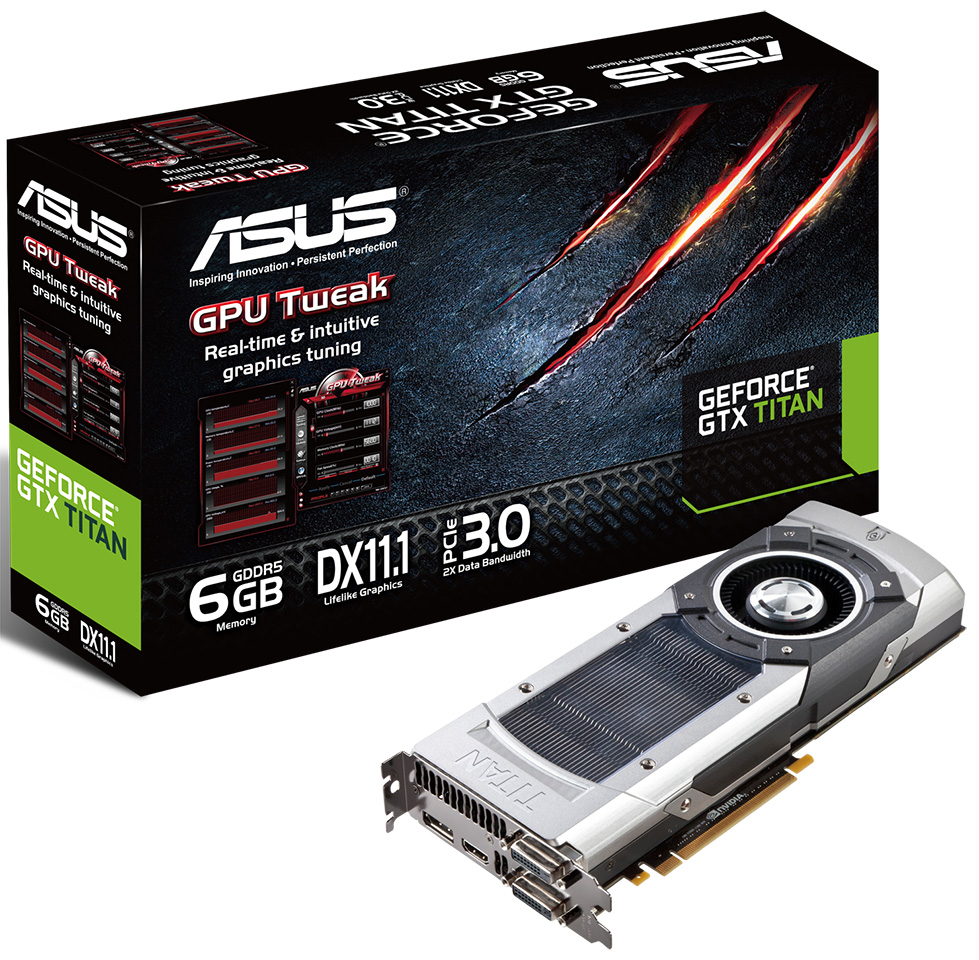
ASUS today announced the GeForce GTX Titan graphics card, based on supercomputer-grade NVIDIA Tesla K20X architecture. The new card delivers the world's most powerful single-GPU performance to PC gamers and multimedia enthusiasts. It is optimized for DirectX 11.1 and PCI Express 3.0, with a GPU clock of 876MHz achieved by use of NVIDIA GPU Boost 2.0 technology. The ASUS GeForce GTX Titan offers 6GB of GDDR5 video memory clocked at 6000MHz.

It presents the advanced graphics processing power required to fully enjoy the next evolution in gaming technology and multimedia in standards well beyond full HD 1080p. The ASUS GeForce GTX Titan ships with the user-friendly GPU Tweak utility in the box, which allows customers to easily modify performance parameters through a clear yet detailed interface.

Current State and Future of AMD Radeon Graphics: Teleconference Transcript

You may have read our report from earlier today, covering the main points that AMD was trying to make in its recent teleconference with the European press (which includes us). While in the call, we were a little jolted by the choices of words some of AMD's executives used to describe their company's consumer graphics outlook for 2013, how they believe they can hold out for almost the entire year with little or no major updates to their product stack, and more interestingly, a few above-the-belt jabs at NVIDIA and its upcoming GeForce GTX Titan product.

The crux of AMD's emergency meeting with the press was to bust some misconceptions spread in the press over the last couple of weeks, to tell them a Graham's Number of times that they still hold the fastest single GPU on the planet, which powers the fastest graphics card there is (ASUS ARES II). The most ironic part of AMD's emergency meeting with the press was the one in which they called GeForce Titan NVIDIA's emergency/knee-jerk reaction to AMD's getting cozy with game developers, and netting some of the biggest PC game launches of the season for its Never Settle Reloaded bundle.

ASUS Launches TUF Sabertooth 990FX GEN3 R2.0

ASUS today announced the TUF Series SABERTOOTH 990FX/GEN3 R2.0, the world's first AMD-based motherboard to feature PCI Express 3.0 for use with next generation high performance graphics cards. Up to three DirectX 11 graphics cards with 28nm GPU technology can be used via NVIDIA SLI or AMD CrossFireX to create desktop PCs with formidable graphics performance.

SABERTOOTH 990FX/GEN3 R2.0 also features renowned ASUS TUF Series thermal design for superior heat removal. Like all TUF Series motherboards, it undergoes military and server-grade testing to ensure absolute stability, reliability, and longevity. SABERTOOTH 990FX/GEN3 R2.0 is backed by a five-year warranty.

New Radeon HD 7000 Series Products in 1H-2013

Over the last weekend, AMD hosted a teleconference with the press in which it charted out its strategy for 2013. Older reports led us to believe that the company's next-generation GPU lineup won't launch any time before Q4, but the press overlooked another possibility, that AMD could make additions to its existing HD 7000 series product family, before Q4.

The current Radeon HD 7000 appears "complete," due to the fact that there are products covering nearly every competitive price point. With the introduction of the GeForce GTX Titan, NVIDIA could gain two products in the price-range of $900-$1200, the other being GTX 690. AMD's various board partners, lead by TUL-affiliated ones, and HIS, launched the HD 7990 around the $800 mark, and ASUS topped things up with the Republic of Gamers ARES II at an unreal $1,600 point, which AMD claims is the fastest graphics card money can buy.

ASUS Rolls Out a Pair of Energy Efficient GeForce GTX 650 Graphics Cards

ASUS today announced global availability of the GeForce GTX 650-E, a motherboard bus-powered DirectX 11.1 graphics card that's ideal for desktop PCs with low-wattage power supplies The GeForce GTX 650-E combines DirectX 11.1 compatibility and 28nm NVIDIA GPU technology with a mere 60W power consumption, making it a very appealing upgrade option for users looking for a high-performance graphics card at an affordable price.

The ASUS GeForce GTX 650-E offers a quick and accessible upgrade for customers interested in affordable NVIDIA 28nm GPU technology. Powered from a PCI Express slot with a modest 60W average power consumption, the ASUS GeForce GTX 650-E is an ideal choice for users looking to upgrade their PCs without investing in a new power supply, making the process much easier and less costly. Available with 1GB or 2GB GDDR5 video memory, the ASUS GeForce GTX 650-E supports medium-to-high detail in current PC games, along with smooth 1080p full HD video playback.

GeForce GTX Titan 6 GB Listed by Danish Store

A store listing by Danish online retailer Proshop reveals a couple of things, one, that NVIDIA's next flagship graphics card will indeed be called "GeForce GTX Titan," and two, it could be out of reach of a vast majority of enthusiasts. The retailer is listing an ASUS-branded card for 5,820.80 Danish Krone (US $1,046), and that's before Europe's famous taxation kicks in. After, that goes up to 7,276 DKK ($1,307).

If one has to infer performance of the card from this price, given that NVIDIA won't botch up price-performance in relation to GTX 690, the GTX Titan should perform on-par, or outperform the GTX 690. Even if it's a tiny bit slower, NVIDIA could focus its marketing efforts on the card's 4-way and 3-way SLI capabilities, using which one could outperform GTX 690 QuadSLI setups.

ASUS Intros F2A85-V Socket FM2 Motherboard

ASUS augmented its socket FM2 motherboard lineup with the F2A85-V, a lite variant of the F2A85-V Pro the company kicked off its Trinity APU-compatible motherboard lineup with. The new F2A85-V trims down on a few things over the -Pro variant, such as simpler independent VRM and FCH heatsinks with no heat-pipe connecting them, fewer APU power phases, and a lighter expansion slot layout that isn't ideal for multi-GPU setups.

To begin with, the F2A85-V features a 6-phase APU VRM that draws power from a 4-pin ATX connector, compared to the 8-phase one drawing from an 8-pin EPS, on the F2A85-V Pro. The FM2 socket is connected to four DDR3 DIMM slots, supporting a maximum of 64 GB of dual-channel DDR3-1866 MHz memory; and a single PCI-Express 2.0 x16. Other expansion slots include a PCI-Express 2.0 x16 (electrical x4, wired to the A85X FCH), two PCI-Express 2.0 x1, and three legacy PCI slots.

ASUSTOR Releases Enterprise-Level Rackmount NAS

ASUSTOR Inc., a leading innovator and provider of network storage solutions, today announced the release of four new enterprise-level 1U and 2U rackmount NAS devices. These new devices consist of the four drive bay AS-604RS and AS-604RD models and the nine drive bay AS-609RS and AS-609RD models. All devices come equipped with the Intel Atom 2.13 GHz dual-core processor which combines supercharged performance with low power consumption. Furthermore, all devices are verified as VMware, Citrix and Hyper-V ready, providing businesses with a flexible and cost-efficient virtual storage solution.

"Our new rackmount NAS models include the type of hardware specifications required by the most demanding business environments such as dual gigabit Ethernet ports, eSATA and SuperSpeed USB 3.0 interfaces and support for hard drive hot swapping." said Johnny Chen, Product Manager at ASUSTOR. "The AS-604RD and AS-609RD models also feature redundant power supplies meaning that should the primary power supply fail, a second one will automatically start running to keep the NAS powered on. This undoubtedly gives businesses the type of 24/7, round-the-clock, uninterrupted access that they need."

TechPowerUp GPU-Z 0.6.7 Released

TechPowerUp released version 0.6.7 of GPU-Z, the popular graphics subsystem information, monitoring, and diagnostic utility. The new release brings some feature-additions, support for more graphics processors, and stability improvements. To begin with, we made room in the GPU-Z window to display TMU (texture memory unit) count. Support for a large number of recently-launched GPUs, including Radeon HD 7870 "Tahiti LE," mobile GeForce 600 series MX, and from Quadro family, were added.

TechPowerUp GPU-Z 0.6.7 also brings a few UI enhancements. To begin with, GPU-Z remembers window position from its previous session, cutting you time for positioning it right for screenshots. Next up, when minimized, its tray icon does more than just show you the app is running. Its tooltip (visible when hovered), displays some important sensor data. A new "-tab" command line parameter allows proverclockers to script-launch GPU-Z showing a specific tab. Among the bugs fixed are one related to a crash occurring on CrossFire setups (a Catalyst-related bug), another crash occurring on NVIDIA setups when updating sensor data (GeForce driver-related bug), temperature reading on AMD "Llano" APUs is improved.

DOWNLOAD: TechPowerUp GPU-Z 0.6.7, TechPowerUp GPU-Z 0.6.7 ASUS ROG Themed

The change-log follows.

Soft PC Shipments in Fourth Quarter Lead to Annual Decline as HP Holds Onto Top Spot

Worldwide PC shipments totaled 89.8 million units in the fourth quarter of 2012 (4Q12), down 6.4% compared to the same quarter in 2011 and worse than the forecasted decline of 4.4%, according to the International Data Corporation (IDC) Worldwide Quarterly PC Tracker. Although the quarter marked the beginning of a new stage in the PC industry with the launch of Windows 8, its impact did not quickly change recently sluggish PC demand, and the PC market continued to take a back seat to competing devices and sustained economic woes. As a result, the fourth quarter of 2012 marked the first time in more than five years that the PC market has seen a year-on-year decline during the holiday season.

The lackluster fourth quarter results were not entirely surprising given the spate of challenges the PC market faced over the course of 2012. IDC had expected the second half of 2012 to be difficult. Consumers as well as PC vendors and distribution channels continued to be diverted from PC sales by ongoing demand for tablets and smartphones. In addition, questions about the use of touch on Windows PCs vs. tablets slowed commercial spending on PCs.

ASUS Unveils World's First PCI-Express 3.0 Motherboard for AMD Processors

ASUS did the unthinkable yet simple, by innovating the first AMD platform motherboard that features PCI-Express 3.0 x16 slots, the Sabertooth 990FX/GEN3.0 R2.0. Long naming aside, the board provides you a couple of gen 3.0 slots by using PLX-made 48-lane PCI-Express Gen 3.0 bridge chip.

While the board features four PCI-Express x16 slots, only two similarly-colored slots can be used at a time, of which two are PCI-Express 2.0 x16, wired to the 990FX northbridge, and two slots being x16/NC or x8/x8-capable, being wired to a PLX 48-lane PCI-Express Gen 3.0 switch, which in turn takes two PCI-Express 2.0 x16 links from the northbridge.
Return to Keyword Browsing
Nov 26th, 2026 00:33 CST change timezone

New Forum Posts

Popular Reviews

TPU on YouTube

Controversial News Posts