News Posts matching #Asus

Return to Keyword Browsing

AMD Reports Second Quarter Results

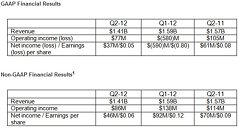
AMD (NYSE:AMD) today announced revenue for the second quarter of 2012 of $1.41 billion, net income of $37 million, or $0.05 per share, and operating income of $77 million. The company reported non-GAAP net income of $46 million, or $0.06 per share, and non-GAAP operating income of $86 million.

"Overall weakness in the global economy, softer consumer spending and lower channel demand for our desktop processors in China and Europe made the closing weeks of the quarter challenging," said Rory Read, AMD president and CEO. "We are taking definitive steps to improve our performance and correct the issues within our control as we expect headwinds will continue in the third quarter as the industry sets a new baseline. We remain optimistic about our core businesses as well as future opportunities with our competitively differentiated next-generation Accelerated Processor Units (APUs). Our recently launched Trinity APU continues to gain traction with customers. We are committed to driving profitable growth."

TechPowerUp GPU-Z 0.6.3 Released

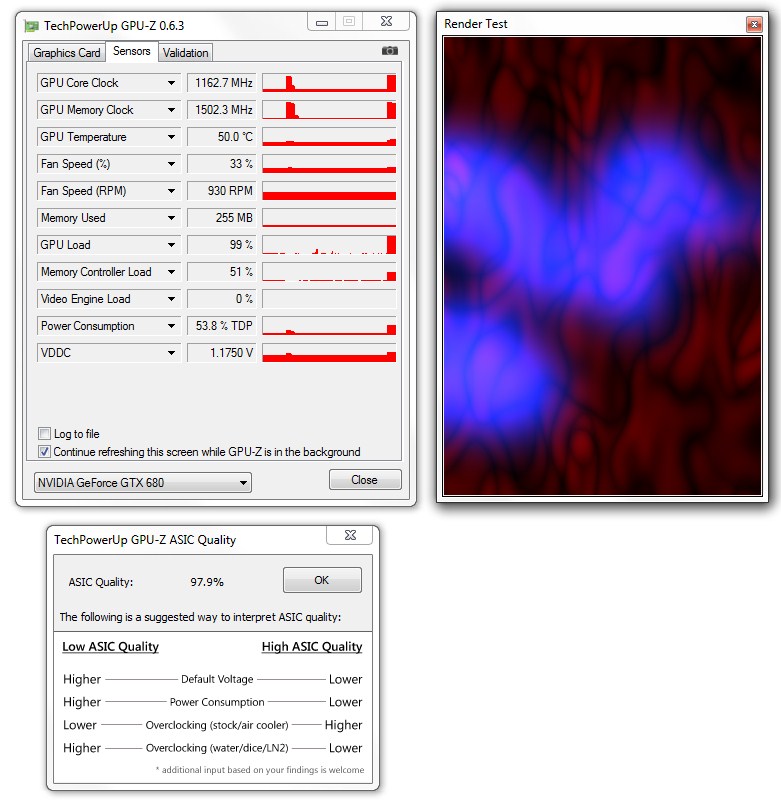
TechPowerUp released GPU-Z 0.6.3, the latest version of the popular PC graphics subsystem information and diagnostic utility. The new release adds support for dozens of new GPUs, including AMD "Trinity" APU-integrated HD 7600D series, upcoming NVIDIA GeForce GTX 660; improves stability in Windows 8, and adds a large number of other stability improvements. GPU-Z 0.6.3 adds support for NVIDIA GPUs including GeForce GT 620, GT 630, GT 640, GTX 660, Tesla M2090, Quadro 1100M, Quadro 5000M, NVS 5400M, G610M, GeForce GT 620M, GT 630M, GT640M LE, and GT 660M; AMD GPUs including Trinity (HD 7600D series), HD 7570, HD 7670, HD 6610M, HD 7550M, HD 7850M, HD 7520G, and HD 7640G.

Keeping in tune with previous versions, GPU-Z 0.6.3 introduces a new killer feature: power-consumption measurement for IGPs (integrated graphics) on Intel "Sandy Bridge" and "Ivy Bridge" Core/Pentium processors. The measurement isolates the power draw of the IGP from the rest of the processor. TechPowerUp GPU-Z 0.6.3 fixes crashes related to OpenCL detection (when using Intel drivers), with improved OpenCL drivers on Intel and AMD graphics drivers. It adds voltage monitoring for Radeon HD 7700 series. Boost clock detection is improved for NVIDIA "Kepler" architecture GPUs.

DOWNLOAD: TechPowerUp GPU-Z 0.6.3, GPU-Z 0.6.3 ASUS ROG Edition

The complete change-log follows.

ASUS Revises Radeon HD 7950 DirectCU II

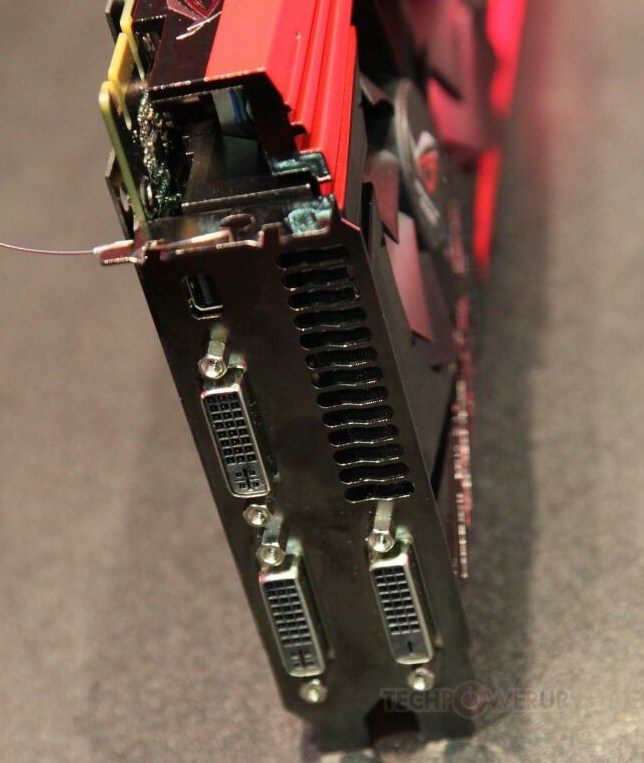
ASUS is working to redesign its Radeon HD 7950 DirectCU II family of graphics cards. The new revision sees a breakaway from the common design that HD 7950 and HD 7970 DirectCU II graphics cards share, to one that has a more compact cooler and PCB, with denser aluminum fin stacks, six copper heat pipes (instead of five on the original design), and a redesigned display output layout (2x DVI DL, 1x HDMI, 1x DisplayPort; compared to 1x DVI, 1x HDMI, and 2x mini-DisplayPort, on the original). The new design could be implemented on both the standard and TOP models. The standard model ships with clock speeds of 800 MHz core, while the TOP model ships with 900 MHz core clock speed. While it's not expected that the new cards will be cheaper than the current HD 7950 DirectCU II cards (at least not significantly), they could let ASUS brace itself for industry-wide price-cuts of the HD 7950, if and when they come about.

ASUS EeeBox EB1030 Nettop Detailed

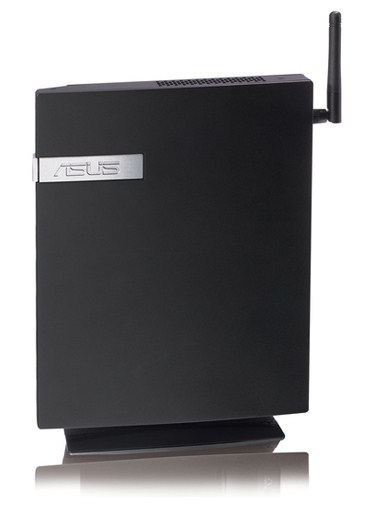
ASUS unveiled a 1 liter (volume equivalent) sized nettop, the EeeBox EB1030, powered by Intel Atom "Cedar Trail" platform. It measures just 219 x 172.5 x 29 mm, weighing 690 g. Under the hood is an Atom D2550 dual-core processor, clocked at 1.86 GHz, backed by 1 GB of DDR3 memory, and 320 GB storage. Upgrade options include up to 4 GB of memory, and 500 GB HDD or 32 GB SSD.

Most basic network and peripheral connectivity options are present, including 802.11 b/g/n, gigabit Ethernet, stereo audio with 5.1 channels over SPDIF, legacy serial, and display outputs that include HDMI and D-Sub. The EeeBox EB1030 starts at €296. The company plans two other models, the EB1031 featuring Atom D2700 processor, and the EB1033, which tops the EB1031 up with NVIDIA GeForce GT 610M graphics.

ASUS Readies HD 7850 DirectCu II Dragon Edition Graphics Card

ASUS is reportedly working on a new custom-design Radeon HD 7850 graphics card, to capture a key price-point in the performance market segment. The card uses the company's in-house DirectCu II dual-slot cooling solution, and is labeled "Dragon Edition" (model: DRAGON HD7850-DC2O-2GD5). The card ships with clock speeds lower than those of the HD 7850 DirectCu II TOP, with 910 MHz GPU and 5.00 GHz memory (vs. reference clock speeds of 870/4.84 GHz; and DCU2 TOP clock speeds of 975/5.00 GHz).

Interestingly, the HD 7850 DirectCu II Dragon Edition features a metal back-plate, something even the TOP model lacks. The PCB, too, differs from the that is found in other HD 7850 DCU2 graphics cards, featuring a 6+3 phase Digi+ VRM, which draws power from two 6-pin PCIe power connectors. The main heatsink bears a slightly different design to that of the other DCU2 models based on the GPU. ASUS is likely to price the card somewhere between the stock HD 7850 DirectCu II and the HD 7850 DirectCu II TOP.

ASUS Readies ROG ARES 2 Graphics Card with Dual-HD 7870 GPUs

ASUS is working on its second Republic of Gamers (ROG) ARES graphics card, the ARES 2 dual-HD 7870. Its first ARES was dual-HD 5870. ASUS' decision to go with a pair of Radeon HD 7870 GPUs, instead of the premium HD 7970, certainly comes as a surprise. With it, one could deduce the target market-segment ASUS is aiming at: US $650-750, providing a solution that outperforms even the fastest HD 7970 GHz Edition and GTX 680 graphics cards, while being cheaper than Radeon HD 7990 (which is MIA), dual-HD 7970 X2, and of course, the GTX 690.

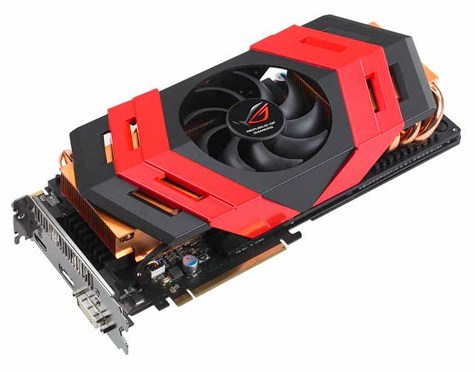
ASUS ARES 2 will back two 28 nm "Pitcairn" GPUs with all components unlocked; likely factory-overclocked speeds beyond those of the HD 7870 GHz Edition; and a total of 4 GB of GDDR5 memory (2 GB per GPU system). The card will draw power from two 8-pin PCIe power connectors, and will have a TDP of around 300W. It will take advantage of AMD ZeroCore CrossFire, with which it powers down the second GPU when not gaming, or with light 3D loads that the first GPU can munch on. With the monitor idling for a set amount of time, both GPUs power down. It's likely that ASUS will use a triple-slot cooling solution, despite the fact that the HD 7870 is a generally cool GPU. Pictured below is the first-generation ROG ARES (dual-HD 5870).

Update Jun 26: We have received word from ASUS that "There is no plan to release a dual 7870 VGA".

AMD Introduces the Radeon HD 7970 GHz Edition

Today AMD launched the world's fastest graphics processing unit (GPU), the AMD Radeon HD 7970 GHz Edition. The AMD Radeon HD 7970 GHz Edition uses AMD's innovative Graphics Core Next (GCN) architecture to deliver astonishing performance and breathtaking image quality, providing world-class gameplay at the highest resolutions in the most demanding games such as Battlefield 3, Deus Ex: Human Revolution and DiRT Showdown.

"The AMD Radeon HD 7970 GHz Edition rounds out our award-winning GCN family, providing world-class gameplay thanks to the industry's fastest single GPU," said Matt Skynner, corporate vice president and general manager, GPU Division, AMD. "Gamers have been hungry for our AMD Radeon HD 7000 Series since our launch last December. We have been able to meet that growing demand as we expanded our AMD Radeon HD 7000 offerings and brought the industry's most advanced graphics across a complete family of leading-edge desktop and notebook graphics cards."
ASUS to Give AMD AM3+ Platform Thunderbolt Support

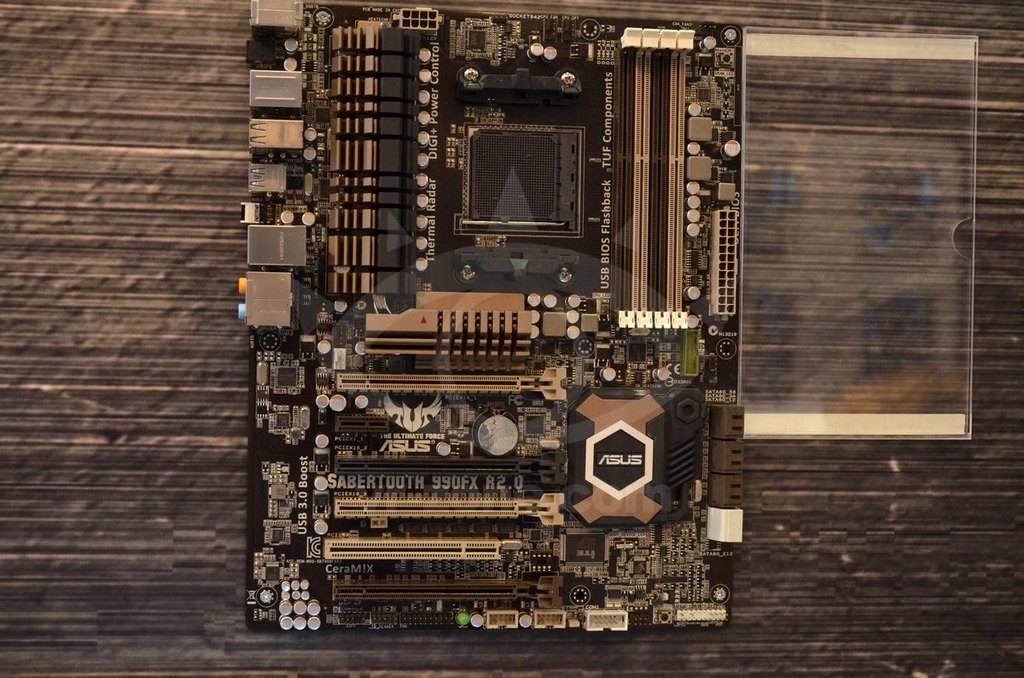
ASUS unveiled a new line of socket AM3+ motherboards at Computex, which will constitute its lineup at least for the rest of 2012. The new motherboards are based on existing 9-series chipset, and are mere revisions of existing AM3+ motherboard models. These include the Crosshair V Formula-Z (990FX + SB950), M5A99FX PRO R2.0 (990FX + SB950), Sabertooth 990FX R2.0 (990FX + SB950) and M5A99X EVO R2.0 (990X + SB950). What all these motherboards have in common, is a header labeled "TB_HEADER," which connects them to ASUS' Thunderbolt EX add-on card.

The ASUS Thunderbolt EX is a swanky PCI-Express 2.0 x4 add-on card, which is driven by an Intel "Cactus Ridge 2C" Thunderbolt host controller. The TB_HEADER is a low-level connection between the motherboard and the add-on card, which transacts power state, signaling, and device hot-plugging events to the system BIOS. Some of ASUS' recent 7-series LGA1155 motherboards can be retrofitted with Thunderbolt the same way, and feature the same header. The card has a nice EMI shield running the entire length of its PCB. Its rear panel has one full-size DisplayPort, which is actually an input from your graphics card, and one Thunderbolt + mini-DP output.

G.SKILL Showcasing "Largest & Fastest" DDR3 Memory at 2012 Computex

G.SKILL - manufacturer of world leading high performance memory and SSD, debuts the largest memory computer system that runs a total of 96GB (8GBx 12) RipjawsZ DDR3 1600MHz kit on the latest EVGA SR-X motherboard at Computex 2012.

G.SKILL also displays the fastest memory of G.SKILL's TridentX which achieved the amazing speed over DDR3 3000MHz CL11 16GB (4GBx4) on both ASUS Z77 MAXIMUS V FORMULA and GIGABYTE Z77A-UD5 motherboards.

New Details on ASUS ZEUS Emerge

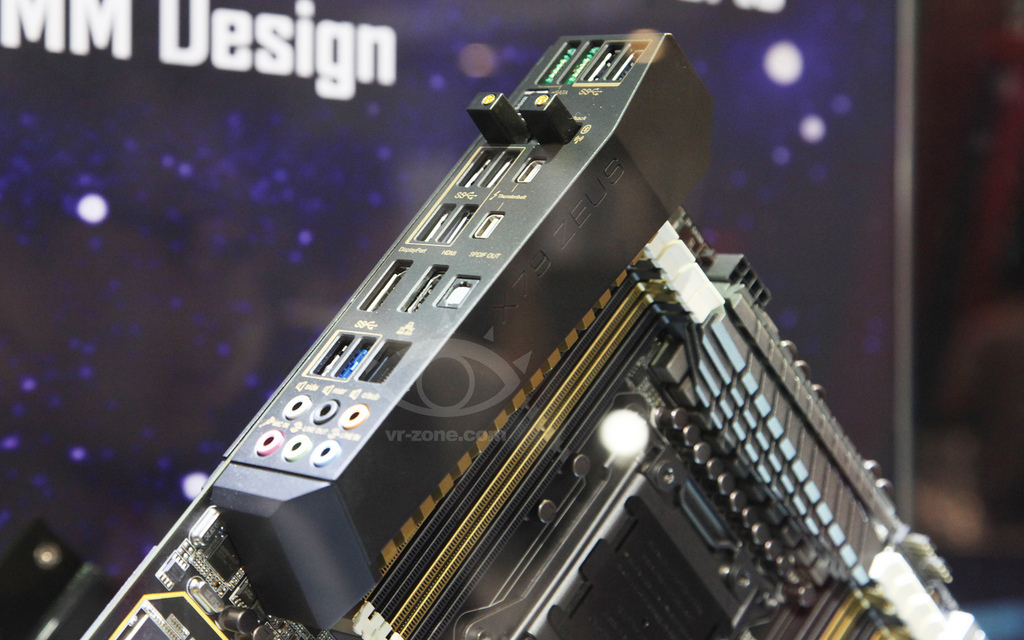
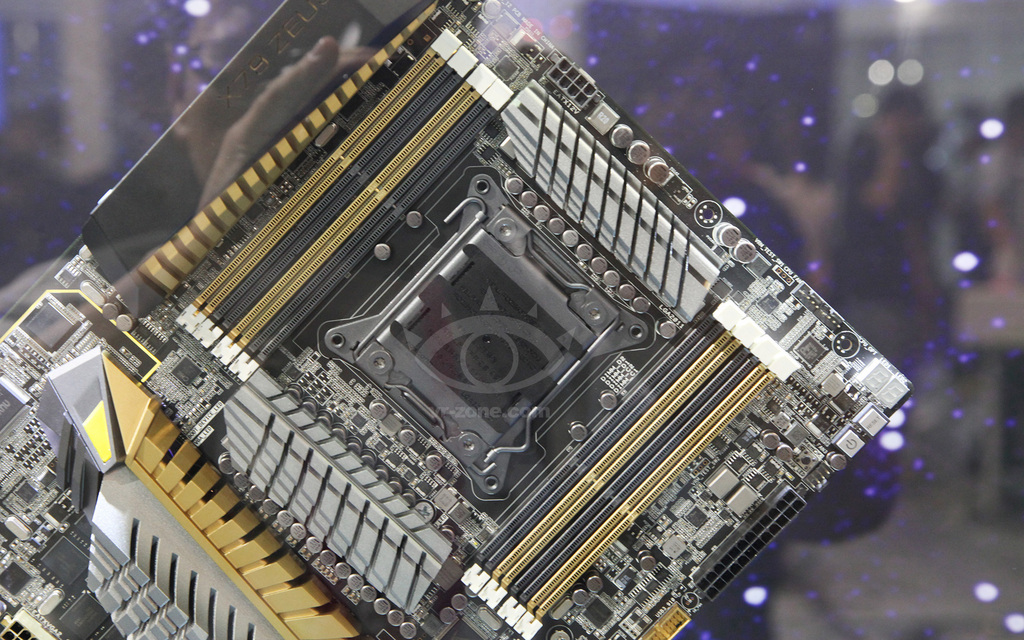
A star attraction at the motherboard section of ASUS booth was its ZEUS Dual-GPU X79 concept motherboard. We got a chance to talk at lengths with people at ASUS about the exhibit, and learned a few details beyond what we already know. To begin with, ASUS is likely using a pair of "Southern Islands" family discrete mobile GPUs, not desktop ones. Further, it's likely that the GPUs are 28 nm "Pitcairn" based. The two GPUs are installed in CrossFire configuration. The next big detail is that the design focus on [evidently] isn't the integrated dual-GPU, but to demonstrate the first Thunderbolt-equipped X79 motherboard. The ZEUS has not one, but two Thunderbolt ports. The third (and most depressing) detail is that it's "highly unlikely" that the ZEUS will ever make it to the market. Think of it as yet another tradeshow concept by a big company. Perhaps ASUS doesn't want the ZEUS to end up like the ROG GSurf-365, its first off-beat ROG motherboard, which went beyond the show-floor but didn't have market-success.

ASUS Working on World's First Notebook with 802.11ac

According to Broadcom vice-president Michael Hurlston, the upcoming ASUS Republic of Gamers G75VW will be the world's first notebook PC with an integrated 802.11ac WLAN adapter. It will be the "world's first 5G Wi-Fi laptop," according to Hurlston. Yet to be released to the market, the G75VW will be equipped with a Broadcom-made 802.11ac adapter, although its product page currently only mentions 802.11n support. The notebook will pack dual-antennae MIMO support, and will be capable of theoretical network speeds in the 800 to 850 Mbps range. Hurlston made this statement at the Computex 2012 company booth.

ASUS Unveils Z77 Wolverine Motherboard with 40-Phase CPU VRM

If you thought the GIGABYTE Z77X-UP7 with its 32-phase CPU VRM was over the top, check out the Z77 Wolverine from ASUS. A design concept for the time being, this beast packs 40 (yes, forty) CPU VRM phases. The VRM makes use of compact chokes and driver-MOSFETs, with 20 phases on each side of the PCB. Given that it draws power from just one 8-pin EPS connector, the only idea we see behind this concoction is reducing load per "phase", resulting in lower temperatures per driver-MOSFET, perhaps even letting the motherboard do away with with VRM area heatsinks altogether.

ASUS insists that the CPU VRM of the Z77 Wolverine features Digi+, so we assume it uses the same EPU controller found on several other P8Z77-V series motherboards. The bottom half of the Z77 Wolverine is nearly identical to that of the P8Z77-V Deluxe, including the layout of expansion slots (3x PCIe 3.0 x16, 3x PCIe 2.0 x1). The board's connectivity resembles that of the P8Z77-V Deluxe, too. This include four SATA 6 Gb/s ports, four SATA 3 Gb/s ports, and two eSATA 6 Gb/s ports; eight USB 3.0 ports (6x rear-panel, 2 via header); dual gigabit Ethernet; and 802.11 b/g/n + Bluetooth module.

ASUS ROG MARS III Dual GTX 680 Graphics Card Detailed

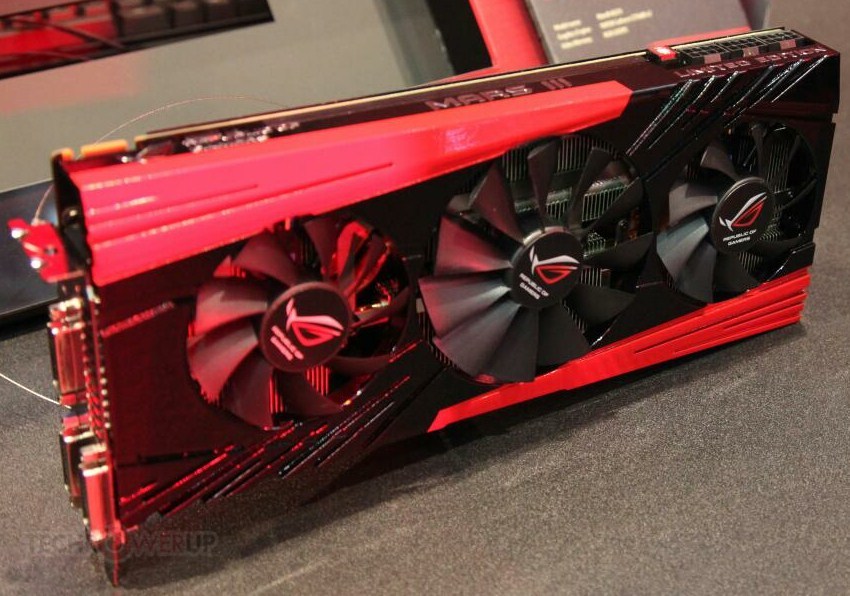
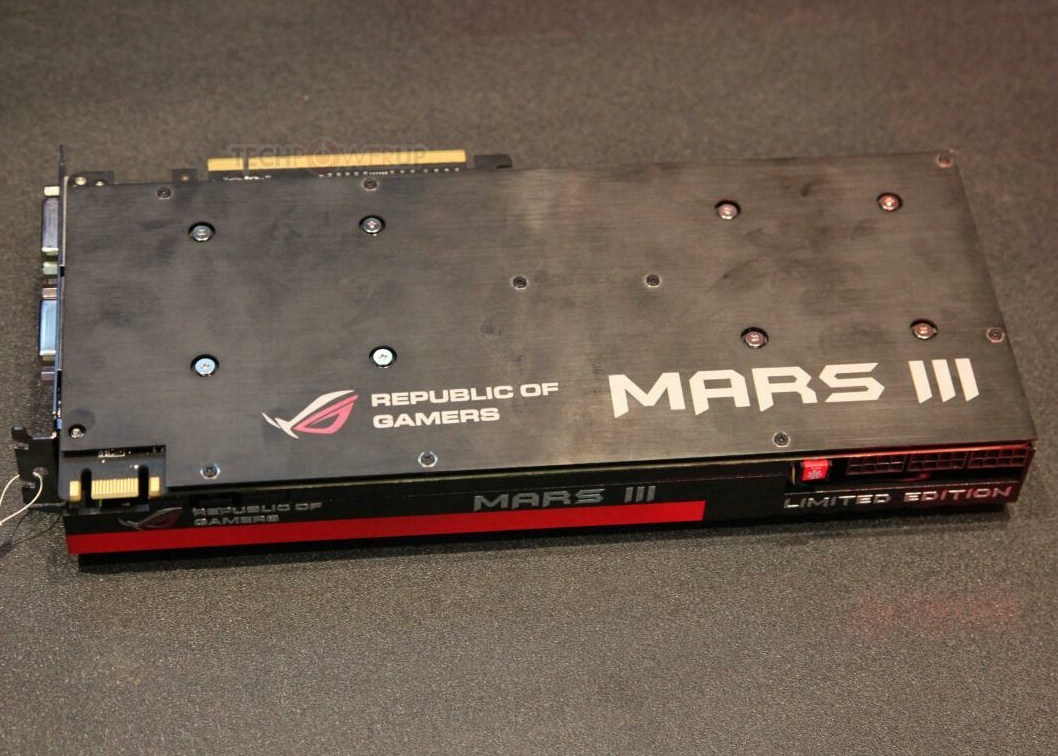
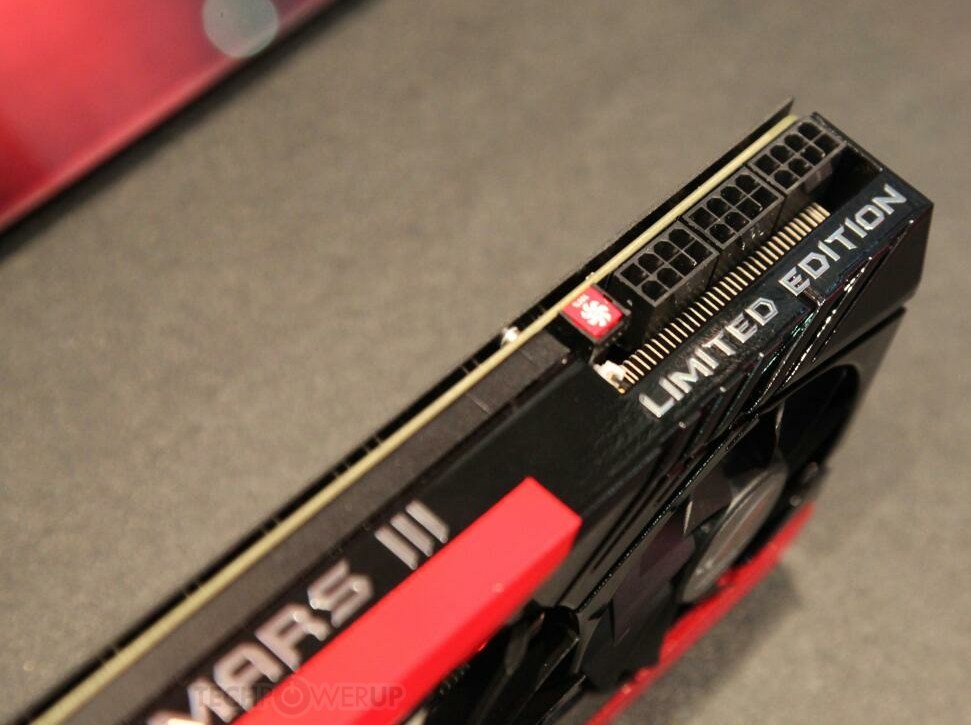
The ROG MATRIX 7970 wasn't the only new Republic of Gamers graphics card on display at Computex, it was sitting next to the MARS III. This monstrosity is a dual-GeForce GTX 680 graphics card, it packs two 28 nm GK104 GPUs with clock speeds that match or exceed those of the GeForce GTX 680. ASUS stopped short of revealing the clock speeds. The card draws power from three 8-pin PCI-Express power connectors, next to it is an instant fan-override button that revs up the card's fans to 100%. The card gives out three dual-link DVI display outputs, and is capable of driving 3D Vision Surround using three >1920x1200 pixels displays. Unlike the MATRIX 7970 and countless recent examples of ASUS' ugly fixation with triple-slot cooling solutions, it's a pleasant surprise seeing that the triple-fan cooling solution of the MARS III needs just two expansion card slots. The MARS III will be manufactured in limited quantities, and will probably cost more than a GeForce GTX 690.

ASUS Shows off ROG Matrix 7970 Graphics Card

ASUS showed off its newest high-end single-GPU graphics card, the Republic of Gamers (ROG) Matrix 7970. The card will be ASUS' addition to a new wave of highly-overclocked Radeon HD 7970 graphics cards (we're talking ≥25% factory-OC), by AMD AIB partners, to compete with GeForce GTX 680. ASUS did not disclose the clock speeds the Matrix 7970 ships with, but listed out its exclusive features, such as VGA Hotwire (read and control voltages at a hardware level), TweakIT (hardware voltage-speed control using buttons, one-push fan override), ProbeIT (voltage fan-speed monitoring points), a 20-phase Digi+ VRM with software control using GPUTweak software, and the software itself, which comes with a plethora of tweaking options.

ASUS ROG ZEUS Fuses LGA2011 Motherboard with Dual-GPU Graphics

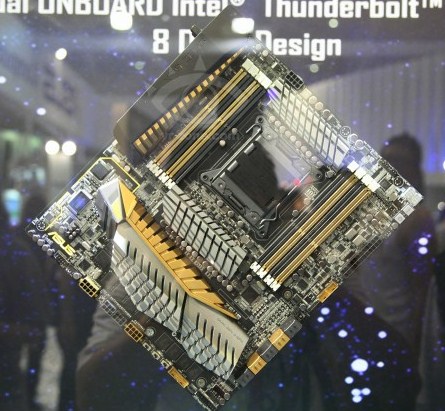
ASUS displayed a nerdtastic motherboard design concept, at Computex. Called the Republic of Gamers ZEUS, ASUS' creation is a socket LGA2011 motherboard with a dual-GPU graphics hardware soldered onto the board, in the place otherwise assigned for expansion slots. The top half of the ZEUS resembles that of a conventional LGA2011 motherboard, with the processor being powered by a 10-phase Digi+ VRM, and eight DDR3 DIMM slots. ASUS somehow made the platform support up to 128 GB of unregistered DIMM DDR3 memory (double the 64 GB limit of the Sandy Bridge-E HEDT platform).

The second half of the motherboard has the X79 PCH, and two PCI-Express 3.0 GPUs in dual-GPU configuration. ASUS hasn't revealed which GPUs these are, but sources predict it's a pair of AMD Radeon HD 7970 (Tahiti XT) or HD 7870 (Pitcairn XT). Each GPU system has its own set of memory, and a set of 8-pin + 6-pin PCIe power connectors. The display outputs of this dual-GPU setup are given out on the rear panel, as two mini-DP + Thunderbolt ports, and one each of HDMI and standard DP. The ZEUS even has as many as 8 SATA 6 Gb/s ports, four SATA 3 Gb/s ports, and 12 USB 3.0 ports, besides two Thunderbolt 10 Gb/s ports. For now, ASUS' monstrosity is a design concept, and the company is undecided about launching it to the market. If nothing, the ZEUS serves as a testament of ASUS' mammoth engineering potential.

ASUS Shows off Trio of TUF Sabertooth Z77 Design Concepts

ASUS showed of three new design concepts for the otherwise boring-looking thermal armor of the TUF Sabertooth Z77 motherboard. The designs were sourced from the PC enthusiast community. The top design is entitled "Ammo depot," and makes use of props that look like grenades and shells. The next design is entitled "Gears of TUF," and bears a rustic industrial look. The final design concept is called "Desert Warrior," and features a non-digital desert camo design with a few rounds lying on it. For now, these are merely design concepts. ASUS probably found its newest product designer out of the exercise.

ASUS Announces the RT-AC66U (802.11ac) Dual-Band Router

The ASUS RT-AC66U router integrates dual-band Gigabit wireless with fifth generation 802.11ac Wi-Fi technology, also known as 5G WiFi, which enables speeds up to three times faster than existing 802.11n. As one of the first routers to achieve this, it tops Gigabit wireless requirements with a combined 2.4 GHz/5 GHz bandwidth of 1.75 Gbps. This massive data rate makes it an excellent high speed router for demanding online applications, coupled with exclusive ASUS AiRadar signal amplification and shaping technology. Easy ASUSWRT setup, multiple SSIDs, and IPv6 support further enhance networking, while strong USB-based capabilities turn the RT-AC66U into a 3G, FTP, DLNA, and printer server for genuine multi-role functionality.

ASUS Readies Two Variants of Maximus V Formula Motherboard

For various reasons, ASUS confined its Z77 Express-based Republic of Gamers (ROG) lineup to just the micro-ATX Maximus V Gene, and although we've got to see its ATX sibling, the Maximus V Formula on several occasions, ASUS didn't officially launch it. According to a new report by VR-Zone, ASUS will be offering two SKUs of the Maximus V Formula. The company is known to offer these tiny sub-variants with its ROG products. Sometimes the differences between such sub-variants are as major as inclusion/exclusion of a component (eg: Crosshair V Formula/ThunderBolt), and as minor as inclusion of a game (eg: Rampage IV Extreme/Battlefield 3). In this case, it's the inclusion/exclusion of a component called ThunderFX, which makes up the two variants.

ThunderFX is a USB sound card and headphones amplifier. Backed by the C-Media CMI6631 chipset, the device could be used for headphones amplification. The CMI6631 has been implemented on several other solutions for console headset noise-cancellation. It is possible that ThunderFX does the same, using an external microphone array. That aside, the motherboard has a headphones amplifier of its own. The motherboard's onboard audio is backed by a TI 6120A2 amplifier, the same kit found on high-end sound cards such as ASUS Xonar Essence ST/STX. Find other fine details about the Maximus V Formula in our previous article.

G.SKILL Aims To Break World Overclocking Record At Computex 2012

G.SKILL International Co. Ltd., the world's leading manufacturer of extreme performance memory and superior solid-state storage, has teamed up with ASUS, MSI, EVGA and GIGABYTE and will be hosting an industry-first, "G.SKILL World-Class Overclocking Invitational" with G.SKILL's extreme performance DDR3 memory at the Computex 2012.

G.SKILL invited up to 8 professional overclockers from across the world, including legendary overclockers from the United States, Sweden, Switzerland, Taiwan, Australia and Japan. Collaborating with 4 industry leading motherboard brands, G.SKILL aims to smash all overclocking world records by using ultra high performance motherboards, VGA and the fastest DDR3 memory, the "TridentX".

AMD FX 8150 Cracks 8.80 GHz in New OC Feat

It is no news that AMD FX likes high clock speeds, even if they come at the expense of energy efficiency and heat. It's only when one such chips crosses 8.80 GHz (8805.64 MHz, to be precise), that it makes headlines. Thai overclocker "ksin" claimed to able drive the chip to its record speed using a base clock speed of 303.29 MHz, and multiplier of 29.0x. A scorching 1.86V core voltage was used. Other components include ASUS Crosshair V Formula motherboard, and 4 GB (2x 2 GB) of ADATA-made memory, clocked at 1417 MHz. Ksin didn't bother providing more details such as method of cooling, and that seems like a reason behind the CPU-Z Validation rejection.

ASUS Intros DVD Writer with 50% Lower Power Draw

ASUS announced a new retail and OEM channel DVD writer drive, the DRW-24B5ST. Built in the conventional 5.25-inch SATA form-factor, the drive is said to pack energy-efficient components that reduce idle power draw (mounted disc idling, and no disc idling), by 50%. ASUS branded this feature as E-Green. Armed with 1536 KB of cache, the drive offers DVD access times as low as 160 ms, and CD access times as low as 140 ms. It writes DVDs at speeds as high as 24X depending on the media type, and CDs at speeds as high as 48X. It is priced at 2,500 JPY (US $31).

ASUS Launches First Intel Thunderbolt Certified Motherboard

Further demonstrating its market leading innovation, ASUS has announced the launch of its P8Z77-V PREMIUM motherboard - the flagship of the P8Z77 Series and the first Intel certified motherboard in the market to offer the latest Thunderbolt connection interface. The PREMIUM designation has been reserved for only the best motherboards with the latest technologies, and the P8Z77-V PREMIUM maintains this standard. In addition to the onboard Thunderbolt connection on the P8Z77-V PREMIUM, ASUS also offers the same technology on the P8Z77-V PRO/THUNDERBOLT to give consumers a wider range of choices.

"Intel and Asus have worked closely on the implementation of Thunderbolt technology onto Asus motherboards," said Jason Ziller, Intel's Director of Thunderbolt Marketing. "The P8Z77-V PREMIUM is the first Thunderbolt certified motherboard in the industry, a testament to its solid design and compatibility."

ASUS Releases the P8C WS Motherboard with the Intel C216 Chipset

The ASUS P8C WS motherboard combines the advantages of several product classes. While mainly a workstation board, it also incorporates server readiness, and can be easily used in high end standard desktop builds.

As a flexible choice for system integrators, its compact design and Intel C216 chipset offer better convenience and compatibility. It is fully Independent Software Vendor certified, and supports Intel Xeon E3-1200/12x5 v2 series processors as well as 2nd and 3rd generation Intel Core i3 processors. The board also works equally well with non-ECC and ECC DDR3 memory. Four USB 3.0 ports cover both the rear I/O and front panel to enhance user-friendly connectivity, while dual Intel Ethernet ports double networking capabilities and reduce CPU workload.

ASUS Showcases the Zenbook UX32VD Ultrabook

In addition to the UX21A and UX31A models exposed a couple of months ago, the next wave of ASUS Zenbooks is set to include another unit, one called UX32VD which packs an Intel Ivy Bridge (3rd generation Core) processor, an NVIDIA GeForce GT 620M discrete graphics card, and a 13.3-inch IPS screen with a native resolution of 1920 x 1080 pixels.

Showcased in Taiwan, this upcoming ultrabook also has up to 4 GB of RAM, a 500 GB hybrid drive, three USB 3.0 ports, an SD card slot, and both HDMI and mini DisplayPort outputs. The Zenbook UX32VD will run Windows 7. Its price tag and release date are still unknown.
Return to Keyword Browsing
Nov 26th, 2026 00:23 CST change timezone

New Forum Posts

Popular Reviews

TPU on YouTube

Controversial News Posts