
NVIDIA H100 Makes Its Cosmic Debut as the First AI Accelerator in Space
NVIDIA has decided that covering the earth with data centers is not enough, so the company now wants to accelerate infrastructure in the outer space. According to the latest blog post, NVIDIA will be a part of an AI-equipped satellite from Starcloud, powered by a single NVIDIA H100 "Hopper" GPU. After many months or even years of validation and testing that goes into designing a space payload, Starcloud and NVIDIA have designed a 60 kg package the size of a small fridge, that will be installed in space satellite orbiting the planet Earth. This will be more powerful than any current space infrastructure, at more than 100x compute capacity than the existing accelerators. We still don't know if this GPU has been radiation hardened, or it has just been isolated enough for space radiation to not represent a problem.
In space, the power requirements can easily be neglected. With the use of solar panels, any hardware is capable of tapping nearly infinite energy for powering the infrastructure. That way, NVIDIA H100 GPU can run at full throttle crunching any AI computation without any issues, and making sure that the Starcloud satellite is doing its job. The cooling structure of this AI module is intriguing. It is engineered to function effectively without relying on convective cooling, instead using radiative heat rejection into the cold expanse of space. Since outer space is essentially a vacuum, there is no air to conduct heat away. Therefore, the module must internally conduct heat from the computing components, such as CPUs and GPUs, to external radiators that emit infrared radiation into deep space. When oriented favorably, with radiators facing away from direct solar irradiation, the module can maintain a lower operating temperature than would be possible on Earth. However, this is not a "magic" solution. The design must carefully balance factors such as the thermal interface, radiator area, emissivity, orientation, and internal heat flow.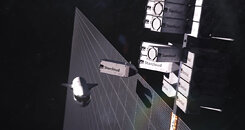
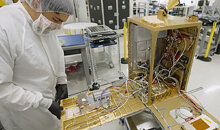
In space, the power requirements can easily be neglected. With the use of solar panels, any hardware is capable of tapping nearly infinite energy for powering the infrastructure. That way, NVIDIA H100 GPU can run at full throttle crunching any AI computation without any issues, and making sure that the Starcloud satellite is doing its job. The cooling structure of this AI module is intriguing. It is engineered to function effectively without relying on convective cooling, instead using radiative heat rejection into the cold expanse of space. Since outer space is essentially a vacuum, there is no air to conduct heat away. Therefore, the module must internally conduct heat from the computing components, such as CPUs and GPUs, to external radiators that emit infrared radiation into deep space. When oriented favorably, with radiators facing away from direct solar irradiation, the module can maintain a lower operating temperature than would be possible on Earth. However, this is not a "magic" solution. The design must carefully balance factors such as the thermal interface, radiator area, emissivity, orientation, and internal heat flow.


