Wednesday, October 22nd 2025

NVIDIA H100 Makes Its Cosmic Debut as the First AI Accelerator in Space
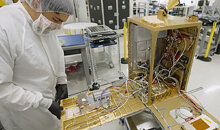
NVIDIA has decided that covering the earth with data centers is not enough, so the company now wants to accelerate infrastructure in the outer space. According to the latest blog post, NVIDIA will be a part of an AI-equipped satellite from Starcloud, powered by a single NVIDIA H100 "Hopper" GPU. After many months or even years of validation and testing that goes into designing a space payload, Starcloud and NVIDIA have designed a 60 kg package the size of a small fridge, that will be installed in space satellite orbiting the planet Earth. This will be more powerful than any current space infrastructure, at more than 100x compute capacity than the existing accelerators. We still don't know if this GPU has been radiation hardened, or it has just been isolated enough for space radiation to not represent a problem.
In space, the power requirements can easily be neglected. With the use of solar panels, any hardware is capable of tapping nearly infinite energy for powering the infrastructure. That way, NVIDIA H100 GPU can run at full throttle crunching any AI computation without any issues, and making sure that the Starcloud satellite is doing its job. The cooling structure of this AI module is intriguing. It is engineered to function effectively without relying on convective cooling, instead using radiative heat rejection into the cold expanse of space. Since outer space is essentially a vacuum, there is no air to conduct heat away. Therefore, the module must internally conduct heat from the computing components, such as CPUs and GPUs, to external radiators that emit infrared radiation into deep space. When oriented favorably, with radiators facing away from direct solar irradiation, the module can maintain a lower operating temperature than would be possible on Earth. However, this is not a "magic" solution. The design must carefully balance factors such as the thermal interface, radiator area, emissivity, orientation, and internal heat flow.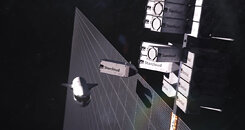
 Starcloud wants to build a 5 GW data center in space in the future, with solar panels reaching about 4 KM in length and 4 KM in width. This massive 16 square kilometer panel will capture enough sunlight so that the five gigawatt data center can run undisrupted without any batteries or backup power source. However, that project is still a distant future. For now, Starcloud-1 will be the goal to accomplish, and we can expect a launch in November. NVIDIA claims that a key use case for extraterrestrial data centers is processing Earth observation data to enhance applications like crop identification, weather prediction, wildfire detection, and distress signal response, enabling near-instantaneous insights by analyzing data directly in space.
Source:
NVIDIA Blog
In space, the power requirements can easily be neglected. With the use of solar panels, any hardware is capable of tapping nearly infinite energy for powering the infrastructure. That way, NVIDIA H100 GPU can run at full throttle crunching any AI computation without any issues, and making sure that the Starcloud satellite is doing its job. The cooling structure of this AI module is intriguing. It is engineered to function effectively without relying on convective cooling, instead using radiative heat rejection into the cold expanse of space. Since outer space is essentially a vacuum, there is no air to conduct heat away. Therefore, the module must internally conduct heat from the computing components, such as CPUs and GPUs, to external radiators that emit infrared radiation into deep space. When oriented favorably, with radiators facing away from direct solar irradiation, the module can maintain a lower operating temperature than would be possible on Earth. However, this is not a "magic" solution. The design must carefully balance factors such as the thermal interface, radiator area, emissivity, orientation, and internal heat flow.


24 Comments on NVIDIA H100 Makes Its Cosmic Debut as the First AI Accelerator in Space
The conscious choice was to kick prices sky high, polute the earth and add a key to keyboard layouts.
We need infrastructure for power and water terrestrially more than we need space AI
I'm kinda impressed. :laugh:
Gonna take a lot of surface area to radiate all that heat...Ah, Investor Bait. Got it.
www.sarna.net/wiki/Laser_Heat_Sink
This has military application written all over it, let's stop pretending we are all idiots.radiator panels to dump waste heat as IR radiation.
But that water in turn would need to radiate the heat or lose it to an other medium too.
So no, it’s not more efficient.
In space you need to be able to radiate away the heat in a vacuum at some point.
Also yeah, 16km² of solar panels generate power BUT THEY ALSO HEAT THE FUCK UP, I don't even want to imagine the sheer amount of hardware required to be launched in space to have enough cooling surface to radiate away that heat, it's a ridiculously high amount
www.nasa.gov/wp-content/uploads/2021/02/473486main_iss_atcs_overview.pdf
If they seriously start building this, it will consume all the remaining aluminium and copper here on Earth. Indeed, all metals and earths will become rare metals and rare earths.
A nuclear reactor would be the most sensible choice cuz you'd only need to deal with the cooling then but 5GW ?? Go cool a nuke, all the components heated by the nuke, all the components heated by the electricity generated by the nuke which bringing it to the hardware AND all the hardware the electricity was actually intended for, that's gonna be A LOT.
Imagine if the AWS outage happened in space.
I just don't see the practicality.
Talking of which: