News Posts matching #Fugaku

Return to Keyword Browsing

Fujitsu Showcases "MONAKA" CPU Sample with 3.5D XDSiP Packaging

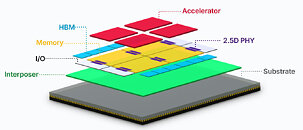
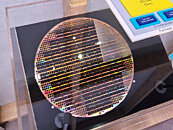
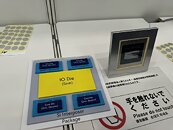
During MWC, Fujitsu partnered with networking equipment maker 1FINITY to unveil the first silicon wafers and an engineering sample of its "MONAKA" CPU. Scheduled for release in 2027, the initial Fujitsu MONAKA CPU utilizes the Armv9-A architecture and a 3D chiplet layout that combines a core die with separate SRAM and I/O dies. A single chip features 144 cores, and two-socket configurations can scale up to 288 cores per node. The platform supports 12-channel DDR5, PCIe 6.0 with CXL 3.0, and Arm SVE2 for AI and HPC workloads. Fujitsu has chosen TSMC to manufacture this chip using the 2 nm node, paired with Broadcom's 3.5D eXtreme Dimension System-in-Package (XDSiP) packaging architecture. This packaging allows MONAKA to become a 144-core design featuring four 36-core chiplets. These chiplets are stacked face-to-face with SRAM tiles through hybrid copper bonding, utilizing TSMC's N5 process for the cache layer.

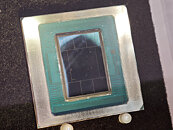
In the pictures below, we can see the silicon complex in its early sample packaging, which shows a large central I/O die, HBM memory around the CPU, and the new packaging technology. Reportedly, this CPU has already reached a working version, with Broadcom shipping the CPU to Fujitsu in late February this year. After initial testing and early performance validation, Fujitsu plans to ship these processors to customers around summer, with mass shipping to commence in 2027. The company envisions this SoC as a powerhouse for AI inference, simulation, and large-scale data processing. It will sell these systems to external customers, who showed great interest in Fujitsu's A64FX when the Fugaku computer came online. Fugaku was the most powerful supercomputer back in 2020, achieving 415.53 PetaFLOPS of FP64 and an impressive HPL-AI score of 1.421 ExaFLOPS using lower FP16 precision. Hence, we expect the new MONAKA CPU to enable much greater speeds and some efficiency improvements as well.
RIKEN Partners With Fujitsu and NVIDIA for "FugakuNEXT" Supercomputer

RIKEN is collaborating with Fujitsu Limited (Fujitsu) and NVIDIA to launch an international initiative for the development of Japan's new flagship supercomputer - the next-generation successor to the current "Fugaku" supercomputer - (development codename: "FugakuNEXT"). For the first time in Japan's flagship supercomputing systems, GPUs will be adopted as accelerators, with NVIDIA leading the design for the GPU infrastructure. Fujitsu, which has already been working with RIKEN, will lead the basic design of the overall system, compute nodes, and CPUs. As a foundation for high-performance computing (HPC) infrastructure, the three organizations will work together to build an "AI-HPC platform" to solve challenges through computation.

Aiming for operation around 2030, FugakuNEXT is envisioned to deliver not only the simulation performance pursued by previous supercomputers, but also world-leading capabilities in both simulation and AI, with the two working in close integration as a unified "AI-HPC platform". To this end, FugakuNEXT will extend the CPU technologies developed for Fugaku, while incorporating GPUs as accelerators, aiming to maximize execution performance for both simulation and AI applications. At the same time, to continuously generate scientific achievements through the use of next-generation computing infrastructure, it is becoming increasingly important to pursue not only advances in hardware technology, but also comprehensive innovations in software and algorithms.

IBM and RIKEN Unveil First IBM Quantum System Two Outside of the U.S.

IBM and RIKEN, a national research laboratory in Japan, today unveiled the first IBM Quantum System Two ever to be deployed outside of the United States and beyond an IBM Quantum Data Center. The availability of this system also marks a milestone as the first quantum computer to be co-located with RIKEN's supercomputer Fugaku—one of the most powerful classical systems on Earth. This effort is supported by the New Energy and Industrial Technology Development Organization (NEDO), an organization under the jurisdiction of Japan's Ministry of Economy, Trade and Industry (METI)'s "Development of Integrated Utilization Technology for Quantum and Supercomputers" as part of the "Project for Research and Development of Enhanced Infrastructures for Post 5G Information and Communications Systems."

IBM Quantum System Two at RIKEN is powered by IBM's 156-qubit IBM Quantum Heron, the company's best performing quantum processor to-date. IBM Heron's quality as measured by the two-qubit error rate, across a 100-qubit layered circuit, is 3x10⁻³ (with the best two-qubit error being 1x10⁻³)—which is 10 times better than the previous generation 127-qubit IBM Quantum Eagle. IBM Heron's speed, as measured by the CLOPS (circuit layer operations per second) metric is 250,000, which reflects another 10x improvement in the past year, over IBM Eagle.

SC24: Supercomputer Fugaku Retains First Place Worldwide in HPCG and Graph500 Rankings

The supercomputer Fugaku, jointly developed by RIKEN and Fujitsu, has successfully retained the top spot for 10 consecutive terms in two major high-performance computer rankings, HPCG and Graph500 BFS (Breadth-First Search), and has also taken sixth place for the TOP500 and fourth place for the HPL-MxP rankings. The HPCG is a performance ranking for computing methods often used for real-world applications, and the Graph500 ranks systems based on graph analytic performance, an important element in data-intensive workloads. The results of the rankings were announced on November 19 at SC24, which is currently being held at Georgia World Congress Center in Atlanta, Georgia, USA.

The top ranking on Graph500 was won by a collaboration involving RIKEN, Institute of Science Tokyo, Fixstars Corporation, Nippon Telegraph and Telephone Corporation, and Fujitsu. It earned a score of 204.068 TeraTEPS with Fugaku's 152,064 nodes, an improvement of 38.038 TeraTEPS in performance from the previous measurement. This is the first time that a score of over 200 TeraTEPS has been recorded on the Graph500 benchmark.

Japan Unveils Plans for Zettascale Supercomputer: 100 PFLOPs of AI Compute per Node

The zettascale era is officially on the map, as Japan has announced plans to develop a successor to its renowned Fugaku supercomputer. The Ministry of Education, Culture, Sports, Science and Technology (MEXT) has set its sights on creating a machine capable of unprecedented processing power, aiming for 50 ExaFLOPS of peak AI performance with zettascale capabilities. The ambitious "Fugaku Next" project, slated to begin development next year, will be headed by RIKEN, one of Japan's leading research institutions, in collaboration with tech giant Fujitsu. With a target completion date of 2030, the new supercomputer aims to surpass current technological boundaries, potentially becoming the world's fastest once again. MEXT's vision for the "Fugaku Next" includes groundbreaking specifications for each computational node.

The ministry anticipates peak performance of several hundred FP64 TFLOPS for double-precision computations, around 50 FP16 PFLOPS for AI-oriented half-precision calculations, and approximately 100 PFLOPS for AI-oriented 8-bit precision calculations. These figures represent a major leap from Fugaku's current capabilities. The project's initial funding is set at ¥4.2 billion ($29.06 million) for the first year, with total government investment expected to exceed ¥110 billion ($761 million). While the specific architecture remains undecided, MEXT suggests the use of CPUs with special-purpose accelerators or a CPU-GPU combination. The semiconductor node of choice will likely be a 1 nm node or even more advanced nodes available at the time, with advanced packaging also used. The supercomputer will also feature an advanced storage system to handle traditional HPC and AI workloads efficiently. We already have an insight into Monaka, Fujitsu's upcoming CPU design with 150 Armv9 cores. However, Fugaku Next will be powered by the Monaka Next design, which will likely be much more capable.
Return to Keyword Browsing
Nov 14th, 2026 02:02 CST change timezone

New Forum Posts

Popular Reviews

TPU on YouTube

Controversial News Posts