News Posts matching #Intel Product

Return to Keyword Browsing

Intel Foundry Improves Yields Across Intel 4, Intel 3, and 18A Nodes

Intel posted strong Q1 2026 earnings results, indicating improvements across multiple verticals, from Intel Products to Intel Foundry divisions. Both groups experienced operational enhancements, but Intel Foundry achieved a significant milestone: yield improvement across all major foundry nodes currently in high-volume manufacturing. This includes Intel 4, Intel 3, and 18A nodes, which power the majority of Intel's product portfolio. In the latest Q1 2026 earnings call, Intel CFO David Zinsner noted that the company continues to improve yields on its older nodes, such as Intel 4 and Intel 3, while refining the yield of the current top-performing 18A node to reduce waste and increase the number of functional chips, even in larger dies.
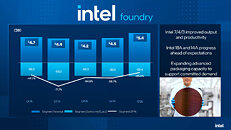
David Zinsner, Intel CFOIntel Foundry operating loss in Q1 was $2.4 billion, improved $72 million quarter-over-quarter as better yields across Intel 4, Intel 3, and 18A drove higher gross margins. This was mostly offset by increased operating expenses associated with an intentional step-up in Intel 14A investments to support both internal and external customer evaluations. As a reminder, Intel Foundry carries the bulk of the cost associated with the early ramp of Intel 18A, and we expect Intel Foundry's operating loss to improve through the year as 18A continues to ramp into volume and yields improve further. Within the quarter, Intel Foundry delivered output above our expectations, drove steady improvements in yields, and met key 14A milestones.

Intel Promises Overclocking on Budget CPUs in the Future

Intel's Robert Hallock, a vice president and general manager of the enthusiast section at the company, has announced plans to expand overclocking support to a much wider range of processors in the future. This is a significant move for Intel's product business, which has been producing CPUs unlocked for overclocking for years but typically reserved this capability for its K and KF SKUs. Robert Hallock argues that enabling this feature across a broader range of CPUs will allow enthusiasts at different price points to access one of the most appealing features of the K/KF SKUs. Just because a PC enthusiast buys at a different price point doesn't mean their enthusiasm is any less, and Intel aims to support that going forward. In an exclusive interview with PC Games Hardware, we learn more about this initiative and get a quote below.
Robert HallockWhat you will see is more and more unlocked SKUs over time. That is the goal. That should not be a feature that is exclusively reserved for the people paying the most amount of money. Not everyone can afford the most amount of money...and that doesn't make them any less an enthusiastic than the person who can spend 500 USD on a CPU. They are still PC enthusiasts, and they deserve the same level of features, and that is what we intend to deliver in our roadmap.

NVIDIA Tested Intel's 18A Node but Did Not Commit to Intel Foundry

According to a report from Reuters, NVIDIA has explored using Intel Foundry's 18A node but has not proceeded to mass production. Reuters states, "NVIDIA recently tested out whether it would manufacture its chips using Intel's production process known as 18A but stopped moving forward, two people familiar with the matter said. NVIDIA did not answer a request for comment." This is not necessarily a negative sign for Intel Foundry, as many customers have previously approached Intel to try out the 18A node. It is common for chip designers to evaluate what TSMC's competitors offer before committing to additional foundry capacity.

For the 18A node, the general impression is that it primarily serves Intel's internal products. Future versions, like 18A-P and 18A-PT, aim to attract external customers and are expected to be long-term Intel Foundry products. Intel's 14A node is becoming a critical product for Intel Foundry, with active development targeting a 2027 release. As Intel collaborates with customers on the node design, potential foundry partners are assessing whether the upcoming technology meets their needs. Early customer feedback indicates strong satisfaction with the development progress, with those familiar with the node describing it as genuinely competitive.

Intel CTO and AI Chief Sachin Katti Departs for OpenAI

Intel's chief technology and AI officer, senior vice president, and general manager of the Network and Edge Group (NEX)—Sachin Katti—is leaving the company to join OpenAI. He spent four years at Intel and was appointed CTO and AI chief in April, though his tenure in that role was brief. Katti was responsible for guiding Intel's AI strategy and product roadmap, leading the NEX group, and fostering partnerships between Intel Labs, startups, and ecosystems. In the interim, Intel's CEO, Lip-Bu Tan, will assume Katti's responsibilities to facilitate a smooth transition. Tan will now oversee some of the most challenging roles in the semiconductor industry, including managing Intel Foundry, Intel Product, and AI strategy, among other duties.

For Sachin Katti, a new chapter has been opened. He posted on his X account: "Excited for the opportunity to work with @gdb, @sama and the @OpenAI team on building out the compute infrastructure for AGI! Very grateful for the tremendous opportunity and experience at Intel over the last 4 years leading networking, edge computing and AI." This means that he will help with the infrastructure build out for OpenAI, which is now measure in megawatts for all the plans OpenAI has. It is a difficult task to achieve, so we are waiting to see how it manifests.

Intel Announces Key Leadership Changes to Data Center and Client Computing Group

Intel Corporation today announced a series of senior leadership appointments that support the company's strategy to strengthen its core product business, build a trusted foundry, and foster a culture of engineering across the business.

Kevork Kechichian Appointed to Lead Data Center Group
Kevork Kechichian has joined Intel as executive vice president and general manager of the Data Center Group (DCG). In this role, he will lead Intel's data center business across cloud and enterprise, including the Intel Xeon processor family.

U.S. Government to Take a 10% Equity Stake in Intel

According to the latest report from Bloomberg, the U.S. government is currently discussing taking a 10% stake in Intel Corp. Late last week, we reported on Intel's CEO Lip-Bu Tan's visit to the White House to discuss the future of Intel as America's most important semiconductor manufacturer. And today, parts of the deal seem to be near completion, according to sources close to Bloomberg. Reportedly, some or all of Intel's CHIPS Act grants are going to be converted by the federal government into an equity stake in the company, which could help fuel further Intel Foundry expansion and R&D investments. Intel's CHIPS Act funding has reportedly not yet been reflected in the balance sheet, as the company has issued warnings in the past that these grants have been slow to arrive. However, under the new initiative, the U.S. government now plans to use this grant funding as a way to get equity in Intel Corp and become its largest shareholder with a 10% share.

Historically, Intel has been awarded roughly $10.9 billion in CHIPS Act grants for commercial and military applications. However, that funding hasn't materialized yet. What the U.S. now plans is a 10% stake, roughly worth $10.5 billion, which would practically mean the same thing, with voting power over company decisions as its largest stakeholder.

Intel Foundry Services "Unsuccessful" at Attracting External Customers: 10-Q Filing

Intel in its latest 10-Q filing with the US SEC revealed that the company has been "unsuccessful to date" in attracting significant customers to its external foundry business. Traditionally dedicated to manufacturing Intel products, the company's foundry had over the years reorganized itself into Intel Foundry Services, and opened its doors to manufacturing chips for external customers the way Samsung Electronics does. While Samsung's foundry manufactures SoCs, DRAM, and NAND flash products for itself, it's also been a contract manufacturer of cutting edge logic chips. For example, NVIDIA's GeForce "Ampere" GPUs were made on a Samsung 8 nm node. Intel was eying a similar future for its foundry, however, major chip designers seem less than enthusiastic.

Intel battled foundry woes since the second half of the 2010s, when its switch from 14 nm to 10 nm took much longer than expected, and a resurgent AMD building chips on TSMC 7 nm adding pressure on Intel Products to court TSMC. The company's current "Arrow Lake" processor is made almost entirely on TSMC nodes, with its Compute tile being built on TSMC 3 nm, Graphics tile on TSMC 5 nm, and SoC tile on TSMC 6 nm. Only its Base tile (active interposer) is made on a mature Intel 22 nm node. This probably does not help Intel attract customers to its latest foundry nodes such as Intel 4, much less its upcoming sub-2 nm class nodes such as the upcoming Intel 14A. Intel Foundry Services in the filing disclosed that in the YTD, it raked in revenues from external customers of just $50 million. These are probably low-volume chip designers from the defense industry that are mandated to manufacture chips on US soil.

Intel Sets 50% Gross Margin Goal for Every New Product Before Production

Intel's tale of financial difficulties has been told for many quarters now, and the company is slowly paving the way to profitability through workforce reduction, new aggressive product roadmaps, and, as of now, a 50% gross margin requirement before entering production. At Bank of America's global technology conference, Intel Products CEO Michelle Johnston Holthaus noted that CEO Lip-Bu Tan is "laser-focused on the fact that we need to get our gross margins back up above 50%." Explaining the reasoning behind this decision, MJH added that it is "something that we probably should have had before, but we have it now so that product doesn't move forward; you actually don't get engineers assigned to it if it's not 50% or higher gross margins moving forward."

Interestingly, this means that every new product will now go into evaluation of profitability first, unlike the "build it and they will (hopefully) come" philosophy, which cost Intel many billions of R&D just to enter new markets without a solid financial plan. MJH also added about 50% gross margin expectation:" So I think our future products can all get there, I think really what it comes down to is you have to have a lot of discipline in your product life cycle planning to build products from day one that hit that and so there's a lot of things that I talked about when we talked about Lip-Bu coming on board of getting our OpEx and our CapEx in line, getting the types of products that we're going to build in alignment, really understanding market and ASPs." This means that upcoming Panther Lake, 18A node HVM, Clearwater Forest Xeons, Xe3/Xe4 Arc GPUs, and Jaguar Shores AI accelerators all carry a gross margin of 50% or more, making them viable for Intel and sustainable in the long run.

Intel's New CEO Lip-Bu Tan Reaffirms "World-Class Foundry" Vision, Casting Doubt on Spinoff Rumors

At the time of crisis for Intel and uncertainty with foundry goals, Intel has appointed a semiconductor veteran as its new Chief Executive Officer (CEO)—Lip-Bu Tan. In a letter to Intel employees, Lip-Bu Tan has quietly addressed Intel Foundry spinoff rumors, saying that his commitment as a CEO is to "restore Intel's position as a world-class products company, establish ourselves as a world-class foundry and delight our customers like never before." Hence, the foundry spinoff rumors are now not so certain. Previous industry rumors suggested that Intel may very well spin off its fabs entirely or get it in a joint venture that would see TSMC and US companies like AMD, Broadcom, and NVIDIA get a part of the say. That is still a possibility. However, Intel's new CEO understands the strategic importance of Intel's fabs, just like the previous CEO, Pat Gelsinger.

Intel moves a lot of volume with its products, most of that thanks to its internal manufacturing capacity. Without it, Intel would be forced to go to external fabs like Samsung and TSMC and deal with additional complexity, lead times, etc. With the 18A node, Intel plans to use it for its products and offer it to external customers. Some features like backside power delivery using PowerVia and RibbonFET are standout aspects that make its 18A node PDK much more attractive on paper than solutions from TSMC and Samsung. Keeping that technology and manufacturing ability inside Intel is strategically vital for both Intel and US-based advanced silicon manufacturing. The foundry has been burning a lot of cash, 13.4 billion in 2024 alone, but Intel expects it to be net positive by the end of 2027. After that, Intel's products and external customers should be keeping Intel's fab busy with enough revenue to offset losses in the coming years.
Return to Keyword Browsing
Nov 12th, 2026 06:39 PST change timezone

New Forum Posts

Popular Reviews

TPU on YouTube

Controversial News Posts