News Posts matching #Kickstart

Return to Keyword Browsing

Mchose Launches Ace75 Hall Effect Gaming Keyboard on Kickstarter

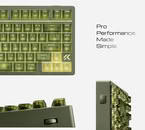
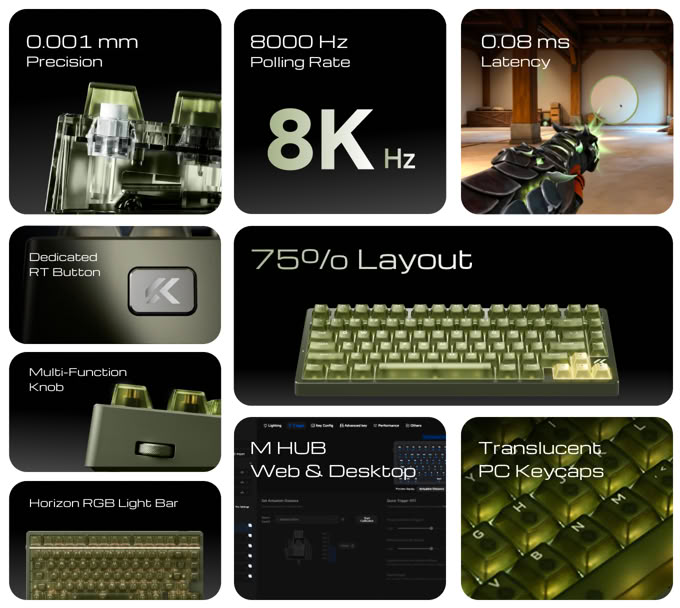
Mchose, a brand known for making affordable high-performance gaming peripherals, has officially launched the Ace75, a new Hall effect gaming keyboard with a 75% layout and a focus on both aesthetics and gaming performance. Mchose hasn't specified what the keyboard is made from, but the images on the Kickstarter page suggest an aluminium case that's been anodized to color-match the keycaps for various colorways. On Kickstarter, the Mchose Ace75 starts at $109, but the MSRP will be $149 when it eventually launches out of the Kickstarter.

The Ace75 offers the choice of two switches, depending on what keyboard color you choose: the Moon Rock Grey keyboard will come with Berserker Magnetic Switches, while the more exciting Mecha Green, Navy Blue, and Midnight Purple versions will come with TTC Royal Steed switches. The Moon Rock Grey colorway will also be the only one of the lot to ship with opaque PBT keycaps, while the other three colorways come with translucent polycarbonate, instead. Aside from the fairly minimalist case design, the Ace75 comes with a few tricks up its sleeve that may make it particularly useful as a keyboard that's both a daily driver and a gaming accessory.


Awekeys Officially Reveals Shine-Through Metal Keycaps For Mechanical Keyboards

Following the recent launch of its low-profile metal keycaps, Awekeys has officially announced a new shine-through variant of its metal keycaps for full-height MX-style switches. The Awekeys RGB keycaps are not yet available for purchase, but Awekeys has revealed the design, layout options, colors, kits, and eventual pricing for the keycaps. The Awekeys RGB shine-through metal keycaps will soon be available on Kickstarter in three different kit options: $169 for the 83-key base kit, $199 for the 98-key kit, and $229 for the full-size 116-key kit. The quoted MSRPs will increase to a claimed $269, $319, and $369, respectively, after the end of the Kickstarter campaign.

[Editor's note: Our hands-on review of a previous set of Awekeys metal keycaps is available]

The keycaps, like the company's other designs, will use a recycled alloy called cupronickel, and they will be available in six different colors in both brushed and satin finishes. The available colors include gold, copper, silver, titanium black, obsidian black, and a special glow-in-the-dark neon variant. Some of these colors and finishes will likely cost extra when they launch, and there will likely be specific combinations of colors and finishes, rather than both finishes being available in all colors—this was the case with the low-profile keycaps and Awekeys's other metal keycap products. The Awekeys RGB keycaps seem to follow OEM profile, rather than Cherry, and they will be compatible with both ISO and ANSI keyboard layouts.

RAWM eSports Debuts Nyx60 Gaming Keyboard with Light-Guided Optical Switches

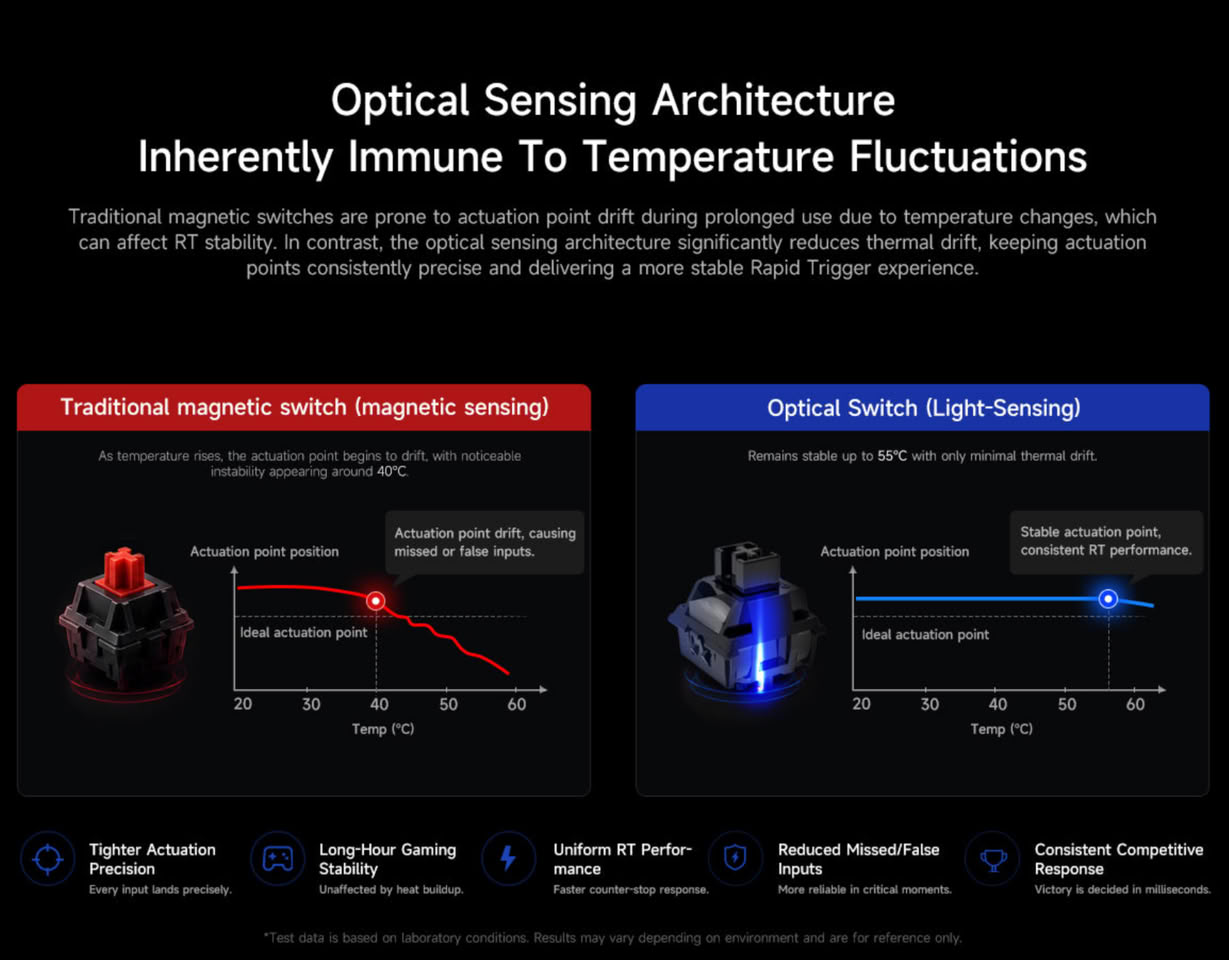
With an ever-growing selection of Hall effect gaming keyboards to choose from, it seems as though e-sports brand RAWM has opted for optical switch tech for its next keyboard, the Nyx60, which it has announced will launch on Kickstarter on September 3. The only other major player in the PC peripherals market still relying on optical switches is Razer, and even Razer recently launched the Huntsman V3 HE to complement its optical keyboard line-up. The RAWM Nyx60's current listed MSRP is $199, but it will launch on Kickstarter with an early bird price of $99 for those who sign up with a $1 reservation.

RAWM argues that optical switch tech provides more stable actuation detection than magnetic switches and sensors, and it claims to be the first gaming keyboard to offer "light-guided optical switches in a full aluminium keyboard. It's currently unclear what, if anything, sets RAWM's switch tech apart from the prismatic designs we've already seen in Wooting and Razer's switches, but RAWM claims that the optical switch tech will offer 0.01 mm precision for both actuation and rapid trigger, and it says that the optical switches offer other benefits over HE, while offering all of the nifty analogue features, like RT, DKS, SOCD, and Mod Tap.

Piston V Touchscreen Bazzite Mini PC Launches on Kickstarter With $799 MSRP

In early August, the Piston V appeared online, shrouded in mystery, but ran the gauntlet in a video by ETA Prime. Now, the Piston V has officially launched on Kickstarter at a surprisingly early bird price. The Kickstarter campaign also fully reveals the mini PC's specs and bundled accessories. The Piston V launched on Kickstarter with a super early bird price of $559, and, at the time of writing, is available starting at $590. However, the post-Kickstarter MSRP is expected to be around $799. The creators of the mini PC and its crowdfunding campaign tout the device as a hybrid mini PC and game console "in a gadget form factor," with the Bazzite/Windows dual-boot and a 4-inch touchscreen on the front adding to the HTPC experience.

As was shown in the pre-launch hands-video, the mini PC will feature the AMD Ryzen AI 9 365 APU with its built-in AMD Radeon 880M iGPU, which should deliver reasonable performance for most non-AAA games. All models available in the Kickstarter come with 16 GB of DDR5-5600 memory and a 500 GB PCIe Gen 4×4 M.2 SSD, but the specs are upgradeable 24, 32, 48, or 64 GB of memory and up to 4 TB of SSD storage. One thing that wasn't mentioned in the original hands-on was the presence of an OCuLink port for eGPU support.

Double Fine Hosts Amnesia Fortnight To Raise Funds and Vote for First Post-Xbox Game

Following the split from Xbox as a result of the gaming giant's year-long "reset," game studio Double Fine will be hosting the first Amnesia Fortnight event, a game jam event in which is pitches ideas and lets the community vote on which will eventually get made into a game.

This will be the studio's first Amnesia Fortnight since 2019, when the company was acquired by Microsoft. This time, the Amnesia Fortnight event will be accompanied by a Kickstarter campaign that Double Fine says will "help support our newly (re)gained independence," and backers will vote for four finalists to become a game prototype, one of which will "become a real (small) game."

Keychron V6 Ultra Hybrid TMR Keyboard Launches on Kickstarter

Keychron previously teased the V6 Ultra Hybrid, a new wireless hybrid keyboard that is compatible with both magnetic and mechanical switches, and the company has now officially launched the new keyboard on Kickstarter with a pledge goal of $30,000. Merely a day after launching on the crowdfunding platform, the V6 Ultra Hybrid has managed to accrue over $166,000 from 926 backers.

The Keychron V6 Ultra Hybrid is compatible with both regular MX-style 3- or 5-pin mechanical switches and more modern, gaming-oriented magnetic switches, thanks to its TMR sensing tech. The keyboard has a built-in mechanism to automatically detect whether mechanical or magnetic switches are installed in a given socket and automatically switch between mechanical or magnetic mode without human intervention.

GPD Box Mini PC: $1,452 Base Price—PCIe 5.0 x8 MCIO Port Skips Intel Core Ultra X7 SKU

We previously covered the announcement of the GPD Box, a new Panther Lake mini PC that features an MCIO 8i port and dual USB4 v2.0 ports for expanded connectivity with eGPUs and other high-bandwidth applications. Now, the GPD Box has finally launched on Indiegogo with a starting price of HK$11,377 ($1,452.25 converted). The base configuration is powered by an Intel Core Ultra 7 356H with 32 GB LPDDR5-8533 RAM and a 1 TB M.2 2280 NVMe SSD. The next level up upgrades the CPU to the Core Ultra X7 358H for HK$12,020 ($1,534 converted), and the bundles with the Box mini PC and the G2 MCIO eGPU Dock come in at HK$14,394 ($1,837 converted) for the Core Ultra 7 356H version and HK$15,036 ($1,919 converted) for the X7 358H variant. The biggest difference between the Core Ultra X7 358H and the Ultra 7 356H is the significantly more powerful Arc B390 iGPU in the former—importantly, there is no MCIO connection on the Core Ultra X7 358H version of the Box, leaving it with only USB4 for eGPU connections.

Despite its compact chassis, at just 175 × 134 × 39.5 mm, the GPD Box has decent I/O capabilities, with the highlight of the show being the MCIO 8i port that allows for eGPU expansion with minimal bandwidth loss compared to USB4 and Thunderbolt connections. According to GPD, the maximum bidirectional bandwidth of the GPD Box's MCIO port is 512 Gbps, which effectively matches a native PCIe 5.0 x8 cable connection. Notably, while the G2 eGPU dock does include a PSU with an 800 W ATX 3.1 PSU with two GPU power cables, you will need to bring your own GPU if you buy the bundle with the dock. The G2 dock can also be purchased separately via Indiegogo at a starting price of $385. The GPD Box itself also features dual 2.5 GbE RJ45 ports with link aggregation support. For wireless support, there is Bluetooth 5.3 and Wi-Fi 6E, while the physical I/O includes 2× USB4 V2 Type-C ports, 2× USB 3.2 Gen 2 Type-A, and a 3.5 mm audio combo jack on the front. The rear I/O has a DP 2.1 UHBR20 port, 1× HDMI 2.1 FRL ports, 2× RJ45 ports with 2.5 Gbps speeds, 2× USB 3.2 Gen 2 Type-A ports, and the MCIO 8i port.

Lofree Hyzen Keyboard Features All-New Hybrid Mechanical-Magnetic Switches in World First

Lofree is no stranger to peculiar peripheral designs, with the brand having previously released devices like the Hypace wireless gaming mouse and the Lofree Flow 2, with all its ergonomic quirks. It seems as though Lofree's next release, the Hyzen keyboard, may be even more unique than even those examples. The Hyzen is a futuristic, but otherwise unassuming 65% keyboard made out of CNC-cut aluminium, but its design conceals a few nifty features and an entirely new switch design that supposedly combines the best of both mechanical and magnetic tech. The Hyzen will be a wireless keyboard with a gasket mount design, and Lofree claims that the 10,000 mAh battery can last up to 80 hours. It will launch on Kickstarter on April 23, but early bird reservations are available on the Lofree site ahead of the official launch. Kickstarter pricing plans include the tri-mode wireless version priced at $189 with a $299 claimed MSRP further down the line or a $169 wired version that will later retail for $279.

The Nexus switch is a hybrid mechanical switch, designed by Lofree in collaboration with Kailh, that features both a magnet in the stem for TMR functionality and metal contacts and pins for traditional mechanical operation. Lofree says that the new switch design, which it claims is the first of its kind, combines the tactile feedback of mechanical switches with the low latency, customizable actuation distance and analog features of TMR switches. Aside from the new switches, the keyboard also has a physical toggle that switches the number row to a function row, with the function indicated by a row of LEDs above the num row when the function row is active. The Hyzen also has a knob on the back edge for volume control and a switch to select between 2.4 GHz, Bluetooth, and wired operation. It will also be powered by a Nordic nRF54L series MCU and be capable of 8 kHz polling.

Hardware Startup Pixelpaw Labs Shows Off "Phase" Split Game Controller That Doubles As a Mouse

Gaming has largely been split into two camps: mouse-and-keyboard gamers and controller gamers, and while devices like the Lenovo Legion Go and the new Joy-Cons on the Nintendo Switch 2 blur those lines, the Phase project, recently shown off by a new startup called Pixelpaw Labs, is attempting to blur those lines even further. The Phase is a split game controller that combines using magnets and pogo pin connectors to become a standard PC mouse. The goal behind the project is to "bridge the gap between a mouse, a mobile gamepad, and a controller," all in one device that can be carried with you when you might do both work and play away from home. Phase has not yet launched, although Pixelpaw Labs aims to launch the project as a Kickstarter, and it is currently offering a $20 refundable pre-launch deposit, which also guarantees a 15% discount when the Phase launches on Kickstarter. Kickstarter launch pricing is slated to start at $159 or $188 with the Phasegrip accessory.

Given that this is Pixelpaw Labs's first product and the fact that there is an inherent risk to Kickstarters, it would be impertinent to not mention that there is non-zero chance that the project never makes it to production. That said, the design and concept are interesting, as are some of the workarounds that the designers behind the project came up with for some unexpected problems. For one, the Phase doesn't have a scroll wheel when the two controller halves are in mouse mode—instead, the whole left click button is a touch-sensitive surface. The mouse connects wirelessly or via USB-C while in mouse mode, and it features a 16,000 DPI sensor—likely something like the PixArt PMW 3389 or PAW 3335, both of which are commonly found in gaming mice, even if they are somewhat outdated.

Awekeys Launches All-Metal Low-Profile Keycaps on Kickstarter

Awekeys, one of very few companies making metal keycaps for mechanical keyboards, has just announced the Awekeys Air as its latest addition to the line-up. The Awekeys Air keycaps are low-profile keycaps designed for slim mechanical keyboards, like the Iqunix Magi65 Pro, NuPhy Air series, and even split ergonomic keyboards, like the ZSA Voyager and MoErgo Go60. The Awekeys Air series is available for both cross stems—for Choc V2 and Gateron switches—and Choc V1 stems, which are common on niche low-profile split keyboards, and Early Bird Kickstarter pricing starts at $109 for a 68-key DIY kit, $139 for a 95-key 80% Base kit, and $159 for a 113-key 100% kit. These prices are only for the Ivory White and Obsidian Black, with the Titanium Black and Satin Copper coming in slightly more expensive and the limited edition Satin Silver and Satin Gold costing as much as $249 for the 80% Base kit. These prices will also increase when the keycaps hit retail. The Kickstarter campaign lists MSRP of the Ivory White and Obsidian Black 100% kit colorways as $249, but keyboards and accessories often cost less than anticipated when moving from a Kickstarter to regular retail.

The Awekeys Air keycaps come in six different colors—Titanium Black, Ivory White, Obsidian Black, Satin Copper, Satin Silver, and Satin Gold—and Awekeys is offering a hand-finished brush finish on the Gold, Silver, Copper, and Titanium colorways. The keycaps themselves are made from a recycled alloy called cupronickel, which is predominantly copper and nickel, which resists corrosion, offers some anti-microbial benefits, and is considered low allergy risk—although you may want to avoid it if you have a known nickel allergy. The keycaps are also available with legends or as blanks, and the profile has a uniform height with spherical tops and a total height of 5 mm.

Darkhaven Kickstarter Officially Launches with $500,000 Goal and Full Roadmap

Darkhaven, a new multiplayer online ARPG that makes some pretty bold promises, has officially gone live on Kickstarter to raise its $500,000 funding goal, managing to raise $79,906 halfway through the first day of funding. Darkhaven's developer, Moon Beast Productions, explains that the game will have a fully procedurally generated, destructible sandbox world with "Diablo-style progression, skills, and itemization," and free, open exploration with a high degree of mobility in and out of combat. The Kickstarter will run until March 20, 2026, giving the developer a little over a month to garner funding. In addition to the Kickstarter, Moon Beast Productions has published both a development timeline and a pre-alpha demo on Steam.

The pre-alpha demo is touted as the foundation of the game, and it admittedly lacks polish and serves only as a way for players to test out the gameplay mechanics of Darkhaven. Moon Beast claims that the pre-alpha is an "unfiltered version of what we're building, not a watered-down teaser," suggesting players will be able to explore much more of the game world than a traditional demo would allow. The developer has also published a timeline explaining what it had been working on in the time the game has been in development as part of its Darkhaven timeline, in the process revealing that Darkhaven should launch in Steam Early Access close to Q4 2026. The studio also explains that the Kickstarter funding will go towards developing more character classes and skills, adding to the mob roster, building out the game's lore, NPCs, and quests, and adding more biomes and environmental events.

ATK Yogo 75 Keyboard Gets Extended Kickstarter Ahead of Imminent Launch

ATK Gear showed off its latest Ghost gaming mouse at CES earlier this year, but the brand is apparently stepping into the less gamer-focussed peripheral scene as well with the new Yogo 75 low-profile mechanical keyboard. The Yogo 75 is, as the name suggests, a 75% mechanical keyboard, but it uses a new all-POM low-profile switch designed in collaboration with Kailh and features some unique design touches, making it a competitive option at its expected $100-130 price point, depending on sales and the specific model. ATK is currently wrapping up the Kickstarter campaign for the Yogo 75, and the keyboard will soon become available on the ATK Gear online store. It will be available with both silent linear and regular linear switches and in black, silver, or yellow (which looks more like a creamy color).

The ATK Yogo 75 has an all-aluminium chassis with a silicone gasket mount, while the Pro version has a built-in pixel display with a frosted cover, and a rotary encoder, and both models feature the retro-future aesthetic that's going around at the moment. Much like the Wooting 80HE (review here), the Yogo 75 has detachable feet for typing angle adjustment, although they are magnetic on the Yogo, where they are simply press-fit on the Wooting. The Yogo 75 will be available with two switch options, and it will have universal-height dye-sublimated PBT keycaps that look like they have the same profile as the keycaps from the similar Iqunix Magi and MQ series keyboards. In terms of connectivity, the standard tri-mode affair—Bluetooth, 2.4 GHz, and USB-C connectivity. ATK has put a 5,000 mAh battery into the Yogo 75, and the brand says that it will be able to run for as long as 2,500 hours on a single charge. This is likely tested without the north-facing RGB backlighting enabled.

Abxylute N6 and N9C Switch 2 Controllers Boast Retro Looks, Hall Effect Sticks, and On-Board Macros

Abxylute is known for its mobile gaming controllers, with models often featuring TMR joysticks and triggers, and the company's latest projects, which are yet to launch, bring its designs and tech to the Nintendo Switch 2. The N9C is a retro-themed game controller based on the design and layout of the Nintendo GameCube. It features a wired USB-C connection that plugs into the bottom of the Switch 2, and it has traditional capacitive joysticks and mechanical micro switches for the face buttons, Alps tactile switches for the shoulders, and mechanical micro switches for the triggers. There are also two customizable rear buttons on the back of each controller side, and it has a 9-axis gyro input. Interestingly, the N9C has a built-in stand and BLE, although it has no built-in battery. That's because the BLE is designed to be used exclusively for customization and reprogramming. It also features on-board macros and customizable vibration and mapping for the rear and face buttons.

The N6 is a more modern take on a Switch 2 controller. It also connects to the Switch 2 via the same bottom USB-C port, but this time the focus seems to be on comfort and customizability rather than the retro looks of the N9C. The N6's grip design is reminiscent of the Steam Deck, although Abxylute has opted for a more traditional Xbox-style layout, with the offset joysticks. While the N6 is also fully customizable, it only features one rear button per side instead of the dual rear buttons of the N9C. The N6, however, uses Hall effect sticks, which are resistant to drift, and the joysticks have an anti-friction ring around the joysticks to avoid sticky movements. The ABXY face buttons on the N6 are silicone rubber domes, which are likely to feel somewhat softer than the Alps switches in the N9C, and the D-pad uses tactile switches. The triggers, meanwhile are digital triggers. The N6 has a solid tray back panel, but Abxylute has designed the back panel so that it redirects the sound from the Switch 2's down-firing speakers directly towards the user's face. Anxylute claims the audio chamber delivers "10% stronger bass," than the stock Switch 2 configuration. Both the Anxylute N9C and the N6 are launching on Kickstarter "soon," and pricing is not yet available for either controller. You can follow along on the shared Prelaunch page if you're interested.

Angry Miao Unveils AM Infinity .97 Gaming Mouse: 47 g Magnesium Alloy, Viper V3 Pro Shape

Angry Miao, the peripherals brand typically known for its premium mechanical gaming keyboards, has announced a new version of its first wireless mouse. The Angry Miao AM Infinity .97 is a smaller version of the company's first gaming mouse, the AM Infinity, which launched in March 2025. Aside from the magnesium shell, the original AM Infinity mouse's claim to fame is its hot-swap battery system that Angry Miao markets as "infinite battery life." As was revealed in a recent X post, with the Infinity .97, Angry Miao has shrunk down the original design by 3%, which has resulted in a minor reduction in weight as well as size. The main goal of the smaller version of the Infinity mouse seems to be comfort for players with slightly smaller hands who otherwise like the shape of the Razer Viper V3 Pro. A previous project log published by Angry Miao explained that almost half of the people the design team polled preferred the smaller size, while those who had hands measuring 17.5-18.5 cm in length found it to be the ideal size. The new design also reduced discomfort caused by the hump design of the previous model.

After the reduction, the AM Infinity .97 weighs in at 47 g, which is around 2 g less than the original Infinity mouse, and it seems to be using the same capacity battery as the original, meaning 340 mAh, which should deliver 43 hours of use at 1000 Hz polling or 17 hours at 8000 Hz polling while used wirelessly. If you're striving for even more weight reduction, you can run it wirelessly, which should drop another 10 g. It will feature the same PixArt 3950 sensor as the original version, as well. It also stands to reason that the Infinity .97 will use the same TTC Optical Micro switches as the original. One of the other changes coming to the .97 mouse is the addition of a transparent plastic panel that covers the large hole in the rear of the mouse and provides a little more support for palm and claw grip players. In a similar vein, the sides of the .97 version will also be solid, instead of honeycomb. The Angry Miao AM Infinity .97 mouse is slated to officially launch on February 26 on Kickstarter. Pricing is as-yet unknown, but the original AM Infinity mouse starts at $129 with the 2.4 GHz receiver and two battery packs.

OneXPlayer Super X: 14-Inch Strix Halo Tablet with Liquid Cooling

OneXPlayer has already revealed the OneXFly Apex, an AMD Strix Halo-powered gaming handheld, but now it has revealed more information about the Super X, which the company calls the "ultimate 2-in-1 gaming laptop." The new OneXPlayer 14-inch tablet, which was previously revealed in a presentation, is powered by AMD's Ryzen AI Max+ 395 APU with up to 128 GB of LPDDR5X unified memory. The OneXPlayer Super X is currently listed on Kickstarter, although it hasn't officially launched there yet, so pricing is unclear. Although it is technically a tablet, OneXPlayer ships the Super X with a magnetic keyboard accessory, technically making it something akin to a Microsoft Surface-style 2-in-1 device. OneXPlayer is billing the Super X as a do-it-all compact tablet for everything from creative workloads and gaming to heavy local AI tasks. The AMD Ryzen AI Max+ 395 has a TDP of up to 120 W, and it will supposedly have an 83.5 Wh battery, which isn't particularly large, given the sizeable power budget. That 120 W TDP may pose a problem for a slim form factor, but OneXPlayer is allegedly planning a liquid-cooled version of the Super X tablet—although not much is available regarding the details of said liquid-cooling system.

As with most AMD Strix Halo devices, expansion and upgrades are limited to the SSDs, and the Super X has one M.2 2280 PCIe 4.0 slots, although a maximum storage capacity is not listed by OneXPlayer. The display is a 14-inch, 2880×1800, 120 Hz AMOLED panel with a claimed 138% coverage of the sRGB color space. The display supposedly also supports HDR and VRR, the latter of which should be a decent help when it comes to gaming workloads and perhaps even battery life. It also supports a stylus with 4096 levels of pressure sensitivity, so it may be useful as a sketching tablet or note-taking tool. The ports on the Super X include 2× USB4, 1× USB 3.2 Type-A, 1× 3.5 mm audio, 1× TF Card slot, 1× HDMI 2.1, 1× PCIe 4.0 Mini SSD Expansion Slot (externally accessible).

Ambitious Wee Beastie Project Aims To Put Desktop NVIDIA RTX 4070 GPU Into 4.75 L Chassis

A rift appears to be forming in the desktop PC market, with full-size desktops on one side and mini PCs on the other side. Of course, there is small, but dedicated community that has sprung up around SFF PCs, but those are often limited, with many calling for flex PSUs and other compromises. The Wee Beastie, a new project on Kickstarter, is a small form-factor PC that hopes to cut back on the compromises, claiming to offer a powerful gaming and LLM-oriented system with an upgradeable dGPU in just 4.75 L volume—this is just 0.25 L more than the Framework Desktop PC, which uses an AMD Ryzen AI+ 395 Max with an iGPU. That said, even the pre-release Kickstarter marketing leaves some questions.

The Wee Beastie Super Mini Fishtank, as it is called, is a mini PC with up to an Intel Core Ultra 7 255H CPU and NVIDIA GeForce RTX 4070 12 GB GPU. It will also be available with up to 128 GB of DDR5 RAM and a 16 TB SSD, and it boasts Wi-Fi 7 and room for up to 13 case fans. It will also contain an internal PSU capable of 400 W, which technically falls well below the 550 W we recommend for a desktop RTX 4070. Although the GPU shown on the Kickstarter page has the "AD104-251-A1" associated with the desktop variants of the RTX 4070, the PSU output suggests that there will be some power throttling or down-tuning at play, so RTX 4070 Mobile performance might be what's to be expected here. Often, the most challenging part of projects like these, as was the case with the custom expansion modules on the Framework Laptop 16 until recently, is supporting the MXM standard for future hardware revisions. Although MXM modules are technically an open standard, like ATX, it is not commonly used due to limited demand and size constraints. Currently, the Kickstarter has completed funding, having reached $53,763 of its $2,570 goal, and the SFF PC looks to be going into production as soon as 2026.

Lexar Prepares Professional Go Portable SSD with Hub for Mobile Creators

Lexar, a leading global brand of flash memory solutions, is excited to announce their Kickstarter program for the upcoming Professional Go Portable SSD with Hub. Offering the ultimate setup to shoot seamless video from a mobile phone, the innovative Lexar Professional Go Portable SSD with Hub is a revolutionary solution that lets creators use the SSD on its own for unmatched freedom and portability or with the hub to add peripherals like lighting, microphones, power banks, and more. Weighing a mere 13 grams but packing a capacity of 1 TB-2 TB, the powerful SSD delivers USB 3.2 Gen 2 performance of 1050 MB/s read, 1000 MB/s write to shoot seamless Apple ProRes 4K 60 FPS video from an iPhone 15 Pro/Max or above and perform post-production processes right on the drive.

The Kickstarter campaign, which is already underway, gives consumers a chance to not only be first in line to receive the product when it launches, but seeks to engage with them for input, feedback, and an overall better understanding of what customers' needs and pain points are. The campaign currently has more than 2,375 backers with 20 days left.

Rokid AR Lite: The First AR Glasses Powered by Snapdragon 6 Gen 1 Mobile Platform

Rokid has announced the launch of its new AR device, the Rokid AR Lite, on Kickstarter, marking the first AR glasses powered by the Snapdragon 6 Gen 1 Mobile Platform. This integration brings the power and versatility of a mid-range smartphone into an AR device, opening up a new chapter in the industry.

Priced at USD $749, with early backers able to purchase it for USD $499, the Rokid AR Lite offers an accessible entry point into advanced AR technology. The versatility of Rokid AR Lite makes it suitable for various activities, including entertainment, work, and productivity tasks. It supports video conferencing, document editing, navigation, and photo-taking, enhancing user experiences across different scenarios.
Rokid AR Lite Rokid AR Lite Rokid AR Lite

Last Epoch 1.0 Launches on February 21, Pre-Order Editions Updated

The Eleventh Hour Games team is thrilled to showcase the launch trailer for Last Epoch 1.0: Echoes from the Void, and the opening of our updated Pre-Order Editions. Last Epoch combines time travel, exciting dungeon crawling, engrossing character customization and endless replayability to create an Action RPG for veterans and newcomers alike. Travel through the world of Eterra's past and face dark empires, wrathful gods and untouched wilds—to find a way to save time itself from The Void.

I'm thrilled to announce that Eleventh Hour Games is launching the long-awaited 1.0 version of Last Epoch on February 21st, 2024. After a journey that started with the dream of uniting genre enthusiasts to create the next great ARPG and forming an after-hours team through Reddit, to holding a successful Kickstarter 18 months later, and then building Last Epoch alongside our passionate community throughout Early Access…we're confident in saying that we've made something truly special.

Cooler Master Debuts ControlPad via Kickstarter

Cooler Master, a global leader in designing and manufacturing innovative gaming peripherals and computer components, today announces the debut of ControlPad, the world's first PC keypad with analog Aimpad technology, designed for gamers, content creators, musicians, and more. "Designed as a passion project from the ground up, ControlPad aims to change the way we interact with our most used programs and applications on a more intuitive scale," says Bryant Nguyen, Peripheral General Manager.

ControlPad harbors 24 mechanical keys available in Cherry MX Red or Gateron Red switch types. It is fully programmable through easy to use software, has a removable wrist rest for ultimate comfort, two precision scroll wheels, fully RGB backlit, and finished in a sleek brushed aluminum. ControlPad is equipped with Aimpad technology that provides mechanical keyboards the precision control most commonly found in devices such as aviation joysticks, steering wheels, and gaming controllers, enabling analog control in digital inputs.

Kickstarted - Calyos NSG S0 Fanless Chassis With Phase Change Cooling

Kickstarted pieces of tech aren't usually covered here, but knowing the community, I'd say this is an interesting take on traditional cooling systems. I, for one, know how much I loathe the sound of spinning fans - but I think I'm in the majority here. And this case by Calyos promises to put an end to all of those, in a much cleaner, environmental-friendly way that doesn't involve dipping your thousands of dollars worth of hardware in something resembling cooking oil.

Das Keyboard to Demo the World's First Cloud-Connected Keyboard at CES 2017

Das Keyboard, maker of award-winning mechanical keyboards, today announced it will demo the 5Q at CES 2017. The 5Q is the world's first cloud-connected keyboard and the only keyboard of its kind that increases productivity by streaming information from the Internet directly to the keyboard. After a successful Kickstarter campaign that exceeded the company's fundraising goal by over 580%, Das Keyboard is now ready to demo the 5Q with its connected software suite called Q, allowing information like email activity, project status, stock quotes, and sports updates to be color-coded and displayed on the keyboard keys.

Dune Case is the Mac Pro Lookalike That Everyone Can Have

Dune Case is a premium small form-factor PC case that should instantly remind you of the latest Apple Mac Pro, but packing whatever hardware (or software) you wish it had, in its 260 mm x 215 mm x 215 mm dimensions. Its designer is raising $130,000 on Kickstarter to get it to the shelves, and has already raised half the amount, with 8 days of fundraising to go. You can back the project from this page. The aluminium-built case comes in rose gold and black.

Unlike the Mac Pro, which features a cylindrical design with key components arranged along three sides of a triangular structure, with cooling machinery taking up its center; the Dune Case takes a different approach. It's spit into three compartments vertically along the bore of the cylinder, with the center holding a mini-ITX motherboard, one side with room for a full-height yet under 185 mm graphics card (connected to the motherboard through a PCIe riser); and the third compartment holding two 2.5-inch drives. A custom rear panel plugs into your motherboard, and an SFX power supply (not included) fuels your build. The main air channel is a 140 mm spinner that spouts warm air from the top.

Meet Tango PC, The Desktop Computer That Can Fit in Your Pocket

After raising over $300,000 during a hugely successful crowd-funding campaign on Indiegogo earlier this year, the team behind the Tango PC has taken to Kickstarter to raise additional funds to support retailing their PC you can fit in your pocket. Not only is the Tango PC ultraportable, it is a formidable office as well as entertainment machine with mid-core gaming performance on traditional Windows.

The Tango Kickstarter Campaign got fully funded just a day ago, and with only a day or so more to go, the consumers still can back their campaign in return of not just the Tango PC, but also a free additional PC whenever their worldwide sales reaches a 100k units milestone. What really stands out is that the Tango PC is slim and weighs below 7 ounces, fitting what amounts to a full range of desktop components in a package about the size of an iPhone 5s. The specifications include an AMD A6-5200 2 GHz quad-core processor, DDR3 RAM (from 2-8GB), SSD hard drive (from 32GB-1TB or higher), 3x USB 2.0 ports, 1x USB 3.0 port, 1x HDMI port, headphone jack and internal Wi-Fi.

Delta Six Game Gun Redesigned

Inventor David Kotkin announced today that his Delta Six project is getting a make-over. After the initial announcement of the Delta Six gaming controller hit the media, an unfortunate controversy erupted over its appearance. "The toy gun looked too realistic and was consequently considered threatening by some critics," said Kotkin. While many reviewers applauded the enhanced realism of the new game gun, anecdotal evidence suggested that some video game critics were opposed to it. Citing the controversy, a small number of potential investors began backing away from providing funding. Deciding to find new backers, Kotkin submitting Delta Six to Kickstarter, a leading source of the new enterprise of "crowd funding." It seems likely that success on Kickstarter will fully revive the project.
Return to Keyword Browsing
Nov 11th, 2026 04:17 CST change timezone

New Forum Posts

Popular Reviews

TPU on YouTube

Controversial News Posts