
News Posts matching #Mesa

Return to Keyword Browsing

Bazzite 45 Launches With Start of Linux EAC V2 Support and Wider Handheld Compatibility

Shortly after the official Fedora 45 launch, Bazzite 45 has launched, with a rebase to Fedora 45, Gnome 51.1, and KDE Plasma 6.8.2. The new Bazzite version lists updated OGC Linux kernels—7.2.15 for AMD and Intel, and 6.18.60 for NVIDIA users—and additional hardware support, including for the Acer Predator Atlas 8 and ASUS ROG Xbox Ally X20, but also for more peripherals, including the Logitech TrueForce racing wheel hardware. The Mesa driver version has also been updated to 26.2.6, InputPlumber has been updated, and CoolerController has been moved to the official docker container, while XWaylandVideoBridge has been removed in the name of stability and squashing KDE bugs. The rest of the actual updates are minor back-end changes, save one.

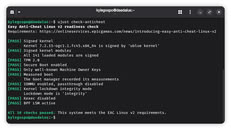
As per the announcement post on the Universal Blue Discourse page, as of Bazzite 45, Bazzite has become accepted by Epic Games as a signing key provider, and the development team behind Bazzite has added a Linux EAC V2 readiness checker to Bazzite 45. The checker automatically updates the latest Linux EAC V2 requirements and compares the requirements to the current kernel and BIOS configurations—specifically kernel and module signing, Secure Boot, TPM 2.0, measured boot, IOMMU, kernel lockdown, kexec, and BPF LSM. If there are any incompatibilities, the user will be notified by the readiness checker.

AMD Lists Three Zen 6 "Medusa" GPU IDs in HIPRT 3.2

AMD has published HIPRT 3.2, the latest version of its ray tracing library for HIP, and the release notes name the integrated graphics of its upcoming Zen 6 "Medusa" processors outright. Under new features, AMD lists Medusa support for three GPU architecture IDs: gfx1170, gfx1171, and gfx115E. HIPRT is mostly used by rendering apps like Blender, so this says nothing about gaming performance. Still, the link between these IDs and Medusa has so far rested on compiler patches and leaks, and now the Medusa name sits right in AMD's own changelog.

The gfx117x IDs belong to RDNA 4m, which first showed up in LLVM back in February. AMD added GFX1171 and GFX1172 targets in March, merged GFX1171 into Mesa 26.3 in August, and pushed RDNA 4m firmware later that month. Despite the name, RDNA 4m sits in the GFX11 family with RDNA 3 and 3.5, plus a few RDNA 4 style additions like FP8/BF8 conversion and new matrix instructions. The gfx115E entry is the more curious one. GFX115x covers the RDNA 3.5 graphics in Strix Point and Strix Halo, so it looks like at least one Medusa chip could stick with RDNA 3.5. The same release fixes a bug that truncated architecture numbers containing a letter, gfx115E included.

Intel Arc B580 Running SteamOS Impresses Despite Missing XeSS Driver Support

Valve's SteamOS has been gaining a lot of new hardware support in recent months, including support for dGPUs and Intel's Arc GPUs. ETA Prime, the YouTuber who has become synonymous with gaming handheld and SteamOS testing, has put Intel's Arc B580 to the test on SteamOS, finding impressive performance but an unfortunate lack of support for built-in Xe Matrix eXtensions (XMX) hardware.

For starters, it's impressive to see that Intel's Arc B580 GPUs now boot on SteamOS without the workarounds or experimental support that was previously required. Despite the seamless boot and installation, the Mesa driver being used by SteamOS still doesn't have support for Intel's XMX engines, making the experience of running XeSS far less worthwhile. In testing, XeSS still technically works, but quality and performance both suffer compared to XeSS running on the proper hardware. The lack of support for XMX engines also completely disables XeSS Multi-Frame Generation.

Frame Buffer Compression Promises Performance Boost for Intel GPUs on Linux

Intel's Arc GPU performance on Linux has improved greatly since the early days of the new architecture, but improvements are still being made via updates to the GPU drivers. The latest performance boost comes by way of the addition of frame buffer compression in the DXVK translation layer for Direct3D 8, 9, 10, and 11 games. The new patch comes by way of Mesa 26.3-devel, a new update to the open-source GPU driver stack, and it brings performance improvements previously seen in the VKD3D for DX12 games.

Frame buffer compression is a Linux kernel feature that aims to save memory bandwidth and power consumption by compressing the frame buffer and reducing the amount of memory used by the display. At the time of writing, Mesa 26.3-devel can be downloaded from the Mesa Git, but it, along with global frame buffer compression via DXVK, is expected to land in November when the new version of Mesa ships in the stable branch. Performance improvements, as noted in the merge request, are notable but not necessarily earth-shattering, ranging from 0.53% to just over 5%.

Devs Port Open-Source Linux AMD Graphics Driver to Windows

The AMD RADV driver is an open-source driver in the Mesa 3D graphics library optimized for running Vulkan games and software. RADV is the default Linux graphics driver on many AMD-powered Linux systems. Until now, Windows has had no open-source drivers for any GPU maker, but Valve is apparently looking to change that by funding development of the AMD RADV driver for Windows.

The actual driver porting is being done by Collabora, who often works with Valve on low-level software development, but Valve has sponsored the first phase of the project, according to a recent blog post by Collabora. The development outfit explains that it has managed to run Counter-Strike 2 on the new driver, but that there are still challenges that need to be solved. One of those challenges holding development back.
Return to Keyword Browsing
Nov 12th, 2026 06:39 PST change timezone

New Forum Posts

Popular Reviews

TPU on YouTube

Controversial News Posts

