Thursday, August 20th 2026

Intel Arc B580 Running SteamOS Impresses Despite Missing XeSS Driver Support

Valve's SteamOS has been gaining a lot of new hardware support in recent months, including support for dGPUs and Intel's Arc GPUs. ETA Prime, the YouTuber who has become synonymous with gaming handheld and SteamOS testing, has put Intel's Arc B580 to the test on SteamOS, finding impressive performance but an unfortunate lack of support for built-in Xe Matrix eXtensions (XMX) hardware.

For starters, it's impressive to see that Intel's Arc B580 GPUs now boot on SteamOS without the workarounds or experimental support that was previously required. Despite the seamless boot and installation, the Mesa driver being used by SteamOS still doesn't have support for Intel's XMX engines, making the experience of running XeSS far less worthwhile. In testing, XeSS still technically works, but quality and performance both suffer compared to XeSS running on the proper hardware. The lack of support for XMX engines also completely disables XeSS Multi-Frame Generation.
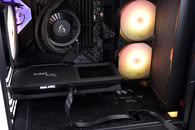

Running at 1440p, Cyberpunk 2077 at high settings still managed frame rates of 75-90 FPS with XeSS 2.0 on Quality mode. Horizon Zero Dawn Remastered also ran well at 1440p and high settings, with XeSS at balanced resulting in frame rates between 62 and 73, which ETA Prime says is basically identical performance to Windows. The reviewer also tested the older Fallout 4 at 1440p and ultra settings, with the hardware and OS combo achieving 60 FPS with plenty of headroom to spare. The same was true for Elden Ring, which ran at a very stable 60 FPS at a native 1440p resolution and maximum graphics quality with no upscaling. In Forza Horizon 5 at 1440p, high settings, and no upscaling, the Arc B580 managed to achieve a relatively smooth 75-85 FPS, with occasional dips into the 60s. He notes that, in his testing, Forza Horizon 5 runs in the mid-80s at the same settings in Windows, suggesting that SteamOS is leaving some performance on the table.
The primary takeaway here is that SteamOS has seen significant progress in getting GPU vendors other than AMD running and gaming, once again showing Valve's commitment to allowing both users and OEMs to make their own SteamOS devices, despite Valve's all-AMD approach.
Source: ETA Prime
Add your own comment

16 Comments on Intel Arc B580 Running SteamOS Impresses Despite Missing XeSS Driver Support

#1
TheGeekn°72
it would be absolutely hilarious if we got Intel ARC support on SteamOS before NvidAI GPUs lmao
Posted on Reply
#2
Solaris17
Super Dainty Moderator
TheGeekn°72Intel ARC support on SteamOS
It already does. The kernel just doesn’t include Xe but it still has the Intel driver.

I actually straight up run it on my claw (A2VM) so second gen lunar lake. (Ai 7+)

couchit.net/blog/steamos-msi-claw/

I actually mentioned the XE driver coming at the very end. Since in 7.x its enabled by default.
Posted on Reply
#3
Darmok N Jalad
Now if only Valve can patch the sleep bug for dGPU Navi 1/2 owners. They generally recommend the beta for AMD GPUs, but it’s good to see Intel can still work just fine.
Posted on Reply
#4
Destined
i am dreaming or the pc is running on virtual DDR5 RAM In the picture :roll::pimp:
Posted on Reply
#5
Chaitanya
If only these GPUs were actually available for purchase.
Posted on Reply
#6
ISSEnterprise
Still unfortunately, there is no much space for new GPU makers today. Around three decades ago, there are more than just two GPU makers and people had greater tolerance for their immaturity.
Posted on Reply
#7
TheGeekn°72
Solaris17It already does. The kernel just doesn’t include Xe but it still has the Intel driver.
I know it does, I already saw SteamOS working on ARC a few months back but that was with the dev branch
happy to see it booting and using an ARC GPU ootb without switching release branches, though as stated by the article, support could be better
ChaitanyaIf only these GPUs were actually available for purchase.
ARC GPUs? they are available, what are you talking about?
Posted on Reply
#8
ixi
Darmok N JaladNow if only Valve can patch the sleep bug for dGPU Navi 1/2 owners. They generally recommend the beta for AMD GPUs, but it’s good to see Intel can still work just fine.
They can be purchased, but god damn, to pay 380 peso for B580, little bit harsh.
Posted on Reply
#9
soder
Translation for the folks who dont understand it: Intel didnt care to include support of Xe supersampling and Framegen of their own in-house GPU under Linux. Because they would have to "opensource" that code, I believe. Xe only works natively under Windows, as that is running a closed-source blackbox Xe DLL. On the other hand, there is a simplified / generic version of Xe, which is supported on any other GPU, that meets some basic prereqs. That piece is opensourced if Im not mistaken.
But running the generic (weaker) version of Xe on Intels own chips, because the company didnt care to release the proper code for the native support is quite ridiculous. Thats the biggest defect of Intel ARC. Wonder if Intel will ever change their mind, or thats how it will be forever.
Posted on Reply
#10
Chaitanya
TheGeekn°72ARC GPUs? they are available, what are you talking about?
In India they have vanished from channel.
Posted on Reply
#11
zus
soderTranslation for the folks who dont understand it: Intel didnt care to include support of Xe supersampling and Framegen of their own in-house GPU under Linux. Because they would have to "opensource" that code, I believe. Xe only works natively under Windows, as that is running a closed-source blackbox Xe DLL. On the other hand, there is a simplified / generic version of Xe, which is supported on any other GPU, that meets some basic prereqs. That piece is opensourced if Im not mistaken.
But running the generic (weaker) version of Xe on Intels own chips, because the company didnt care to release the proper code for the native support is quite ridiculous. Thats the biggest defect of Intel ARC. Wonder if Intel will ever change their mind, or thats how it will be forever.
I think Intel just isn't focusing on Linux at the moment, they have a lot of work to do even on Windows. Apparently, OpenGL performance was broken until very recently, and I've seen some people complaining about VRR flickering on MSI Claw too. And they still don't have a VSR/DSR equivalent. Their upscaler needs an update too... Anyway, I believe Intel WILL have to change their mind sooner or later because Linux seems to be getting pretty popular in the handheld community, and the mobile market might be the easiest way to increase Intel Arc adoption.
Posted on Reply
#12
HOkay
Well this is annoying, I just setup a lounge PC & I wanted to use my B580 but it didn't support SteamOS out of the box then, & Bazzite said it should work but it didn't, so I ended up going with my trusty old 1080ti for it! Oh well, the B580 is getting its exercise as a secondary GPU in my main machine running the occasional LLM anyway.
Posted on Reply
#13
TheGeekn°72
HOkayWell this is annoying, I just setup a lounge PC & I wanted to use my B580 but it didn't support SteamOS out of the box then, & Bazzite said it should work but it didn't, so I ended up going with my trusty old 1080ti for it! Oh well, the B580 is getting its exercise as a secondary GPU in my main machine running the occasional LLM anyway.
the B580 isn't a great LLM GPU and is stronger in gaming than a 1080Ti, you stand to gain by swapping the GPUs and redoing your SteamOS install and run LLMs via CUDA honestly
Posted on Reply
#14
Onasi
soderTranslation for the folks who dont understand it: Intel didnt care to include support of Xe supersampling and Framegen of their own in-house GPU under Linux. Because they would have to "opensource" that code, I believe. Xe only works natively under Windows, as that is running a closed-source blackbox Xe DLL. On the other hand, there is a simplified / generic version of Xe, which is supported on any other GPU, that meets some basic prereqs. That piece is opensourced if Im not mistaken.
But running the generic (weaker) version of Xe on Intels own chips, because the company didnt care to release the proper code for the native support is quite ridiculous. Thats the biggest defect of Intel ARC. Wonder if Intel will ever change their mind, or thats how it will be forever.
There is no obligation for companies to open-source anything on Linux. Nothing prevents Intel from creating a proprietary driver that supports XeSS on Linux. You realize DLSS works on Linux under Proton just fine, provided NVAPI is exposed, right? And DLSS sure as hell is not open-sourced. Hell, even the MESA driver is getting the DLSS update.
Posted on Reply
#15
HOkay
TheGeekn°72the B580 isn't a great LLM GPU and is stronger in gaming than a 1080Ti, you stand to gain by swapping the GPUs and redoing your SteamOS install and run LLMs via CUDA honestly
There's only about 10% in it gaming performance wise, & the B580 has that extra GB of previous VRAM for LLMing! That actually matters as I'm really liking qwen3.8 27B, but I'm limited on context size due to VRAM, so whilst my preference was initial B580 for the lounge gaming PC it's kinda got its advantages this way round anyway.

The game plan is to grab a 9060XT 16GB to pair with my 9070XT for the main gaming/LLM PC, then I can swap the B580 into the lounge PC. Things should have matured a little more on the Linux side by then too.
Posted on Reply
#16
igormp
soderIntel didnt care to include support of Xe supersampling and Framegen of their own in-house GPU under Linux. Because they would have to "opensource" that code, I believe. Xe only works natively under Windows, as that is running a closed-source blackbox Xe DLL. On the other hand, there is a simplified / generic version of Xe, which is supported on any other GPU, that meets some basic prereqs. That piece is opensourced if Im not mistaken.
Getting into more details: the issue is the lack of support to use the XMX cores (basically intel's tensor cores) via graphic APIs such as Vulkan, which means that it falls back to DP4a instructions (which are slower). There's some work happening to enable support for it, but AFAIK it's just a single person doing it slowly:
github.com/ValveSoftware/wine/pull/347
github.com/ccallawa-intel/wine/pull/3

"open sourcing" is not an issue, they could just ship binary blobs without problems. It's more of an "integration" issue. The actual kernel mode driver does have support for XMX, it's totally accessible via SYCL and can be used to do inference tasks such as in frameworks like pytorch or when running LLMs.
Posted on Reply
Add your own comment
Nov 19th, 2026 16:50 CST change timezone

New Forum Posts

Popular Reviews

TPU on YouTube

Controversial News Posts