News Posts matching #NVIDIA

Return to Keyword Browsing

Micron Ships HBM4 Samples: 12-Hi 36 GB Modules with 2 TB/s Bandwidth

Micron has achieved a significant advancement of the HBM4 architecture, which will stack 12 DRAM dies (12-Hi) to provide 36 GB of capacity per package. According to company representatives, initial engineering samples are scheduled to ship to key partners in the coming weeks, paving the way for full production in early 2026. The HBM4 design relies on Micron's established 1β ("one-beta") process node for DRAM tiles, in production since 2022, while it prepares to introduce EUV-enabled 1γ ("one-gamma") later this year for DDR5. By increasing the interface width from 1,024 to 2,048 bits per stack, each HBM4 chip can achieve a sustained memory bandwidth of 2 TB/s, representing a 20% efficiency improvement over the existing HBM3E standard.

NVIDIA and AMD are expected to be early adopters of Micron's HBM4. NVIDIA plans to integrate these memory modules into its upcoming Rubin-Vera AI accelerators in the second half of 2026. AMD is anticipated to incorporate HBM4 into its next-generation Instinct MI400 series, with further information to be revealed at the company's Advancing AI 2025 conference. The increased capacity and bandwidth of HBM4 will address growing demands in generative AI, high-performance computing, and other data-intensive applications. Larger stack heights and expanded interface widths enable more efficient data movement, a critical factor in multi-chip configurations and memory-coherent interconnects. As Micron begins mass production of HBM4, major obstacles to overcome will be thermal performance and real-world benchmarks, which will determine how effectively this new memory standard can support the most demanding AI workloads.
Micron HBM4 Memory

NVIDIA and HPE Join Forces to Construct Advanced Supercomputer in Germany

NVIDIA and Hewlett Packard Enterprise announced Tuesday at a supercomputing conference in Hamburg their partnership with Germany's Leibniz Supercomputing Centre to build a new supercomputer called Blue Lion which will deliver approximately 30 times more computing power than the current SuperMUC-NG system. The Blue Lion supercomputer will run on NVIDIA's upcoming Vera Rubin architecture. This setup combines the Rubin GPU with NVIDIA's first custom CPU Vera. The integrated system aims to unite simulation, data processing, and AI into one high-bandwidth low-latency platform. Optimized to support scientific research it boasts shared memory coherent compute abilities, and in-network acceleration.

HPE will build the system using its next-gen Cray technology by including NVIDIA GPUs along with cutting-edge storage and interconnect systems. The Blue Lion supercomputer will use HPE's 100% fanless direct liquid-cooling setup. This design circulates warm water through pipes for efficient cooling while the generated system's heat output will be reused to warm buildings nearby. The Blue Lion project comes after NVIDIA said Lawrence Berkeley National Lab in the US will also set up a Vera Rubin-powered system called Doudna next year. Scientists will have access to the Blue Lion supercomputer beginning in early 2027. The Blue Lion supercomputer, based in Germany will be utilized by researchers working on climate, physics, and machine learning. In contrast, Doudna, the U.S. Department of Energy's next supercomputer, will get its data from telescopes, genome sequencers, and fusion experiments.

El Capitan Retains Top Spot in 65th TOP500 List as Exascale Era Expands

The 65th edition of the TOP500 showed that the El Capitan system retains the No. 1 position. With El Capitan, Frontier, and Aurora, there are now 3 Exascale systems leading the TOP500. All three are installed at Department of Energy (DOE) laboratories in the United States.

The El Capitan system at the Lawrence Livermore National Laboratory, California, remains the No. 1 system on the TOP500. The HPE Cray EX255a system was measured with 1.742 EFlop/s on the HPL benchmark. LLNL now also submitted a measurement for the HPCG benchmark, achieving 17.41 Petaflop/s, which makes the system the new No. 1 on this ranking as well.

NVIDIA N1x is the Company's Arm Notebook Superchip

We've known since 2023 that NVIDIA is working on an Arm-based notebook SoC, and now we're seeing the first signs of the chip. A processor labelled "NVIDIA N1x" surfaced on the Geekbench 6.2.2 online database, where it scored 3096 points in the single-threaded benchmark, and 18837 points in the multithreaded benchmark. This chip is shown powering an HP-branded prototype notebook, labelled "HP 8EA3," which is running Geekbench on Ubuntu 24.04.1 LTS. The processor is identified by Geekbench as having 20 logical processors, which means it has a core-count of 20. This could be a multi-tiered big.LITTLE configuration making up those 20 cores. The clock speed being reported is 2.81 GHz. The company could implement reference Arm cores, such as the Cortex-X925 P-cores, and Cortex A725 E-cores. The HP testbed used for the Geekbench run has a whopping 128 GB of RAM.

NVIDIA has been eyeing a specific slice of the PC pie that's addressed by Qualcomm with its Snapdragon Elite line of processors for Windows-on-Arm notebooks, complete with an NPU accelerating Microsoft Copilot+ on device. The N1x could also compete with Apple's M3 or M4 chips powering its iPad Pro and MacBooks. For now, Microsoft has confined Arm-based Copilot+ to Snapdragon processors, but NVIDIA will probably work with Microsoft to open up this platform to its chips. NVIDIA has been an Arm SoC maker for decades, its first rodeo with Arm-based client-segment SoCs has been under the Tegra brand, powering Android smartphones and tablets. The company has been making Arm CPUs all this while, but for the enterprise segment (eg: Grace CPU).

Samsung 3 GB GDDR7 Chips Sold in Chinese Retail, Attracts Memory Modders

Samsung-branded 24 Gbit (3 GB) GDDR7 memory chips are being loosely sold in the Chinese retail market. The chips are being sold in OEM packaging meant for PCB pick-and-place machines, although the seller offers to sell these chips on a per-unit basis, priced at RMB ¥72.50, or approximately USD $10 per chip. This opens the door for graphics card memory modders to, in theory, give the GeForce RTX 5090 a 50% memory boost with $160 worth of memory chips. An RTX 5090 with 48 GB of memory would accelerate AI models with larger parameter counts than a stock card.

Given that off-brand RTX 5090 cards are being sold in China in board designs meant for commercial AI acceleration farms, this sale opens the door for off-brand RTX 5090 cards with 48 GB memory. Much of the RTX 5090 gray-market in China runs in complete disregard of U.S. export controls that prevent NVIDIA from selling the RTX 5090 in the Chinese domestic market, instead selling the RTX 5090D, a card with nearly identical gaming performance to RTX 5090, but with reduced AI acceleration and blockchain performance.

NVIDIA GeForce RTX 5050 Uses Slower GDDR6 Memory, Based on GB207 Silicon

NVIDIA is preparing to launch a new lower mid-range graphics card SKU in July, the GeForce RTX 5050. Positioned below the RTX 5060, the RTX 5050 possibly targets a price-point under the $250 mark, looking for a slice of the pie commanded by the Intel Arc B580. We are now learning that NVIDIA is making design choices that enable it to sell this card with an aggressive price, specifically, the choice of older generation GDDR6 memory. The card will likely feature 8 GB of GDDR6 memory across a 128-bit memory interface. At this point, we don't know the memory speeds, but if we were to hazard a guess, it could be 18 Gbps, for 288 GB/s of memory bandwidth.

The RTX 5050 is also expected to debut and max out the new "GB207" silicon, the smallest chip based on the GeForce Blackwell graphics architecture. This chip is expected to come with 20 SM, for 2,560 CUDA cores, 80 Tensor cores, 20 RT cores, 80 TMUs, and an unknown number of ROPs. The RTX 5050 is expected to be given a total graphics power (TGP) value of 130 W. It will be possible to build cards with 6-pin PCIe power connectors (75 W from connector, 75 W from the PCIe slot), although we expect single 8-pin PCIe to be the standard. The 130 W TGP will make it possible to build low-profile or compact, ITX-friendly cards.

NVIDIA GeForce RTX 5050 Max-Q/Mobile GPU Turns up in PC ID List

Post-Computex 2025, another hint about NVIDIA's next rung of current-gen mobile graphics cards has emerged online. Mid-week, harukaze5719 shared an intriguing screenshot of PCI IDs, accompanied by a brief message: "2d80-2dff = GB207." Most of the captured information is common knowledge, but an unreleased model was present. The "GeForce RTX 5050 Max-Q/Mobile" entry will likely translate into real life laptop/notebook form by mid-summer.

harukaze5719's leaked list seems to confirm the future deployment of a "GB207M" GPU die—likely the smallest and least potent iteration of Team Green's "Blackwell" gaming line. According to fresh reportage, a desktop sibling is supposedly being lined up for launch in July. A late April theory suggested AMD's preparing of RDNA 4 mobile "Radeon RX 9000M" GPUs; the least powerful options—reportedly based on a Navi 44 die—could compete with NVIDIA's GeForce RTX 5060 Laptop design. Rival timelines are unclear, but manufacturing partners (Lenovo, LG, MSI, Razer etc.) seem to be prepping a plethora of Team Green-based portable gaming devices.

NVIDIA Grabs Market Share, AMD Loses Ground, and Intel Disappears in Latest dGPU Update

Within the discrete graphics card sector, NVIDIA achieved a remarkable 92% share of the add-in board (AIB) GPU market in the first quarter of 2025, according to data released by Jon Peddie Research (JPR). This represents an 8.5% increase compared to NVIDIA's previous position. By contrast, AMD's share contracted to just 8%, down 7.3 points, while Intel's presence effectively disappeared, falling to 0% after losing 1.2 points. JPR reported that AIB shipments reached 9.2 million units during Q1 2025 despite desktop CPU shipments declining to 17.8 million units. The firm projects that the AIB market will face a compound annual decline of 10.3% from 2024 to 2028, although the installed base of discrete GPUs is expected to grow to 130 million units by the end of the forecast period. By 2028, an estimated 86% of desktop PCs are expected to feature a dedicated graphics card.

NVIDIA's success this quarter can be attributed to its launch of the RTX 50 series GPUs. In contrast, AMD's RDNA 4 GPUs were released significantly later in Q1. Additionally, Intel's Battlemage Arc GPUs, which were launched in Q4 2024, have struggled to gain traction, likely due to limited availability and low demand in the mainstream market. The broader PC GPU market, which includes integrated solutions, contracted by 12% from the previous quarter, with a total of 68.8 million units shipped. Desktop graphics unit sales declined by 16%, while notebook GPUs decreased by 10%. Overall, NVIDIA's total GPU share rose by 3.6 points, AMD's dipped by 1.6 points, and Intel's declined by 2.1 points. Meanwhile, data center GPUs bucked the overall downward trend, rising by 9.6% as enterprises continue to invest in artificial intelligence applications. On the CPU side, notebook processors accounted for 71% of shipments, with desktop CPUs comprising the remaining 29%.

NVIDIA Blackwell Delivers Breakthrough Performance in Latest MLPerf Training Results

NVIDIA is working with companies worldwide to build out AI factories—speeding the training and deployment of next-generation AI applications that use the latest advancements in training and inference. The NVIDIA Blackwell architecture is built to meet the heightened performance requirements of these new applications. In the latest round of MLPerf Training—the 12th since the benchmark's introduction in 2018—the NVIDIA AI platform delivered the highest performance at scale on every benchmark and powered every result submitted on the benchmark's toughest large language model (LLM)-focused test: Llama 3.1 405B pretraining.

The NVIDIA platform was the only one that submitted results on every MLPerf Training v5.0 benchmark—underscoring its exceptional performance and versatility across a wide array of AI workloads, spanning LLMs, recommendation systems, multimodal LLMs, object detection and graph neural networks. The at-scale submissions used two AI supercomputers powered by the NVIDIA Blackwell platform: Tyche, built using NVIDIA GB200 NVL72 rack-scale systems, and Nyx, based on NVIDIA DGX B200 systems. In addition, NVIDIA collaborated with CoreWeave and IBM to submit GB200 NVL72 results using a total of 2,496 Blackwell GPUs and 1,248 NVIDIA Grace CPUs.

Chinese Tech Firms Reportedly Unimpressed with Overheating of Huawei AI Accelerator Samples

Mid-way through last month, Tencent's President—Martin Lau—confirmed that this company had stockpiled a huge quantity of NVIDIA H20 AI GPUs, prior to new trade restrictions coming into effect. According to earlier reports, China's largest tech firms have collectively spent $16 billion on hardware acquisitions in Q1'25. Team Green engineers are likely engaged in the creation of "nerfed" enterprise-grade chip designs—potentially ready for deployment later on in 2025. Huawei leadership is likely keen to take advantage of this situation, although it will be difficult to compete with the sheer volume of accumulated H20 units. The Shenzhen, Guangdong-based giant's Ascend AI accelerator family is considered to be a valid alternative to equivalent "sanction-conformant" NVIDIA products.

The controversial 910C model and a successor seem to be worthy candidates; as demonstrated by preliminary performance data, but fresh industry murmurs suggest teething problems. The Information has picked up inside track chatter from unnamed moles at ByteDance and Alibaba. During test runs, staffers noted the overheating of Huawei Ascend 910C trial samples. Additionally, they highlighted limitations within the Huawei Compute Architecture for Neural Networks (CANN) software platform. NVIDIA's extremely mature CUDA ecosystem holds a significant advantage here. Several of China's prime AI players—including DeepSeek—are reportedly pursuing in-house AI chip development projects; therefore positioning themselves as competing with Huawei, in a future scenario.

NVIDIA Marketplace Briefly Lists "Acme GeForce RTX 4040 8 GB BRICK Edition"

Perusers of the NVIDIA US Marketplace noticed a listing of an "Acme GeForce RTX 4040 8 GB BRICK Edition" product. Prior to a fresh removal, this mystery item was not in stock—reflecting the short supply of many GeForce RTX 50-series offerings. An advertised £$0.00" price indicates internal placeholder or jokey origins. After all, graphics card-related scams have involved the swiping of genuine articles—craftily replaced with similarly weighted substitutes. In some cases actual bricks, or—very recently—multiple cross-body backpacks stuffed into retail packages. According to news reports, NVIDIA's past-gen BRICK SKU is equipped with an impressive set of amusing features: "durable casing, passive cooling, absolute silence, and zero dependency on drivers." On a serious note, Team Green's desktop "Ada Lovelace" gaming card generation never dipped below the GeForce RTX 4060 tier. TechPowerUp's GPU database lists an unreleased GeForce RTX 4050 model—leakers believe that a direct successor will turn up in July.

EUROCOM Intros Nightsky RX515 Laptop Series Powered by NVIDIA Blackwell GPU

EUROCOM launches the Nightsky RX515 - a remarkable fusion of power, portability, and precision, designed to cater demanding professionals, students creators and gamers. EUROCOM Nightsky RX515 is powered by NVIDIA latest Blackwell RTX 5060 architecture, Intel Core Ultra 9 275HX processor and supports up to 4 active displays, 128 GB of DDR5 memory and up to 24 TB of SSD RAID 0/1/5 NVMe drives.

EUROCOM Nightsky RX515 is a 15.6-inch customizable laptop engineered for users who desire maximum flexibility and connectivity in a lightweight, travel-ready form factor. Whether user is a student, professional, gamer, home user or creator on the move, the Nightsky RX515 offers the freedom to do more wherever the work or pleasure takes user to.

GeForce NOW Early Summer Lineup Revealed: Dune: Awakening, Firebreak,' 'REMATCH, & more...

GeForce NOW is a gamer's ticket to an unforgettable summer of gaming. With 25 titles coming this month and endless ways to play, the summer is going to be epic. Dive in, level up and make it a summer to remember, one game at a time. Start with the ten games available this week, including advanced access for those who've preordered the Deluxe or Ultimate versions of Funcom's highly anticipated Dune: Awakening. Plus, check out the latest update for miHoYo's Zenless Zone Zero, bringing fresh content and even more action for summer. And to keep the good times rolling, take advantage of the GeForce NOW Summer Sale to enjoy a sizzling 40% off a six-month Performance membership. It's the perfect way to extend a summer of fun in the cloud.

Dawn Rises With the Cloud
Get ready for a new leap in Zenless Zone Zero. Version 2.0 "Where Clouds Embrace the Dawn" launches tomorrow, June 6, marking the start of the game's second season. Explore the new Waifei Peninsula, team up with Grandmaster Yixuan and manage the Suibian Temple, all with enhanced maps and navigation. Celebrate the game's first anniversary with free rewards—including an S-Rank Agent, S-Rank W-Engine, and 1,600 Polychromes. With new agents, expanded content and major improvements, now's the perfect time to jump into New Eridu. Stream it on GeForce NOW for instant access and top-tier performance—no downloads or high-end hardware needed. Stream the latest content with smooth graphics and low latency on any device, and jump straight into the action to enjoy all the new features and anniversary rewards.

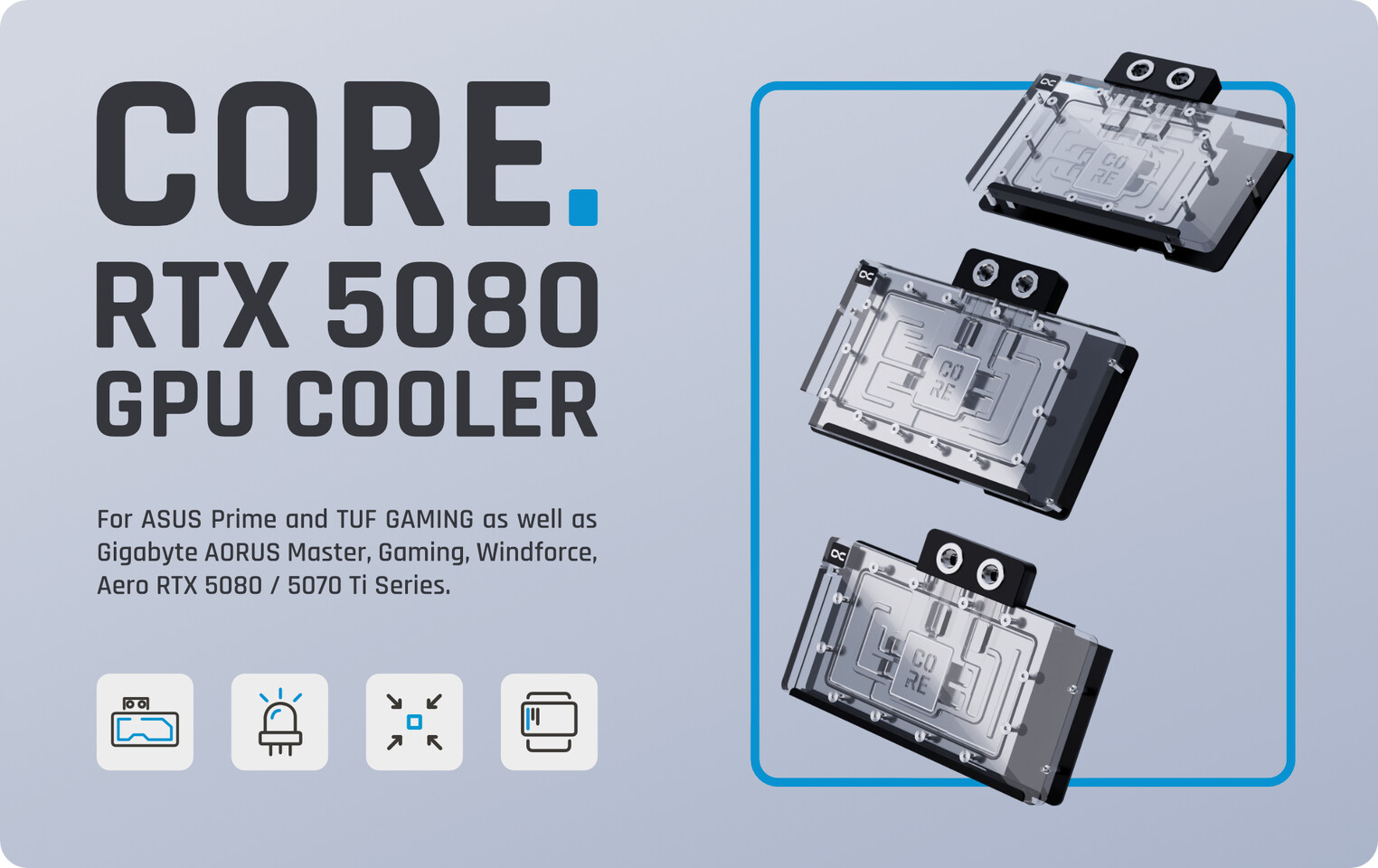
Alphacool Unveils New Core GeForce RTX 5080 GPU Water Block For ASUS and Gigabyte Graphics Cards

Alphacool International GmbH, based in Braunschweig, has been a pioneer in PC water cooling technology for over 20 years. With one of the most comprehensive product portfolios in the industry and over 20 years of experience, Alphacool is now expanding its portfolio with the new Core GeForce RTX 5080 GPU water cooler with Backplate for the ASUS Prime and TUF Gaming graphics cards as well as the Gigabyte AORUS Master, Gaming, Windforce and Aero graphics cards.

The GPU water coolers have been completely redesigned. Precise adjustments to the spacing between the cooler and the PCB, along with optimized water flow simulations and extensive practical testing, have resulted in significant improvements to the cooler base and jetplate. These enhancements ensure maximum cooling performance for the newest NVIDIA GeForce RTX generation. The GPU water coolers feature a precisely machined copper base with high-quality chrome plating for exceptional durability and a smooth surface. The design is further complemented by robust brass fittings with a nylon cover, ensuring maximum safety and reliability.

NVIDIA GeForce Hotfix Driver v576.66 Fixes Game Crashes

NVIDIA has just released its latest Hotfix for the GeForce display driver, version 576.66, which brings a heap of valuable fixes for gamers and RTX 50 series users. This update resolves unexpected crashes during gameplay in Dune: Awakening [5273568] and EA Sports FC 25 [5251937]. On RTX 50 series GPUs, Dragon's Dogma 2 no longer suffers from distracting shadow flicker [5252205], and web browser video playback is now free from brief red/green flash corruption [5241341]. Additionally, Clair Obscur: Expedition 33 has been stabilized to eliminate in-game crashes [5283401], ensuring a smoother and more reliable experience.

As NVIDIA notes, GeForce Hotfix drivers are lightweight beta releases that bundle a few targeted fixes chosen from user feedback and feasibility, allowing you to receive critical updates faster rather than waiting for the next full WHQL-certified driver. These hotfixes undergo an abbreviated QA process and are provided as-is through NVIDIA Customer Care. However, rest assured that every fix will be merged into the next official driver release. If you experience these issues, update to Hotfix now or wait for the WHQL driver, which will be available for download on TechPowerUp's download section.

CD Projekt Red Believes Cyberpunk 2077 Switch 2 Version is Superior to Past-gen Builds

Charles Tremblay, CD Projekt RED's Technology Vice President, has been fielding questions from members of the press—regarding the forthcoming Switch 2 version of Cyberpunk 2077: Ultimate Edition. Large portions of the company's Polish and North American/Canadian teams are concentrating on next-gen projects (respectively, Witcher 4 and "Cyberpunk 2"), but a smaller group has worked on porting a current sci-fi title onto Nintendo's NVIDIA Custom SoC-powered hybrid console. Despite arriving almost five years ago, Cyberpunk 2077 has remained a firm favorite—especially as a gauge of hardware capabilities, across PC and home console platforms. Since then, the developer's in-house REDengine has been dropped from primary activities. Epic's ubiquitous Unreal Engine 5 will serve as the technological foundation for future CD Projekt RED IPs.

In an interview conducted by IGN, Tremblay outlined the challenges his team faced when dealing with REDengine 4 and Switch 2: "we have very key people in here that know exactly how to make Cyberpunk run. Cyberpunk is built for x86 with old PC architecture. So, from the beginning this was completely different. Lots of changes had to be done at the engine level, all the shaders (are in a) different language. We had to convert everything, some HLSL to GLSL. (The Switch 2 utilizes) a very, very different architecture." In another Q&A session (with NintendoLife), the Tech VP mentioned a roping in of external assistance (from Hungary and Japan): "all development is being done in-house, with support from Yigsoft when it comes to incorporating the Nintendo Switch 2 specific features, and support from Nintendo when it comes to overcoming all the fun challenges that come with creating for new hardware."

Bootleg GeForce "RTX 5090 32G D7 Turbo" Cards with Blower-style Coolers Spotted on Goofish

Around mid-April, an unusual custom GeForce RTX 5090D design received international news coverage. Under normal circumstances, NVIDIA's board partners have not equipped modern gaming graphics cards with blower-style cooling solutions—typically, this type of treatment is reserved for workstation-grade products (operating at lower TDPs). Team Green's GB202 "Blackwell" GPU is in high demand, due to its AI-crunching prowess—even in slightly nerfed form. Smaller Chinese AI firms and well-heeled hobbyists seemed to be snapping up sanction-adjusted flagship gaming GPUs that are/were coupled with very unofficial blower-type coolers. A month and a half later, Olrak29 has placed a spotlight on a curious batch of bootleg-esque "RTX 5090 32G D7 Turbo" models. As implied by this identifier, these offerings seem to leverage the unpasteurized GeForce RTX 5090 (non-D) GPU.

Photo evidence was scraped from Goofish; a second-hand trading platform owned and operated by Alibaba. As of last month, industry whispers suggested another downgrade of the Chinese market-exclusive GeForce RTX 5090D design—following the complete cutoff of GB202 die shipments into the region. Given current global tensions and export restrictions, NVIDIA and Leadtek's Blackwell PRO W card series faces an uncertain future in China. The Goofish photo uploads indicate an impressive volume of unbranded "RTX 5090 32G D7 Turbo" stock. Stacks of boxes in the background are labelled with "NVIDIA RTX 4090 24G AIB BLOWER" or "NVIDIA RTX 4070 12G AIB BLOWER" stickers—perhaps as diversion tactics. According to VideoCardz and Tom's Hardware, Team Green is not expected to play detective—the North American corporation will probably not provide in-depth comments about elaborate "GPU smuggling" channels.

NVIDIA's Arm-Based Gaming SoC to Debut in Alienware Laptops

NVIDIA plans to introduce its first Arm-based "N1/N1x" gaming SoC in Dell's Alienware laptops later this year or early 2026, according to Taiwanese reports. The SoC is being developed with MediaTek, combining an Arm-derived CPU core and NVIDIA's Blackwell GPU architecture. Early rumors suggest that NVIDIA's new SoC will operate within an 80 W to 120 W power range, positioning it among existing high-performance laptop chips. When Qualcomm entered the Arm-based laptop design market with its Snapdragon X-series, it faced challenges because many titles required emulation through Microsoft's Prism framework, leading to compatibility issues and lower frame rates on Arm-based Windows devices. NVIDIA plans to work closely with Microsoft and game developers to ensure that Arm compatibility is present from day one, so every Arm SoC maker will benefit.

Rumors of an Arm-centric NVIDIA chip first appeared in 2023, and recent leaks suggest an engineering prototype already exists. During an earnings presentation earlier this year, NVIDIA CEO Jensen Huang announced that the company plans to integrate Arm CPU blocks into AI-oriented hardware, specifically mentioning the Digits compute system. Dell's CEO, Michael Dell, also hinted at a future AI-capable PC collaboration with NVIDIA, fueling speculation that Alienware will be the first to use the new chip. Beyond gaming, the partnership with MediaTek could lead to broader Arm solutions for both desktops and mobile devices. MediaTek is reportedly working on its own Arm-based PC processors, and AMD is exploring Arm architectures for future Surface devices. NVIDIA's entry into this space could turn Dell's Alienware laptops into a practical testbed for high-performance Arm technology in a market long dominated by x86 workforce.

NVIDIA on AI Factories: The More You Buy, the More You Make

How NVIDIA's AI factory platform balances maximum performance and minimum latency, optimizing AI inference to power the next industrial revolution. When we prompt generative AI to answer a question or create an image, large language models generate tokens of intelligence that combine to provide the result. One prompt. One set of tokens for the answer. This is called AI inference. Agentic AI uses reasoning to complete tasks. AI agents aren't just providing one-shot answers. They break tasks down into a series of steps, each one a different inference technique. One prompt. Many sets of tokens to complete the job.

The engines of AI inference are called AI factories—massive infrastructures that serve AI to millions of users at once. AI factories generate AI tokens. Their product is intelligence. In the AI era, this intelligence grows revenue and profits. Growing revenue over time depends on how efficient the AI factory can be as it scales. AI factories are the machines of the next industrial revolution.

ASUS Announces TUF Gaming Series Five Monitor Range

ASUS today announced TUF Gaming Series Five monitors. This latest gaming monitor range offers over 20 models to choose from and features varied specifications to meet different user needs. The competitively-priced Series Five monitors deliver five-star gaming experiences by offering upgrades in five key aspects: Speed boost enables up to 300 Hz refresh rates and 0.3 ms response; ultrasmooth gameplay is enabled via Adaptive Sync technology; vivid colors are delivered with up to 95% DCI-P3 gamut; Gaming AI features offer a competitive edge; and easier control is offered thanks to DisplayWidget Center software.

The flagship TUF Series Five VG27AQML5A boasts a 300 Hz refresh rate and 0.3 ms response time, making it ideal for the most competitive gamers; alternately, VG34WQML5A offers a 250 Hz refresh rate (OC) and 0.5 ms response for ultra-immersive gaming experiences.

Microsoft's Agility SDK Update Brings Shader Execution Reordering, Opacity Micromaps, and Tiled Resource Tier 4 Support

Microsoft has quietly rolled out two updates to its DirectX Agility SDK, and developers are already finding reasons to celebrate. The 1.717-preview release brings Shader Execution Reordering (SER) and Cooperative Vectors to the table, while the 1.616-retail update introduces Opacity Micromaps (OMM) and D3D12 Tiled Resource Tier 4 support. Together, they promise smoother and more efficient ray tracing, as well as improved resource handling. In 1.717-preview, the arrival of Cooperative Vectors means that vector and matrix operations, essential for AI-driven effects, now enjoy dedicated hardware acceleration. Instead of performing complex calculations on the CPU, developers can offload these tasks to the GPU, potentially unlocking richer neural rendering techniques in real time. Additionally, SER provides ray tracing pipelines with a helpful feature: it reorganizes the order in which shader threads execute, reducing wasted cycles caused by thread divergence.

Early internal tests show up to a 2× performance boost in path-traced scenes when SER is enabled. The preview also updates Direct3D's video encoder with a HEVC Reference List extension for longer-term reference frames, a two-pass low-resolution first encode, and built-in PSNR metrics so creators can see exactly how crisp their output really is. The 1.616-retail SDK centers on Opacity Micromaps, a feature designed to handle alpha-tested geometry, such as foliage or chain-link fences, without firing off expensive AnyHit shader calls. With OMM, supported GPUs intelligently skip unnecessary work, and Microsoft's numbers suggest a speedup of as much as 2.3x in path-traced scenes. For example, one NVIDIA demo increased from approximately 55 FPS to around 90 FPS simply by enabling OMM. Today, only NVIDIA's RTX cards have driver-level support for these micromaps, but AMD and Intel are preparing their own updates for the coming months. That same 1.616-retail release also unlocks D3D12 Tiled Resource Tier 4, finally lifting the restriction on packed mipmaps in texture arrays. This means finer-grained texture streaming, less wasted memory, and more creative freedom in writing shader code. NVIDIA has confirmed its support for this tier, Intel's drivers are already shipping, and AMD is aiming to release compatible drivers by early June 2025.

GALAX Readying Mirror Finish Backplates for GeForce RTX 50-series Boomstar Cards

GALAX's modular "Boomstar" series of GeForce RTX 50-series cards are not well known in the West, but a little bit of global coverage trickled out last month. The Chinese manufacturer often releases regional exclusives, and its latest LUNA (white) and NOX (black) options are prime examples. Lucky owners can attach/detach Boomstar shrouds and cooling fans via a convenient and fully magnetic system. According to their latest teaser/promo material, GALAX seems to be preparing another modular part. A snazzy mirror finish backplate design has turned up online—as pointed out by VideoCardz. So far, published renders show only white examples sporting reflective back surfaces. Current LUNA and NOX SKUs cover GeForce RTX 5080, RTX 5070 Ti, and RTX 5070 GPU tiers. Unfortunately, NVIDIA's slightly nerfed flagship "Blackwell" chip is no longer available in China—another GeForce RTX 5090D downgrade is pending. Up until recently, GALAX was promoting an impressive Hall of Fame record-breaking lineup. Looking at the other end of Team Green's "Blackwell" gaming GPU spectrum, a GeForce RTX 5060 Ti Boomstar model seems to be in the pipeline.

Doudna Supercomputer Will be Powered by NVIDIA's Next-gen Vera Rubin Platform

Ready for a front-row seat to the next scientific revolution? That's the idea behind Doudna—a groundbreaking supercomputer announced today at Lawrence Berkeley National Laboratory in Berkeley, California. The system represents a major national investment in advancing U.S. high-performance computing (HPC) leadership, ensuring U.S. researchers have access to cutting-edge tools to address global challenges. "It will advance scientific discovery from chemistry to physics to biology and all powered by—unleashing this power—of artificial intelligence," U.S. Energy Secretary Chris Wright (pictured above) said at today's event.

Also known as NERSC-10, Doudna is named for Nobel laureate and CRISPR pioneer Jennifer Doudna. The next-generation system announced today is designed not just for speed but for impact. Powered by Dell Technologies infrastructure with the NVIDIA Vera Rubin architecture, and set to launch in 2026, Doudna is tailored for real-time discovery across the U.S. Department of Energy's most urgent scientific missions. It's poised to catapult American researchers to the forefront of critical scientific breakthroughs, fostering innovation and securing the nation's competitive edge in key technological fields.

Client Interest in Samsung Foundry Reportedly Buoyed by Nintendo Switch 2 SoC Production Deal

The Nintendo Switch 2 hybrid console is due to launch globally next Wednesday (June 4). The highly anticipated next-gen handheld is powered by a custom NVIDIA processor. To the surprise of many industry watchdogs, both parties have semi-recently disclosed a couple of technical details regarding their fruitful hardware collaboration. Historically, Nintendo has guarded many aspects of its past generation hardware. Throughout the 2020s, data miners and leakers have unearthed plenty of pre-release information—leading to theories about the Switch 2 chipset's origins. During the Switch 1 era, TSMC was the chosen manufacturing partner. NVIDIA's off-the-shelf Tegra X1 mobile SoC powered the first wave of Nintendo Switch (2017) devices, in 20 nm form. A 2019 revision resulted in Switch Lite and (refreshed) Switch models being equipped with a more efficient 16 nm solution, also present within 2023's premium OLED variant.

Since then, Switch 2's alleged NVIDIA Tegra T239 SoC was linked to a Samsung 8 nm node process. Earlier this month, extremely brave Chinese leakers produced "full die shot" evidence of South Korean foundry origins. Bloomberg insider news articles have implied that Samsung Semi's mature 8 nm FinFET node is better suited—rather than an equivalent TSMC product—for the Switch 2's custom NVIDIA chipset. Unnamed sources have mentioned critical factors; namely stable production and process compatibility. Industry moles reckon that Samsung leadership is actively and aggressively pushing for a longer Switch 2 chipset production deal. Renewed terms could include a future die shrink; pre-launch analysis indicates a sizeable 207 mm² footprint. Beyond foundry biz negotiations, additional murmurs suggest company executives dangling an OLED panel supply agreement. Industry experts have viewed Samsung's key entry—into the gaming console chip market—as a seismic development. A DigiTimes article dives into a so-called "tripartite cooperation"—involving Nintendo, NVIDIA, and the South Korean semiconductor giant. The Samsung Foundry has floundered and struggled in recent times, but is keen to catch up with its arch rival. Fresh rumors have AMD and Sony considering Samsung's chip making channels; possibly with futuristic PlayStation hardware in mind.

AnythingLLM App Best Experienced on NVIDIA RTX AI PCs

Large language models (LLMs), trained on datasets with billions of tokens, can generate high-quality content. They're the backbone for many of the most popular AI applications, including chatbots, assistants, code generators and much more. One of today's most accessible ways to work with LLMs is with AnythingLLM, a desktop app built for enthusiasts who want an all-in-one, privacy-focused AI assistant directly on their PC. With new support for NVIDIA NIM microservices on NVIDIA GeForce RTX and NVIDIA RTX PRO GPUs, AnythingLLM users can now get even faster performance for more responsive local AI workflows.

What Is AnythingLLM?
AnythingLLM is an all-in-one AI application that lets users run local LLMs, retrieval-augmented generation (RAG) systems and agentic tools. It acts as a bridge between a user's preferred LLMs and their data, and enables access to tools (called skills), making it easier and more efficient to use LLMs for specific tasks.
Return to Keyword Browsing
Nov 27th, 2026 19:17 CST change timezone

New Forum Posts

Popular Reviews

TPU on YouTube

Controversial News Posts