Intel Expects 14A Node to Be Within 5% of TSMC's A14
Intel's Foundry chief, Naga Chandrasekaran, spoke with investment bank KeyBanc Capital Markets about Intel Foundry and the future trajectory of its nodes. One of the most intriguing insights is that Intel expects its 14A node to be within 5% of TSMC's A14 node, with both competing in the same sector. What this means exactly is unclear, as there are many factors by which a node is measured. These include transistor switching frequency, power efficiency, and density. The "within 5%" figure could imply a 5% advantage, a 5% disadvantage, or a mix of both, so the technical specifics remain uncertain. Intel's recent nodes, like the shipping 18A, are proving to be efficient and high-performing, but TSMC's nodes are also strong, with both companies continuing development.
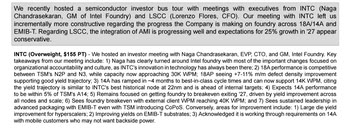
Intel plans to start 14A node risk production in the second half of 2027, with high-volume production expected in 2028. The company has processed tens of thousands of 14A wafers in pilot production runs and is now working on yield improvements and minor node adjustments before beginning risk production next year. The 14A node is designed to offer a 15-20% performance improvement at the same power level compared to Intel 18A, or it can be optimized for a 25-35% power reduction at the same performance level. This will be accompanied by up to a 30% improvement in chip density compared to Intel 18A, though it is unclear if this refers to logic or SRAM scaling, as the latter has been challenging for the industry.
Intel plans to start 14A node risk production in the second half of 2027, with high-volume production expected in 2028. The company has processed tens of thousands of 14A wafers in pilot production runs and is now working on yield improvements and minor node adjustments before beginning risk production next year. The 14A node is designed to offer a 15-20% performance improvement at the same power level compared to Intel 18A, or it can be optimized for a 25-35% power reduction at the same performance level. This will be accompanied by up to a 30% improvement in chip density compared to Intel 18A, though it is unclear if this refers to logic or SRAM scaling, as the latter has been challenging for the industry.