News Posts matching #Phase-Change

Return to Keyword Browsing

Noctua Prototype Phase-Change AIO and Auxiliary Fan

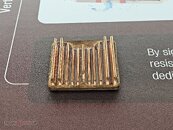
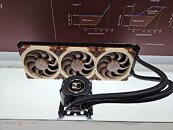
Noctua at the 2026 Computex showcased its prototype all-in-one liquid CPU cooler featuring a coolant phase-change mechanism. The pump-block has been designed entirely in house by Noctua, and not licensed by a third party. Its design involves a special treatment on the pump-block that adds layers of porous sintered copper particles along the surface of the microfins that dissipate heat pulled from the CPU to the coolant. This enhances vaporization of the coolant to better dissipate heat along the coolant volume as it's being circulated to the radiator.

Sticking with Noctua AIOs, the company showed us the NL-ACF1, an auxiliary fan for AIO CLCs. While most other brands are putting screens on CPU coolers, Noctua made it easy to upgrade its AIOs with a fan sitting right on top of the pump-block, with a conical frame designed to spread airflow onto components surrounding the CPU socket, such as CPU VRM and memory. Installing the fan is as easy as slotting it in place on top of the pump-block, no tools required. Three contact points below the fan connect it to the fan-controller inside the block that synchronizes speed with the radiator fans.
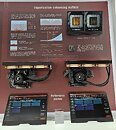
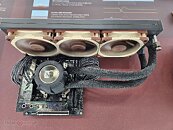
Pictures of the NL-ACF1 follow.

Noctua Teases Computex Launch for Phase-Change AIO for Silent Builds

Noctua previously showed off an early prototype of a thermosiphon AIO cooler at Computex 2024, in which it would use a similar design to a traditional AIO but omit the pump that is usually to blame for the low humming noise emitted from some PC builds, even at low fan speeds. The brand recently shared a short post on X with the caption "Vaporisation... enhanced," with Computex 2026 hashtag, suggesting that the thermosiphon will launch at Computex 2026.

The benefits of a thermosiphon extend beyond just noise reduction, since the lack of moving parts and a pump theoretically make them maintenance-free. Noctua has also once again teased its previously announced partnership with Asetek for a more conventional AIO design, which it will seemingly launch alongside the thermosiphon at Computex 2026.

ASUS TUF Gaming Discusses GeForce RTX 5090 & 5080 Feature Sets

We build our TUF Gaming components for users who want an emphasis on substance, meaning you're paying for pure performance when you go TUF. That focus on function is where the TUF Gaming GeForce RTX 5090 and TUF Gaming GeForce RTX 5080 graphics cards excel, providing you with next-gen graphics capabilities as well as high-performance thermal solutions that'll hold up under 4K AAA gaming pressure. If you've been waiting to upgrade your rig and want to treat yourself to a premium power bump, now's the time to pull the trigger. You're in for a truly substantial generational leap with these high-end components featuring the power of NVIDIA's latest GPU architecture alongside the sophistication of our latest graphics card designs.

Next-gen tech for tomorrow's heavyweight games
The GeForce RTX 5090 and 5080 comprise the top of the power stack for NVIDIA's 50 Series GPUs, so when you invest in either a TUF Gaming GeForce RTX 5090 or 5080 graphics card, you're setting yourself up for years to come. The 50 Series is powered by NVIDIA's Blackwell architecture, meaning these GPUs feature 4th generation RT cores to give gamers the best ray tracing performance yet. They also pack neural shaders, which compress textures to cut down on memory usage and produce incredible real-time visuals. And NVIDIA has ensured its 50 Series is equipped for neural processing via a built-in AI management processor, so you'll get an optimal experience when harnessing the power of NVIDIA DLSS 4. Powered by 5th generation Tensor Cores, DLSS 4 uses a Multi Frame Generation solution to boost your framerate to new heights.

Thermaltake Xpressar Portable Phase-Change Cooling Systems at Cebit 2009

Thermaltake unveiled today that during the upcoming Cebit 2009 show, it will officially launch its brand new Xpressar series of portable phase-change cooling systems. Although this method of cooling was used long time ago by names like Asetek, Prometeia and recently even OCZ Technology, it was still too expensive, risky for 24/7 operation, and adopted only by extreme overclockers and people that don't mind to spend $1000 for a cooling experiment. Thermaltake's Xpressar micro vapor-compression refrigeration systems, are said to be widely availabe, much more portable, easy to use, not that expensive and still a lot more efficient than current top water coolers. At Cebit Thermaltake will introduce one final product, the RCS100 for internal use in computer cases, and one prototype - the next generation RCB400 series with a micro compressor that fits in two 5.25-inch slots and offers an LCD screen for the system's vital readings (temp, fan speed etc.). The second system will also have the ability to cool video cards when released. Expect much more information after the start of Cebit 2009 - March 3-8, 2009.

Thermaltake Reveals the XPRESSAR RCS100 Phase-Change Processor Cooling

Back in March 2008, Thermaltake introduced its first phase change cooling prototype. At the time, we were able to reveal only a few pictures, without knowing what was to come. Today Thermaltake said that after four years of research, the company's first DC inverter type micro refrigeration cooling system is finally ready to hit the market. The so-called Thermaltake XPRESSAR utilizes cyclic refrigeration method based on the vapor-compression refrigeration, to take away the heat produced by processors. Vapor-compression refrigeration systems use a circulating liquid refrigerant as cooling medium which absorbs and removes heat from the space to be cooled and subsequently reject that heat elsewhere. All such systems have four components: a compressor, a condenser, an expansion valve, and an evaporator. For now the XPRESSAR phase-change cooling will be paired with a Xaser VI case and sold as XPRESSAR RCS100. The total weight of both parts will equal to 22.2kg. Thermaltake ensures that such a system will result in 20ºC better temps than most liquid-based systems, and also be compatible with all Intel LGA775 and LGA1366 (Nehalem) processors (maybe an AMD kit will be released sometime later). More information on the XPRESSAR RCS100 can be found here. Pricing and availability are still to be announced. It's time for the reviews now.
Return to Keyword Browsing
Nov 22nd, 2026 01:28 PST change timezone

New Forum Posts

Popular Reviews

TPU on YouTube

Controversial News Posts