News Posts matching #RTX 5080

Return to Keyword Browsing

NVIDIA GeForce RTX 5090 Features 575 W TDP, RTX 5080 Carries 360 W TDP

According to two of the most accurate leakers, kopite7kimi and hongxing2020, NVIDIA's GeForce RTX 5090 and RTX 5080 will feature 575 W and 360 W TDP, respectively. Previously, rumors have pointed out that these GPU SKUs carry 600 W and 400 W TGPs, which translates into total graphics power, meaning that an entire GPU with its RAM and everything else draws a certain amount of power. However, TDP (thermal design power) is a more specific value attributed to the GPU die or the specific SKU in question. According to the latest leaks, 575 Watts are dedicated to the GB202-300-A1 GPU die in the GeForce RTX 5090, while 25 Watts are for GDDR7 memory and other components on the PCB.

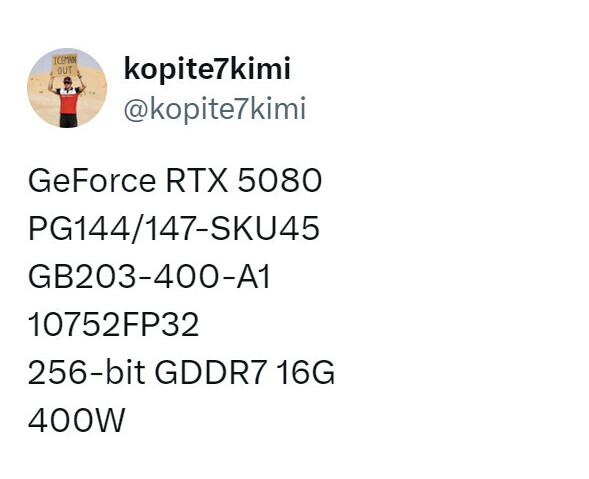
For the RTX 5080, the GB203-400-A1 chip is supposedly drawing 360 Watts of power alone, while 40 Watts are set aside for GDDR7 memory and other components in the PC. The lower-end RTX 5080 uses more power than the RTX 5090 because its GDDR7 memory modules reportedly run at 30 Gbps, while the RTX 5090 uses GDDR7 memory modules with 28 Gbps speeds. Indeed, the RTX 5090 uses more modules or higher capacity modules, but the first-generation GDDR7 memory could require more power to reach the 30 Gbps threshold. Hence, more power is set aside for that. In future GDDR7 iterations, more speed could be easily achieved without much more power.

Glimpse of NVIDIA GeForce RTX 50 Series "Blackwell" Founders Edition GPU Appears

NVIDIA uploaded a new video on its GeForce YouTube channel called "GeForce LAN 50 Missions and Rewards" that not only features the objective of its upcoming LAN party but also a teaser of one of the GeForce RTX 50 series "Blackwell" GPUs. Pictured below, NVIDIA purposely left it extremely dark to hide as much information as possible. However, we uncovered what was hiding in the dark PC enclosure thanks to some image processing. From the picture alone, we cannot determine what possible SKU this would represent. Potential candidates include the GeForce RTX 5090 or 5080, which are rumored to appear first at the CES launch event, with NVIDIA's CEO Jensen Huang taking the stage and unveiling details about the new GPU generation.

In regards to the design itself, the GPU features a two-fan configuration, meaning that the founder's edition has undergone a redesign from the traditional push/pull cooler design. If this is only a render, time will tell. However, we look forward to seeing more leaks, details, and hints just like NVIDIA left.

MSI GeForce RTX 5080 Gaming Trio "Blackwell" Box Leaked

Here are some of the first pictures of the MSI GeForce RTX 5080 Gaming Trio "Blackwell" graphics card. The box art provides the first look at what the actual product will look like. It remains over 2 slots thick, and is fairly long; with a trio of what look like 100 mm fans. As with all past generation Gaming X series graphics cards from MSI, this product will feature extensive RGB LED lighting, and a fairly generous factory overclock among its base and premium tiers (Gaming and Gaming X); although historically, MSI's Suprim series has had the company's highest factory tuning.

The back-side of the box lists out MSI-specific and NVIDIA "Blackwell" specific features. The RTX 50-series will see MSI debut the new StormForce fan, which appears to have greater impeller depth than the previous-generation TorX 3.0 fan. The impellers are webbed for axial airflow, the fan blades have ridges. The box also says that the cooler features a nickel-plated copper base-plate, which makes contact with the GPU, which probably has mirror finish. This baseplate will be backed by Core Pipes, which are the cooler's copper heatpipes made square near the baseplate for better contact with it. Lastly, the card comes with a metal backplate—no surprises there. NVIDIA is looking to debut the GeForce RTX 5080 on January 21.

-- images removed at request of MSI --

NVIDIA Plans GeForce RTX 5080 "Blackwell" Availability on January 21, Right After CES Announcement

Hong Kong tech media HKEPC report indicates that NVIDIA's GeForce RTX 5080 graphics card will launch on January 21, 2025. The release follows a planned announcement event on January 6, where CEO Jensen Huang will present the new "Blackwell" architecture. Anticipated specifications based on prior rumors point to RTX 5080 using GB203-400-A1 chip, containing 10,752 CUDA cores across 84 SM. The card maintains 16 GB of memory but upgrades to GDDR7 technology running at 30 Gbps, while other cards in the series are expected to use 28 Gbps memory. The graphics card is manufactured using TSMC's 4NP 4 nm node. This improvement in manufacturing technology, combined with architectural changes, accounts for most of the expected performance gains, as the raw CUDA core count only increased by 10% over the RTX 4080. NVIDIA is also introducing larger segmentation between its Blackwell SKUs, as the RTX 5090 has nearly double CUDA cores and double GDDR7 memory capacity.

NVIDIA is organizing a GeForce LAN event two days before the announcement, marking the return of this gathering after 13 years, so the timing is interesting. NVIDIA wants to capture gamer's hearts with 50 hours of non-stop gameplay. Meanwhile, AMD currently has no competing products announced in the high-end graphics segment, leaving NVIDIA without direct competition in this performance tier. This market situation could affect the final pricing of the RTX 5080, which will be revealed during the January keynote. While the January 21 date appears set for the RTX 5080, launch dates for other cards in the Blackwell family, including the RTX 5090 and RTX 5070 series, remain unconfirmed. NVIDIA typically releases different models in their GPU families on separate dates to manage production and distribution effectively.

NVIDIA RTX 5000 Blackwell Memory Amounts Confirmed by Pre-Built PC Maker

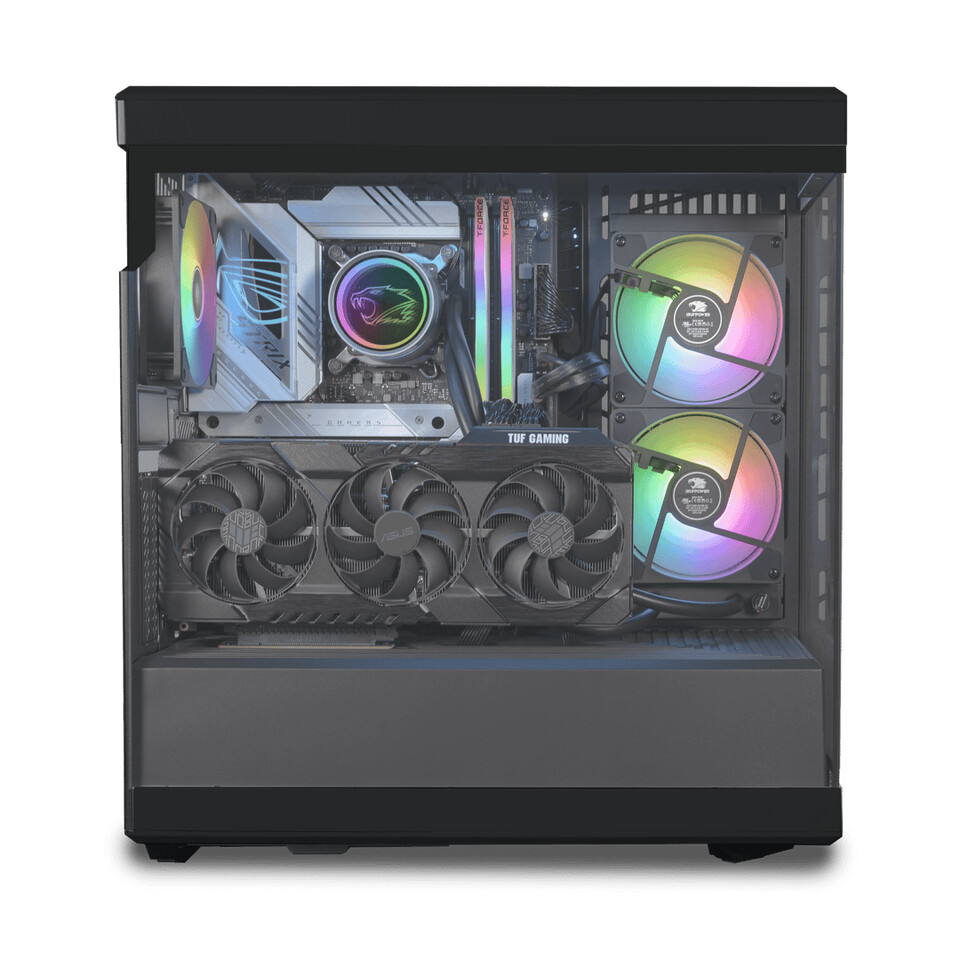
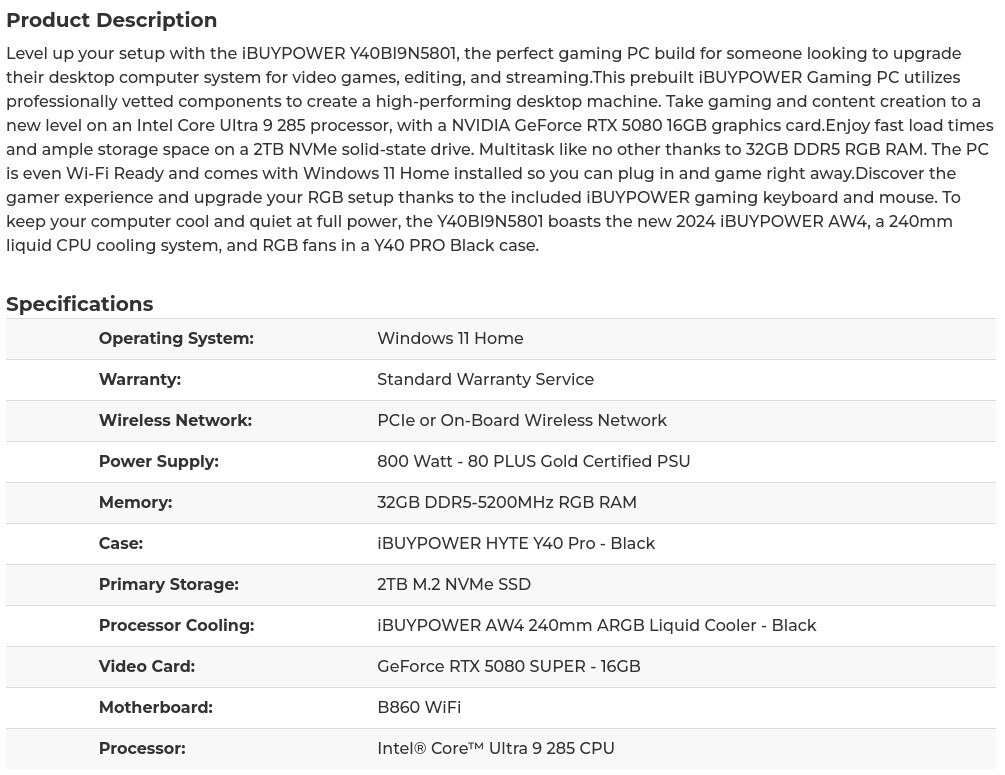
By now, it's a surprise to almost nobody that NVIDIA plans to launch its next-generation RTX 5000-series "Blackwell" gaming graphics cards at the upcoming CES 2025 event in Las Vegas in early January. Previously, leaks and rumors gave us a full run-down of expected VRAM amounts and other specifications and features for the new GPUs, but these have yet to be confirmed by NVIDIA—for obvious reasons. Now, though, it looks as though iBuyPower has jumped the gun and prematurely revealed the new specifications for its updated line-up of pre-built gaming PCs with RTX 5000-series GPUs ahead of NVIDIA's official announcement. The offending product pages have since been removed, but they both give us confirmation of the previously leaked VRAM amounts and of the expected release cadence for RTX 5000, which will reportedly see the RTX 5070 Ti and RTX 5080 launch before the RTX 5090 flagship.

On iBuyPower's now-pulled pages, the NVIDIA GeForce RTX 5080 16 GB and GeForce RTX 5070 Ti 16 GB can be seen as the GPUs powering two different upcoming Y40 pre-built gaming PCs from the system integrator. The VRAM specifications here coincide with what we have previously seen from other leaked sources. Unfortunately, while an archived version of the page for the pre-built containing the RTX 5080 appears to show the design for an ASUS TUF Gaming RTX 5080 with a triple-fan cooler, it looks like iBuyPower is using the same renders for both the 5080 and 5070Ti versions of the pre-built PCs. What's also interesting is that iBuyPower looks to be pairing the next-gen GPUs with 7000-series AMD X3D CPUs, as opposed to the newly released AMD Ryzen 9000 X3D chips that have started making their way out into the market.

Potential RTX 5090 and RTX 5080 Pricing in China Leaks

What we've all been waiting for, might just have appeared and what we're talking about is of course the pricing of NVIDIA's upcoming graphics cards. @wxnod has posted a single screenshot on X/Twitter of what could be the MSRP of the RTX 5090 and RTX 5080 in China. The MSRP of the RTX 4080 was 9,499 RMB and the RTX 5080 appears to be not that much higher, at 9,999 RMB, but this still equates to about US$1,370, although do note that there's 13 percent sales tax/VAT in China.

Now as for the RTX 5090, things won't be as rosy. The RTX 4090 had an MSRP of 12,999 RMB in China and the RTX 5090 comes in at an insane 18,999 RMB or US$2,600. That's a price hike of a not insignificant 46 percent over the RTX 4090 and this might make it the most expensive consumer graphics card ever released. We'd suggest taking these prices with a helping of NaCl just to be on the safe side. The cards are expected to be available some time in January according to the screenshot.

Update 15:34 UTC: A second picture was posted in the same thread on X/Twitter that shows the expected launch months of the lower-tier RTX 5000-series cards as well and it appears to be taken from a video.

Alleged GALAX GeForce RTX 5080 "Blackwell" Box-art Drops Big Clue About Neural Rendering

The box-art of upcoming GALAX GeForce RTX 5080 "Blackwell" graphics card has much to say about the graphics architecture, without dropping any explicit mentions. The front-face of the box features a hooded human face—nothing fancy, until you begin to pay attention to the details. Half the face is composed of triangles streaming toward the face, while the other half is composed in place by a blue stream of light, as if to denote that it's being drawn by a fundamentally different method than "triangles."

The triangles here represent classic raster 3D graphics, while the other spirit-like half denotes neural rendering. Here's where it gets interesting. Both kinds of rendering are being applied to the same frame, and so neural rendering is fundamentally different from DLSS 3 Frame Generation, a technology that draws alternate frames using optical flow, motion vectors, and AI. Neural rendering appears to be, at least from this GALAX box-art, a technology that runs in real-time, where some elements, portions, or details of a frame are rendered by a generative AI, and others by raster 3D graphics.

ASUS Teases Next-generation RTX 50-powered Gaming Laptops For CES 2025

Last week, we reported on a massive leak that gave us a glimpse at a surfeit of upcoming ROG gaming laptops from ASUS boasting Arrow Lake-HX and Strix Halo processors, along with RTX 50-series Laptop GPUs. The company has now gone ahead and officially teased its ROG Flow Z13 laptop and the ROG Strix 18 laptop, the videos for which were obtained by VideoCardz. Considering that these were just teasers, the details shared were sparse, but undoubtedly intriguing regardless.

The ROG Strix 18, will likely boast the Core Ultra 9 285HX and Core Ultra 9 275HX CPUs along with NVIDIA "Blackwell" Laptop GPUs, with up to an 175-watt RTX 5090 Laptop with 16 GB of GDDR7 VRAM. Multiple other GPU options will also be available, with the RTX 5070 Ti Laptop GPU being the entry-point as per the leaked listings. Clearly, the Strix 18 is poised to be a powerful and power-hungry desktop replacement-class laptop, along with a massive 18-inch mini LED screen with a speedy 240 Hz refresh rate. Needless to say, the G18 has no intention of being affordable.

NVIDIA RTX 5080 Laptop GPU Might Be Up to 60% Faster Than RTX 4080 Laptop

Moore's Law is Dead, a prominent YouTube channel specializing in computer hardware leaks, has revealed its expectations for the RTX 50-series Laptop GPUs. We have already reported on a massive product listing leak shedding light on almost every single "Blackwell" laptop GPU, but needless to say, more information is always welcome. According to Moore's Law is Dead, the RTX 5090 Laptop GPU, and this has been hinted at by the aforementioned prior leak, will only sport 16 GB of GDDR7 VRAM - the same as the RTX 5080 Laptop.

Moreover, his sources indicate that the RTX 5080 will drop with a 175-watt TGP and 7,680 CUDA cores, which is shockingly only a hair more than the 7,424 found in its predecessor. However, the source did state that the RTX 5080 will be around 40 to 60% faster than the RTX 4080, which is a massive generational leap in performance. It is not clear at this point how this number was arrived at, but it sure does seem rather utopian. Yet another source has also indicated that an RTX 5090 Laptop card with a whopping 24 GB of VRAM is also in the works which might launch down the line, but there is little else to be said about it. As MLID notes, NVIDIA has very little to no competition in the high-end laptop segment, which inevitably makes things worse for the end-user.

RTX 5090, RTX 5080 Laptop GPUs Leak Alongside ASUS ROG Gaming Laptops

It is barely a surprise that the desktop RTX 50X0-series cards will be accompanied by laptop variants soon after their launch. And as such, multiple listings of upcoming gaming laptops have appeared on the internet. The information is rather intriguing, to say the least. The leaked listings indicate that both AMD and Intel will have products ready to join forces with Blackwell, with Intel's Arrow Lake-HX and, rather shockingly, Ryzen 7000HX-series from Team Red - much to the chagrin of those expecting Ryzen 9000HX to drop sooner. The listings also reveal some other specifications, such as the display, but there is nothing notable there - it's the typical spread of mini LED and OLED panels.

Among the leaked laptops, we have the ROG Strix Scar 18, which will pack up to a Core Ultra 9 285HX "Arrow Lake-HX" CPU, along with either an RTX 5080, or an RTX 5090 GPU. Disappointingly, it appears that the RTX 5090 will be limited to only 16 GB of VRAM, which is half that of its desktop counterpart. The RTX 5080 will also be available with 16 GB of VRAM, which certainly makes us sigh in relief. A lower-tier laptop, namely the Strix 16, has also been leaked, packing either an RTX 5070 Ti, or an RTX 5060 GPU with 12 GB and 8 GB of VRAM respectively. The laptops further down will also have the entry-level RTX 5050, with 8 GB of VRAM as well. Of course, all of this is on the new GDDR7 spec. The full-resolution image of the leaked listings can be found here.

Acer Leaks GeForce RTX 5090 and RTX 5080 GPU, Memory Sizes Confirmed

Acer has jumped the gun and listed its ACER Predator Orion 7000 systems with the upcoming NVIDIA RTX 50 series graphics cards, namely the GeForce RTX 5080 and the GeForce RTX 5090. In addition, the listing confirms that the GeForce RTX 5080 will come with 16 GB of GDDR7 memory, while the GeForce RTX 5090 will get 32 GB of GDDR7 memory.

The ACER Predator Orion 7000 gaming PC was announced back in September, together with Intel's Core Ultra 200 series, and it does not come as a surprise that this high-end pre-built system will now be getting NVIDIA's new GeForce RTX 50 series graphics cards. In case you missed previous rumors, the GeForce RTX 5080 is expected to use the GB203-400 GPU with 10,752 CUDA cores, and come with 16 GB of GDDR7 memory on a 256-bit memory interface. The GeForce RTX 5090, on the other hand, gets the GB202-300 GPU with 21,760 CUDA cores and packs 32 GB of GDDR7 memory.

NVIDIA GeForce RTX 5080 to Stand Out with 30 Gbps GDDR7 Memory, Other SKUs Remain on 28 Gbps

NVIDIA is preparing to unveil its "Blackwell" GeForce RTX 5080 graphics card, featuring cutting-edge GDDR7 memory technology. However, RTX 5080 is expected to be equipped with 16 GB of GDDR7 memory running at an impressive 30 Gbps. Combined with a 256-bit memory bus, this configuration will deliver approximately 960 GB/s bandwidth—a 34% improvement over its predecessor, the RTX 4080, which operates at 716.8 GB/s. While the RTX 5080 will stand as the sole card in the lineup featuring 30 Gbps memory modules, while other models in the RTX 50 series will incorporate slightly slower 28 Gbps variants. This strategic differentiation is possibly due to the massive CUDA cores gap between the rumored RTX 5080 and RTX 5090.

The flagship RTX 5090 is set to push boundaries even further, implementing a wider 512-bit memory bus that could potentially achieve bandwidth exceeding 1.7 TB/s. NVIDIA appears to be reserving larger memory configurations of 16 GB+ exclusively for this top-tier model, at least until higher-capacity GDDR7 modules become available in the market. Despite these impressive specifications, the RTX 5080's bandwidth still falls approximately 5% short of the current RTX 4090, which benefits from a physically wider bus configuration. This performance gap between the 5080 and the anticipated 5090 suggests NVIDIA is maintaining a clear hierarchy within its product stack, and we have to wait for the final launch to conclude what, how, and why of the Blackwell gaming GPUs.

NVIDIA GeForce RTX 5070 Ti Specs Leak: Same Die as RTX 5080, 300 W TDP

Recent leaks have unveiled specifications for NVIDIA's upcoming RTX 5070 Ti graphics card, suggesting an increase in power consumption. According to industry leaker Kopite7kimi, the RTX 5070 Ti will feature 8,960 CUDA cores and operate at a 300 W TDP. In a departure from previous generations, the RTX 5070 Ti will reportedly share the same GB203 die with its higher-tier sibling, the RTX 5080. This architectural decision differs from the RTX 40-series lineup, where the 4070 Ti and 4080 utilized different dies (AD104 and AD103, respectively). This shared die approach could potentially keep NVIDIA's manufacturing costs lower. Performance-wise, the RTX 5070 Ti shows promising improvements over its predecessor. The leaked specifications indicate a 16% increase in CUDA cores compared to the RTX 4070 Ti, though this advantage shrinks to 6% when measured against the RTX 4070 Ti Super.

Power consumption sees a modest 5% increase to 300 W, suggesting improved efficiency despite the enhanced capabilities. Memory configurations remain unconfirmed, but speculations about the card indicate that it could feature 16 GB of memory on a 256-bit interface, distinguishing it from the RTX 5080's rumored 24 GB configuration. The positioning across the 50-series GPU stack of this RTX 5070 Ti appears carefully calculated, with its 8,960 CUDA cores sitting approximately 20% below the RTX 5080's 10,752 cores. This larger performance gap between tiers contrasts with the previous generation's approach, potentially indicating a more defined product hierarchy in the Blackwell lineup. NVIDIA is expected to unveil its Blackwell gaming graphics cards at CES 2025, with the RTX 5090, 5080, and 5070 series leading the announcement.

NVIDIA Switches Production Capacity to RTX 50-series "Blackwell"

Q1-2025 promises to be an action-packed quarter for graphics cards, with NVIDIA introducing the bulk of its next-generation GeForce RTX 50-series "Blackwell" GPUs. The company is expected to start things off with the two enthusiast-segment SKUs, the RTX 5090 and RTX 5080, in January, followed by the RTX 5070-series in February, and rounded off nicely with the RTX 5060-series in March. This would mean hundreds of individual new graphics card SKUs from NVIDIA's board partners, which are reportedly busy winding up the final inventory deliveries of their RTX 40-series "Ada" products, and transferring this production capacity to the RTX 50-series. So, when the RTX 50-series GPU models do come out across the quarter, there's plenty of inventory to go around. Board Channels reports that on NVIDIA's end, production of nearly every AD100-series silicon has ended, except the AD107, which will continue selling for entry-mainstream GeForce RTX 40-series SKUs. The AD106 production line has stopped, as has the AD103, AD104, and AD102.

Possible NVIDIA GeForce RTX 5080 Laptop GPU Pictured

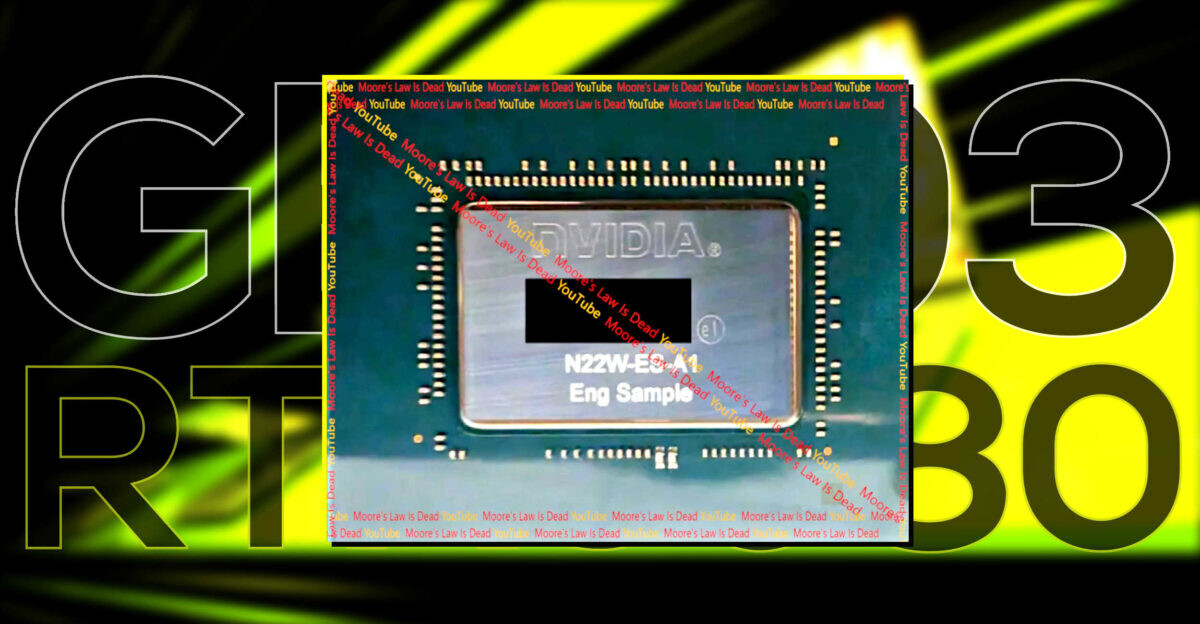
Could this be the first picture of an NVIDIA GeForce RTX 5080 Laptop GPU? This picture, coupled with a specs sheet by notebook OEM Clevo, seems to suggest so, thanks to a new video by Moore's Law is Dead. The chip is noticeably more rectangular than the Ada "AD104," and is labelled N22W-ES-A1. It is an engineering sample. Cross-referencing "N22W" with the Clevo specs-sheet for a next-generation laptop mainboard, points to the possibility that the chip is indeed based on a next-gen silicon by NVIDIA. The board design has to undergo a significant change, due to the major change in the pin-map of the fiberglass substrate brought about by the switch to the new GDDR7 memory type.

The GeForce "Blackwell" generation comes in several GPU silicon sizes, and the RTX 5080 Laptop GPU is expected to be based on the "GB203" chip, which is expected to power the desktop RTX 5080 and possibly some SKUs in even the RTX 5070 series, such as the "RTX 5070 Ti." It is rumored to feature as many as 8,192 CUDA cores, and a 256-bit wide GDDR7 memory interface. NVIDIA is expected to unveil the GeForce "Blackwell" generation at CES 2025.

NVIDIA to Release the Bulk of its RTX 50-series in Q1-2025

The first quarter of 2025 (January thru March) will see back-to-back launches of next-generation GeForce RTX 50-series "Blackwell" graphics card, according to the latest rumors. NVIDIA CEO Jensen Huang is confirmed to take center stage for the 2025 International CES keynote address, where he is widely expected to kick off the GeForce "Blackwell" gaming GPU generation. CES is expected to see NVIDIA launch its flagship GeForce RTX 5090 (RTX 4090-successor SKU), and its next-best part, the GeForce RTX 5080 (RTX 4080 successor).

February 2025 is expected to see the company debut the RTX 5070, and possibly the RTX 5070 Ti, if there is such a SKU. The RTX 5070 succeeds a long line of extremely successful SKUs that tended to sell in large volumes. Perhaps the most important launches of the generation will come in March 2025, when the company is expected to debut the RTX 5060 and RTX 5060 Ti, which succeed the current RTX 4060 and RTX 4060 Ti, respectively. The xx60 tier tends to be the bestselling class of gaming GPUs in any generation. In all, it's expected that NVIDIA will release six new SKUs within Q1, and you can expect over a hundred graphics card reviews from TechPowerUp in Q1.

NVIDIA Tunes GeForce RTX 5080 GDDR7 Memory to 32 Gbps, RTX 5070 Launches at CES

NVIDIA is gearing up for an exciting showcase at CES 2025, where its CEO, Jensen Huang, will take the stage and talk about, hopefully, future "Blackwell" products. According to Wccftech's sources, the anticipated GeForce RTX 5090, RTX 5080, and RTX 5070 graphics cards should arrive at CES 2025 in January. The flagship RTX 5090 is rumored to come equipped with 32 GB of GDDR7 memory running at 28 Gbps. Meanwhile, the RTX 5080 looks very interesting with reports of its impressive 16 GB of GDDR7 memory running at 32 Gbps. This advancement comes after we previously believed that the RTX 5080 model is going to feature 28 Gbps GDDR7 memory. However, the newest rumors suggest that we are in for a surprise, as the massive gap between RTX 5090 and RTX 5080 compute cores will be filled... with a faster memory.

The more budget-friendly RTX 5070 is also set for a CES debut, featuring 12 GB of memory. This card aims to deliver solid performance for gamers who want high-quality graphics without breaking the bank, targeting the mid-range segment. We are very curious about pricing of these models and how they would fit in the current market. As anticipation builds for CES 2025, we are eager to see how these innovations will impact gaming experiences and creative workflows in the coming year. Stay tuned for more updates as the event approaches!

NVIDIA GeForce RTX 5090 and RTX 5080 Specifications Surface, Showing Larger SKU Segmentation

Thanks to the renowned NVIDIA hardware leaker kopite7Kimi on X, we are getting information about the final versions of NVIDIA's first upcoming wave of GeForce RTX 50 series "Blackwell" graphics cards. The two leaked GPUs are the GeForce RTX 5090 and RTX 5080, which now feature a more significant gap between xx80 and xx90 SKUs. For starters, we have the highest-end GeForce RTX 5090. NVIDIA has decided to use the GB202-300-A1 die and enabled 21,760 FP32 CUDA cores on this top-end model. Accompanying the massive 170 SM GPU configuration, the RTX 5090 has 32 GB of GDDR7 memory on a 512-bit bus, with each GDDR7 die running at 28 Gbps. This translates to 1,568 GB/s memory bandwidth. All of this is confined to a 600 W TGP.

When it comes to the GeForce RTX 5080, NVIDIA has decided to further separate its xx80 and xx90 SKUs. The RTX 5080 has 10,752 FP32 CUDA cores paired with 16 GB of GDDR7 memory on a 256-bit bus. With GDDR7 running at 28 Gbps, the memory bandwidth is also halved at 784 GB/s. This SKU uses a GB203-400-A1 die, which is designed to run within a 400 W TGP power envelope. For reference, the RTX 4090 has 68% more CUDA cores than the RTX 4080. The rumored RTX 5090 has around 102% more CUDA cores than the rumored RTX 5080, which means that NVIDIA is separating its top SKUs even more. We are curious to see at what price point NVIDIA places its upcoming GPUs so that we can compare generational updates and the difference between xx80 and xx90 models and their widened gaps.

NVIDIA GeForce RTX 5090 and RTX 5080 Reach Final Stages This Month, Chinese "D" Variant Arrives for Both SKUs

NVIDIA is on the brink of finalizing its next-generation "Blackwell" graphics cards, the GeForce RTX 5090 and RTX 5080. Sources close to BenchLife indicate that NVIDIA is targeting September for the official design specification finalization of both models. This timeline hints at a possible unveiling at CES 2025, with a market release shortly after. The RTX 5090 is rumored to boast a staggering 550 W TGP, a significant 22% increase from its predecessor, the RTX 4090. Meanwhile, the RTX 5080 is expected to draw 350 W, a more modest 9.3% bump from the current RTX 4080. Interestingly, NVIDIA appears to be developing "D" variants for both cards, which are likely tailored for the Chinese market to comply with export regulations.

Regarding raw power, the RTX 5090 is speculated to feature 24,576 CUDA cores paired with 512-bit GDDR7 memory. The RTX 5080, while less mighty, is still expected to pack a punch with 10,752 CUDA cores and 256-bit GDDR7 memory. As NVIDIA prepares to launch these powerhouses, rumors suggest the RTX 4090D may be discontinued by December 2024, paving the way for its successor. We are curious to see how the power consumption is handled and if these cards are packed efficiently within the higher power envelope. Some rumors indicate that the RTX 5090 could reach 600 watts at its peak, while RTX 5080 reaches 400 watts. However, that is just a rumor for now. As always, until NVIDIA makes an official announcement, these details should be taken with a grain of salt.
Return to Keyword Browsing
Nov 28th, 2026 06:37 CST change timezone

New Forum Posts

Popular Reviews

TPU on YouTube

Controversial News Posts