News Posts matching #RTX 5080

Return to Keyword Browsing

MODDIY Recommends Latest 12V-2X6 Cables for GeForce RTX 50-series Cards

MODDIY has swiftly updated its Help Center site with new guidelines, following recent reports of one of its older 12VHPWR cable designs having a high temperature disagreement with an NVIDIA GeForce RTX 5090 Founders Edition card and ASUS ROG Loki SFX-L power supply unit. The company's newest batch of (2025) 12V-2X6 and 12VHPWR are manufactured with the latest specifications and standards in mind, thus given the all-clear for utilization with NVIDIA's recently introduced GeForce RTX 5090 and RTX 5080 graphics cards. Any products from the 2024 production cycle (and before) are deemed safe to use with the GeForce RTX 40-series, but not "officially" valid for anything newer.

The company's renewed guidelines state: "as of 2025, the industry standard has transitioned to 12V-2X6, replacing the previous 12VHPWR standard. Our new cables incorporate significant advancements, including enhanced terminal and connector housing materials, along with thicker wires, to provide an additional safety buffer for the latest GPUs. At MODDIY, all 12VHPWR / 12V-2X6 cables purchased from 2025 onward are manufactured in accordance with the new 12V-2X6 specifications and standards, ensuring compatibility and optimal performance with the RTX50 series GPUs. Prior to 2024, the RTX50 series GPUs had not yet been introduced, and the prevailing standard was 12VHPWR. All cables produced before this period were designed and tested for use with the RTX40 series GPUs. We recommend that all users upgrade to the new 12V-2X6 cables to take full advantage of the enhanced safety and performance features offered by this new standard." They believe that their messily-named "ATX 3.1 PCIe 5.1 H++ 12V-2X6 675 W 12VHPWR 16 Pin Power Cable" premium custom tailor-made model is the best candidate for Team Green's modern generation of gaming cards.

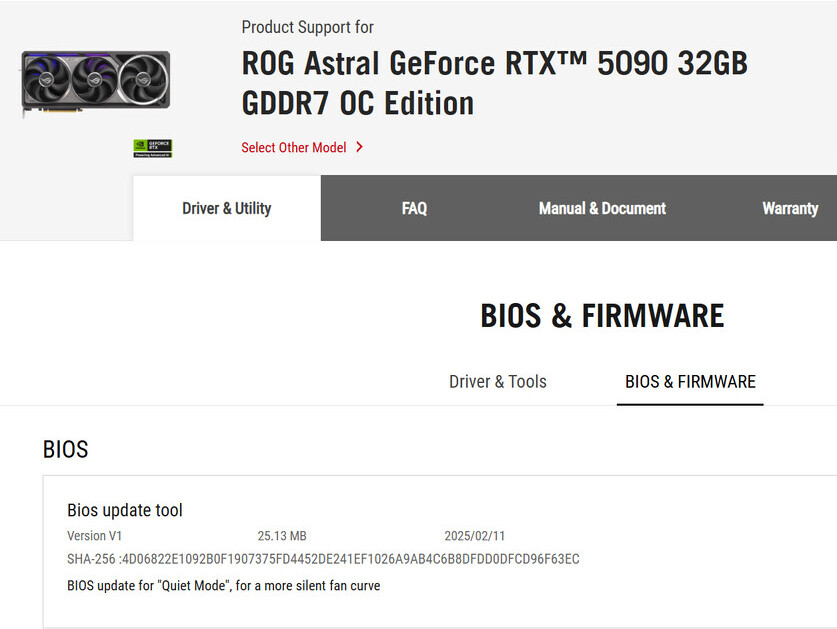
ASUS ROG Astral GeForce RTX 5090 & 5080 BIOS Update Tool Retunes Quiet Mode

ASUS has released version one of a BIOS update tool for its ultra-premium air-cooled ROG Astral graphics cards, OC and standard flavors. Yesterday's update advertises an improved "Quiet Mode," that implements a "more silent fan curve." TechPowerUp reviewed the quad-fan configured ASUS ROG Astral GeForce RTX 5090 and RTX 5080 OC Edition cards late last month. Resident GPU evaluator, W1zzard, awarded the astronomically-priced flagship model with an "Editor's Choice" badge, but simultaneously pinned on a "But Expensive" honor. The lesser (GB203-based) Astral did not receive any accolades. Both models have courted criticism for louder than expected operation; W1zzard did not enjoy listening to the Astral GeForce RTX 5090 OC Edition's collective fan concerto. "Out of the box" settings were not great, and the quiet BIOS mode did not "help much" in reducing the highest-end Astral's cacophony.

TPU's GPU guru elaborated further: "the second BIOS runs a more relaxed fan curve, but it's not much quieter and achieves 36.5 dBA with 70°C. Sure, good temperature, but isn't the point of a 'quiet' BIOS that isn't quiet, even if temperatures are higher? MSI's Suprim lineup does much better noise-wise, with temperatures that aren't that much higher." The ASUS ROG Astral RTX 5080 OC Edition seems to be a less noisy prospect, given that its cooling solution is not dealing with the largest "Blackwell" GPU die. Its sound signature was less offensive, but W1zzard reckoned that there was room for improvement. On this subject he stated: "with the default (performance) BIOS, temperatures are extremely low, but noise levels are a little bit on the high side with 36 dBA. I would have preferred a more balanced setting. Good thing that ASUS includes a secondary quiet BIOS with their card. Now the card runs whisper quiet, emitting only 26 dBA, which is highly impressive for a card in this performance segment. It is not the quietest card though, the MSI Suprim SOC is a tiny bit quieter, and it is so out of the box, without requiring a manual BIOS switch change." ASUS has seemingly absorbed initial feedback from review outlets (plus early adopters)—yesterday's update arrived just under two weeks from launch time. Watch out for possible upcoming reassessments.

GIGABYTE AORUS RTX 5080 MASTER's Optional Fourth Fan Lowers Temps by 2 °C

The new ASUS ROG Astral GeForce RTX 5090 and RTX 5080 designs have attracted a lot of attention, due to an unusual cooling configuration that includes a backplate-mounted fourth fan. At CES 2025, MSI teased onlookers with a placard adorned with a GeForce RTX 32G "Lightning" Special Edition model—featuring a "FiveFrozr" cooling solution. A traditional triple-fan setup is placed in the expected shroud location, but two additional units are integrated into the card's backplate. According to recent reports and early reviews, GIGABYTE has deployed a somewhat related system, albeit entirely optional (depending on user discretion). The Taiwanese manufacturer sent its AORUS RTX 5090 and 5080 MASTER models to market last week. These premium card designs feature the company's new "Screen Cooling Plus" system. CES press material claims that the "extra air-boosting fan" grants more airflow.

GIGABYTE's fourth fan has flown under the radar, but major hardware news outlets have just picked up on initial impressions. Singapore's HardwareZone appreciated the inclusion of an optional extra—with their AORUS RTX 5080 MASTER sample—but criticized GIGABYTE's slightly undercooked implementation. Their reviewer did not evaluate whether the modular part made any difference in terms of reducing temperatures—instead, they opined: "to further improve cooling, the card also comes bundled with a separate 120 mm RGB fan that you can place on the back of the card to pull air out—a design reminiscent of the ROG Astral RTX 5080's built-in cooling solution. It's a practical touch but not an elegant one, as it means having to deal with additional cables to tidy up since—oddly enough—the card itself does not come with a power connector for the extra fan." GLITCHED.online, a South African tech site, took GIGABYTE's AORUS RTX 5080 MASTER ICE card for a test drive—they found that the extra bit of cooling potential made a difference, but it was "almost unnoticeable." We hope that GIGABYTE will send review samples to TPU's W1zzard in the near future. Will the fourth fan make any difference on the AORUS RTX 5090 MASTER model?

NVIDIA GeForce RTX 5070 Ti AIB Card Listed Online for $1,212

The NVIDIA RTX 5070 Ti gaming GPU is expected to be available starting February 20, although whether gamers are going to be able to purchase one anytime soon is a different story entirely. That said, a recent listing on an Austrian retailer's website has revealed the pricing details for the MSI RTX 5070 Ti Gaming Trio card - a cool €1169 (inclusive of 19% VAT), roughly equivalent to $1212. Compared to NVIDIA's official pricing for the RTX 5070 Ti in most parts of the EU, a 33% increase in price can be observed. Of course, the MSI GAMING TRIO is quite a high-end card, but the price delta is quite surprising regardless. Depending on supply, the prices may further inflate, if the events of the RTX 5090 and RTX 5080 launch are repeated.

The RTX 5070 Ti is expected to boast 8690 CUDA cores paired with 16 GB of GDDR7 memory on a 256-bit bus. Recent leaks have hinted at very mediocre performance improvements, similar to what we witnessed with the RTX 5080. As of this writing, there seems to be a decent possibility that the RX 9070 and RX 9070 XT will beat the RTX 5070 family, not just in raster performance, but also in value. Of course, since NVIDIA is clearly going to fire first, gamers will not have much of a choice before RDNA 4 hits the scene. That said if the RTX 5070 series witnesses similarly atrocious availability at launch as its siblings, a lot of folks will have no option but to wait.

Official: NVIDIA GeForce RTX 50-series Laptop Pre-orders Start on February 25

Earlier today, NVIDIA happily declared that: "GeForce RTX 50-series laptop pre-orders start February 25 from OEMs." A March launch window was mentioned during the company's official unveiling of its "Blackwell" GPU architecture at CES 2025. Mobile variants of the GeForce RTX 5090, RTX 5080, and RTX 5070 Ti are expected to ship with laptops next month. GeForce RTX 5070 Mobile-equipped devices are due in April. As reported by VideoCardz, a Finnish retailer's webstore has confirmed the February 25 pre-order start date. The Gigantti.fi site lists several new ASUS ROG Zephyrus and Strix laptops; configured with the latest Intel Core Ultra 200HX or AMD "Strix Point/Fire Range" mobile APUs, and NVIDIA GeForce RTX 50-series discrete graphics solutions. The most expensive option is listed with a €5499 price point—interested buyers are looking at a spec that includes a 16-inch OLED screen, Core Ultra 9-285H processor, 32 GB LPDDR5X RAM, 1 TB M.2 PCIe SSD, and a GeForce RTX 5090 32 GB mobile GPU. At the time of writing, Gigantti's "cheapest" option is a €2999 ROG Strix 16 model; sporting a Ryzen 9 9955HX APU and GeForce RTX 5070 Ti 12 GB Mobile GPU.

NVIDIA disclosed official MSRPs during last month's CES presentation: $2199 for RTX 5090, $2199 for RTX 5080, $1599 for RTX 5070 Ti, and $1299 for the RTX 5070. Western press outlets have scouted North American online retail outlets. Tom's Hardware observed (ASUS and HP) price ranges starting at $1800. The most expensive offering came in at $4200; an ultra high-end ROG Strix Scar 18 laptop featuring a GeForce RTX 5090 Mobile GPU and an Intel Core Ultra 9 275HX CPU. Team Green's upcoming launch partners include Acer, ASUS, Dell, Gigabyte, HP, Lenovo, Mechrevo, MSI and Razer. NVIDIA seems to have extra GeForce RTX 50-series announcements in the pipeline—they recommend that potential buyers: "stay tuned for more details!"

NVIDIA Investigating Reported GeForce RTX 5090 & 5080 Black Screen & Stability Issues

Unlucky owners of problematic GeForce RTX 5090 and RTX 5080 graphics cards have posted feedback across various online community sites. Press outlets started to take notice of these documented issues soon after the launch of NVIDIA's debut wave of "Blackwell" GPUs. PC Gamer has "kept track" of reports relating to black screens and miscellaneous failures—the site published an investigative article late last week, following user feedback "hitting critical mass" across Reddit and Team Green's own forum. A request for comment was sent over to NVIDIA HQ; PC Gamer received a brief response. A company spokesperson confirmed that their team is: "investigating the reported issues with the RTX 50-series."

Several PC hardware community members have documented their troubleshooting experiences—the most common suggestion involves downshifting from a PCIe 5.0 connection to 4.0, on the PEG-16 graphics port. Unfortunately, this step did not resolve black screen issues for certain owners—a member of the buildapc subreddit explored a wide array of troubleshooting channels. They re-installed Windows 11 (23H2), adjusted BIOS settings, experimented with monitor connections, and played around with drivers. Best results were produced by connecting a single monitor to their MSI GeForce RTX 5090 GAMING TRIO OC's DisplayPort, with nothing else hooked up to the other ports (DP and HDMI). They suspect that Team Green's GPU drivers could be the source of frustrations; corroborated by a recent VideoCardz news piece. In addition, the 572.16 driver is reportedly affecting "certain GeForce RTX 40-series." A smaller number of owners have discussed a "bricking" of cards; VideoCardz believes that China-exclusive GeForce RTX 5090D models are suffering the most. Manli will be analyzing a "bricked" unit at its service center, in the near future. Colorful did not reply with a comment on the situation.

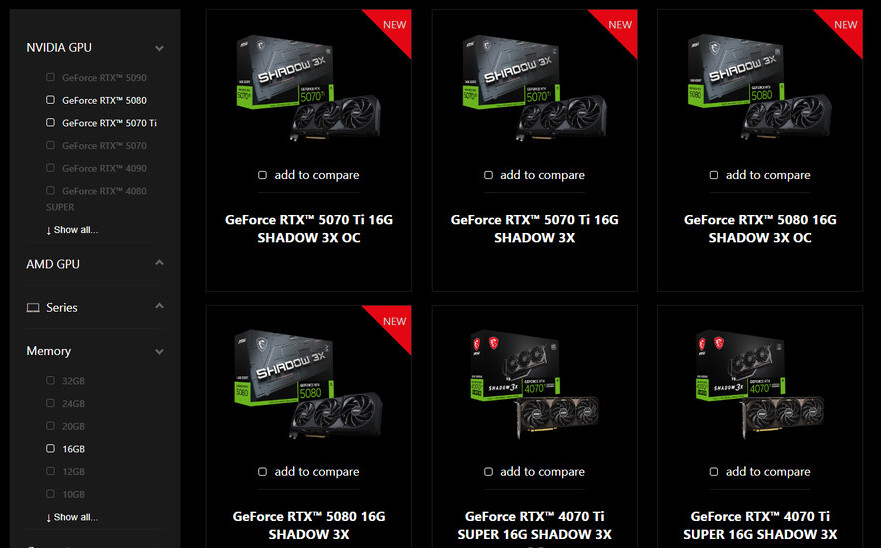
MSI Website Lists New SHADOW 3X GeForce RTX 5080 & 5070 Ti Models

MSI has, quite appropriately, introduced new SHADOW 3X graphics card models in a low-key manner. These stealth-black GeForce RTX 5080 and RTX 5070 Ti custom designs have just appeared online via official product pages. We expect to see press material published in the near future, perhaps closer to the launch of NVIDIA's next wave of Blackwell GPUs. MSI's newly discovered product pages place emphasis on the SHADOW 3X's essential features: "a performance-focused design that delivers the gaming experience players want, making it the ideal choice when upgrading or building a gaming rig." VideoCardz believes that the incoming SHADOW 3X cards will be the first to reach Western markets—previous-gen models have released as Chinese regional exclusives. The GeForce RTX 4070 Ti SUPER 16G SHADOW 3X overclocked (OC) and non-OC SKUs appear to re-use MSI's familiar VENTUS 3X design, just tinted many shades darker.

The new SHADOW 3X cards seem to utilize a fresh design, with no recycling from a similarly appointed sibling product family. MSI's latest barebones/essential tier brings a minimal set of perks: a sizable heatsink, a triple-fan cooling solution, a single 16-pin power connector and a straightforward shroud and backplate aesthetic. SHADOW 3X eschews anything RGB lighting-related. Potential buyers will not be dealing with fancy vapor chambers or liquid cooling systems. MSI will be offering overclocked editions, as well as standard models that conform to NVIDIA reference specifications. TechPowerUp's well-maintained GPU database will be updated with these new additions.

Zotac Uses Discord to Sell RTX 50 GPUs and Stop Scalpers

Zotac has come up with a new way to fight graphics card scalping by starting a "Priority Access Campaign" on their Discord server, with a Zotac employee named Bryant making the announcement. The plan is simple and has only one main goal: to help regular buyers get a real chance of buying NVIDIA's new GeForce RTX 5080 and 5090 models at the right price. These cards have been almost impossible to get because they sell out fast and end up on resale sites at high prices. Zotac says it wants to use its online community to help real gamers, not scalpers.

The process is pretty straightforward, with users being selected based on engagement in discussions and various challenges. Then, using a random number generator, eligible buyers will be selected. The campaign is already active (is limited to users in the U.S.) with special Discord channels to give out RTX 5080 models (currently Zotac has only ten RTX 5080 cards) while the RTX 5090 isn't yet available. The company has insisted on warning scalpers; each card sold via this method will have its serial number recorded, and any user caught trying to resell it at a higher price will be permanently banned from any future Zotac direct sales events or raffles. Zotac isn't the first to try this approach, in the past, companies like Newegg and NVIDIA have used lottery systems or sold directly to customers to avoid scalpers. While there is no guarantee of completely avoiding scalpers, the action is commendable and it is possible that we will see similar actions from other brands or retailers in the future.

NVIDIA RTX 5080 Laptop Defeats Predecessor By 19% in Time Spy Benchmark

The NVIDIA RTX 50-series witnessed quite a contentious launch, to say the least. Hindered by abysmal availability, controversial generational improvement, and whacky marketing tactics by Team Green, it would be safe to say a lot of passionate gamers were left utterly disappointed. That said, while the desktop cards have been the talk of the town as of late, the RTX 50 Laptop counterparts are yet to make headlines. Occasional leaks do appear on the interwebs, the latest one of which seems to indicate the 3D Mark Time Spy performance for the RTX 5080 Laptop GPU. And the results are - well, debatable.

We do know that the RTX 5080 Laptop GPU will feature 7680 CUDA cores, a shockingly modest increase over its predecessor. Considering that we did not get a node shrink this time around, the architectural improvements appear to be rather minimal, going by the tests conducted so far. Of course, the biggest boost in performance will likely be afforded by GDDR7 memory, utilizing a 256-bit bus, compared its predecessor's GDDR6 memory on a 192-bit bus. In 3D Mark's Time Spy DX12 test, which is somewhat of an outdated benchmark, the RTX 5080 Laptop managed roughly around 21,900 points. The RTX 4080 Laptop, on an average, rakes in around 18,200 points, putting the RTX 5080 Laptop ahead by almost 19%. The RTX 4090 Laptop is also left behind, by around 5%.

NVIDIA GeForce RTX 5080 FE Buyer Receives Mislabeled Card, Engraved with "5090"

As documented on the Linus Tech Tips (LTT) subreddit, a lucky customer presented their freshly-delivered Founders Edition (FE) GeForce RTX 5080 graphics card model. Newly registered member, EssDee3D, had much to celebrate—having acquired launch stock, presumably at a non-scalped price—but they were confused by their package's contents. A question was pushed out to the LTT community: "can someone explain what happened here? Direct from NVIDIA...I ordered an RTX 5080, and I got a graphics card with 5090 engraved on it. The outer box has the 5080 SKU on it. Wondering if anyone else has seen something like this before?" Unique circumstances—possibly caused by a mix-up during the manufacturing process—have produced an oddball hybrid. EssDee3D proceeded to add this curiosity to their PC build—following an absorption of (very mixed) feedback from other LTT members. Basic diagnostics—performed in a Windows OS environment—revealed that the card in question housed a bog-standard GeForce RTX 5080 GB203-based GPU.

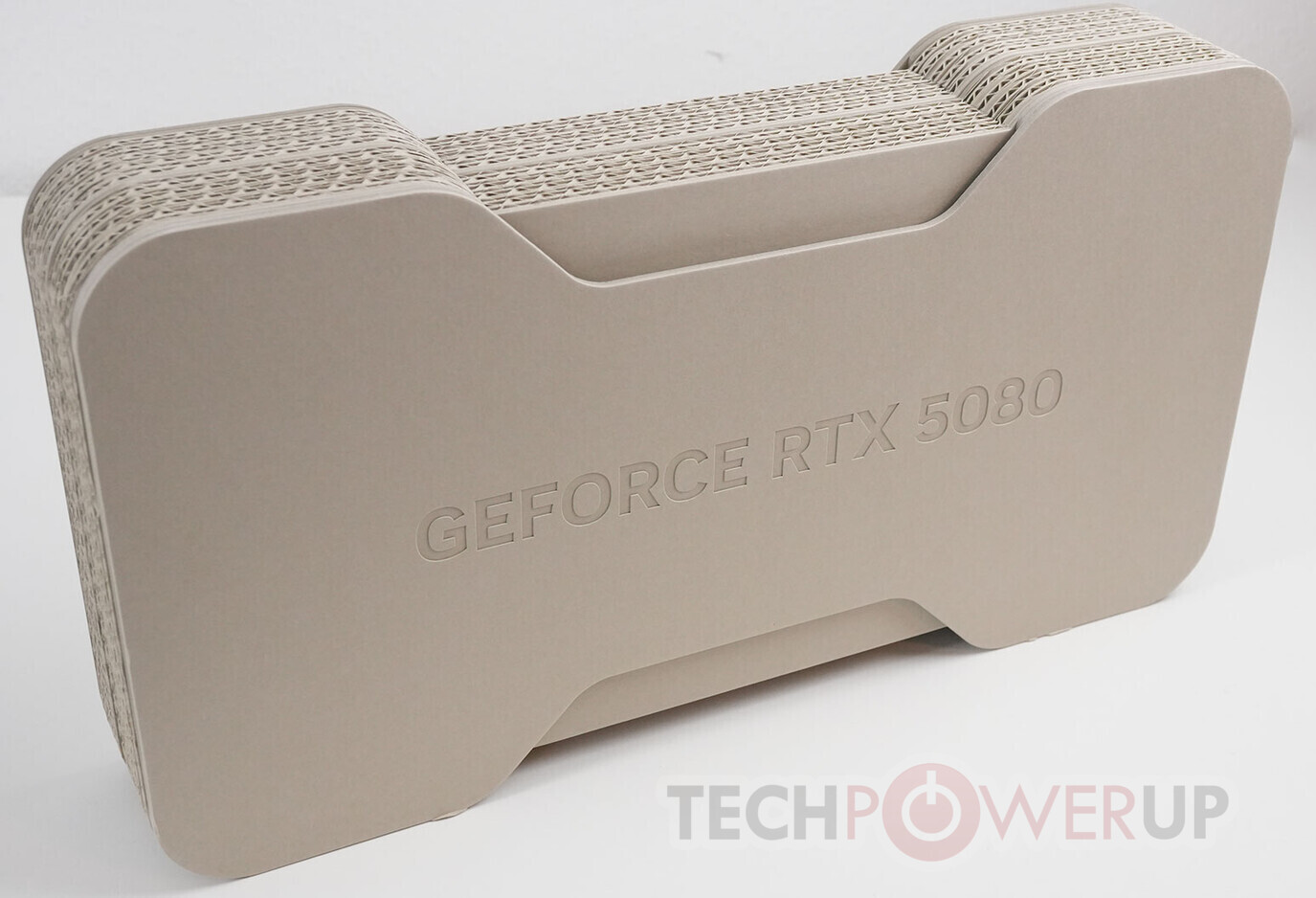
NVIDIA's two Founders Edition shroud designs—for its GeForce RTX 5090 and 5080 SKUs—look nigh identical. TechPowerUp's resident graphics card reviewer extraordinaire—W1zzard—captured a handful of comparison shots for usage in his evaluation of NVIDIA's GeForce RTX 5080 Founders Edition model. The GeForce RTX 5090 FE's cooling solution—utilizing liquid metal, instead of thermal paste—is more robust when compared to the one present on its step-down sibling—rated for a TDP of 575 W (versus 360 W). Evidently, designed to temper any radiance emitted by Team Green's GB202 GPU. EssDee3D's "chimera" card was placed in the correct packaging; a 5080-labelled paper-fiber box—but the shroud's backside advertises itself as a GeForce RTX 5090 FE. PC hardware news outlets and Redditors are wondering whether additional examples—of jumbled up "Blackwell" GPU Founders Edition parts—will appear online over the next month or two, or three...or more.

ASUS ROG Takes a Closer Look at Astral GeForce RTX 5090 & 5080 Models

The next generation of graphics performance has arrived. We've prepared an all-new series of cards: ROG Astral. Featuring a new, sophisticated design and an outstanding cooling solution, the ROG Astral GeForce RTX 5090 and ROG Astral GeForce RTX 5080 are your premium picks for supercharging the performance of your gaming PC. All this new hardware in the ROG Astral GeForce RTX 5090 requires no small amount of power so that it can stretch its legs and run. Your PSU should be capable of at least 1000 W to run this card—more on that later. The circuitry that delivers this power is just as important, and it's one reason why many enthusiasts prefer ROG graphics cards. We've equipped the ROG Astral GeForce RTX 5090 and 5080 for premium power delivery with 80-amp MOSFETs that can supply over 35% more headroom than standard designs. A massive 24-phase VRM array for the GPU and a seven-phase VRM for the GDDR7 memory chips distribute the work of supplying power, ensuring rock-solid stability and long-lasting performance. To give you peace of mind that your 16-pin PCIe power connector is seated properly, we provide monitoring through Power Detector+ in the GPU Tweak III app so that you can verify that the connector is fully seated. The app can even tell you exactly which pin is not seated properly, if that ever becomes a concern.

Ada, meet Blackwell
With the GeForce RTX 50 Series, NVIDIA debuts its latest Blackwell architecture. Armed with fifth-gen Tensor cores, new streaming multiprocessors optimized for neural shaders, and fourth-gen Ray Tracing cores built for Mega Geometry, the new graphics cards unlock access to the next generation of graphics technologies. For many gamers, the highlight of the new architecture is DLSS 4. DLSS is a revolutionary suite of neural rendering technologies that uses AI to boost FPS, reduce latency, and improve image quality. The latest breakthrough, DLSS 4, brings new Multi Frame Generation and enhanced Ray Reconstruction and Super Resolution. But there's more. NVIDIA Reflex 2 with Frame Warp provides game-winning responsiveness, and these cards are equipped to give you the best experience with ray-traced graphics yet.

ASUS & MSI US Official Stores Raise GeForce RTX 5090 & 5080 MSRPs

The buying landscape for GeForce RTX 5090 and RTX 5080 graphics cards is looking barren, just one week post-launch—global demand has far outstretched initial supply. Mid-week news points to two of NVIDIA's board partners increasing MSRPs for the top-end Blackwell GPU models, seemingly adding insult to already inflicted injuries. ASUS and MSI's North American online stores are completely devoid of stock—at the time of writing, almost all product entries are accompanied by "notify me" tags. The two hardware manufacturers have implemented comprehensive price hikes—as reported by VideoCardz. The publication pinpointed flagship models, as prime examples. The liquid-cooled ASUS ROG Astral LC RTX 5090 OC Edition 32 GB model was already a pricey prospect at launch ($3099), but the official store has tacked on another $311. A total charge of $3410 gets you one of the nicest and feature-rich card designs on the market, but you will be paying a premium of $1411—above Team Green's official GeForce RTX 5090 MSRP of $1999—for the privilege of ownership and/or bragging rights. Further down in the product stack—TechSpot noted that a Prime GeForce RTX 5080 (non-OC) 16 GB model has jumped from an original figure of $999, up to $1,264. At the time of writing, this price has been re-adjusted back down to just below $1000—thanks to a special "deal." The overclocked Prime variant is currently priced at $1320.

Looking at the MSI US store, VideoCardz reported on all GeForce RTX 5090 and RTX 5080 cards being priced north of original MSRPs—they highlighted a lowly not-overclocked RTX 5080 16G VENTUS 3X model having its price adjusted upwards—now $1140, instead of the original $1000 (at launch). MSI's "cheapest" RTX 5090 card is another VENTUS 3X design—this non-OC model is now $380 more expensive than last week's asking price ($2000). Overall, MSI's US webshop has raised prices in the ranges of $140 to $500 for GeForce RTX 5080 cards, and $380 to $790 for RTX 5090 offering—according to VideoCardz research. The company's RTX 5090 SUPRIM LIQUID SOC flagship design is not quite expensive as the equivalently appointed ASUS liquid-cooled model, but the newly adjusted MSRP of $2790 is difficult to digest. Press outlets have noted that listings on Newegg are up to $40 more expensive, when compared to the prices published on MSI's first-party store. As an added incentive, the MSI North American store is offering potential buyers a saving of: "$200 on MPG 322URX QD-OLED at checkout with RTX 5080/5090 series purchase."

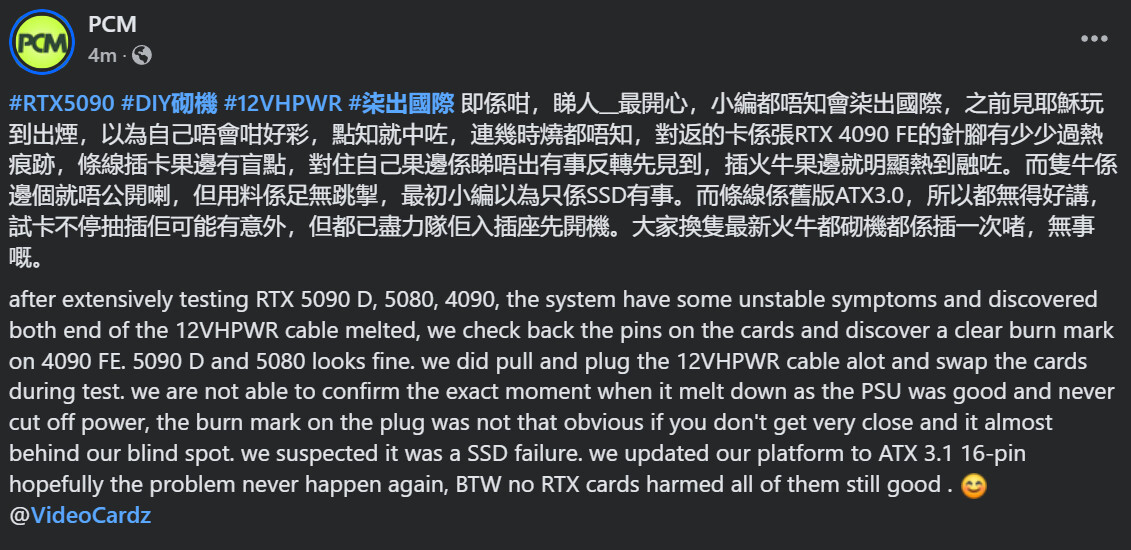
Human Error Reportedly Caused Latest 12VHPWR Cable Melting Incident

Late last month, NVIDIA claimed that 16-pin power connector issues were a thing of the past. The controversial 12VHPWR connection standard has fueled many online debates—prompting investigations from several prominent press outlets. Following NVIDIA's latest "safety" declaration—likely by coincidence—PCM Hong Kong reported another melting incident, affecting two cables and a power supply unit. The publication's hardware reviewer was recently engaged in the "full-load" testing of GeForce RTX 5090D and RTX 5080 graphics cards. Last week's evaluation session was interrupted by notable test system instabilities—upon downing tools, the PCM staffer discovered that their 1200 W PSU had given up the ghost. Additionally, two 16-pin cables had melted at both ends—initial detective work pointed to a GeForce RTX 4090 sample card being the main culprit.
VideoCardz and UNIKO's Hardware kept close tabs on PCM's next steps—online interactions, over the past weekend, spurred a re-evaluation of circumstances. According to PCM's latest update, they noticed burn marks on the GeForce RTX 4090 test unit—the two GeForce RTX-50-series cards did not exhibit any physical damage. Post-analysis, the reviewer now suspects that an SSD failure could be the root cause. They were happy to report that all involved RTX cards have survived, and that their test platform has been re-equipped with 12V-2x6 cables. An amended VideoCardz article proposes that everything came down to a simple human error.

Manli Launches the GeForce RTX 5080 Graphics Card Series

Manli Technology Group Limited is proud to announce the Manli GeForce RTX 5080 graphics card. Gear up for game-changing experiences with the NVIDIA GeForce RTX 5080 and AI-powered DLSS 4. Built with NVIDIA Blackwell and equipped with blistering-fast GDDR7 memory, it lets you run the most graphically demanding games and creative applications with stunning fidelity and performance. With NVIDIA Studio you can bring your creative projects to life faster than ever.

Manli Design
There are 10,752 CUDA cores onboard powering the RTX 5080. It also has 16 GB of memory, and GDDR7 memory speeds of up to 30 Gbps, with 5th Gen Tensor Cores, AI TOPS 1801.

NVIDIA GeForce RTX 5090 Runs on 3x8-Pin PCI Power Adapter, RTX 5080 Not Booting on 2x8-Pin Configuration

NVIDIA's flagship GeForce RTX 5090 demonstrated flexibility in power compatibility, while its sibling, the RTX 5080, struggled with stricter requirements. Recent tests by a German tech outlet, ComputerBase, reveal that the RTX 5090 can operate with three 8-pin PCI power connectors instead of the recommended four, albeit with a performance trade-off. However, the RTX 5080 fails to boot when using only two 8-pin connectors. The RTX 5090, with a default TDP of 575 W, officially requires a 600 W 12V-2×6 connector or an adapter with four 8-pin PCI cables. However, tests on the ASUS ROG RTX 5090 Astral and Zotac RTX 5090 Solid show the GPU boots even with three 8-pin cables, capping its TDP at 450 W—matching the three connectors' 150 W-per-cable spec. Performance losses are modest: benchmarks indicate a 5% drop in average FPS at 450 W compared to full power.

In contrast, the RTX 5080's 360 W TDP proves less forgiving. Attempts to run the Founders Edition and Zotac RTX 5080 AMP Extreme Infinity with two 8-pin connectors (300 W total) resulted in failure: the screen remained blank, and the card refused to initialize. NVIDIA's firmware appears to lack a lower power-limit threshold for the RTX 5080, unlike the 5090, which automatically adjusts when detecting insufficient power delivery. This requirement forces users to adhere strictly to the three 8-pin or 12V-2×6 power connectors. While the RTX 5090 offers flexibility for users upgrading from older systems, the RTX 5080's limitations may frustrate owners of less powerful PSUs. For the RTX 5090, the 5% performance penalty at 450 W may be a reasonable trade-off for avoiding costly PSU upgrades, but RTX 5080 users have no such recourse. Verifying power supply compatibility, as underpowered setups risk instability or hardware damage, is a must, and when your $2000+ GPU runs, you should at least power it properly. This experiment is more a "for science" type of run.

ASUS Outlines PRIME RTX 5080 Model's SFF-Ready Profile

Many gamers aren't that concerned about the size of their graphics card. A wide range of today's most popular PC cases offer plenty of elbow room, even for unabashedly large cards like our new ROG Astral GeForce RTX 5090. That said, there's a community of gamers who are always on the lookout for cards that deliver the performance they need in a more compact profile. Some have their eye on a space-saving small-form-factor (SFF) chassis. Others need a slimmer heatsink that leaves their secondary PCIe x16 slot accessible, perhaps to leave room for a capture card. Whatever your needs, the Prime GeForce RTX 5080 is ready for the occasion.

Slim and trim for your SFF PC
In the past, building a petite gaming PC involved double and even triple-checking component sizes to ensure compatibility. Today, the process is much easier thanks to the NVIDIA GeForce SFF-Ready program, which simplifies the process of building a space-saving PC by labeling SFF-Ready cases and graphics cards. When you select a chassis and a GPU that are both SFF-Ready, you can be confident they'll be compatible, and you'll have a streamlined building experience. Just 50 mm thick and 304 mm long, the 2.5-slot Prime GeForce RTX 5080 fits comfortably within NVIDIA's recommended form factor guidelines for SFF PCs so that you can build your space-saving PC with confidence.

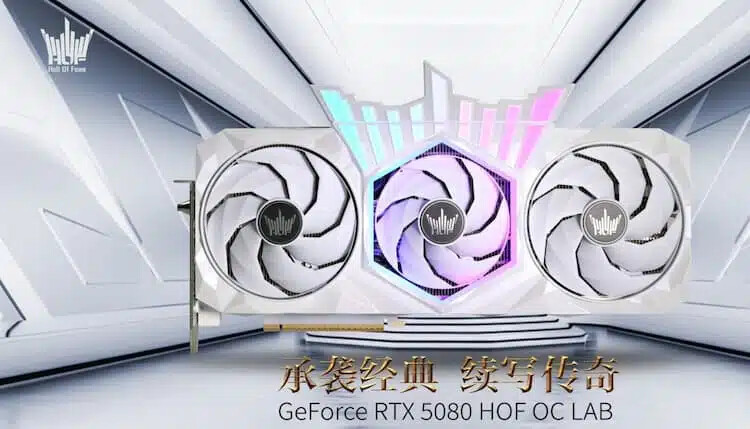
GALAX Introduces GeForce RTX 5080 HOF OC LAB Plus-X Flagship Card

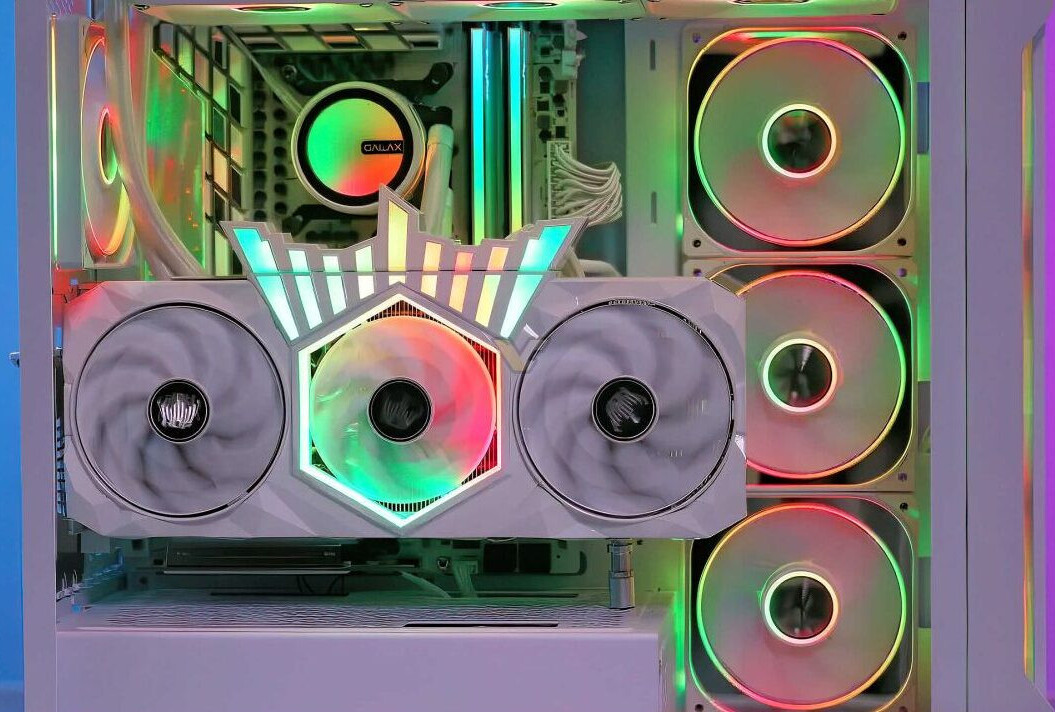
GALAX has introduced its new-generation Hall of Fame (HOF) graphics card to the Chinese hardware market. This ultra high-end custom design is based on NVIDIA's brand new "Blackwell" GeForce RTX 5080 GPU—this (almost) all-white model is adorned with a signature "Plus-X" crown-like structure, loudly proclaiming (via ARGB) its placement in GALAX's product stack. Several press outlets have expressed disappointment about the Hong Kong-based manufacturer not selecting GeForce RTX 5090D internals for their first unveiling of new HOF designs in 2025. According to a weekend VideoCardz report, the GALAX GeForce RTX 5080 HOF OC LAB Plus-X Edition model houses a striking white 12-layer PCB, with a 14+6+6 phase power design. Additionally, the card features a 70A high-current DR-MOS power stage. GALAX's previous-gen GeForce RTX 4080 HOF OC LAB Plus-X design sported two 16-pin power connectors—in contrast, its successor is reliant on a single 16-pin input.

A dedicated product page—with full specifications—has not appeared on the manufacturer's website, so VideoCardz guesstimated the card's maximum TDP rating. 400 W could be the default power, as seen on many AIB model spec sheets. GALAX has specced its latest HOF OC LAB Plus-X Edition with a dual BIOS system—their overclocked "P-Mode" takes the boost clock up to 2730 MHz. The card's air cooling solution consists of two 102 mm fans, positioned either side of a central 92 mm unit—the GALAX "Frost Ring Blades" are advertised as offering quiet operation, combined with maximizing air flow. GALAX has—once again—implemented its "Hyper Boost" system—the triple-fan cooling solution can be set to operate at maximum RPMs; enabled via an I/O bracket-mounted switch. The manufacturer has seemingly taken inspiration from ZOTAC—GALAX's new model sports a Safety Light-esque error detection system. The GeForce RTX 5080 HOF OC LAB Plus-X Edition is not available for sale in China, at the time of writing.

TechPowerUp Introduces TechPowerUp GPU-Z v2.62.0

TechPowerUp today released the latest version of TechPowerUp GPU-Z, the graphics sub-system information and monitoring utility for PC gamers and enthusiasts. The latest version 2.62.0 introduces full support for NVIDIA "Blackwell" generation of GPUs, which should cover not just the RTX 5090 and RTX 5080 that were recently released, but also preliminary support for upcoming SKUs such as the RTX 5070 Ti, and RTX 5070. Support is also added for the NVIDIA H200 NVLink compute GPU, and RTX 5000 Ada Generation Embedded pro-vis graphics card. Subvendor detection for Maxsun has been fixed. Grab GPU-Z from the link below.

DOWNLOAD: TechPowerUp GPU-Z 2.62.0

Edward Snowden Lashes Out at NVIDIA Over GeForce RTX 50 Pricing And Value

It's not every day that we witness a famous NSA whistleblower voice their disappointment over modern gaming hardware. Edward Snowden, who likely needs no introduction, did not bother to hold back his disapproval of NVIDIA's recently launched RTX 5090, RTX 5080, and RTX 5070 gaming GPUs. The reviews for the RTX 5090 have been mostly positive, although the same cannot be said for its affordable sibling, the RTX 5080. Snowden, voicing his thoughts on Twitter, claimed that NVIDIA is selling "F-tier value for S-tier prices".

Needless to say, there is no doubt that the RTX 5090's pricing is quite exorbitant, regardless of how anyone puts it. Snowden was particularly displeased with the amount of VRAM on offer, which is also hard to argue against. The RTX 5080 ships with "only" 16 GB of VRAM, whereas Snowden believes that it should have shipped with at least 24, or even 32 GB. He further adds that the RTX 5090, which ships with a whopping 32 GB of VRAM, should have been available with a 48 GB variant. As for the RTX 5070, the security consultant expressed desire for at least 16 GB of VRAM (instead of 12 GB).

ASUS TUF Gaming Discusses GeForce RTX 5090 & 5080 Feature Sets

We build our TUF Gaming components for users who want an emphasis on substance, meaning you're paying for pure performance when you go TUF. That focus on function is where the TUF Gaming GeForce RTX 5090 and TUF Gaming GeForce RTX 5080 graphics cards excel, providing you with next-gen graphics capabilities as well as high-performance thermal solutions that'll hold up under 4K AAA gaming pressure. If you've been waiting to upgrade your rig and want to treat yourself to a premium power bump, now's the time to pull the trigger. You're in for a truly substantial generational leap with these high-end components featuring the power of NVIDIA's latest GPU architecture alongside the sophistication of our latest graphics card designs.

Next-gen tech for tomorrow's heavyweight games
The GeForce RTX 5090 and 5080 comprise the top of the power stack for NVIDIA's 50 Series GPUs, so when you invest in either a TUF Gaming GeForce RTX 5090 or 5080 graphics card, you're setting yourself up for years to come. The 50 Series is powered by NVIDIA's Blackwell architecture, meaning these GPUs feature 4th generation RT cores to give gamers the best ray tracing performance yet. They also pack neural shaders, which compress textures to cut down on memory usage and produce incredible real-time visuals. And NVIDIA has ensured its 50 Series is equipped for neural processing via a built-in AI management processor, so you'll get an optimal experience when harnessing the power of NVIDIA DLSS 4. Powered by 5th generation Tensor Cores, DLSS 4 uses a Multi Frame Generation solution to boost your framerate to new heights.

Newegg Sold Out Most NVIDIA RTX 50 Series GPUs in Just 5 Minutes, Entire Stock Cleared in 20 Minutes

Newegg Commerce, Inc., a global leader in e-commerce for technology products, experienced an overwhelming response to the highly anticipated launch of the NVIDIA GeForce RTX 50 Series GPUs, with inventory selling out within minutes. Gaming enthusiasts, content creators, system integrators, and PC builders rushed to secure the first batch of the latest AI-powered graphics technology, driving demand to unprecedented levels and cementing the RTX 50 Series as one of the most sought-after GPU launches in history.

"The response to the NVIDIA RTX 50 Series has been extraordinary," said Jim Tseng, VP of Product Management at Newegg. "The overwhelming demand reaffirms the gaming and PC community's enthusiasm for the very best technology. For our customers who have not yet been able to secure a GPU, we're committed to working with NVIDIA and our AIB (Add-In Board) partners to ensure future restocks and continued availability." Tseng continued, "Getting the latest cards into our customers is our passion, and we're proud to also offer a GPU trade-in program that makes it more affordable for customers to upgrade to the latest generation of video cards."

MAINGEAR Launches New Desktop Gaming PCs and Workstations With NVIDIA GeForce RTX 50 Series GPUs

MAINGEAR, the leader in premium-quality, high-performance gaming PCs, today unveiled a variety of custom-configurable "50 Series" gaming desktops, featuring NVIDIA's newly revealed GeForce RTX 5080 and RTX 5090 GPUs. Available across seven gaming chassis options—MG-1, North, shroud, shroud Signature Edition, Rush, Force, and Zero, as well as all Workstations—these systems can be custom configured with NVIDIA GeForce RTX 50-series GPUs and the latest CPU options from AMD and Intel to set a new benchmark for desktop gaming performance and customization.

Building on the excitement from CES 2025, MAINGEAR's "50 Series" also introduces non-APEX configurations of the hot new Rush and Force desktops, featuring 360 mm and 420 mm AIO coolers respectively, instead of open loop liquid cooling. Additionally, customers can order Rush desktops with custom chassis artwork for unparalleled personalization - as seen at CES. Available custom designs include Machina, Night Drive and Good Fortune.

GeForce RTX 50 Series GPUs Are Now Available for iBUYPOWER's Custom Gaming PCs

The leading system integrator iBUYPOWER, a company focusing on building high-performance gaming computers, is excited to announce that gaming PCs equipped with NVIDIA's GeForce RTX 50 Series GPUs can now be purchased starting today. Backed by iBUYPOWER's comprehensive warranty of three-years labor and two-years parts, players can literally change the game thanks to the RTX 50 Series video cards enabling all-new experiences and next-level graphical fidelity.

Powered by NVIDIA Blackwell, the all-new GeForce RTX 50 Series GPUs bring game-changing capabilities to gamers and creators. Equipped with a massive level of AI horsepower, the RTX 50 Series video cards enable new experiences and next-level graphics fidelity. Owners of these new GPUs can look forward to multiplying their in-game performance with NVIDIA DLSS 4, generating images at unprecedented speed, and unleashing their creativity with NVIDIA Studio.

New NVIDIA Broadcast AI Features Now Streaming With GeForce RTX 50 Series GPUs

New GeForce RTX 5090 and RTX 5080 GPUs - built on the NVIDIA Blackwell architecture - are now available to power generative AI content creation and accelerate creative performance. GeForce RTX 5090 and RTX 5080 GPUs feature fifth-generation Tensor Cores with support for FP4, reducing the VRAM requirements to run generative AI models while doubling performance. For example, Black Forest Labs' FLUX models - available on Hugging Face this week - at FP4 precision require less than 10 GB of VRAM, compared with over 23 GB at FP16. With a GeForce RTX 5090 GPU, the FLUX.1 [dev] model can generate images in just over five seconds, compared with 15 seconds on FP16 or 10 seconds on FP8 on a GeForce RTX 4090 GPU.

GeForce RTX 50 Series GPUs also come equipped with ninth-generation encoders and sixth-generation decoders that add support for 4:2:2 and increase encoding quality for HEVC and AV1. Fourth-generation RT Cores paired with DLSS 4 provide creators with super-smooth 3D rendering viewports. The GeForce RTX 5090 GPU includes 32 GB of ultra-fast GDDR7 memory and 1,792 GB/sec of total memory bandwidth - a 77% bandwidth increase over the GeForce RTX 4090 GPU. It also includes three encoders and two decoders, reducing export times by a third compared with the prior generation.

Alphacool Presents the RTX 5080 / 5090 Core GPU Water Cooler

Alphacool International GmbH, based in Braunschweig, has been a pioneer in PC water cooling technology for over 20 years. With one of the most comprehensive product portfolios in the industry, Alphacool is now expanding its lineup with the introduction of new Core GPU water coolers for the latest NVIDIA GeForce RTX 5080 and 5090 series.

The GPU water coolers have been completely redesigned. Precise adjustments to the spacing between the cooler and the PCB, along with optimized water flow simulations and extensive practical testing, have resulted in significant improvements to the cooler base and jetplate. These enhancements ensure maximum cooling performance for the newest NVIDIA GeForce RTX generation. The GPU water coolers feature a precisely machined copper base with high-quality chrome plating for exceptional durability and a smooth surface. The design is further complemented by robust brass fittings with a nylon cover, ensuring maximum safety and reliability.
Return to Keyword Browsing
Nov 28th, 2026 06:37 CST change timezone

New Forum Posts

Popular Reviews

TPU on YouTube

Controversial News Posts