
News Posts matching #SD Express

Return to Keyword Browsing

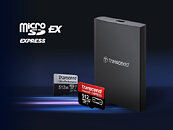
Transcend Introduces RDE3 microSD Express Card Reader

Transcend Information, Inc. (Transcend), a global leader in digital storage solutions, announced the launch of the RDE3 microSD Express high-speed card reader, engineered for high-performance applications. Featuring a USB 3.2 Gen 2 (10 Gbps) interface, the RDE3 delivers transfer speeds of up to 900 MB/s while maintaining backward compatibility with UHS-I memory cards. From content creation to gaming, the RDE3 enables fast, stable, and efficient data handling. With a rugged yet refined design that combines performance with reliability, the RDE3—when paired with Transcend's high-capacity microSD Express memory card USD710S—fully unleashes the potential of microSD Express, offering SSD-class performance to meet the demands of gamers and creators seeking smooth, consistent performance.

RDE3 microSD Express Card Reader: Performance Meets Premium Design
Purpose-built for high-speed workflows, the RDE3 microSD Express card reader leverages a USB 3.2 Gen 2 (10 Gbps) interface to achieve transfer speeds of up to 900 MB/s, enabling rapid imports of 8K high-resolution footage and large game files to significantly reduce wait times and boost productivity. Supporting the PCIe-based microSD Express standard while remaining backward compatible with UHS-I cards, the RDE3 balances top-tier performance with broad compatibility. Its USB-C connector supports Windows, macOS, and USB-C tablets for true plug-and-play convenience. The metal alloy housing offers excellent heat dissipation in a lightweight, durable form, while the scratch-resistant exterior delivers a clean, professional aesthetic—ensuring stable and reliable high-speed data transfers.

Good Way Shows Off Thunderbolt 5 eGPU Dock

Does your external graphics card have to be completely enclosed? Can it be a dock so you could revel upon the card, and it can ventilate itself better? Good Way has a possible answer to this solution, with its new DBF7059 Thunderbolt 5 eGPU Dock. This dock features a Thunderbolt 5 upstream link, including the ability to segment the interconnect such that the host-to-GPU transfers operate at 120 Gbps, and GPU-to-host at 40 Gbps, ensuring the best possible bandwidth for the GPU in an eGPU configuration.

The dock features a PCI-Express 4.0 x16 slot, and a bridge chip that converts this to Thunderbolt 5. It also integrates a 700 W power supply, so it can supply a modern graphics card with a 600 W-capable 12V-2x6, besides 75 W from the slot, and the remaining power for its bridge chip and other dock features to function. The dock has been extensively stress-tested by its designers using high-end graphics cards to ensure endurance in a professional and enterprise environment, where its target users are trying to expand their commercial laptop's graphics capabilities with a high-end GPU. Lastly, Good Way also threw in some downstream connectivity, including stereo USB audio, an SD Express card reader, a 10 Gbps USB 3.2 Gen 2 type-A, a 10 Gbps type-C, and a Thunderbolt 5 downstream port, so you can daisy-chain the dock to additional devices.

Lexar Celebrates 30th Anniversary at CES, Bringing Several New Storage Products to the Show

As Lexar celebrates its 30th anniversary, the brand reflects on three decades of innovation, engineering excellence, and trusted performance. Since 1996, Lexar has evolved from a pioneer in memory card standards into a global brand shaping the workflows of creators, gamers, professionals, and next-generation smart devices. Building on this foundation, Lexar enters 2026 with a clear focus: continuing to meet evolving user needs while preparing for a future shaped by AI-enabled workflows, mobility, and real-time data.

Value Leadership-30 Years of Innovation, Reliability, and User-Centric Product Design
For 30 years, Lexar has built its reputation on three core values-Professionalism, Innovation, and Service-delivering storage solutions that evolve with the needs of photographers, filmmakers, gamers, and mobile creators.

Samsung Launches New microSD Express Card P9 Express

Samsung Electronics today announced the launch of its new microSD Express card lineup, the P9 Express, designed to deliver next-gen gaming experiences and optimized for leading platforms, including the Nintendo Switch 2. Based on the PCIe interface and NVMe protocol, SD Express technology significantly enhances data
transfer performance compared to UHS-I cards, making it ideal for environments that demand high-capacity processing and fast data transmission.

The P9 Express is especially valuable for hardcore console gamers who frequently enjoy a diverse range of games and Downloadable Content (DLC), often demanding additional storage capacity beyond the internal storage. To meet different gaming needs, it is available in both 256 GB and 512 GB options. It also provides an ideal solution for multiple users sharing a single console, where ample capacity is required for several different game installations, helping gamers overcome limited internal storage and enjoy a wide variety of titles without compromise. When used with a dedicated SD Express interface, the P9 Express delivers sequential read speeds up to four times faster than UHS-I, enabling creators and professionals to efficiently move large volumes of data from devices to PCs, laptops, or workstations.

Lexar Presents New Products at Gamescom 2025

Lexar, a global leader in flash memory solutions, will once again be exhibiting at Gamescom from 20 to 24 August 2025. The trade fair is considered the world's largest gaming event and offers manufacturers, developers and users a platform for exchanging ideas and presenting new technologies. Lexar will have an extensive presence at Gamescom, showcasing its products in three exhibition areas, including its main stand and, for the first time, a joint stand with SDA. Among other things, the company will be presenting new products in the field of gaming and content creation storage solutions.

Two new products at the Lexar stand - Hall 10.1, Aisle B - 071
  • Lexar NM990 M.2 2280 PCIe 5.0 NVMe SSD (for retail in the EU) / Lexar ARES PRO M.2 2280 PCIe 5.0 NVMe SSD (for Amazon) - High-performance SSD with PCIe 5.0 interface for extremely fast load times and maximum stability in gaming and content creation.
  • Lexar THOR RGB 2nd Gen DDR5 Desktop Memory (for retail stores in the EU) / Lexar THOR Z RGB DDR5 Desktop Memory (for Amazon) - Modern DDR5 desktop memory modules with dynamic RGB lighting and optimised performance for demanding gaming setups.

addlink Launches Turbo Play Express MicroSD Express Card

addlink Technology Co., Ltd., a pioneer in high-performance storage solutions, proudly announces the launch of the Turbo Play Express microSD Express Card. Specifically engineered for the new Nintendo Switch 2 and powered by cutting-edge SD 7.1 and PCIe Gen 3 NVMe technologies, Turbo Play Express redefines what's possible for handheld gaming, promising speed, capacity, and total compatibility for gamers everywhere.

Turbo Play Express: Next-Level Speed for Next-Gen Gaming
Fueled by microSD Express and NVMe, Turbo Play Express demolishes the barriers of conventional game storage. With read speeds up to 880 MB/s and write speeds up to 750 MB/s, gamers can now say goodbye to long wait times and hello to instant action—whether loading massive open-world titles, transferring DLCs, or switching between classics and the newest releases.

AGI Technology Launches High-Speed microSD Express Card TF338

To support the new storage standard adopted by Nintendo Switch 2, AGI proudly announces the release of the TF338 microSD Express card. Built on the microSD Express standard and powered by the PCIe Gen 3 x1 interface with NVMe protocol, the TF338 delivers performance far beyond traditional microSD cards—offering up to 800 MB/s read and 700 MB/s write speeds for lightning-fast game loading and data transfer.

Compared to previous UHS-I microSD cards, microSD Express offers more than 4 times faster speeds, approaching SSD-level performance. This makes the TF338 an ideal solution for both high-performance gaming and mobile content creation. The card is backward compatible with UHS-I devices and has passed multiple durability tests—ensuring water, dust, shock, and temperature resistance for stable operation across demanding environments.

Team Group Unveils The APEX SD7.1 MicroSD Express Card

Team Group Inc., a global leader in memory solutions, officially announced the launch of the APEX SD7.1 MicroSD Express Card today. Designed to meet the next generation's demands for both speed and capacity in gaming, the card delivers read and write speeds of up to 800 MB/s and 700 MB/s, respectively, on devices that support the MicroSD Express interface.

The APEX SD7.1 features a PCIe Gen 3 x1 interface and NVMe protocol, and is rated A1 for application performance, delivering significantly faster data transfer speeds. It offers optimal performance on devices equipped with a MicroSD Express slot (e.g. Nintendo Switch 2) while remaining fully backward compatible with handheld consoles and mobile devices that support standard MicroSD cards. The card is available in 128 GB, 256 GB, 512 GB, and 1 TB capacities, with the highest capacity model storing up to 30 games. It also supports Video Speed Class V30 and 4K UHD video recording, making it ideal for capturing smoothly rendered, high-resolution footage.

Final Nintendo Switch 2 Specifications Surface: CPU, GPU, Memory, and System Reservation

With the launch scheduled for June 5, Nintendo has quietly confirmed the final technical details for its next-generation hybrid console, the Switch 2, clarifying the specifications of the "custom NVIDIA processor" at its core and specifying exactly how much horsepower developers can access. The Switch 2's SoC is officially labeled the NVIDIA T239, a custom iteration of the Ampere architecture rather than a repurposed Tegra. It contains eight Arm Cortex-A78C cores running a 64-bit ARMv8 instruction set, with cryptography extensions enabled and no support for 32-bit code. Each core features 64 KB of L1 instruction cache and 64 KB of L1 data cache. Six cores are available for game development, while two are reserved for system tasks. Clock speeds reach 998 MHz in handheld mode and 1,101 MHz when docked, and the CPU can theoretically burst to 1,700 MHz for demanding operations or future updates.

Graphics are powered by a full Ampere-based GPU with 1,536 CUDA cores. Clock speeds top out at 1,007 MHz in docked mode and 561 MHz in handheld mode, delivering approximately 3.07 TeraFLOPS when docked and 1.71 TeraFLOPS in portable use. As with the CPU, a portion of GPU resources is allocated to operating system functions, slightly reducing the amount available for applications. Memory capacity has increased from 4 GB of LPDDR4 in the original Switch to 12 GB of LPDDR5X in the new model, split across two 6 GB modules. Peak bandwidth measures 102 GB/s docked and 68 GB/s handheld. Of the total, 3 GB are reserved for system functions and 9 GB are dedicated to games and applications. Nintendo has also introduced a dedicated File Decompression Engine for LZ4-compressed data, offloading asset unpacking from the CPU to improve loading times without overheating the chipset. The console ships with 256 GB of UFS storage, expandable via microSD Express up to 2 TB, and features a 7.9-inch, 1080p LCD that supports HDR10 and up to 120 Hz variable refresh rate in handheld mode. Although HDMI VRR is not yet available, the internal display fully supports it.

Silicon Power Launches Industrial-Grade microSD Express Card with SSD-Level Performance

Silicon Power is thrilled to announce the launch of its first microSD Express memory card, the SET320. Available in 256 GB capacity with an operating temperature of -25°C to 70°C, this industrial-grade solution is designed to meet the growing demands of AI-driven applications. Harnessing the SD Express interface, this advanced memory card delivers exceptional performance in a familiar form factor, enabling cutting-edge AI systems and data centers to operate at their maximum potential.

SSD Performance in microSD Card Size
The SET320 leverages PCIe Gen 3x1 and NVMe interfaces to achieve incredible read speeds of up to 820 MB/s - 1.4 times faster than SATA SSDs (up to 560 MB/s) and more than eight times faster than traditional UHS-I microSD cards (up to 100 MB/s). It also boasts write speeds of up to 640 MB/s to handle data-intensive calculations with ease. These impressive figures make the SET320 comparable to SSDs in terms of performance, all within the compact and versatile form factor of a microSD card, allowing users to experience SSD-like speed and efficiency in devices that require a smaller footprint.

Samsung's New microSD Cards Bring High Performance and Capacity, with Speeds of up to 800 MB/s and 1 TB in Size

Samsung Electronics, the world leader in advanced memory technology, today announced that it has started sampling its 256-gigabyte (GB) SD Express microSD card with sequential read speed of up to 800 megabytes per second (MB/s) and has commenced mass production of its 1-terabyte (TB) UHS-1 microSD card. With the introduction of its next-generation microSD card line-up, Samsung aims to provide differentiated memory solutions required for tomorrow's mobile computing and on-device AI applications.

"With our two new microSD cards, Samsung has provided effective solutions to address the growing demands of mobile computing and on-device AI," said Hangu Sohn, Vice President of the Memory Brand Product Biz Team at Samsung Electronics. "Despite their tiny size, these memory cards deliver powerful SSD-like performance and capacity to help users get more out of demanding modern and future applications."

microSD Express Doubles Speeds, New SD Express Speed Classes Introduced

SD Association (SDA) today announced the latest evolution of SD Express memory cards doubling microSD Express memory card speed up to 2 GB/s, plus four new SD Express Speed Classes to ensure guaranteed minimum sequential performance levels in the new SD 9.1 specification including support of Multi-stream access and related Power and Thermal Management assuring the guaranteed performance. SD 9.1 helps consumers identify the right card for their device while giving manufacturers new tools to assure minimum level of performance of SD Express memory cards and have means to guide consumers what type of cards will assure specific application operations.

The latest generation of microSD Express uses the PCIe interface delivering a 1,969 megabytes per second (MB/s), nearly 2 gigabytes per second (GB/s) speeds by using the PCIe Gen 4 x1 lane as defined in the latest update to the microSD Addendum version 8 specification. microSD Express was introduced with 985 MB/s speed maximum data transfer rate and the NVMe upper layer protocol in the SD 7.1 specification. The increase in speed gives product designers more storage options and SSD level performance for a variety of size constrained devices requiring easily repairable or upgradeable storage.

ASUS Announces Vivobook Pro 15 OLED and Pro 16 OLED

ASUS today announced Vivobook Pro 15 OLED (K6502) and Vivobook Pro 16 OLED (K6602), a pair of 15.6-inch and 16-inch laptops designed to make creativity easy and fun for anyone. Harnessing the performance of the latest 12th Generation Intel Core H-Series processors, with an efficient triple-vented cooling system and up to a studio-grade NVIDIA GeForce RTX 3050 Ti GPU, these powerful laptops can handle any content creation, gaming or entertainment tasks with ease.

Vivobook Pro 15 OLED and Pro 16 OLED are equipped with color-accurate PANTONE Validated OLED displays—with up to a world-leading 3.2K 120 Hz 600-nit OLED version on Vivobook Pro 16 OLED—that deliver a superb high-quality visual experience with a cinema-grade 100% DCI-P3 color gamut. The new MUX switch allows users to enjoy maximum low-latency graphics performance when gaming, and entertainment is enhanced by immersive, multi-dimensional Dolby Atmos audio via the Harman Kardon-certified speaker system.

SD Specification 9 - New Opportunities for SD Memory Cards as Semi-Embedded Memory

SD Association (SDA) today announced three advanced security features in the new SD 9 specification: Boot support, Trusted Computing Group (TCG) Storage and Replay Protected Memory Block (RPMB) authenticated memory. SD 9 gives device manufacturers the ability to use an SD memory card for all memory and storage needs, simplifying future device upgrades or repairs and enhancing security capabilities for applications when the cards are tightly bound to specific hosts. SD 9 defines Fast Boot and Secure Boot capabilities giving cards the ability to serve as a device's boot code memory while offering a simple fast boot code uploading process along with secured methods of providing future boot code updates. SD 9 adds TCG secured storage by adding self-encrypted drive functionality. The specification defines RPMB as a secured hidden memory accessible only through a secured authentication process, while also providing a secured boot code update process, plus write-protect and replay protection security mechanisms.

Devices ideally suited for the new capabilities defined by SD 9 include Chromebook computers, tablets, drones, surveillance cameras, dash cameras, gaming consoles, virtual reality (VR) headsets/glasses, small IoT modules and wearable medical devices, to name a few. SD 9 also helps product manufacturers meet new right to repair regulations and simplifies upgrade and repair processes for devices installed in locations without internet connectivity. "SD memory cards are a compelling choice for both storage and memory because they will boot devices, are capable of delivering SSD performance levels and simplify device repairs or upgrades," said Hiroyuki Sakamoto, SDA president. "The SD 9 specification gives product manufacturers a compelling array of choices when defining memory and storage needs of devices." The optional features defined in SD 9 are available to both microSD and full-sized SD memory card form factors. The features are applicable across all capacity types, from SD to the forthcoming SDUC memory cards. Importantly, these features will be supported by SD Express, capable of delivering SSD performance levels up to 4 GB/sec. The SDA has prepared a whitepaper providing more details about the compelling new features defined by SD 9 for SD memory cards.

ADATA Announces Premier Extreme SDXC SD7.0 Spec SD Express Cards

ADATA Technology, a manufacturer of high-performance DRAM modules, NAND Flash products, mobile accessories, gaming products, electric power trains, and industrial solutions today announced that its Premier Extreme SDXC SD7.0 Express Card, equipped with an SMI SM2708AB controller, is the world's first branded SD Express Card to pass SD Association's SD Express Verification Program (SVP). This verification status affirms that the SD Express Card meets SDA's rigorous interface standards for performance and reliability. The Premier Extreme SDXC Express Card will allow users to take full advantage of the latest SD Express-enabled laptops from all the major PC brands.

"Due to their compact form factors, SD cards have been and continue to be a mainstay of creators, creative professionals, and general users despite their lesser capabilities when compared to other storage devices," said Ibsen Chen, Director of Product Marketing at ADATA. "However, with the SVP verified ADATA Premier Extreme SDXC SD7.0 Express Card, we are giving users an SD Card that meets the standards of a modern world where high-quality content and fast data transfer rates are the norms."

Phison Awarded World's First SD Association's SVP Verification for its SD Express Storage Solution

Phison Electronics Corp., a global leader in NAND flash controller integrated circuits and storage solutions, today announced that its SD Express storage solution is the first product to pass the SD Association's SD Express/UHS-II Verification Program (SVP). This verification indicates that these products meet interface standards, providing confidence to both consumers and businesses that it will operate and perform properly.

According to the SD Association, "PCIe and UHS-II are both high differential interfaces and meeting their specifications demanding requirements is extremely important to assure proper operation and interoperability." The Association officially launched the SVP program at the end of 2021, becoming the notary unit that leads the compatibility verification between the host system and the SD memory card manufacturer to positively assist in the development of the product ecosystem. As the world's leading supplier of SD card controllers and solutions, Phison Electronics has pledged to support the SD Association's SVP program and to work with Phison's global brand customers in launching the latest SD Express storage solutions that meet the SVP verification requirements.

ADATA Unveils Premier Extreme SDXC SD 7.0 Express Card

ADATA Technology, a manufacturer of high-performance DRAM modules, NAND Flash products, mobile accessories, gaming products, electric power trains, and industrial solutions today announces the new ADATA Premier Extreme SDXC SD Express Card. Thanks to the latest SD 7.0 specification, which supports PCIe and NVMe, the Premier Extreme SDXC SD 7.0 Express Card delivers performance on par with SSDs, but in the ultra-portable form factor of an SD Card.

With support for PCIe Gen 3 x1 and NVMe, the Premier Extreme SDXC SD Express Card delivers read and write performance of up to 800/700 MB/s, which is roughly 1.5 times faster than SATA SSDs. When compared to UHS-II SD and UHS-I SD cards, it's about 2.7 and 8 times faster, respectively. This memory card is backward compatible with the UHS-I devices with read and write speed of up to 100 MB/s and conforms to the V30 Video Speed Class.

Silicon Motion Announces World's First Merchant SD Express Controller Solution Supporting The Latest SD 8.0 Specification

Silicon Motion Technology Corporation, a global leader in designing and marketing NAND flash controllers for solid-state storage devices, today announced that its flagship SM2708 SD Express controller solution now supports the latest SD 8.0 specification and backward compatibility to SD 7.1 specification. With PCIe Gen 3 x2 interface and NVMe 1.3, the SM2708 SD Express controller solution is targeted at the advancement of applications with demanding performance levels across a variety of industries enabled by Ultra-High Performance SD Express cards. The SM2708 turnkey solution supports the latest 3D NAND and features Silicon Motion's proprietary NANDXtend ECC technology, internal data path protection, and programmable firmware to maximize reliability and endurance.

"Many of the latest high-end cameras & mobile phones are capable of recording video in 8K and require a faster transfer rate," said Nelson Duann, Silicon Motion's Senior Vice President of Marketing and R&D. "With the SM2708 controller now supporting the SD 8.0 specification which nearly triples throughput, applications such as 8K video capture, RAW photography, multi-channel IOT devices, multi-processing automotive storage and other applications requiring ultra-high data speeds are possible."

ADATA Announces SD Express Cards, Available from Q2-2021

ADATA Technology, a manufacturer of high-performance DRAM modules, NAND Flash products, mobile accessories, gaming products, electric power trains, and industrial solutions, plans to release next-generation SD Express cards by Q2 of 2021.

With the rise of social media influencers, user-generated content, and the deployment of 5G networks worldwide, content creators and others seek high-capacity, high-performance, and portable memory products to meet their needs. To this end, the SD Association (SDA) released SD7.0, which introduced two major new functions, which include the incorporation of the PCIe and NVMe interfaces into SD memory cards for a significant upgrade in read/write speeds. These new SD cards will be known as SD Express cards. ADATA will be launching a new SD Express memory card by Q2 of 2021.

SD Express Delivers New Gigabyte Speeds for SD Memory Cards

The SD Association announced today the SD 8.0 Specification for SD Express memory cards receives even faster transfer speeds by using the popular PCI Express (PCIe ) 4.0 specification delivering a maximum of nearly 4 gigabytes per second (GB/s) data transfer rate. These full sized cards continue to use the NVMe Express (NVMe ) upper layer protocol enabling advanced memory access mechanism. As always SD Express memory cards using SD 8.0 specification maintain backward compatibility.

"SD Express' use of even faster PCIe and NVMe architectures to deliver faster transfer speeds creates more opportunities for devices to use SD memory cards," said Mats Larsson, Senior Market Analyst at Futuresource. "This combination of trusted and well-known technologies makes it easier for future product designs to leverage the benefits of removable storage in new ways."

microSD Express Implements NVMe to Become the Fastest Mobile Removable Media

The SD Association announced today microSD Express, offering the popular PCI Express and NVMe interfaces alongside the legacy microSD interface for backwards compatibility. Like SD Express, microSD Express uses the PCIe interface delivering a 985 megabytes per second (MB/s) maximum data transfer rate and the NVMe upper layer protocol enables advanced memory access mechanism, enabling a new world of opportunities for mobile devices.

microSD Express cards defined in the SD 7.1 specification will be offered in a variety of capacities such as microSDHC Express, microSDXC Express and microSDUC Express. "microSD Express gives the mobile industry a compelling new choice to equip mobile devices with removable SSDs," said Hiroyuki Sakamoto, SDA president. "SD 7.1 prepares consumers and mobile device manufacturers to meet ever increasing storage demands for years to come."

SD Express is a New Memory Card Standard That Leverages PCIe and NVMe

The SD Association announced today SD Express which adds the popular PCI Express and NVMe interfaces to the legacy SD interface. The PCIe interface delivering a 985 megabytes per second (MB/s) maximum data transfer rate and the NVMe upper layer protocol enables advanced memory access mechanism, enabling a new world of opportunities for the popular SD memory card. In addition, the maximum storage capacity in SD memory cards grows from 2 TB with SDXC to 128 TB with the new SD Ultra Capacity (SDUC) card. These innovations maintain the SDA's commitment to backward compatibility and are part of the new SD 7.0 specification.

"SD Express' use of popular PCIe and NVMe interfaces to deliver faster transfer speeds is a savvy choice since both protocols are widely used in the industry today and creates a compelling choice for devices of all types," said Mats Larsson, Senior Market Analyst at Futuresource. "The SD Association has a robust ecosystem with a strong history of integrating SD innovations and has earned the trust of consumers around the world."
Return to Keyword Browsing
Nov 13th, 2026 05:14 PST change timezone

New Forum Posts

Popular Reviews

TPU on YouTube

Controversial News Posts