News Posts matching #YMTC

Return to Keyword Browsing

YMTC Introduces X3-9070 3D NAND Flash Powered by Innovative Xtacking 3.0 Architecture

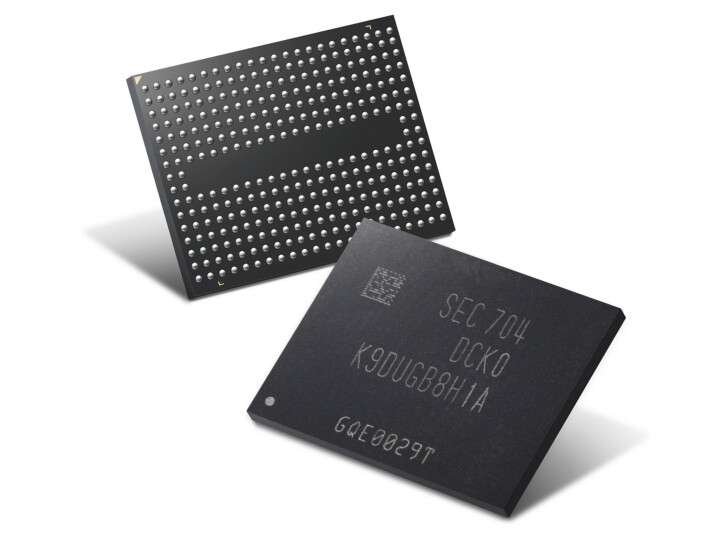
YMTC today at the Flash Memory Summit (FMS) 2022 unveiled its X3-9070 TLC 3D NAND flash powered by Xtacking 3.0 architecture. Since its debut show at FMS 2018, YMTC's Xtacking technology has become a hallmark of the company's vision for innovation, and the approach to hybrid bonding has been widely recognized as one of the key enablers of the industry's future growth. Built out to be a common growth platform that drives value and innovation in the semiconductor ecosystem, YMTC's Xtacking 3.0 architecture opens up a world of opportunities for diversified applications in 5G, AloT, and beyond.

From 1.0 to 3.0, YMTC's Xtacking technology, a heterogeneous 3D integration architecture, has established a proven track record of success, as evidenced by a diverse portfolio of Xtacking NAND-based system solutions, including SATA III, PCIe Gen3 & Gen4 SSDs, as well as eMMC & UFS for mobile and embedded applications, garnering recognition from leading OEMs.

Chinese YMTC Achieves Mass-production of 232-layer 3D NAND, Beating Kioxia, Micron, Samsung, and SK Hynix

YMTC delivered on its roadmaps to achieve a mass-production 232-layer 3D NAND flash memory, beating entrenched players Kioxia, Micron Technology, Samsung Electronics, and SK Hynix, to the production 200+ layer feat. The Chinese memory and NAND flash giant announced this memory back in August 2022 as the YMTC X3-9070, along with its new Xtacking 3.0 architecture—a proprietary method by which the company can reliably stack a large number of NAND flash layers. Micron Technology is ready with a 232-layer 3D NAND flash of its own, although it hasn't hit a production ramp, yet. This is an incredible feat considering that YMTC only got into this business in 2016, compared to the other players that each have over two decades of market presence.

YMTC's ramp to 232-layer closely follows its unexpected 2020 feat of a production-grade 128-layer 3D NAND, which was groundbreaking enough to win a supply contract with Apple, before losing it in October 2022, due to political reasons (not technological reasons). The Xtacking 3.0 architecture involves back side source connect (BSSC) for the memory cell wafer, which leads to simpler process and lower cost compared to Xtacking 2.0 (up to 128-layers, which had introduced nickel silicide (NiSi) instead of tungsten silicide (WSi) for better device performance and I/O speed for CMOS wafer. The original Xtacking architecture from YMTC, which it debuted back in 2016, with layer counts going up to 64-layer, relied on cost-effective wafer-to-wafer bonding. The YMTC 232-layer 3D NAND flash should find plenty of takers in the consumer electronics industry, spanning smartphones, consumer storage devices, TVs, and other appliances. The high layer-count has a direct impact on density, which can help designers lower costs by using fewer chips, or increase capacity.

Apple Terminates Plans to Use YMTC 3D NAND Chips Amid Political Pressure

In September, we reported that Apple, the world's most valuable company, would source some of its 3D NAND flash chips from the Chinese Yangtze Memory Technologies Corp (YMTC). However, according to the latest political pressure from the US government, Apple has reportedly canceled any contracts with the Chinese company and will not include their 3D NAND chips in the production of iPhones, iPads, and Mac computers. Even with YTMC's Xstacking 3.0 six-plane architecture that provides triple-level cell storage with I/O speeds of 2400 MT/s, Apple is not going to source any NAND Flash memory as US-China political relationship gets tighter regulations.

However, this could not be a deal breaker for both companies, as NAND Flash is in high demand, and new clients will emerge. As for Apple, the company has contracts with Kioxia, SK Hynix, Samsung, and possibly others that will ensure a steady supply of storage for the company's solutions.

Apple to Source 3D NAND Memory from Chinese YMTC

As reported by BusinessKorea, Apple, one of the largest companies in the world, will source its 3D NAND from Chinese memory maker Yangtze Memory Technologies Corp (YMTC). Known for supplying 3D NAND to Chinese SSD makers, YTMC's reported contract with Apple will fuel the upcoming iPhone 14 SKU manufacturing. Whether or not this partnership will expand to other products, it is essential to have as many storage sources as possible, as Apple sells millions of devices per year. YTMC is on track to deliver 3D NAND flash with the latest Xstacking 3.0 six-plane architecture that provides triple-level cell storage with I/O speeds of 2400 MT/s.

YTMC has joined the list of 3D NAND flash vendors that Apple works with, including SK Hynix, Samsung, Kioxia, and possibly others. This partnership also highlights that the Chinese memory output is sufficient and significant enough to break into more markets worldwide, not remaining exclusive to domestic use.

Server Shipment Growth and Spiking Pricing Push Total 2Q22 Enterprise SSD Revenue Growth to 31% QoQ, Says TrendForce

According to TrendForce research, material supply improvement and spiking demand for enterprise SSDs from North American hyperscale data center and enterprise clients in 2Q22 coupled with the Kioxia contamination incident in 1Q22 prompted customers to ramp up procurement to avoid future supply shortages. Manufacturers also give priority to meeting the needs of server customers due to the high pricing of enterprise SSD. In the second quarter, overall revenue of the enterprise SSD market increased by 31.3% to US$7.32 billion.

As the market leader, Samsung has grown its enterprise SSD revenue to US$3.26 billion with the recovery of enterprise SSD procurement. Especially in the second quarter, when orders for other consumer products continued to decline, enterprise SSD became the company's outlet for reducing production capacity. At present, Samsung has been continuously investing in the development of next-generation transmission specification products such as the CXL 2.0 product released at the Flash Summit in early August, in order to maintain a leading position in the market.

YMTC Introduces X3-9070 3D NAND Flash Powered by Innovative Xtacking 3.0 Architecture

YMTC today at the Flash Memory Summit (FMS) 2022 unveiled its X3-9070 TLC 3D NAND flash powered by Xtacking 3.0 architecture. Since its debut show at FMS 2018, YMTC's Xtacking technology has become a hallmark of the company's vision for innovation, and the approach to hybrid bonding has been widely recognized as one of the key enablers of the industry's future growth. Built out to be a common growth platform that drives value and innovation in the semiconductor ecosystem, YMTC's Xtacking 3.0 architecture opens up a world of opportunities for diversified applications in 5G, AloT, and beyond.

From 1.0 to 3.0, YMTC's Xtacking technology, a heterogeneous 3D integration architecture, has established a proven track record of success, as evidenced by a diverse portfolio of Xtacking NAND-based system solutions, including SATA III, PCIe Gen3 & Gen4 SSDs, as well as eMMC & UFS for mobile and embedded applications, garnering recognition from leading OEMs.

TrendForce: Demand for Consumer Electronics Sluggish, NAND Flash Wafer Pricing Leads Downturn in May

According to TrendForce research, looking at NAND Flash wafers, the pricing of which more sensitively reflects the market, suppliers are increasingly motivated to cut prices in exchange for sales due to weak retail demand since March and a more conservative outlook for shipments of other end products. The price of NAND Flash wafers is expected to begin falling in May and the supply of NAND Flash will gradually overtake demand in 2H22. The price decline of NAND Flash wafers in 3Q22 may reach 5~10%.

At the same time, TrendForce indicates that February's contamination incident at Kioxia was expected to tighten the market in 2Q22 and 3Q22. However, as a consequence of rising inflation and the war between Russia and Ukraine, market demand for consumer products in the traditional peak season of the second half of the year is trending conservative and the prices of client SSD, eMMC, and UFS in 3Q22 will be flat compared to 2Q22, breaking from the original expectation that prices may rise. In terms of enterprise SSDs, as demand for data centers remains strong, no significant correction in demand has yet been observed. However, as the overall NAND Flash market gradually moves into oversupply, prices will only grow slightly by approximately 0~5% in 3Q22.

COLORFUL Launches Warhalberd CN600 NVMe M.2 SSD

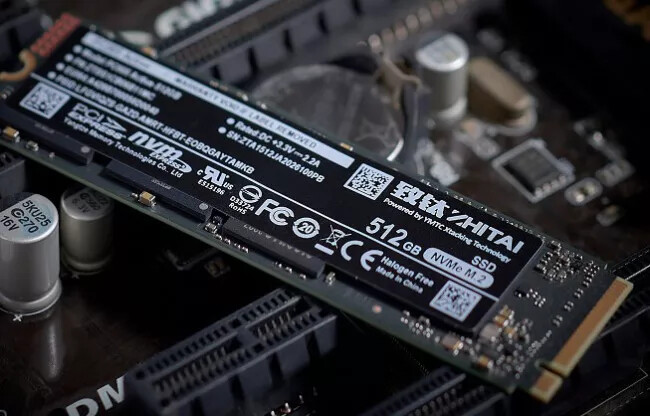
Colorful Technology Company Limited, a professional manufacturer of graphics cards, motherboards, all-in-one gaming and multimedia solutions, and high-performance storage, proudly presents its first-ever PCIe 3.0 NVMe solid-state drive - the COLORFUL WarHalberd CN600. COLORFUL collaborated with Yangtze Memory (YMTC) and Maxio Technology for the CN600 SSD. The cooperation between the companies will ensure the quality and performance of the flash components and the NVMe controller.

The COLORFUL WarHalberd CN600 NVMe SSD is a low-profile NVMe SSD in a standard 2280 M.2 form factor, designed for desktop PCs, laptops, ultrabooks, and mini-PCs. Using PCIe 3.0 X4 interface, the WarHalberd CN600 delivers speeds of up to 3300 MB/s read and up to 2600 MB/s write. The SSD will be offered in 256 GB and 512 GB capacities.

Global Ranking of Top 10 SSD Module Makers for 2020 Shows 15% YoY Drop in Annual Shipment, Says TrendForce

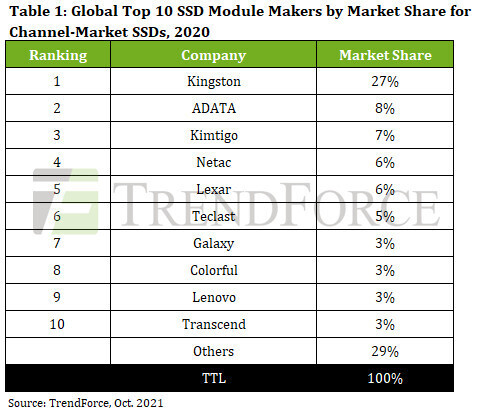
The emergence of the COVID-19 pandemic led to severe delays in manufacturing and logistics. In particular, governments worldwide began implementing border restrictions in 2Q20 to combat the ongoing health crisis, leading to a sudden decline in order volumes for channel-market SSDs, according to TrendForce's latest investigations. Annual shipment of SSDs to the channel (retail) market reached 111.5 million units in 2020, a 15% YoY decrease. In terms of market share by shipment, Kingston, ADATA, and Kimtigo once again occupied the top three spots, respectively.

Looking at the channel market for SSDs as a whole, NAND Flash suppliers (among which Samsung possessed the largest market share) accounted for around 35% of the total shipments in 2020, while SSD module makers accounted for the other 65%. The top 10 module makers accounted for 71% of channel-market SSD shipments from all SSD module makers. Taken together, these figures show that the market remained relatively oligopolistic in 2020. However, it should be noted that TrendForce's ranking of SSD module makers for 2020 takes account of only products bound for the channel market and under brands owned by the module makers themselves; NAND Flash suppliers were therefore excluded from the top 10 ranking.

Asgard Announces AN4 PCIe 4.0 SSD - 128 Layer 3D TLC NAND, 7,500 MB/s Read

Chinese manufacturer Asgard has announced the company's (and the Chinese market's) first PCIe 4.0 SSD. The AN4 pairs 128 Layer 3D TLC NAND manufactured by YMTC (Yangtze Memory Technologies Co., Ltd) Xtacking 2.0 technology, which uses a two-step manufacturing process wherein both NAND cells and interconnects are manufactured in two separate wafers and then optically fused. The NAND memory is then paired with Innogrit's IG5236 Rainier controller. The AN4 is rated for 7,500 MB/s and 5,500 MB/s sequential read and write speeds and features a "high" TBW endurance rating, though Asgard didn't clarify the exact random performance figures, nor the TBW rating for the SSD. Pricing is similarly up in the air - Asgard has only announced market availability for the 1 TB SSD solution come August, with additional 2 TB and 512 GB capacities being readied to market for a later timeframe.

The manufacturing technology of YMTC results in NAND that's as fast as Micron's latest 192-layer NAND tech, and beats well-established Kioxia's 96-layer technology performance-wise. One Bilibili forum user put the drive through its paces, and discovered that to unlock its full potential, one has to have a system capable of 512 bit maximum payload size (MPS), which is currently only supported by AMD motherboards - maximum Intel MPS currently stands at 256 bit, which "only" enables sequential performance of up to 7,150 MB/s. The user put the AN4 through a variety of tests, including PCMark 10's Drive Performance Consistency Test - a 10 to 20 hours workload marathon that puts more than 23 TB of drives on the SSD. It seems that Chinese manufacturers have achieved parity with the top western manufacturers, meaning there is one more option in the global, high-performance NAND market.

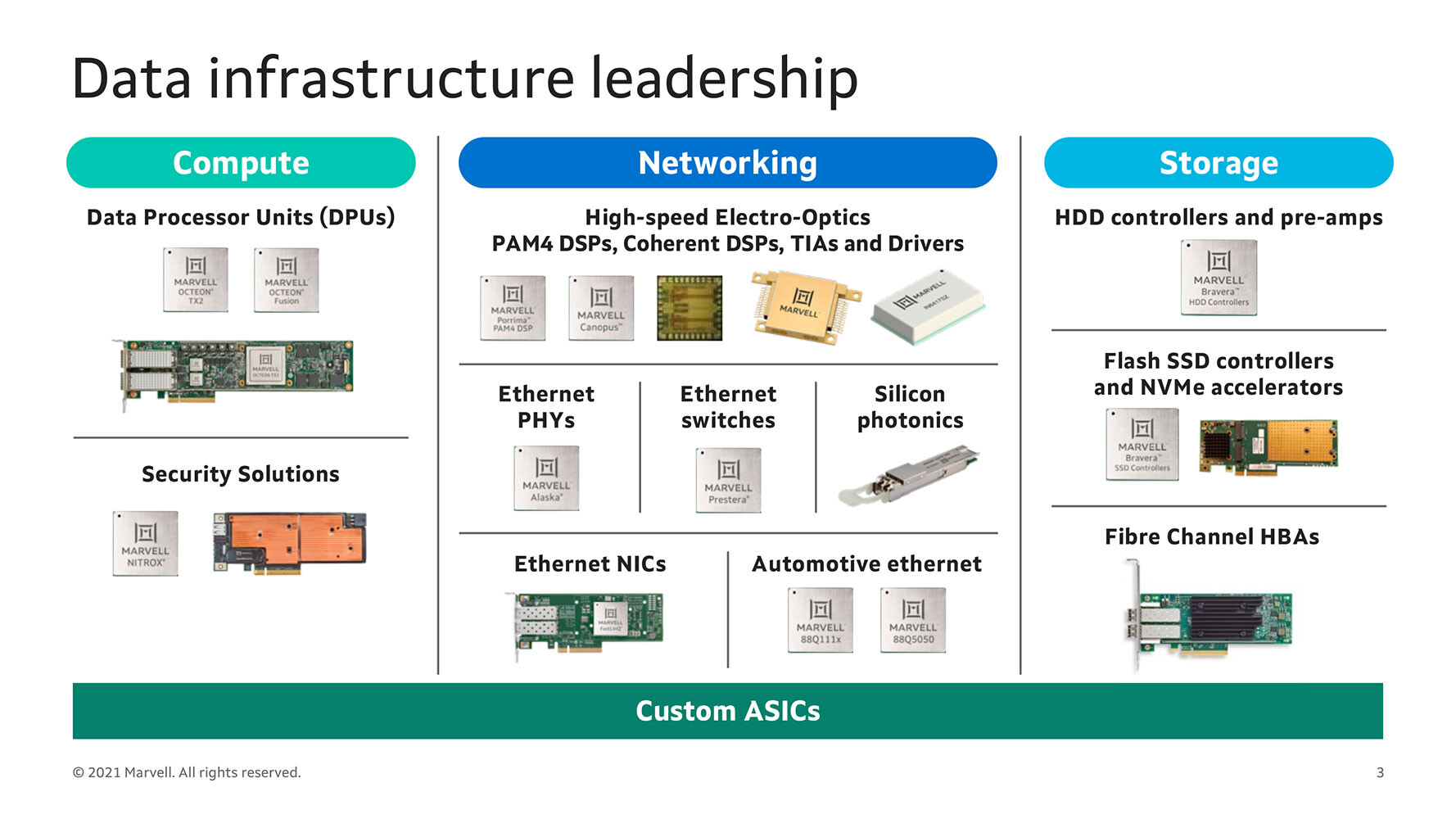
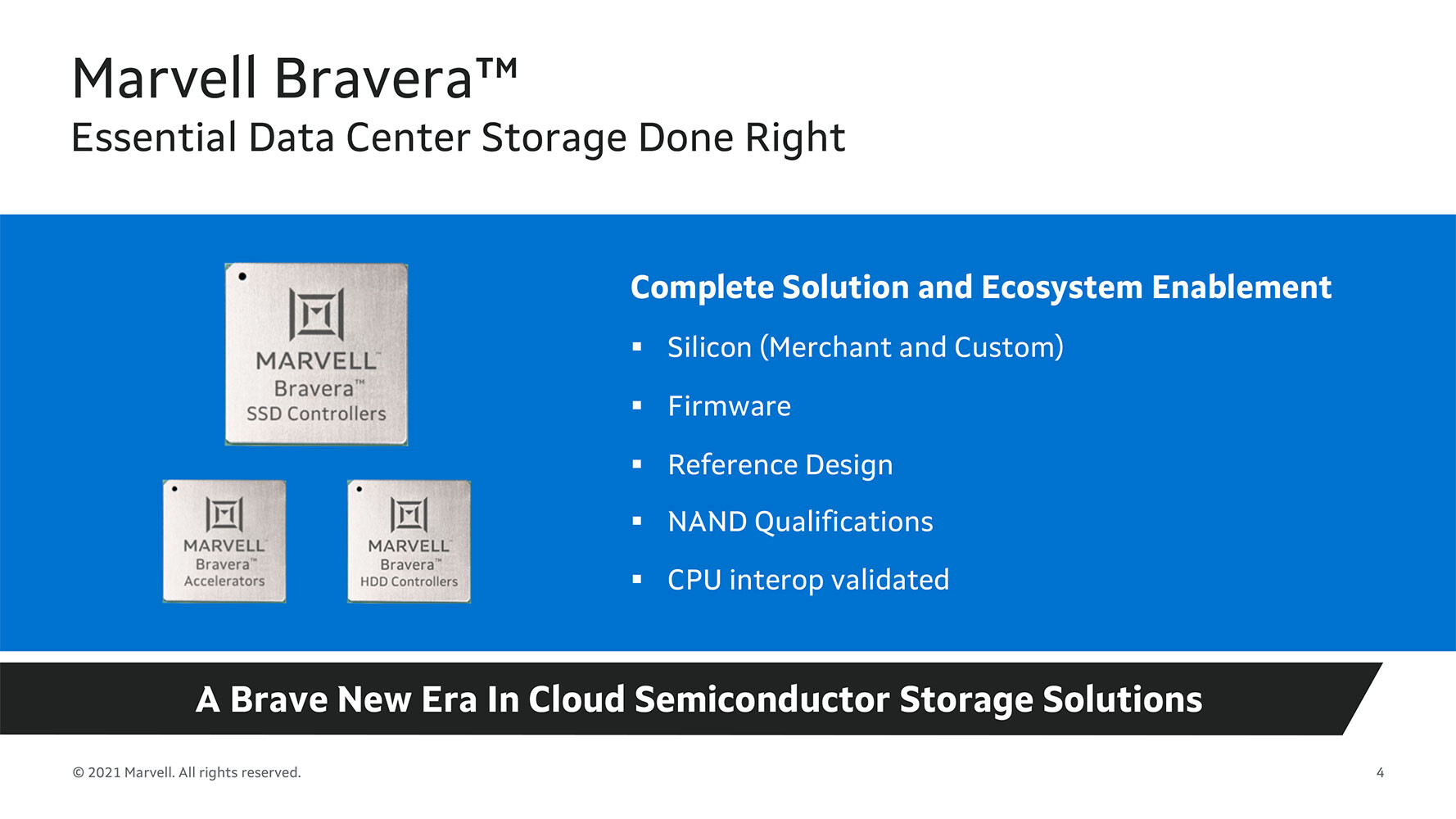
Marvell Announces Bravera, World's First PCIe 5.0 SSD Controllers

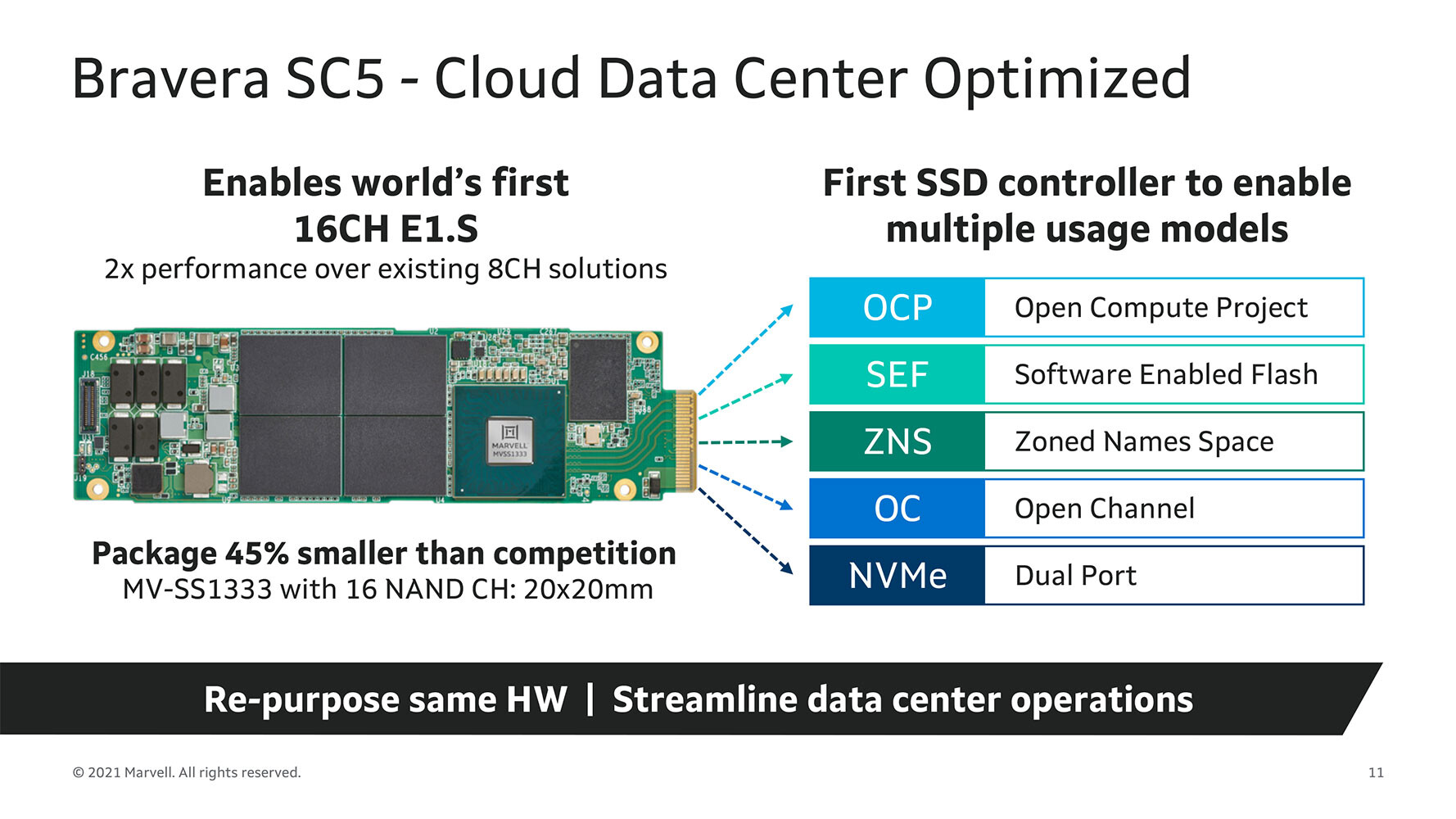
Marvell today announced its new Bravera SC5 controller family, bringing unprecedented performance, best-in-class efficiency, and leading security features to address ever-expanding workloads in the cloud. The massive amount of data to be processed in cloud data centers is driving demand for faster and higher bandwidth storage in these environments. Marvell's Bravera SC5 SSD controllers address the critical requirements for scalable, containerized cloud storage infrastructure. By enabling the highest performing flash storage solutions, Marvell's controllers are poised to be the foundation for data centers that offer ultra-low latency, real-time applications while also providing cost-optimized, cloud-scale capacity.

As the industry's first SSD controllers to support PCIe 5.0 and NVMe 1.4b, Marvell's Bravera SC5 doubles the performance compared to PCIe 4.0 SSDs. This contributes to accelerated workloads and reduced latency, dramatically improving the user experience. In order to meet cloud service providers' stringent security requirements to ensure users' data is safe and protected, the controllers offer FIPS-compliant root of trust (RoT), AES 256-bit encryption and multi-key revocation. The new controllers are the first with a hardware-based Elastic SLA Enforcer to assure quality of service (QoS) and provide metering capabilities per customer to increase overall storage efficiency and utilization while lowering total cost of ownership (TCO).

NAND Flash Contract Prices Projected to Increase by 3-8% QoQ in 2Q21 Due to Easing of Oversupply, Says TrendForce

With Samsung, YMTC, SK Hynix, and Intel leading the charge, NAND Flash suppliers will maintain an aggressive effort to expand their production capacities throughout 2Q21, during which NAND Flash bit output will likely increase by nearly 10% QoQ, according to TrendForce's latest investigations. On the other hand, orders from PC OEMs and Chinese smartphone brands since 1Q21, as well as recovering procurement activities from clients in the data center segment during 2Q21, will generate upward momentum propelling NAND Flash bit demand. Furthermore, buyers are actively stocking up on finished products, such as SSDs and eMMC, due to persistently limited NAND Flash controller supply. TrendForce therefore expects NAND Flash contract prices to increase by an average of 3-8% QoQ in 2Q21 after experiencing a 5-10% decline QoQ in 1Q21. In particular, as Samsung's Line S2 fab in Austin has yet to resume full operation after the Texas winter storm, the supply of NAND Flash controllers going forward may be at risk, and Samsung's ability to manufacture client SSDs will be further constrained as a result. In light of these factors, TrendForce is not ruling out the possibility that NAND Flash contract prices may increase by even more than current forecasts.

NAND Flash Revenue for 3Q20 up by Only 0.3% QoQ Owing to Weak Server Sales, Says TrendForce

Total NAND Flash revenue reached US$14.5 billion in 3Q20, a 0.3% increase QoQ, while total NAND Flash bit shipment rose by 9% QoQ, but the ASP fell by 9% QoQ, according to TrendForce's latest investigations. The market situation in 3Q20 can be attributed to the rising demand from the consumer electronics end as well as the recovering smartphone demand before the year-end peak sales season. Notably, in the PC market, the rise of distance education contributed to the growing number and scale of Chromebook tenders, but the increase in the demand for Chromebook devices has not led to a significant increase in NAND Flash consumption because storage capacity is rather limited for this kind of notebook computer. Moreover, clients in the server and data center segments had aggressively stocked up on components and server barebones during 2Q20 due to worries about the impact of the pandemic on the supply chain. Hence, their inventories reached a fairly high level by 3Q20. Clients are now under pressure to control and reduce their inventories during this second half of the year. With them scaling back procurement, the overall NAND Flash demand has also weakened, leading to a downward turn in the contract prices of most NAND Flash products.

YMTC Announces PC005 M.2 NVMe and SC001 SATA SSDs

Yangtze Memory Technology Company (YMTC), China's ambitious new memory manufacturer specializing in NAND flash, launched the first client-segment SSDs under its own brand, the PC005 Active series and the SC001 Active series. Rumors of YMTC developing its own brand SSDs surfaced first in June. Prior to that in May, it was reported that Phison could add support for YMTC NAND flash chips to variants of its existing SSD controllers, and so it's highly likely that the new YMTC SSDs use Phison-sourced controllers. Interestingly, the company deployed its first-generation Xtracking 64-layer 3D TLC NAND flash chips instead of its 2nd generation 128-layer QLC chips.

The PC005 Active comes in the M.2-2280 form-factor with PCI-Express 3.0 x4 host interface, leveraging the NVMe 1.3 protocol. The drive is available in 1 TB. 512 GB, and 256 GB capacities. All three variants read sequentially at speeds of up to 3,500 MB/s, wiring at up to 2,900 MB/s, up to 2,500 MB/s, and up to 1,200 MB/s, respectively. Their endurance is rated at 640 TBW for the 1 TB version, 320 TBW for the 512 GB, and 200 TBW for the 256 GB variant. All three are backed by 5-year warranties.

NAND Flash Revenue Rises 6.5% QoQ in 2Q20 Due to Pandemic-Induced Demand Growth for Cloud Services, Says TrendForce

The NAND Flash industry benefitted from strong demand for PCs and servers in 2Q20 as the COVID-19 pandemic caused a demand surge for cloud services and technologies that are related to working from home, according to TrendForce's latest investigations. This, in turn, kept demand high for SSDs. However, the smartphone and consumer electronics markets had not recovered from the impact of the pandemic. The demand for these products therefore declined compared to the previous quarter. In 2Q20, total NAND Flash bit shipment and ASP both experienced a minor increase of about 3% QoQ, while NAND Flash revenue reached US$14.5 billion, a 6.5% increase QoQ.

YMTC to Launch its Own SSD Brand Soon

YMTC (Yangtze Memory Technologies Corp) could launch its own SSD brand soon, according to a DigiTimes report. The Mainland Chinese NAND flash maker, which is taking giant strides with the development of NAND flash memory, could join Micron, SK Hynix, Kioxia, and Samsung, in being NAND flash vendors with their own finished SSD product lines on the side.

The SSD brand could be announced in Q3-2020, and could implement the company's 64-layer 3D TLC NAND flash memory in some of its first drives, moving on to 128-layer NAND flash chips next, as the company has pole-vaulted 96-layer. With Phison coming out with support for YMTC chips, it's likely that the company could get a break with these drives. YMTC is one of the rising stars of China's domestic high-technology industry, and a beneficiary of state investment as part of the Chinese Government's plan to eliminate dependency on foreign computer hardware as part of its "3-5-2 plan."

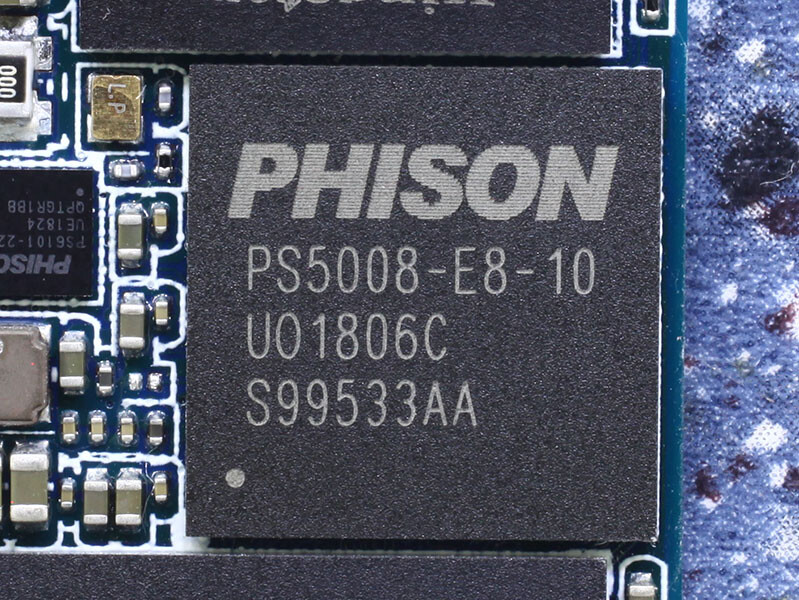
Phison Announces Support for YMTC 128-layer and 64-layer 3D NAND Flash Memory

SSD controller manufacturer Phison Electronics announced that its entire lineup of controllers are compatible with 64-layer 3D NAND flash memory chips by Yangtze Memory Technology Company (YMTC), the Chinese semiconductor firm specializing in memory devices, which is in the news for rapid product portfolio development in aid of China's plans to reduce dependence on foreign technology.

The company also announced readiness for YMTC's upcoming 128-layer 3D NAND flash memory chips. Phison's controllers feature industry-standard NAND flash interfaces, and supporting YMTC's chips would be as simple as developing an optimized firmware. YMTC leapfrogged from 64- to 128-layer, skipping the 96-layer product cycle. YMTC's 64-layer chips have been in mass-production since September 2019, and 128-layer chips will start shipping out later this year. Phison's first collaboration with YMTC will be for client-segment products, before developing enterprise-grade drives.

Intel Ready with 144-layer 3D NAND On its Own, Talks 4-layer 3DXP, "Alder Stream" and "Keystone Harbor"

Intel's memory and storage products division now has a completely independent NAND flash technology development team post its split with Micron Technology, with which it was part of the IMFlash Technologies joint-venture. Intel is close to gaining a technological lead over Micron with a new 144-layer 3D NAND flash chip which will ship roughly around the time Micron begins pushing out its 128-layer 3D NAND chips. SK Hynix will begin shipping its 128-layer 3D NAND flash chips later this year. KIOXIA will put out 112-layer chips before the turn of the year. YMTC is developing its portfolio at a breakneck pace.

The 144-layer 3D NAND flash chip by Intel can handle up to four bits per cell (QLC), and can be configured to function as TLC or SLC, at lower densities. Intel will launch its first SSD based on this 144-layer QLC NAND flash chip, codenamed "Keystone Harbor," later this year. Development is underway at Intel for PLC (5 bits per cell) technology, which should drive up densities by 25 percent. Intel is also close to launching its second generation 3D X-point memory technology.

China's Yangtze Memory Technologies' 64L Xtacking NAND Competitive Against Mainstream Manufacturers' Solutions

China's plans for world domination include the country slowly retracting itself from its dependency on western companies' technologies, via heavy acceleration of plans for and production of a myriad of semiconductor technologies. One of the more important technologies amongst those due to its relative ease of manufacture and overall market value is, of course, NAND technology. And the days of China being undoubtedly behind other manufacturers' technologies seems to be coming to an end, with the countries' Yangtze Memory Technologies (YMTC) 64-layer Xtacking TLC NAND design already achieving pretty impressive results compared to its mainstream counterparts.

Xtacking technology is expected to disrupt the $52 billion NAND memory market and its big players such as Micron, Samsung, SK Hynix, Kioxia, Western Digital, and Intel. The technology separates periphery circuits and memory cell operations towards a separate wafer, which allows for increased performance and throughput compared to other designs. Senior technical fellow Jeongdong Choe at Ottawa, Canada-based TechInsights (a company specializing in reverse-engineering semiconductor technology) has told EE Times YMTC's 64-layer, 256 Gb die bit density is 4.41 Gb/mm, which is higher than the Samsung equivalent 256 Gb die at 3.42 Gb/mm.
Cross-section SEM image along BL direction showing YMTC Xtacking architecture Objective Analysis’ annual report, China’s Memory Ambitions 2019

YMTC to Supply NAND Flash Chips to Lexar

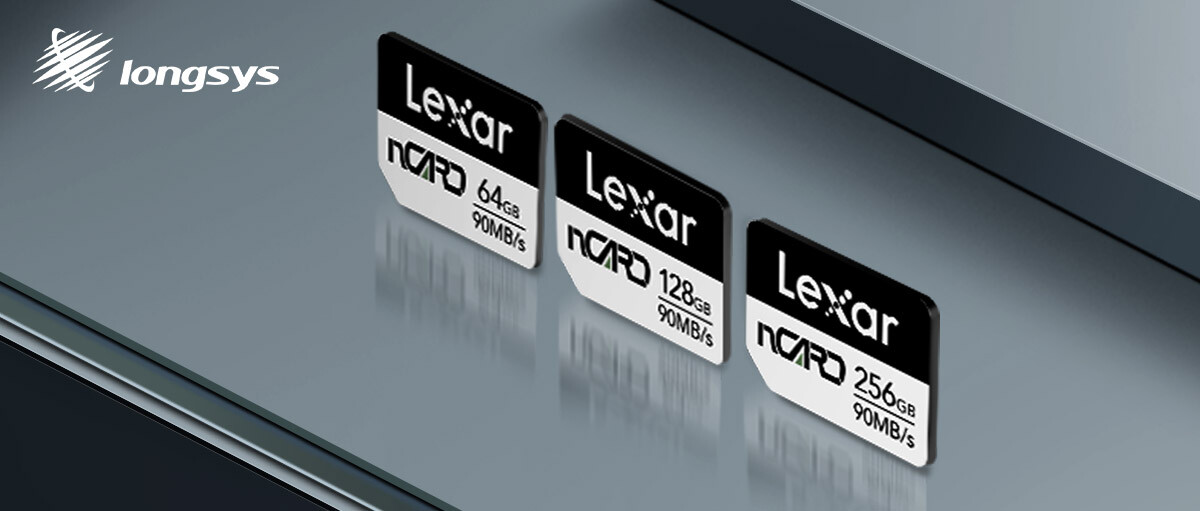
Mainland Chinese semiconductor firm Yangtze Memory Technologies Co (YMTC), has reportedly struck a NAND flash memory chip supply deal with popular solid-state storage products brand Lexar, which specializes in SSDs, memory cards, and USB flash drives; and more importantly, enjoys a prominent market presence in the West. Micron Technology had, in 2017, sold the Lexar brand to Longsys, a Chinese electronics conglomerate. YMTC's first products sold to Lexar will be a 512 Gbit 128-layer 3D QLC NAND flash memory chip for Lexar's nCard line of microSDXC cards, which ships in 64 GB, 128 GB, and 256 GB densities, offering transfer speeds of up to 90 MB/s reads, with up to 70 MB/s writes.

Samsung Developing 160-layer 3D NAND Flash Memory

Samsung Electronics is reportedly developing its 7th generation V-NAND memory with ultra-high 3D stacking technology. The first model will feature at least 160 layers, subsequent models will feature more. In early signs of the company not wanting to yield the technological initiative to China's YMTC, the first 160-layer V-NAND by Samsung is slated to come out roughly around the time YMTC's 128-layer 3D NAND flash hits mass production, towards the end of 2020.

At the heart of the ultra-high 3D stack is Samsung's proprietary Double Stack technology. The double-stack technology creates electron holes at two separate times for current to go through circuits. The current-generation single-stack chips creates these holes once throughout the stack per cycle. The 160-layer NAND flash is expected to herald a 67% increase in densities per package over the 96-layer chips in the market. Densities could also be increased by other means such as switching to newer semiconductor fabrication nodes, and PLC (5 bits per cell), which is currently being developed by KIOXIA.

YMTC Launches 128-layer 3D NAND Flash Memory Chip

Mainland Chinese semiconductor firm Yangtze Memory Technologies Co (YMTC) formally launched a product that could serve as a technological milestone for the company, a 128-layer 3D QLC NAND flash memory chip. Carrying the product naming series "X2-6070," the chip implements YMTC's XTracking 2.0 memory stacking architecture. This is a particularly big development for the company considering the chip's immediate predecessor is a 64-layer chip based on XTracking 1.0, which entered mass-production as recently as in September 2019, a time when most foreign firms such as Samsung, SK Hynix, and Micron, had moved on to 96-layer mass-production, having announced their 128-layer designs around June 2019. YMTC hence appears to have pole-vaulted 96-layer.

"With the launch of Xtacking 2.0, YMTC is now capable of building a new business ecosystem where our partners can play to their strengths and we can achieve mutually beneficial results," said Grace Gong SVP of sales and marketing at YMTC. "This product will first be applied to consumer-grade solid-state drives and will eventually be extended into enterprise-class servers and data centers in order to meet the diverse data storage needs of the 5G and AI era," Gong added. YMTC, part of the state-owned conglomerate Tsinghua Unigroup, is one of the dozens of beneficiaries of the Chinese government's initiative of localizing cutting-edge electronics technology, and reducing reliance on foreign hardware.

Yangtze Memory Begins Mass-production of 64-layer 3D NAND Flash Memory

Yangtze Memory Technologies (YMTC), a Chinese state-backed semiconductor company founded in 2016 as part of the Chinese Government's tech-independence push, has commenced mass-production of 64-layer 3D NAND flash memory chips, at a rate of 100,000 to 150,000 wafers per month leading into 2020. The 64-layer 3D NAND chips are based on YMTC's "in-house" Xtracking architecture. The company is already developing a 128-layer 3D NAND flash chip, and is skipping 96-layer along the way.

YMTC's capacity will be augmented by a new fab being built by its parent company, Tsinghua Unigroup. Tsinghua is a state-owned company which holds a controlling 51 percent stake in YMTC, and is a beneficiary of China's National Semiconductor Industry Investment Fund. When it goes online in 2021-22, the new Tsinghua fab, located in Chengdu, will augment YMTC's capacity by an additional 100,000 12-inch wafers per month. Its existing fab in Nanjing will also receive a capacity expansion.

Yangtze Memory Technologies to Debut New, Ultra-Fast 3D NAND Architecture and Deliver Keynote at Flash Memory Summit 2018

Yangtze Memory Technologies Co., Ltd (YMTC), a new player in the NAND industry, will be joining Flash Memory Summit this year for the first time, delivering a much-anticipated keynote address to reveal its ground-breaking technology - Xtacking. YMTC is the first Chinese company to take part in the high-entry-barrier NAND flash memory industry with its new architecture for unprecedented performance, higher bit density, and faster time-to-market.

Simon Yang, YMTC CEO, will deliver a keynote address, Unleashing 3D NAND's Potential with an Innovative Architecture, on August 7th, from 3:00 p.m. at the Mission Ballroom in the Santa Clara Convention Center, where he will illustrate how the company's new technology can increase NAND I/O speed up to DRAM DDR4 while delivering industry-leading bit density, marking a quantum leap for the NAND market.
Return to Keyword Browsing
Nov 21st, 2026 13:30 PST change timezone

New Forum Posts

Popular Reviews

TPU on YouTube

Controversial News Posts