News Posts matching #i3-8100

Return to Keyword Browsing

Rayman Legends Retold PC System Requirements: 1080p at 60 FPS on GTX 1660

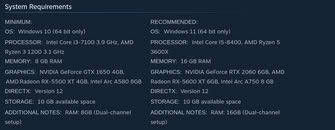
Optimization and low system requirements have been something of a trend in PC gaming of late, with even games like the upcoming Fable slated to be playable on entry-level gaming hardware from 2020. Despite its updated graphics and gameplay, Ubisoft's Rayman Legends Retold seems to be going down the same path. According to the recently announced system requirements for the game, Rayman Legends Retold will be playable at 1080p and 60 FPS on an NVIDIA GeForce GTX 1660, AMD Radeon RX 5500 XT, or Intel Arc A580 and Intel Core i3-8100 or AMD Ryzen 3100, as long as graphics are set to the low preset and the upscaler is set to Quality. On GPUs capable of using it, the game will rely on NVIDIA DLSS, but it will also feature FSR and XeSS, although exact upscaler versions were not specified. The original Rayman Legends is still available on Steam, and it is significantly less demanding on hardware, with recommended specs calling for only an Intel Core 2 Duo E4400 or AMD Athlon64 X2 3800+, 2 GB of RAM, an NVIDIA GeForce 9600 GT or AMD Radeon HD3850, and a mere 2 GB of RAM.

General system requirements also include at least 8 GB of RAM, with recommended, 2K, and 4K configurations all asking for 16 GB, 33 GB of storage, and Windows 10. Windows 11 is required when using DLSS, though, and ReBar must be enabled in order to use Intel GPUs. The recommended spec is aimed at running the game at 1080p, 60 FPS, with high graphics settings enabled on an Intel Core i5-8400 or AMD Ryzen 5 3600 and an NVIDIA GeForce RTX 3070, AMD Radeon RX 5700, or Intel Arc A750. There's no mention of native quality rendering, but tools like FSR 3 and XeSS generally use a 1.5× scale factor in Quality mode. The blanket use of Quality mode also means that gaming handhelds still stand a chance at decent frame rates when using Performance or Ultra Performance upscaling modes.

Intel Expands 8th Gen. Core Desktop Processor Family, Introduces New Chipsets

Intel today expanded its 8th generation Core desktop processor family, to include xx new models across its Core i7, Core i5, and Core i3 brand extensions. The company also introduced entry-level Pentium Gold and Celeron processors. The chips are based on the 14 nm "Coffee Lake" silicon, and are compatible with socket LGA1151 motherboards based on Intel 300-series chipset. Intel has relegated dual-core to the Celeron and Pentium Gold brands. The Celeron series includes 2-core/2-thread chips with 3 MB L3 cache; while the Pentium Gold series includes 2-core/4-thread chips with 4 MB L3 cache.

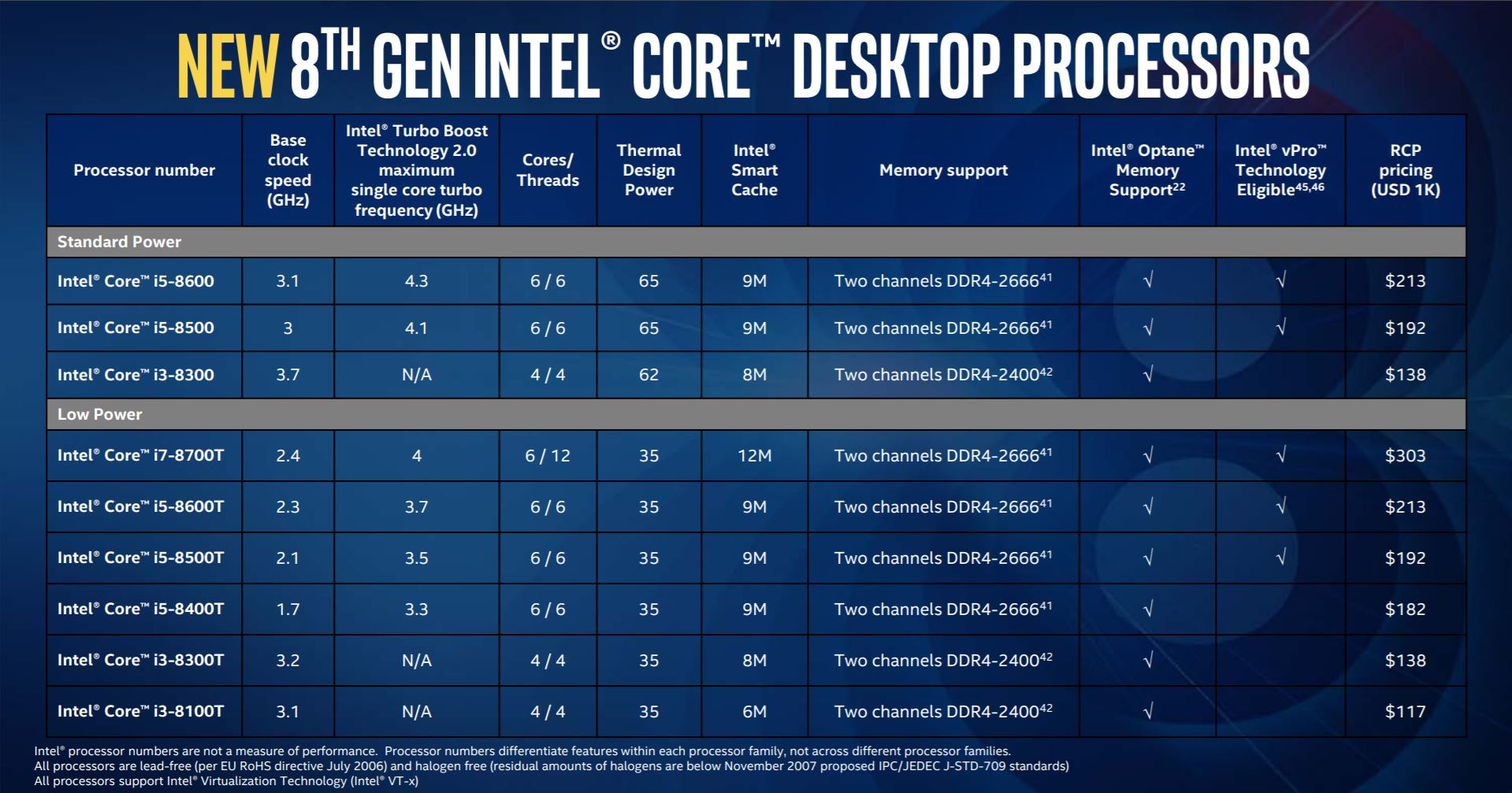
The company is launching the 8th generation Celeron series with two models, the G4900 and the G4920, clocked at 3.10 GHz, and 3.20 GHz, respectively. The Pentium Gold family has three parts, the G5400, the G5500, and the G5600, clocked at 3.70 GHz, 3.80 GHz, and 3.90 GHz, respectively. The 8th generation Core i3 family of 4-core/4-thread parts receives a new member, the i3-8300. Endowed with 8 MB of L3 cache, this chip is clocked at 3.70 GHz, and sits between the i3-8100 and the i3-8350K, but lacks the unlocked multiplier of the latter.

Modders Get "Coffee Lake" Chips to Work Stable on Intel 100/200-series Chipsets

One of the greatest complaints enthusiasts had with Intel's 8th generation Core "Coffee Lake" processors and their companion 300-series chipsets is their lack of compatibility with older 200-series and 100-series chipset motherboards, despite sharing an identical LGA1151 socket. Tinfoil hatters attributed this to Intel's synthetic platform-gating to ensure people buy new motherboards every two CPU generations; while Intel itself maintained that "Coffee Lake" chips have special electrical requirements that come with the increased core-counts, without explaining how that shouldn't exempt quad-core SKUs such as the Core i3-8100 and the i3-8350K from functioning on older platforms.

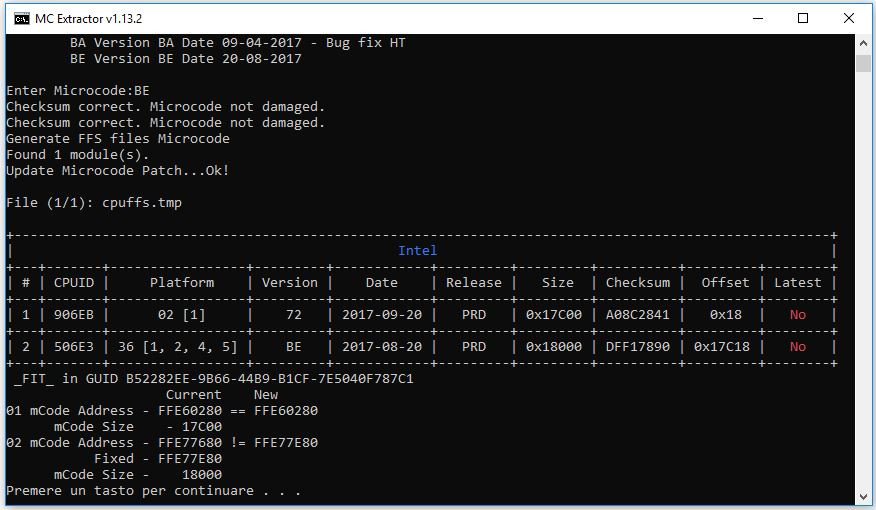
It turns out that "Coffee Lake" is pin-compatible with older LGA1151 motherboards based on 200-series and 100-series chipsets after all, as modders got some of these chips to work on the older platforms. Intel is using software to prevent Coffee Lake from working on older motherboards. This software comes in the form of the CPU's microcode, the iGPU's UEFI GOP driver, and certain Management Engine bootstraps on the side of the motherboard BIOS that lets it recognize the new chips. With the safe transplanting of these pieces of software, Overclock.net modders rootuser123, LittleHill, dsanke, elisw, Mov AX, and 0xDEAD; succeeding in not only getting the chips to work on older platforms, but also found ways to iron out several stability and compatibility issues. They've published a guide at this page.

8th Gen Core i3 Part of Intel's First "Coffee Lake" Wave

It was initially believed that Intel will launch its 8th generation Core "Coffee Lake" desktop processor lineup with only 6-core SKUs in the Core i5 and Core i7 extensions, priced well above $200; with Core i3 SKUs joining in Q1-2018. A popular retailer confirmed to us that the first wave will include two Core i3 SKUs, namely the Core i3-8100 and Core i3-8350K. Both these chips are quad-core, and lack both HyperThreading and Turbo Boost, but feature rather high clock speeds.

The Core i3-8350K is a particularly interesting SKU. This 4-core/4-thread chip features an unlocked base-clock multiplier, and 8 MB of L3 cache, as opposed to 6 MB on the i3-8100. Just as Intel previously differentiated its Core i3-x1xx SKUs from i3-x3xx SKUs by giving the latter 33.33% more L3 cache, the trend is continuing with the 8th generation, except that both the core-count and L3 cache amount has doubled over the 7th generation. The prices could be noticeably higher, too. The six SKUs Intel will launch for the retail channel on the 5th of October, are tabled below.

More Details Surface on Coffee Lake Lineup: i3-8350K, i3-8100 Specs Leaked Again

It appears that Intel's response to AMD's Ryzen desktop processors will be quite a departure from the norm for the blue company. That Ryzen CPUs with their price points are a disruptive piece of silicon is a well-known fact by now. However much we knew that, though, it appears that Intel really is giving a bold (some might say necessary) response to Ryzen's threat to their immutable (for so many years) CPU lineup.

There has already been a leak for the i3-8350K and i3-8100 CPUs for Coffee Lake; this second one comes more as a confirmation of what image was already forming in our minds. And it seems that Intel really is relegating their four-core, four-thread processors to the i3 tier, thus dropping its entire lineup by a rung. Some questions remain regarding Intel's i5 lineup: likely, entry-level processors of this tier ship with four cores and HyperThreading enabled. It's expected that some i5 models will carry six physical cores (absent of HyperThreading), though. This means Intel's clean segmentation, which started with Nehalem almost a decade ago (on the 45 nm process; do you remember that?) has been brought to an end. It also means my puny i5 will now be relegated to i3 territory, but that's... Life.
Return to Keyword Browsing
Nov 12th, 2026 18:25 PST change timezone

New Forum Posts

Popular Reviews

TPU on YouTube

Controversial News Posts