News Posts matching #qualification sample

Return to Keyword Browsing

Intel Reportedly Limits "Nova Lake DS" Samples, Rollout Starts in December

Intel is reportedly limiting access to some of its most interesting "Nova Lake" processors during the early development stages. According to leaker Jaykihn, chips with the internal "DS" designation are being distributed to a much smaller group of testers compared to the rest of the "Nova Lake" lineup. This "DS" designation reportedly includes parts built around two compute tiles, which are expected to be among the first to be released. These SKUs are currently known to carry the "BFC" suffix, which has appeared on several leaked Core Ultra 4000 desktop processors and is linked to Intel's larger big last-level cache (bLLC) implementation. For example, the leaked Core Ultra 9 4970K BFC is a 28-core processor combining eight P-cores, 16 E-cores, and four LPE cores.

The scarcity of BFC hardware in public leaks may be more related to Intel's sampling policy than to availability. The leaker claims these processors are being kept within a restricted testing group, preventing them from appearing through the standard qualification-sample pipeline that usually produces early benchmarks and hardware detections. This way, no public benchmark scores are surfacing, leaving us in complete dark before the official launch happens.
Intel Nova Lake

Latest HWiNFO Beta Adds Support for Intel Nova Lake Qualification Sample CPUs

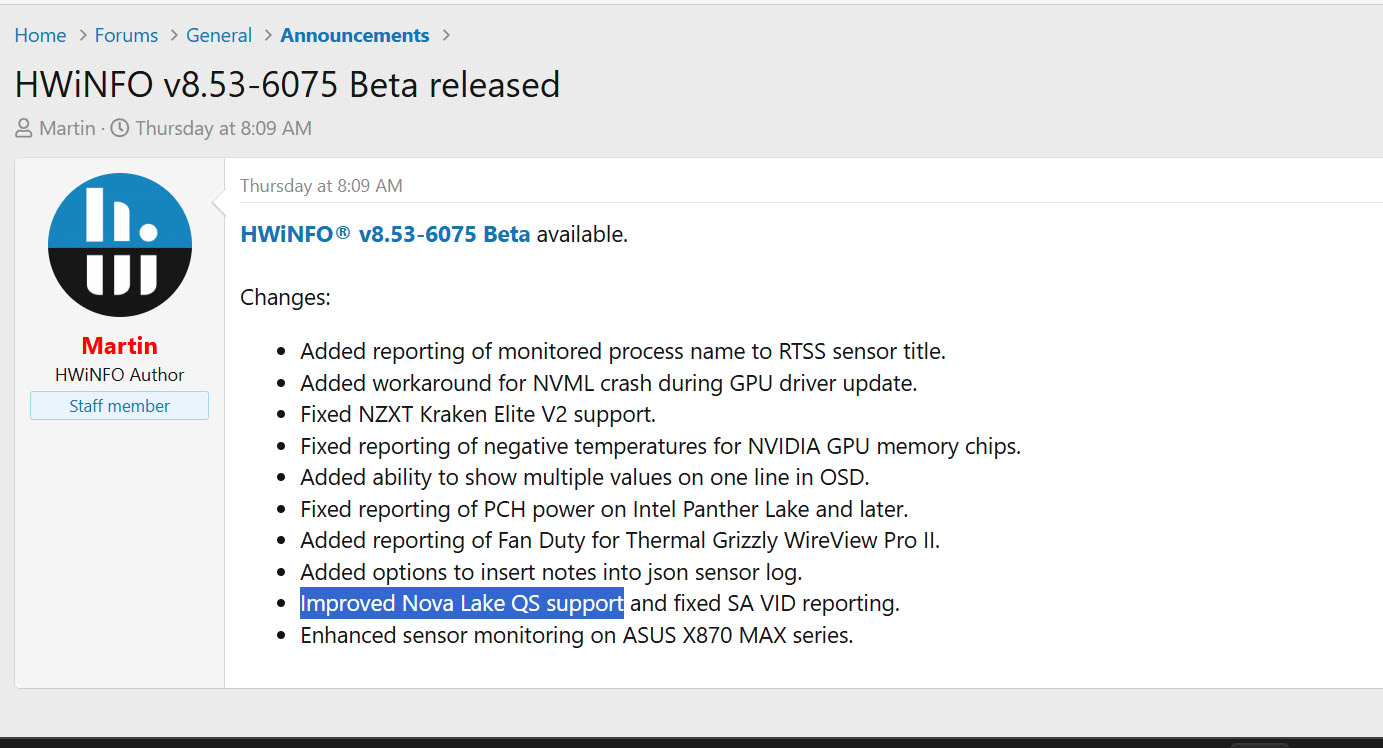
The latest HWiNFO 8.53 beta (build 6075) lists "Improved Nova Lake QS support and fixed SA VID reporting" in its changelog, as spotted by VideoCardz. QS stands for qualification sample, a stage that comes well after the early engineering samples that Intel sends to partners, and it usually sits much closer to retail silicon. HWiNFO has mentioned Nova Lake before, including enhanced support for the mobile Nova Lake-H and HX chips, but this is the first changelog line we've seen that names QS silicon directly. That strongly suggests Nova Lake hardware is very close to its retail form.

The System Agent VID fix is a small detail, but it looks like HWiNFO's developer is working with real telemetry rather than just adding a new identification string. That would suggest at least some developers or validation partners already have Nova Lake QS hardware, although this is an inference from one changelog line. Intel hasn't confirmed Nova Lake launch dates yet; however, previous reports point to an early 2027 release. Leaked roadmaps suggest 28-core desktop parts will arrive first, with the 52-core flagship arriving later in 2027.

Intel Core Ultra 9 4950K Could Signal New Naming Scheme for "Nova Lake-S"

Intel's upcoming desktop CPU generation, part of the "Nova Lake-S" processor family, might adopt a new naming convention that returns to a four-digit format, unlike the current three-digit format used in the "Arrow Lake" family. According to a leaked CPU-Z submission, Intel's Core Ultra 9 4950K has been identified as a 28-core "Nova Lake-S" desktop chip. It features 8 "Coyote Cove" P-Cores, 16 "Arctic Wolf" E-Cores, and 4 LPE-Cores. This chip was tested on an unknown Z990 high-end overclocking platform, where it achieved over 1,000 points in single-core CPU-Z rankings and exceeded 20,000 points in multicore performance. This performance surpasses any consumer-focused desktop CPU currently available.

Despite this information, it's still uncertain if the naming convention is final. Intel is testing many SKUs for "Nova Lake-S," and a four-digit naming could be necessary due to the numerous SKUs and configurations. Some leakers, like Golden Pig Upgrade and Gotou_3rd, have suggested that the four-digit naming is a possibility, leaving room for speculation. Interestingly, qualification samples for NVL-S have not yet started shipping, but we can expect these shipments in the coming weeks, before manufacturers and motherboard makers begin integrating the latest CPU generation into their products.

Intel's Alleged Flagship "Panther Lake-H" Ultra 9 386H Chip Gets Geekbenched

An intriguing Intel Core Ultra 9 386H mobile processor has turned up on Geekbench Browser, as spotted by early morning risers. Today's reports have focused on details produced by an "Acer Predator PHN16S-I51" test subject; presumably a next-gen Helios gaming laptop. The plucky system—sporting 64 GB of memory—was put through the Geekbench 6.50 wringer, running a Windows 11 Pro 64-bit OS combined with a Balanced power plan. Fundamental frequencies and core counts were leaked at the start of this month: 4 P-Cores, 8 E-Cores, 4 LPE-Cores. Presently, this supposed 16-core engineering sample (ES) has racked up impressive single and multicore scores: 2849 and 15434 (respectively). According to Notebookcheck, this data places the Ultra 9 386H ES chip just above the performance range of Team Blue's current-gen "Arrow Lake-H" Core Ultra 9 285H APU.

Crucially, this forthcoming premium component surpasses AMD's Ryzen AI Max+ 395 "Strix Halo" SoC (by a small margin) in single-core performance stakes. Team Red's mobile 16-core Zen 5 flagship remains top of the multicore table. Intel's Core Ultra 300 family is pencilled in for an official launch at CES 2026, but a plethora of leaks have disclosed all manner of pre-launch material. Late last week, photos of an alleged Core Ultra 3 "Panther Lake-H" qualification sample ended up online, alongside CPU-Z-generated diagnostics.

Micron Ships Automotive UFS 4.1 Based on G9 NAND

Micron Technology, Inc., today announced shipping of qualification samples of its automotive universal flash storage (UFS) 4.1 solution to customers worldwide, enabling rapid data access, robust reliability and enhanced safety and security for next-generation vehicles. Delivering bandwidth of 4.2 gigabytes per second (GB/s) - double that of its predecessor - Micron's automotive UFS 4.1 accelerates data access for AI models, enriching the in-cabin experience by powering features such as voice assistants, personalized infotainment and advanced safety alerts. This bandwidth in advanced driver assistance systems (ADAS) and autonomous vehicles also enables rich data capture from cameras, lidar and radar sensors to upload and feed AI model retraining and enhancement in the data center.

Micron's automotive UFS 4.1 is built with the company's sophisticated 9th-generation (G9) 3D NAND flash memory technology, delivering high performance and capacity and supplying the market with the latest process technology to accelerate AI. With this rollout, Micron G9 NAND is the most advanced NAND in the industry to be qualified for rigorous automotive standards such as the AEC-Q104 - enabling Micron's UFS 4.1 to meet the high bar required for automotive quality, safety and reliability.

Intel 14th Gen Raptor Lake Refresh Full Lineup Leaks Out

Six Intel 14th Gen Core Raptor Lake-S Refresh SKUs were prematurely listed by an e-tailer late last month, with the already leaked Core i9-14900K CPU model popping up again (a week later) via CPU-Z and Geekbench tests. This higher end K and KF product lineup is expected to launch at some point next month—according to the rumor mill. Team Blue could be preparing cheaper non-K models for an unveiling at CES 2024, but a leaker has decided to spoil the fun way in advance. YuuKi_AnS uploaded an allegedly extremely comprehensive list of 14th Gen SKUs, complete with full specifications to their X/Twitter handle. This grants an early glimpse of lowly Intel 300 and 300T models—both featuring a 2P+0E core configuration—these appear to be modern successors to (now retired) Pentium Gold and Celeron branded budget-friendly processor families.

It should be noted that the leaked slide (dated September 5) states that everything sitting within the table is a qualification sample (QS), therefore these chips are subject to change due to their pre-production nature. Parts of the table look a bit iffy—support for DDR5 memory varies across the range, while EEC memory support is also very inconsistent. Intel seems to be sticking with the usual set of three different die designs for desktop Raptor Lake Refresh CPUs—Tom's Hardware points out that: "the B0 die (8P-16E) powers SKUs from the Core i5-14600 and up, while the C0 (8P+8E) die targets models from Core i5-14400 to Core i5-14500T. On the contrary, the H0 (6P+0E) die, which is the lowest of the trio, will be inside the Intel 300 to Core i3-14100T chips."
Return to Keyword Browsing
Nov 12th, 2026 06:35 PST change timezone

New Forum Posts

Popular Reviews

TPU on YouTube

Controversial News Posts