News Posts matching #sanctions

Return to Keyword Browsing

U.S. Government to Allow Chipmakers to Expand Facilities in China

The United States government has imposed sanctions on companies exporting their goods to China with the aim of limiting the country's technological advancements. This forced many companies to reduce their shipments of the latest technologies; however, according to the latest information from The Wall Street Journal, the Biden administration will allow companies to keep expanding their production capacities in China. As the source notes, quoting statements from government officials, the top semiconductor makers such as Samsung, SK Hynix, and TSMC, all of which have a chip production facility in China, will be allowed to expand the production capacity without any US backlash.

Of course, this does not contradict the plan of a US export-control policy, which the administration plans to continue. Alan Estevez, undersecretary of commerce for industry and security, noted last week in the industry gathering that the US plans to continue these restrictions for another year. Reportedly, all manufacturers of wafer fab equipment (WFE) from the US must acquire an export license from the Department of Commerce before exporting any tools for making either logic of memory chip indented for customers in China. Chipmakers Samsung, SK Hynix, and TSMC all received their licenses to export from October 2022 to October 2023. However, the US government now allows these companies to continue upgrading their Chinese plans beyond the renewed license expiry date of October 2024.
Russian CPUs Reported to be in High Demand as Prices Climb

Russian business news outlet Kommersant has learned from industry figures that prices of natively-designed computer processors have been on the rise since the beginning of 2023. Domestic manufacturers of PC, server and storage systems are requiring greater supplies of CPUs designed by Baikal Electronics and MCST - the publication posits that growing demand and logistical issues have become the root cause of recent climbs in cost - individuals involved in the computer hardware supply chain have suggested that some processor models have doubled in price. Sergey Ovchinnikov, the chief executive of Norsi-Trans (a server and data storage firm) provided comment: "Production of Russian chips at foreign fabs has become more complex, leading to extended logistics chains and, consequently, an increase in the cost of the final component." International trade sanctions have not prevented the arrival of fresh silicon into the region - Ovchinnikov claims that an unnamed foundry is able to supply (likely via proxy) Russian developers with computer processors.

Kommersant's investigation found out that Baikal's BE-T1000 CPU is now sold for roughly $110 (8900 Rubles) at a popular computer hardware e-tailer (ChipDip) in the region. The very basic dual core MIPS32r5 (28 nm) processor was readily available for $50 (3990 rubles) back in 2018, so its price has risen by 220% in recent times. TSMC was contracted as the manufacturer of Baikal's BE-T1000 CPU, and the Taiwanese foundry started producing these SoCs in 2016. A Baikal Electronics representative has denied any involvement in driving up MSRP, and states that it is up to distributors and retail outfits to determine prices. The company suspects that very old stock is being sold at inflated rates - Kommersant was unable to contact anyone at ChipDip for a statement.

YMTC Using Locally Sourced Equipment for Advanced 3D NAND Manufacturing

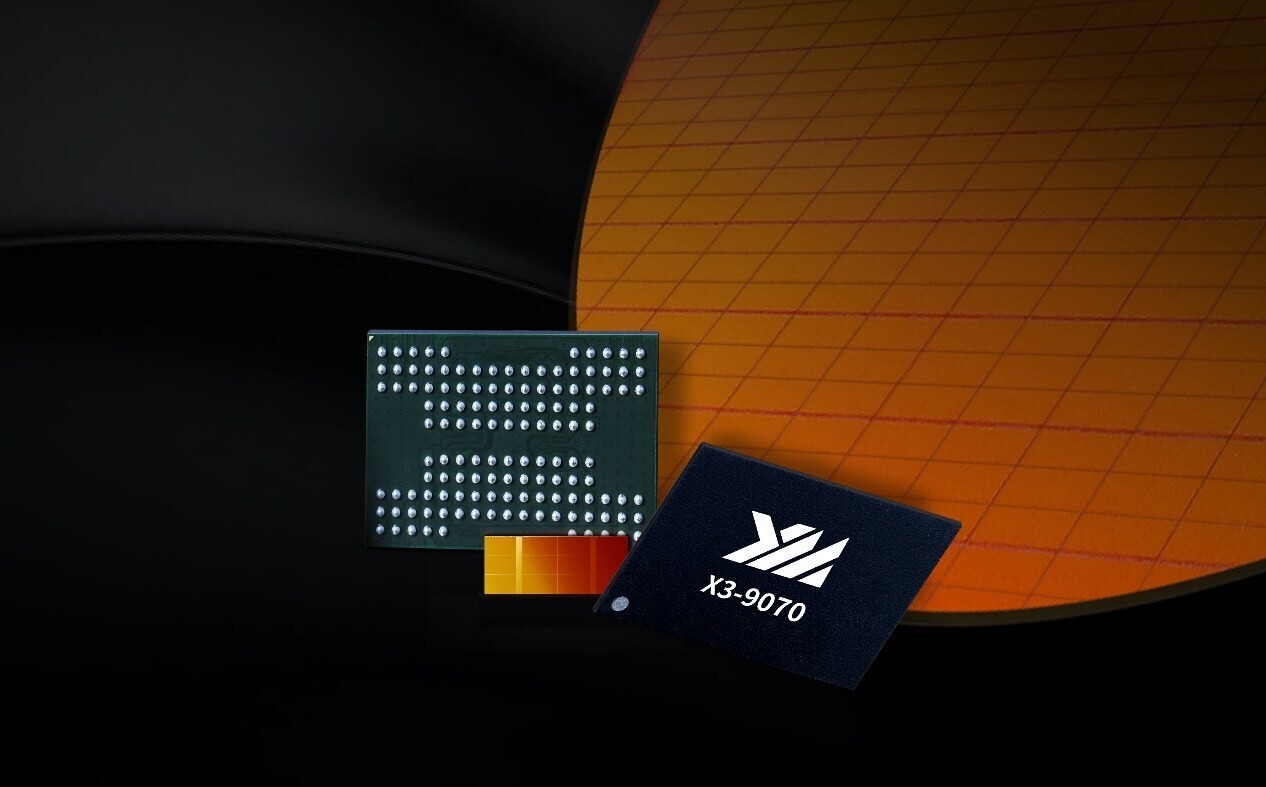
According to the South China Morning Post (SCMP) sources, Yangtze Memory Technologies Corp (YMTC) has been plotting to manufacture its advanced 3D NAND flash using locally sourced equipment. As the source notes, YMTC has placed big orders from local equipment makers in a secret project codenamed Wudangshan, named after the Taoist mountain in the company's home province of Hubei. Last year, YTMC announced significant progress towards creating 200+ layer 3D NAND flash before other 3D NAND makers like Micron and SK Hynix. Called X3-9070, the chip is a 232-layer 3D NAND based on the company's advanced Xtacking 3.0 architecture.

As the SCMP finds, YTMC has placed big orders at Beijing-based Naura Technology Group, maker of etching tools and competitor to Lam Research, to manufacture its advanced flash memory. Additionally, YTMC has reportedly asked all its tool suppliers to remove all logos and other marks from equipment to avoid additional US sanctions holding the development back. This significant order block comes after the state invested 7 billion US Dollars into YTMC to boost its production capacity, and we see the company utilizing those resources right away. However, few industry analysts have identified a few "choke points" in YTMC's path to independent manufacturing, as there are still no viable domestic alternatives to US-based tool makers in areas such as metrology tools, where KLA is the dominant player, and lithography tools, where ASML, Nikon, and Canon, are noteworthy. The Wuhan-based Wudangshan project remains secret about dealing with those choke points in the future.

Strict Restrictions Imposed by US CHIPS Act Will Lower Willingness of Multinational Suppliers to Invest

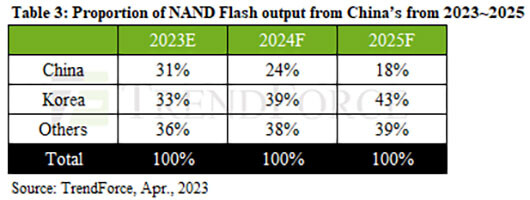
TrendForce reports that the US Department of Commerce recently released details regarding its CHIPS and Science Act, which stipulates that beneficiaries of the act will be restricted in their investment activities—for more advanced and mature processes—in China, North Korea, Iran, and Russia for the next ten years. The scope of restrictions in this updated legislation will be far more extensive than the previous export ban, further reducing the willingness of multinational semiconductor companies to invest in China for the next decade.

CHIPS Act will mainly impact TSMC; and as the decoupling of the supply chain continues, VIS and PSMC capture orders rerouted from Chinese foundries
In recent years, the US has banned semiconductor exports and passed the CHIPS Act, all to ensure supply chains decoupling from China. Initially, bans on exports were primarily focused on non-planar transistor architecture (16/14 nm and more advanced processes). However, Japan and the Netherlands have also announced that they intend to join the sanctions, which means key DUV immersion systems, used for producing both sub-16 nm and 40/28 nm mature processes, are likely to be included within the scope of the ban as well. These developments, in conjunction with the CHIPS Act, mean that the expansion of both Chinese foundries and multinational foundries in China will be suppressed to varying degrees—regardless of whether they are advanced or mature processes.

Cisco Wiped Out $23.5 Million of Unsold Gear During Exit From Russia

According to news agencies residing within Russian territories, it has been widely reported that Cisco has destroyed an inventory of unsold equipment with a total worth of $23.5 million. TASS, a Kremlin-controlled news organization, has made reference to account statements provided by Cisco Systems (the remaining legal entity of the Cisco Group based within the Federation) - it reports that the equipment was "physically destroyed" in January 2023, post a termination of sales in Russia and Belarus. The financial statements outline the liquidation of "primarily spare parts," but the agency claims that Cisco engaged in the destruction of network hardware, demo units and office furniture.

Cisco was one of the first tech companies to withdraw from Russian territories, following the full-scale invasion of the Ukraine. Soon after the beginning of the conflict, Cisco Systems announced the cessation of its business dealings, starting with a stoppage of sales in March 2022. A June deadline was specified for a complete shutdown of operations. The company made a decision by August 2022 to dispose of unsold inventories located within affected territories - the necessary permits for re-export of goods had not been obtained. It is not clear whether U.S. sanctions (against Russia) played a part in influencing the North American tech company's decision to engage in a scorched earth policy and obliterate the physical remnants of stock plus premises in Russia and Belarus.
Return to Keyword Browsing
Nov 14th, 2026 00:28 CST change timezone

New Forum Posts

Popular Reviews

TPU on YouTube

Controversial News Posts