News Posts matching #ssd

Return to Keyword Browsing

Supply Chain Overstocked, NAND Flash 3Q22 Price Drop to Broaden to 8~13%, Says TrendForce

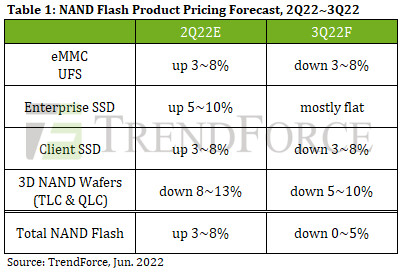
According to TrendForce, market oversupply intensified in 2Q22 due to lagging demand and continued NAND Flash output and process advancement. The market consensus is a disappointing 2H22 peak season for consumer electronics including notebooks, TVs, and smartphones. Material inventory levels continue to rise and has become a risk to the supply chain. Due to slow destocking among distributors and a conservative stocking approach among clients, inventory problems have bubbled over upstream onto the supply side and sellers are under increased pressure to sell. TrendForce estimates, due to the rapid deterioration of the balance between supply and demand, the drop in NAND Flash pricing will expand to 8~13% in 3Q22, and this decline may continue into 4Q22.

In terms of Client SSD, due to weak consumer demand, various PC brands have significantly reduced their purchase order volume in 3Q22 in order to digest 1H22 SSD inventory. As suppliers shift focus to 176-layer client SSD, 176-layer QLC SSDs have begun to ship, and YMTC looks to expand shipment of notebook client SSDs in 2H22, price competition has become increasingly fierce, forcing manufacturers to increase price concessions to incentivize clients to up order volume. Thus, the decline in client SSD pricing is expected to expand to 8~13% in 3Q22.


ADATA to Unveil its Latest Products Inside an Immersive Virtual World

ADATA Technology, a leading manufacturer of memory modules, USB flash drives, memory cards, solid state drives, portable hard drives, and gaming peripherals, today announces that it will be displaying and unveiling its latest products inside the MERAVERSE. The MERAVERSE is a virtual universe created to engage the world beyond the limitations of distance and time. ADATA is keen to provide consumers with an interactive experience by offering virtual exhibitions. On show will be ADATA and XPG's next-generation DDR5 memory modules, solid state drives, gaming products, and more.

Products of note include the ADATA ACE 6400 DDR5 memory module, XPG Gen5 x 4 solid state drive (SSD), and the 2022 Red Dot Design Award winning XPG ALPHA WIRELESS gaming mouse, which has also received several additional awards from other globally recognized media.

Team Group Launches AIO Cooler with Support for PCIe 5.0 NVMe SSDs

In recent years, consumer storage products have seen rapid developments. This year, the industry will officially be entering the first year of Gen5 SSDs. In response to risen temperatures caused by the high transfer speeds of PCIe Gen 5 SSDs, T-FORCE, the gaming sub-brand of Team Group, has launched the world's first all-in-one ARGB liquid cooling system to reduce heat generated by both the CPU and SSD, allowing PCIe Gen5 SSDs to maintain optimal temperatures and stable, high-speed operations for sustained periods. With the new cooling solution, consumers can fully experience the efficient storage performance of next-generation SSDs without any compromises.

Beginning in the 2000s, as the consumer market demanded higher read and write speeds for storage devices, solid-state drives (SSDs) began to replace mechanical hard drives (HDDs) in large numbers. SATA SSDs eventually became the go-to choice for storage upgrades. With the demand for high-speed storage driven by big data and the spread of transmission technology, PCIe became the standard interface for high-speed transmission. In the past few years, read speeds of PCIe SSDs have increased from 3,500 MB/s in Gen3 to 7,000 MB/s in Gen4. PCIe Gen5 SSDs now have over 12,000 MB/s read and write speeds. The large leaps in transfer speeds of each successive generation of SSDs have led to increased power wattage, which in turn have resulted in higher operating temperatures. When SSDs experience rising operating temperatures at high transfer speeds, an automatic throttling mechanism is activated to protect components from damage caused by the high temperatures. With power consumption of approximately 12 W on a PCIe Gen4 SSD running at 7,000 MB/s, the controller temperature can reach over 110℃. When PCIe Gen5 SSDs have speeds of over 12,000 MB/s and consume 14 W or above, one can expect controller temperatures to rise sharply. Therefore, Team Group is committed to providing the best thermal solutions for stable, high-speed operation of SSDs over sustained periods.

Shuttle Unveils XPC Barebone XH510G2 Desktop

The Mini-PC pioneer Shuttle is venturing to achieve the delicate balance between compactness and flexibility with the 4.7-litre design. It has produced a 9.5 cm flat Mini-PC Barebone for lots of Intel Core processors of the 10th & 11th generation which features two PCI Express slots. This means it can confidently compete directly with workstations from major manufacturers with a similar format.

As its base area is only 25 × 20 cm, smaller than a sheet of A4 paper, it fits almost anywhere. Even the overall height of 9.5 cm is regarded as flat and provides plenty of space, for example for Intel Core i9 processors, dual-slot graphics cards, 64 GB of RAM and three drives. "Probably the biggest advantage over other products in the market is the flexibility. Buyers can decide the details of which components they want to use and the choice of operating system," explains Tom Seiffert, Head of Marketing & PR at Shuttle Computer Handels GmbH. "From the entry-level version with scope for an upgrade, through to the maximum configuration level, with the XH510G2 you have almost free rein to decide on a surprisingly large number of features."

Western Digital Releases First Officially Licensed M.2 SSD for the Sony PlayStation 5

Western Digital Corp. and Sony Interactive Entertainment LLC ("SIE") teamed up to deliver the industry's first official PlayStation -licensed M.2 SSD for PlayStation 5 (PS5) to gamers across the globe. The WD_BLACK SN850 NVMe SSD for PS5 Consoles enables players to expand the high-speed storage capacity of their PS5 console and gives them peace of mind knowing that their new and favorite titles are stored on a drive that's been battletested to take on the most intensive PS5 gameplay.

Optimized for the newest-generation console, Western Digital validated drive performance through multiple scenarios to ensure the drive has been fully tested for the PS5. This process included hundreds of hours spent rigorously testing some of the most graphic-rich titles across various genres to ensure that with games stored on the drive, gameplay is fast, smooth and visually immersive.

QNAP Collaborates with Intel to Launch the Industrial-grade TS-i410X 10GbE NAS Solution

QNAP Systems, Inc., a leader and innovator in computing, networking, and storage solutions, introduced the robust and industrial 10GbE NAS - TS-i410X. Built with a fanless design, a rock-solid chassis, multiple flexible installation options (set-top box or wall mounted), and a wide-range temperature and DC power support, the TS-i410X is an ideal NAS solution for factories and warehouses, semi-outdoor environments, and transportation.

Non-office settings would significantly benefit from a NAS, as they are designed for high performance in varying temperatures, environments, and conditions. The robust TS-i410X ensures reliable operations, between -40°C ~ 70°C (-40°F ~ 158°F), when used with industrial-grade SSDs (such as Exascend SI3 2.5-inch SSD). The 9 V-36 V DC wide-range power supply meets the various input voltage requirements for industrial and transportation applications. The TS-i410X utilizes the high-performance Intel Atom x6425E quad-core processor (up to 3.0 GHz), with AES-NI accelerated encryption and long-term life cycle support of at least seven years, along with 8 GB memory and four 2.5-inch SATA 6 Gb/s drive bays that are ideal for SSDs. Given these enhancing designs, users can effectively implement SSD cache acceleration, improving all-round NAS performance and access speeds.

Transcend Announces ESD380C USB 3.2 Portable SSD

Transcend, a leading brand of digital storage and multimedia products, recently announced a new high-speed portable SSD, ESD380C, that comes with a USB 3.2 Gen 2x2 interface, a performance speed of 2,000 MB/s, and up to 2 TB of ample storage space, all in an anti-shock, compact design. This strikingly fast, durable, and secured portable SSD brings the performance of creative professionals and gamers to the next level.

The ESD380C features a USB 3.2 Gen 2x2 interface and a Type-C port, bringing the speed up to 2,000 MB/s. The high performance and low latency are capable of saving 4K videos, high-resolution images, and large media files. The ESD380C is housed in an aluminium enclosure, which is durable to protect data stored on the drive and enhances heat dissipation. The Dynamic Thermal Throttling mechanism allows a more stable performance even under demanding operations.

LIAN LI 2022 Digital Expo 2.0 Reveals Exciting New Prototypes and Updates

LIAN LI Industrial Co. Ltd., a leading manufacturer of aluminium chassis and PC accessories, premieres the LIAN LI 2022 DIGITAL EXPO 2.0 at 9 am EST on YouTube (here). The 2-part video series reveals new prototypes of 3 cases, 4 fans, and an All-In-One liquid cooler. The new cases include the LANCOOL 216, DAN Cases A3 m-ATX, and the highly anticipated O11D EVO XL. LIAN LI also presents the next generation UNI FANs with SL120 V2, SL140 V2, AL120 V2, and AL140, including an update of the UNI FAN P28. And the show closes with a new 100% LIAN LI design All-In-One liquid cooler.

The LANCOOL 216 is a mid-tower with excellent cooling and is configurable for air or All-In-One liquid cooling. The rotatable I/O shield enables Upper Motherboard or Air Cooling mode, where the motherboard can be installed higher for extra room for vertical GPUs and larger CPU tower coolers. By rotating the I/O shield 180 degrees, it enables the Lower Motherboard or All-In-One Liquid Cooling mode to support thicker radiators and lengths of up to 360 mm. To maximize the air intake and exhaust, an external rear fan 120 mm bracket can be installed below the GPU IO ports, and a cover plate can be added on the top to seal off unnecessary openings to reduce air pressure loss.

ADATA Launches Industrial-Grade 31C Series 112-Layer BiCS5 Solid State Drives

ADATA Technology, a leading manufacturer of industrial-grade DRAM modules and NAND Flash products today announces the industrial-grade ADATA 31C series 112-layer 3D NAND (BiCS5) solid state drives (SSD) utilizing the SATA III interface. They include the ISSS31C 2.5-inch, IM2S31C8 M.2 2280, and IM2S31C4 M.2 2242 SSDs. All three SSDs are designed to be energy efficient, feature high capacities, and are well suited for high-load industrial systems relating to industrial computing, embedded devices, automation, networking, transportation, and other fields.

The industrial-grade ISSS31C 2.5-inch, IM2S31C8 M.2 2280, and IM2S31C4 M.2 2242 SSDs are all equipped with 112-layer 3D TLC (BiCS5) flash memory developed by WDC and KIOXIA and come with a maximum capacity of 2 TB. They have undergone rigorous temperature verification and testing to ensure they can operate optimally in a wide range of temperatures (from -40 °C to 85 °C) to ensure excellent quality, reliability, and durability.

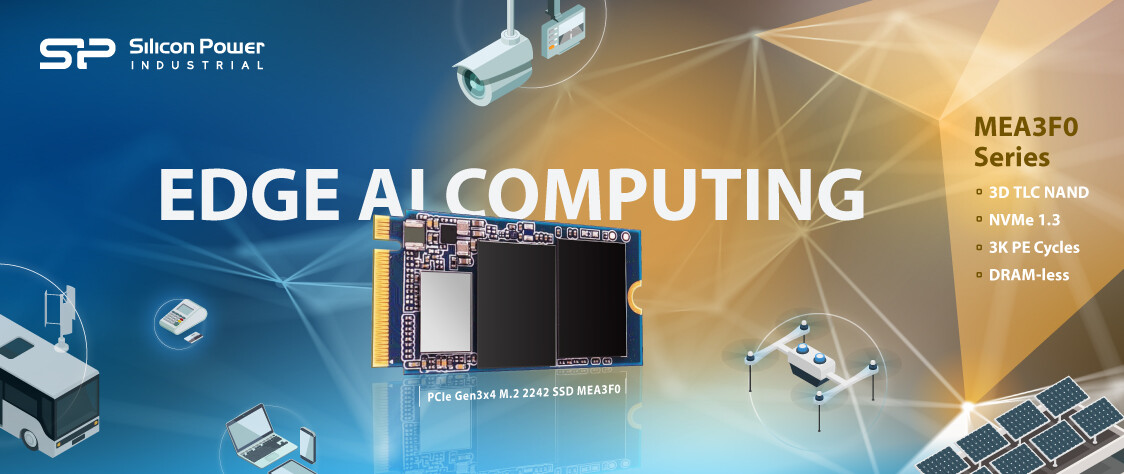
SP Industrial Launches MEA3FEV0 SSD Series with BiCS5 for Edge AI Computing

AI at the edge comes with a host of challenges: limited processing resources, small storage capacities, insufficient memory, security concerns, electrical power requirements, limited physical space on edge devices, and excessive costs. That being said, there is an enormous need for AI at the edge - for devices to learn fast and make decisions in real time. Issues such as latency and distance are current drawbacks that hold edge-to-cloud AI back from reaching its full potential. In some cases, cloud data centers can be as far as hundreds or even thousands of kilometers away from edge devices. Reducing the distance and therefore the latency, by bringing AI into the edge device itself, can open up a world of new possibilities. And, compared to edge-to-cloud AI, AI-enabled edge devices don't need to rely on a stable internet connection, nor do they have as much vulnerability to cyber-security issues, because they don't send data offsite.

Edge AI box computers equipped with compact and high-capacity storage is one of the key factors to make AI come true at the edge. By offloading computation and storage from the cloud to the edge itself, edge computing is enhancing the power and capabilities of the IoT. To help make this a reality, SP Industrial has launched the new MEA3FEV0 SSD Series. This industrial-grade PCIe Gen 3x4 SSD series features support for NVMe 1.3 and BiCS5 112-layer 3D TLC NAND Flash technology. It ticks many boxes that are common problems for edge AI computing: large storage capacities up to 2 TB, small M.2 2242 form factor for minimal space usage, lower power consumption compared to BiCS4, and affordable cost with a DRAM-less design.

Steam Deck Engineer Says SSD Mods Will Significantly Reduce Lifetime of the Device

A few days ago, reports started flooding the web on a Steam Deck mod that successfully vied to replace the handheld console's integrated 2230 SSD towards the more ubiquitous 2242 format. The general idea was that the 2242 SSDs could generally provide higher performance and more bang for the buck on the available storage space, which is at a premium on the Steam Deck already, mostly due to its increased footprint compared to the stock 2230 SSD. However, according to a tweet by Steam Deck engineer Lawrence Yang, this SSD replacement carries with it enough caveats that it might actually severely decrease the longevity of the device itself.

According to him, the Steam Deck's SSD slot is particularly sensitive to fluctuations on power requirements - of which those of 2242 SSDs are usually higher. At the same time, the device's thermal pads (of which the removal and/or compromise is required to fit in the larger form-factor SSD) are a very necessary part of temperature management for the complex engineering of the Deck - specifically for the power delivery subsystem, which should see worsened temperatures due to the thermal pad removal. It might be better to simply invest in a fast SD card solution - some relatively affordable models offer read speeds of 160 MB/s already, show no performance degradation, and are hot-swappable.

addlink Launches Budget-Friendly S90 Lite PCIe 4.0 NVMe SSD

addlink, is introducing a new PCIe 4.0 SSD, the S90 Lite, featuring storage capacities of up to 2 TB and offer speeds up to 5000 MB/s. It is compatible with the latest Intel/AMD PC and laptop computer platforms. The S90 Lite uses the latest Gen4 x4 NVMe controller and 176-layer 3D TLC NAND flash. It utilizes PCIe Gen4x4 and NVMe 1.4 protocol as an interface to achieve rapid sequential read and write speeds up to 5000/4500 MB per second, which is ten times faster than a SATA III SSD. The SSD drive is also backward compatible with the PCIe Gen3 system.

The drive comes with an SLC caching to deliver outstanding performances and better user experiences. It also supports a host memory buffer (HMB) that allows S90 Lite SSD to proactively pursue higher performances by utilizing the memory resource of the host to maximum random read/write speeds of up to 400K/800K IOPS.

NAND Flash Market Oversupplied in 3Q22, Price Quotes to Drop by 0~5%, Says TrendForce

According to TrendForce research, as output from Kioxia and WDC grows month by month, it has become obvious that production capacity is sufficient to meet increased bit demand. However, post-pandemic demand for consumer electronics such as laptops will no longer lead to flagging orders. Coupled with slow destocking among Chinese smartphone brands due to the pandemic and rising inflation, these factors will lead to oversupply in the 3Q22 NAND Flash market, in turn affecting a price drop of 0~5% in 3Q22.
In terms of Client SSD, although a backstop for business notebook orders remains, demand for consumer notebook and Chromebook orders lags behind 2021, especially as PC brands stock more conservatively. Their intention to actively reduce inventory is obvious and the volume of orders in peak season may fall behind last year. However, as SSD production capacity gradually returns to normal, supply of client SSDs continues to increase. In addition, shipments of Kioxia and WDC products been delivered in succession. In order to avoid a sharp increase in inventory, the supply side is willing to let prices spike. Client SSD pricing is expected to reverse direction and move downwards approximately 3-8% in 3Q22.

TerraMaster Launches T6-423 Professional NAS and TOS 5 Operating System

TerraMaster, a professional brand that specializes in providing innovative storage products for home, businesses and enterprises, presents the T6-423 6-bay tower NAS as the latest addition to the TX-423 Series products introduces earlier this year. The T6-423 is a cost-effective professional storage solution for small-sized and medium-sized businesses without the need for a rackmount. The T6-423 can be setup and integrated to your existing storage solutions with ease.

With the launch of the T6-423 6-bay professional NAS, TerraMaster also announces the worldwide availability of the new TOS 5 operating system. The TerraMaster T6-423 supports the new TOS 5 operating system.

Patriot Viper Gaming Announces the VPR400 RGB M.2 NVMe Gen4x4 SSD

VIPER, a trademarked brand of PATRIOT and a global leader in performance memory, solid-state drives, and flash storage solutions, is proud to announce the market launch of its VPR400, the world's first RGB M.2 PCIe Gen 4x4 SSD. A unique aluminium heatspreader has been included to keep the drive thermally stable while accenting the onboard RGB LEDs. This SSD is built using the latest Innogrit IG5220 Gen4 x4 controller along with the highest quality 3D NAND memory chips, allowing the drive to provide the 4K Aligned Random Read and Write speeds up to 600K and 500K IOPs and Sequential Read and Write speeds up to 4,600 MB/s and 4,400 MB/s (1 TB model). Now available in capacities of 1 TB and 512 GB.

"The VIPER VPR400 has been crafted to deliver blazing speeds and performance for intense gaming and video content creation. VIPER understands that keeping high-speed SSDs thermally stable is the key to maintaining the storage unit's performance and longevity." said Roger Shinmoto, Vice President of VIPER GAMING. Onboard RGB is fully synchronizable with other VIPER GAMING RGB peripherals using the smart VIPER RGB 3.0 software, allowing users to customize their lighting profiles or choose any pre-programmed RGB lighting patterns.

KIOXIA First to Introduce JEDEC XFM Removable Storage Device Compliant with Ver.1.0 PCIe/NVMe Spec

KIOXIA America, Inc. today announced sampling of the industry's first XFM DEVICE Ver. 1.0-compliant removable PCIe standard attached, NVMe storage device: the XFMEXPRESS XT2. With a new form factor and connector, the XFM DEVICE Ver. 1.0 standard delivers an unparalleled combination of features designed to revolutionize ultra-mobile PCs, IoT devices and a variety of embedded applications.

First introduced in August of 2019, and then presented as a proposal to the JEDEC Subcommittee for Electrical Specifications and Command Protocols, KIOXIA XFMEXPRESS XT2 is a new form factor for PCIe/NVMe specification devices. Featuring a powerful combination of small size, speed and serviceability, XFMEXPRESS technology was developed to enhance next-generation mobile and embedded applications. The XFMEXPRESS XT2 from KIOXIA is the first product to meet the specification of the new JEDEC standard.

Phison Announces Customizable PCIe Gen4x4 Enterprise SSDs in M.2 2280 and 22110 Form Factors Powered by E18DC PCIe Gen4x4 NVMe Controller

Phison Electronics Corp., a global leader in NAND flash controller and storage solutions, today unveiled two new PCIe Gen4x4 Enterprise Class SSDs: the EPR3750 in M.2 2280 form factor and the EPR3760 in M.2 22110 form factor. The EPR3750 and EPR3760 SSDs are backward compatible in PCIe Gen3 M.2 slots at even faster speeds while offering significant performance enhancements when matched with PCIe Gen4 chipsets. Also, the EPR3750 and EPR3760 SSDs provide a faster quality of service (QoS) command execution with Enterprise SSD firmware. Workstation and Server boot applications require consistent and predictable performance from storage. Phison's new SSDs are ideal to use as boot drives in workstations, servers, and in Network Attached Storage (NAS) and RAID environments.

Highpoint Announces 8-Port M.2 NVMe RAID Controllers

HighPoint M.2 HPC Series RAID Controllers establish a new benchmark for NVMe performance: up to 55,000 MB/s for a single RAID array. HighPoint manufactures the industry's most comprehensive selection of M.2, U.2 and U.3 NVMe RAID controllers. The 8-Port SSD7540 and SSD7140A represent the best M.2 solutions available in today's marketplace. HighPoint 8-Port High-Port-Count (HPC) M.2 controllers deliver unbeatable performance and storage capacity in a compact PCIe device that can be easily integrated into any industry standard computing platform. Our SSD7540 PCIe Gen4 x16 controller can support up to 64 TB of storage at speeds up to 28,000 MB/s. Dual-Card Cross-Sync configurations can double performance and capacity thresholds - up to 120+TB at an astonishing 55,000 MB/s.

HighPoint's unique performance-focused NVMe architecture utilizes intelligent switch technology to allocate up to x4 lanes of bandwidth to each NVMe device port. This enables our 8-port controllers to fully saturate x16 lanes of host bandwidth using as little as four NVMe SSDs. However, additional SSDs can be added to maximize storage capacity, or fine tune the configuration for a specific application by optimizing a RAID array for sequential or random I/O.

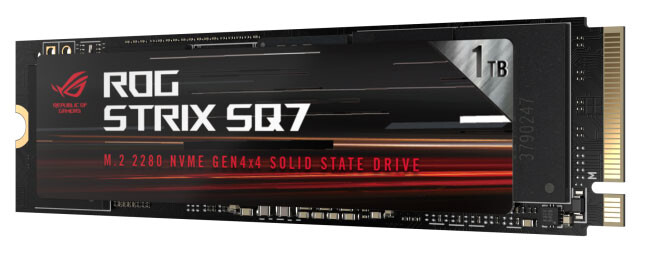
ASUS ROG Strix SQ7 Specifications Finally Revealed

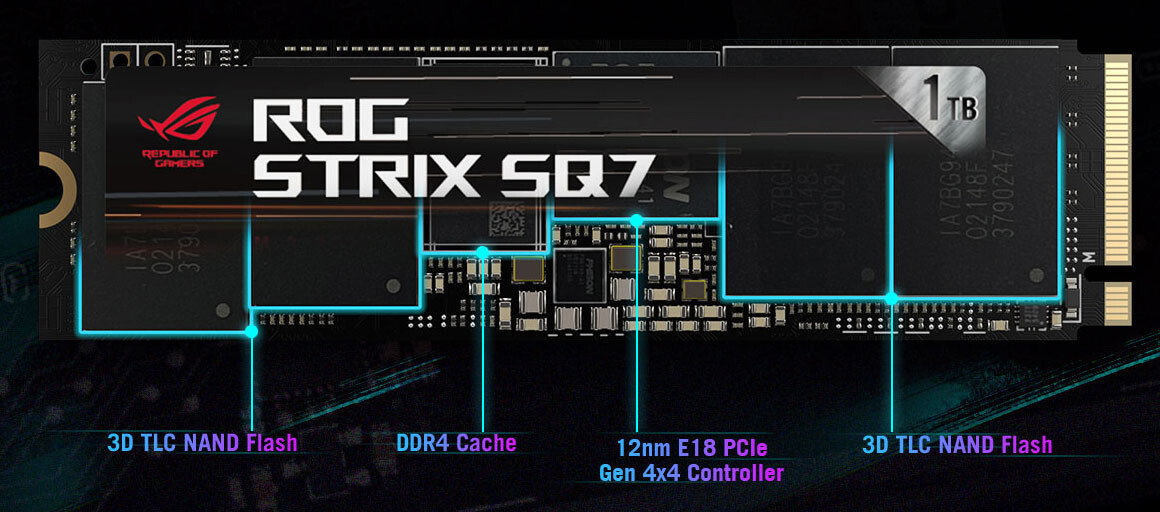
Just under a month ago, ASUS posted a teaser for its first internal SSD, the ROG Strix SQ7 and now the company has finally released the full specs. It is indeed based around the 12 nm Phison E18 controller, as predicted by our Editor-In-Chief, something he spotted from the sneak peek picture. Although ASUS didn't specifically mention what kind of flash the drive is using, they kindly left the flash model number visible in one of its pictures of the drive. Although the full model name isn't visible, enough of it is visible to identify it as Micron's 176-layer TLC flash. The ROG Strix SQ7 also sports a DDR4 cache, as expected, although ASUS doesn't mention clock speeds.

ASUS claims the drive will deliver sequential read speeds of up to 7000 MB/s and write speeds of up to 6000 MB/s, which places the ROG Strix SQ7 in direct competition with several other Phison E18 based high-end drives from the likes of Kingston, MSI, Sabrent and others. Unfortunately, ASUS doesn't mention IOPS or random performance, although an unspecified "large" SLC cache is mentioned. Other features include TGC Opal and AES 256-bit encryption. ASUS also provides its own SSD dashboard, which of course is ROG branded, but looks like a skinned version of Phison's standard SSD dashboard, rather than something custom made. ASUS also provides a copy of NTI Backup Now EZ software and the drives appear to have a five year warranty. ASUS mentions PS5 compatibility outside of the PC space. No word on pricing or retail availability was provided and so far ASUS has only listed a 1 TB model.

Rising Demand and Rush Order Pricing Drive 14.1% QoQ Enterprise SSD Revenue Growth in 1Q22, Says TrendForce

According to TrendForce research, North American data centers saw an improvement in components supply after February, driving a recovery in purchase order volume. As Server brands returned to normal in-office work following the pandemic, the increase in capital expenditures on related information equipment has also boosted order growth. The addition of Kioxia's raw material contamination incident led to an increase in the pricing of certain rush orders, pushing up overall Enterprise SSD revenue in 1Q22 to US$5.58 billion, or 14.1% growth QoQ.

According to TrendForce, Samsung and SK hynix (including Solidigm) were the top two players in 1Q22. At the beginning of the year, demand from hyperscale data centers resulted in high inventory levels due to component mismatches, leading Samsung's order growth missing expectations. However, as repercussions from the WDC and Kioxia contamination incident hit NAND Flash production capacity in 1Q22, server customers quickly turned to Samsung for additional orders, driving the company's 1Q22 revenue to US$2.77 billion, up 14.8% QoQ.
M.2 PCIe 5.0 SSDs Set to Increase to 25 mm in Width, Might Not Fit Older Motherboards

NVMe SSDs based on the M.2 form factor come in several different lengths today, ranging from 30 to 110 mm, although the 30 mm drives are rare and the 110 mm drives have so far been reserved for the server space. However, they've all had one thing in common, the 22 mm width, as otherwise there might be issues in terms of fitting the drives, especially in notebooks. However, it appears that the PCI-SIG snuck in a wider, 25 mm option for M.2 SDDs at the end of 2020, but seemingly forgot to mention it to anyone. The only reason we even noticed, was because Gigabyte listed its upcoming X670 and X670E motherboards as having support for 25110 SSD's, where you'd expect to see support for 2280 or 22110 drives.

An extra 3 mm in width might not sound like much, but many M.2 drives seem to be somewhat space constrained, mainly with regards to the passive components and the power regulation. It also seems like this is in preparation for PCIe 5.0 NVMe drives, where the host controller is expected to run hotter, even though it might not be as bad as initially expected. Regardless, it seems like motherboard makers are now making space for this slightly wider M.2 form factor, as well as implementing suitable cooling solutions to match. Whether we'll see drives using this slightly wider form factor or not, is still up in the air and one reason why the SSD manufacturers might choose not to go wider, is because new drives might not fit in older motherboards and laptops, if the clearance is too small.

Samsung & Red Hat Announce Collaboration in the Field of Next-Generation Memory Software

Samsung Electronics and Red Hat today announced a broad collaboration on software technologies for next-generation memory solutions. The partnership will focus on the development and validation of open source software for existing and emerging memory and storage products, including NVMe SSDs; CXL memory; computational memory/storage (HBM-PIM, Smart SSDs) and fabrics — in building an expansive ecosystem for closely integrated memory hardware and software. The exponential growth of data driven by AI, AR and the fast-approaching metaverse is bringing disruptive changes to memory designs, requiring more sophisticated software technologies that better link with the latest hardware advancements.

"Samsung and Red Hat will make a concerted effort to define and standardize memory software solutions that embrace evolving server and memory hardware, while building a more robust memory ecosystem," said Yongcheol Bae, Executive Vice President and Head of the Memory Application Engineering Team at Samsung Electronics. "We will invite partners from across the IT industry to join us in expanding the software-hardware memory ecosystem to create greater customer value."

Amid Weakening Consumer Demand and Falling Prices, Total NAND Flash Revenue Declined 3.0% in 1Q22, Says TrendForce

According to TrendForce research, as manufacturers actively shifted production capacity to 128 layer products, the market turned to oversupply, resulting in a drop in contract prices in 1Q22, among which the decline in consumer-grade products was more pronounced. Although enterprise SSD purchase order volume has grown, demand for smart phone bits has weakened due to the Russian-Ukrainian war, the traditional off-season, and rising inflation. Client inventories have increased significantly, so it remains challenging for overall bit shipment volume to offset potential decline. In 1Q22, NAND Flash bit shipments and average selling prices fell by 0.5% and 2.3%, respectively, resulting in a 3.0% quarterly decrease in overall industry revenue to US$17.92 billion.

Although China's smartphone stocking momentum was marginally weak considering the off-season, due to sluggish supply on the part of Kioxia and WDC, Samsung's 1Q22 client SSD shipment bit growth was driven up by an influx of rush orders and North American enterprise SSD client orders also recovered significantly in March. Overall bit shipments increased by 9% QoQ and ASP decreased by 2% QoQ. In 1Q22, the NAND Flash portion of Samsung's electronics business posted revenue of US$6.32 billion, up 3.4% QoQ.

Lexar Announces 2 GB/s SL660 BLAZE Portable SSD

Lexar, a leading global brand of flash memory solutions, is proud to announce the new Lexar SL660 BLAZE Gaming Portable SSD. The new drive offers gamers and creatives the latest USB 3.2 Gen2 x2 technology and blazing-fast NVMe performance with speeds up to 2000 MB/s read and 1900 MB/s write. It is perfect for boosting the performance of your consoles and editing work stations.

Beyond the outstanding performance, it's got style. The new Lexar SL660 BLAZE Gaming Portable SSD comes with RGB LEDs to create a lively atmosphere making your gameplay or work station more dynamic by adding a touch of color to your setup. The Lexar SL660 BLAZE Gaming Portable SSD also recently won the Red Dot Design Award which has recognized the best products for design in a given year since 1995. The international panel of experts and judges who reviewed the products that entered the competition were guided by assessment criteria such as the product's formal quality, ergonomics and longevity.
In addition, the Lexar SL660 BLAZE Gaming Portable SSD is durable as it is stylish and built with a premium aluminium enclosure and features a sandblasted finish for added protection against shock and vibration. It also features advanced security software with 256-bit AES encryption to protect essential files against corruption, loss, and deletion.

Crucial Announces P3 and P3 Plus Value M.2 NVMe SSDs

Micron Technology, Inc., today announced the upcoming availability of two new consumer storage products, the Crucial P3 Plus Gen4 NVMe and Crucial P3 NVMe solid state drives (SSDs), as an expansion of its award-winning Crucial NVMe SSD product portfolio. The all new Crucial P3 Plus SSD product line will deliver attractive price-performance metrics with sequential read/write speeds up to 5000/4200 MB/s, while next-generation Crucial P3 SSDs will provide read/write speeds up to 3500/3000 MB/s. Both drives will be available in capacities up to 4 TB, making them the ideal scalable storage solutions that professionals, creatives, gamers and other high-performance users need.

"For users that have been waiting to upgrade their PCs to Gen4 SSDs, the wait is over. With the forthcoming availability of the new Crucial P3 Plus SSD, anyone seeking high-performance SSDs can upgrade to NVMe Gen4 storage and affordably futureproof their PC," said Teresa Kelley, vice president and general manager of Micron's Commercial Products Group. "Both the Crucial P3 Plus and P3 SSD products will strengthen our overall SSD portfolio and NVMe product category by offering competitive choices for high-performance storage that enables users to get more done in less time."
Return to Keyword Browsing
Nov 18th, 2026 23:40 PST change timezone

New Forum Posts

Popular Reviews

TPU on YouTube

Controversial News Posts