News Posts matching #ssd

Return to Keyword Browsing

SanDisk Announces Extreme Portable Line of SSDs

Western Digital Corp. today released two new SanDisk portable SSDs that offer nearly 2x the speed over previous generations. The SanDisk Extreme and SanDisk Extreme PRO portable SSDs are purpose-built to keep up with today's high-quality content demands. Professional photographers, videographers and enthusiasts capture and keep life's best moments every day and they need reliable solutions that perform on the move at astonishing speeds.

With capacities up to 2 TB, the new NVMe drives are perfect for creating amazing content or capturing and moving incredible 4K and 8K footage with ease. The flagship SanDisk Extreme PRO portable SSD features a forged aluminium chassis made to stay cool under the pressure of a heavy workload and a durable silicone design to withstand the rigors of production. The drives also help keep content safe with password protection and an upgrade to 256-bit AES hardware encryption.

Synology Adds 3.84 TB SAT5200 to SSD Lineup

Synology Inc. launched the 3.84 terabyte SAT5200 2.5" solid state drive. Designed for Synology users requiring high capacity and reliable storage arrays, all the while sustaining high performance low-latency operations for mission critical work. With the increasingly demanding environment in storage, the SSD is created with enterprise grade endurance and reliability to help businesses and users tackle intensive workloads with robust data protection.

"Part of designing a reliable storage system requires that companion drives that can consistently sustain heavy read and write operations without any performance degradation. Our SAT5200 SSDs are built specifically to tackle low-latency and consistent performance requirements demanded by our SMB and enterprise customers," said Julien Chen, Product Manager for Synology solid state drives.

KIOXIA Bolsters NVMe-oF Ecosystem with Ethernet SSD Storage

Direct-attached performance from network-attached devices is no longer a thing of storage architects' dreams. KIOXIA America, Inc. (formerly Toshiba Memory America, Inc.), is now sampling Ethernet SSDs to select partners and customers interested in validating the benefits of Ethernet attached storage to their existing Ethernet (RoCEv2) networks. KIOXIA has been working in collaboration with key industry players Marvell, Foxconn-Ingrasys and Accton to bring groundbreaking Ethernet Bunch of Flash (EBOF) technology solutions to market - and this announcement is pivotal to that endeavor.

In an ongoing quest to contain explosive amounts of data, storage capacity and bandwidth must continue to grow while processing time must decrease. An EBOF system addresses these challenges through an Ethernet fabric that can scale flash and optimally disaggregate storage from compute. The EBOF storage solution bypasses the cost, complexity, and system limitations inherent with standard JBOF storage systems, which typically include a CPU, DRAM, HBA, and switch. This accelerates applications and workloads where disaggregated low-latency, high bandwidth, highly available storage is needed - bringing greatly improved performance and lower total cost of ownership to edge, enterprise and cloud data centers.

Sonnet Announces PCIe 3.0 Adapter Card with Direct Mounting Support for Two U.2 SSDs

Sonnet Technologies today announced the Fusion Dual U.2 SSD PCIe Card, the latest product in the company's line of high-performance storage cards that enable the installation of SSDs into a computer's or Thunderbolt expansion system's PCIe card slot. The Fusion card supports two U.2 NVMe PCIe Gen 3 SSDs, which share the same form factor as 2.5-inch SATA drives but deliver up to seven times the performance of the fastest SATA SSDs available.

The Fusion Dual U.2 SSD PCIe Card enables users to install two enterprise-class U.2 SSDs (sold separately) into a full-length PCIe card slot, mounting and connecting the SSDs with no cables, adapters, or mounting trays required. For users who need to add storage to their computer setup and require ultra-high-speed data transfer speeds for a smooth workflow—such as video editors working with 6K and greater resolution footage—U.2 NVMe PCIe Gen 3 SSDs are ideal. Mainstream U.2 SSDs are currently available in capacities up to 16 TB and support data transfers at up to 3,500 MB/s. With two SSDs installed on the Sonnet card and configured as a RAID 0 set, sustained data transfers up to 6,250 MB/s are possible.

Samsung Delivers Next-Level SSD Performance with 980 PRO

Samsung Electronics, the world leader in advanced memory technology, today unveiled the company's first consumer PCIe 4.0 NVMe solid state drive (SSD) - the Samsung SSD 980 PRO. The new 980 PRO is designed for professionals and consumers who want cutting-edge performance in their high-end PCs, workstations and game consoles.

"Over the years, Samsung has continuously challenged the limits of high-speed flash memory storage solutions," said Dr. Mike Mang, vice president of Memory Brand Product Biz at Samsung Electronics. "The new 980 PRO SSD reflects our continuing commitment to delivering exceptional products consumers have come to expect from Samsung."

ADATA XPG Launches GAMMIX S70 PCIe Gen4 M.2 2280 Solid State Drive

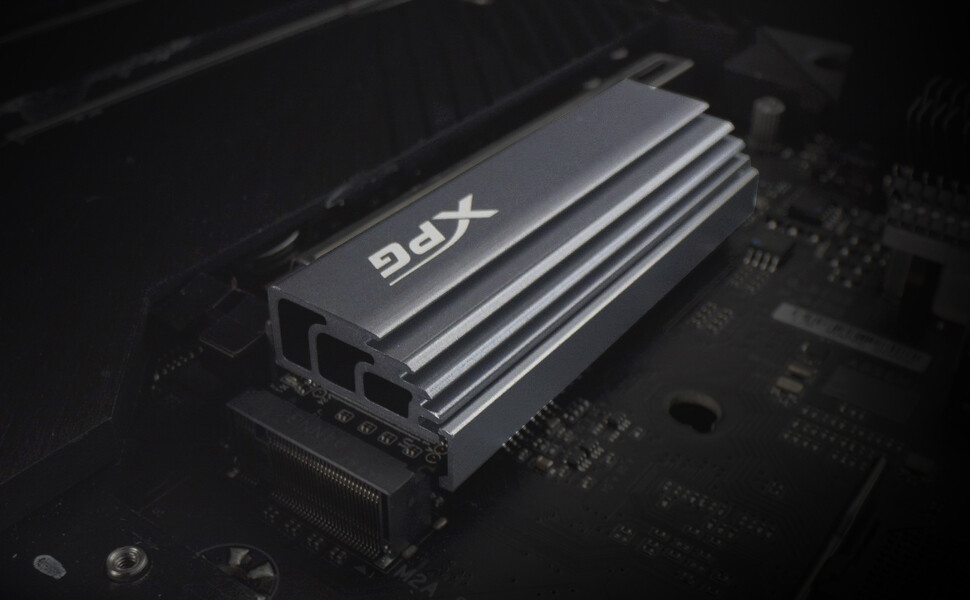
ADATA XPG, a provider of systems, components, and peripherals for gamers, esports pros, and tech enthusiasts, today announces the XPG GAMMIX S70 PCIe Gen4x4 M.2 2280 solid state drive (SSD). With the launch of the S70, XPG now offers a comprehensive lineup of Gen4 SSDs, which includes the GAMMIX S50 and S50 Lite, to meet a range of budgets and needs. With the adoption of next-gen PCIe 4.0, the GAMMIX S70 delivers unmatched read and write performance and has the distinction of being the world's fastest M.2 SSD.

With the advent of 5G networks and the ever-growing volume of data being processed, PCIe Gen4 is a critical upgrade that will bring storage devices to the next level. The GAMMIX S70 expands XPG's Gen4 SSD series with a new option for discerning users seeking to harness the best that PCIe 4.0 can offer. Sporting blazing-fast read/write speeds of up to 7400/6400 MB per second. Users will have no doubt they have reached the pinnacle of SSD performance. In combination with NVMe 1.4 compatible, Dynamic SLC Caching, the S70 offers performance far superior to that of SATA and PCIe 3.0 SSDs. For added ease of use and convenience, the S70 is backward compatible with PCIe 3.0.

ADATA XPG Launches GAMMIX S50 Lite PCIe Gen4 M.2 2280 Solid State Drive

ADATA XPG, a provider of systems, components, and peripherals for gamers, esports pros, and tech enthusiasts, today announces the XPG GAMMIX S50 Lite PCIe Gen 4x4 M.2 2280 solid state drive (SSD). With the advent of 5G networks and the ever-growing volume of data being processed, the PCIe Gen4 interface is a critical upgrade that will bring storage devices to the next level. The S50 Lite expands the GAMMIX S50 series with a new option for mainstream users wanting to harness the capabilities of PCIe 4.0.

"With the launch of the S50 Lite, we have now extended our PCIe 4.0 SSD offering to meet not only the demands of early adopters but also mainstream users, whether for work or play," said Ibsen Chen, Director of Product Marketing at ADATA. "With support from our strategic partners at Silicon Motion, we have invested in developing a next-generation SSD that is accessible and offers exceptional performance."

YMTC Announces PC005 M.2 NVMe and SC001 SATA SSDs

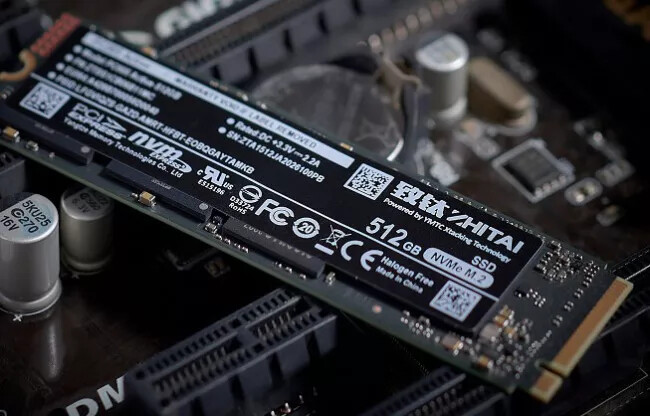
Yangtze Memory Technology Company (YMTC), China's ambitious new memory manufacturer specializing in NAND flash, launched the first client-segment SSDs under its own brand, the PC005 Active series and the SC001 Active series. Rumors of YMTC developing its own brand SSDs surfaced first in June. Prior to that in May, it was reported that Phison could add support for YMTC NAND flash chips to variants of its existing SSD controllers, and so it's highly likely that the new YMTC SSDs use Phison-sourced controllers. Interestingly, the company deployed its first-generation Xtracking 64-layer 3D TLC NAND flash chips instead of its 2nd generation 128-layer QLC chips.

The PC005 Active comes in the M.2-2280 form-factor with PCI-Express 3.0 x4 host interface, leveraging the NVMe 1.3 protocol. The drive is available in 1 TB. 512 GB, and 256 GB capacities. All three variants read sequentially at speeds of up to 3,500 MB/s, wiring at up to 2,900 MB/s, up to 2,500 MB/s, and up to 1,200 MB/s, respectively. Their endurance is rated at 640 TBW for the 1 TB version, 320 TBW for the 512 GB, and 200 TBW for the 256 GB variant. All three are backed by 5-year warranties.

GIGABYTE Intros 2TB AORUS Gen4 AIC SSD

GIGABYTE today introduced a 2 TB variant of its AORUS Gen4 AIC SSD. This drive is essentially a PCI-Express 4.0 x16 to four M.2 PCIe Gen 4 x4 riser card that comes with four 500 GB AORUS Gen4 M.2 NVMe SSDs pre-installed. Using it requires a platform with PCIe lane segmentation (most modern platforms since 2016 do), and for the OS to support NVMe RAID.

The riser card component of the AORUS Gen4 AIC SSD has basic logic that controls a lateral blower based on drive temperature, and provides basic disk activity LEDs. Inside, a copper monoblock heatsink pulls heat from all four drives. Each of the four internal M.2 NVMe drives features 96-layer 3D TLC NAND flash memory, and Phison E16 controllers. With NVMe RAID striped, the card offers peak performance of up to 15,000 MB/s sequential reads, and up to 9,500 MB/s sequential writes. Random access performance is rated at up to 425,000 IPS 4K random reads, and up to 440,000 IOPS 4K random writes. GIGABYTE is backing the drive with a 5-year warranty. The company didn't reveal pricing.

TerraMaster Launches F2-422 10GbE 2-Bay Professional NAS

TerraMaster, a professional brand that specializes in providing innovative storage products including network-attached storage (NAS) devices, launches the TerraMaster F2-422 2-Bay Network-Attached Storage (NAS) featuring 10 Gigabit Ethernet networking. The F2-422 is the brand's latest addition to its 10 GbE NAS Series.

Designed for professional users, the F2-422's 10 GbE LAN port provides speeds of up to 10 Gb/s of high-speed bandwidth. This allows users to access and transfer data faster. With two Seagate IronWolf 4 TB SSD drives in RAID0, the F2-422 can deliver speeds of up to 647 MB/s read and up to 651 MB/s write.
The TerraMaster F2-422 comes equipped with a powerful Intel quad-core processor and 4 GB of DDR3 memory, expandable up to 8 GB (4 GB + 4 GB) memory. The F2-422 is also packed with multiple layers of data security to keep your data safe and secure from attacks and risks of data loss.

GALAX Announces PCIe 4.0 Hall Of Fame Extreme SSD

GALAX have recently unveiled the Hall Of Fame (HOF) Extreme PCIe 4.0 SSD. This is a second-generation PCIe 4.0 SSD featuring the Phison PS5018-E18 controller which allows for speeds which near the limits of PCIe 4.0. The GALAX Hall Of Fame Extreme SSD promises sequential read and write speeds of 7000 MB/s and 6850 MB/s respectively. These claimed speeds are in line with other SSD's utilizing the PS5018-E18 controller such as the Sabrent Rocket 4 Plus which also uses TLC NAND flash. The GALAX HOF Extreme will be offered in 1 TB, 2 TB, and 4 TB versions, and all feature premium designs with mirrored heatsink, pricing and availability were not announced.

TechPowerUp and Team Group Announce Cardea Ceramic C440 Giveaway

TechPowerUp and Team Group bring you a chance to win a Team T-Force Cardea Ceramic C440 1 TB M.2 PCIe Gen 4 NVMe SSD. Announced this June, the T-Force Cardea Ceramic C440 is an M.2 NVMe SSD that takes advantage of PCI-Express 4.0 x4 host interface - perfect for a cutting edge build based on 3rd Gen AMD Ryzen or upcoming Intel processors. This isn't just another Phison E16 + 3D TLC NAND based drive, Team Group innovated a patented new heatspreader which uses ceramic composite materials that more effectively pull heat from the drive's controller and NAND flash components. The 1 TB variant offers blistering speeds of up to 5,000 MB/s reads, with up to 4,400 MB/s writes. Open worldwide (wherever legal), the Giveaway accepts entries until September 17, 2020. To enter, all you have to do is fill us a short form that helps us get back to you if you've won. Good Luck!
For more information, and to participate, visit this page.

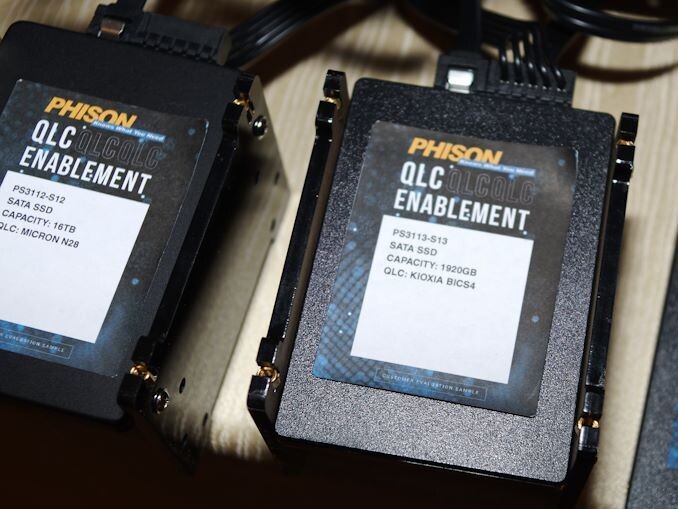
Phison Launches World's Highest Capacity QLC Customizable Enterprise SSD Solution in a 2.5" Form Factor

Phison Electronics , the industry's leader in NAND flash controllers and storage solutions, announces availability of the world's first 15.36 TB QLC customizable Enterprise SSD solution based on Phison's S12DC controller. Phison provides its customers with industry leading SSDs that are customized to their needs by leveraging Phison's firmware, controller, PCBA design, and manufacturing. The S12DC QLC SSD is an ideal storage solution by delivering higher performance, lower power consumption, and greater rack storage density for read intensive storage applications that currently source hard disk drives.

OWC Launches New Mercury Elite Pro Dual with 3-port Hub

OWC ; a leading zero emissions Mac and PC technology company and one of the world's most respected providers of Memory, External Drives, SSDs, Mac & PC docking solutions, and performance upgrade kits introduces the new OWC Mercury Elite Pro Dual with 3-Port Hub. Designed to handle diverse workflows, the Mercury Elite Pro Dual offers up to 32 TB of storage capacity plus a built-in high-powered USB hub for accessory connectivity and device charging, easily making it the centerpiece of your digital desktop. The compact Mercury Elite Pro Dual is equipped and ready to go to give you its best performance with any USB equipped Mac, PC, or tablet from nearly the last decade. You don't need to worry about what system you have, the Mercury Elite Pro Dual with 3-Port Hub is there to provide the performance, data capacity, and hub capability your digital needs.

The Mercury Elite Pro Dual with 3-Port Hub gives you nearly infinite options for your workspace. This modern designed solution is universally USB compatible and can handle diverse workflows. Available plug and play ready, the Mercury Elite Pro Dual is not only superfast, convenient, and versatile, it will quickly become the centerpiece of your digital lifestyle.

MSI Officially Enters the Business Laptop Market With New Logo

Micro-Star International (MSI), the technology and laptop giant debuted its brand new "Business & Productivity" lineup,: The Summit, Prestige, and Modern series. The company also revealed its new, minimalistic, and modern logo for the new lineup. This bold new direction is a major milestone for MSI.

The new line also includes one of the first laptops, Prestige 14 Evo certified on Intel's Evo platform, which indicates advanced efficiency and better mobility. The gaming series also unveiled the world's thinnest 15-inch gaming laptop, the Stealth 15M. All powered by the latest 11th Gen Intel processor, the new lineup provides unprecedented efficiency and performance in the face of the new remote working trend due to COVID-19.

Western Digital Sets a New Standard in Data Protection with Ground-Breaking ArmorLock Security Platform

Underscoring its mission to enable the world to solve its biggest data challenges by building a data infrastructure with next-gen security, Western Digital (NASDAQ: WDC) today introduced the ArmorLock Security Platform. A data encryption platform that rethinks how data security should be done, the ArmorLock Security Platform was created to help with the diverse security demands of data-centric and content-critical storage use cases in industries as varied as finance, government, healthcare, IT enterprise, legal, and media and entertainment. As data security concerns continue to rise in visibility, Western Digital plans to apply the platform across a range of storage solutions.

The first product to leverage this advanced technology, the new G-Technology ArmorLock encrypted NVMe SSD, is designed to deliver an easy-to-use, high-performance, high-grade security storage solution for creators in the media and entertainment industry. Facing the threat of hijacked media files and leaked films, studios, agencies, and especially investors are demanding a better way to protect critical content. While much of the industry's focus has been on cloud security, data often remains vulnerable on the portable storage devices holding critical commercial content.

NVIDIA RTX IO Detailed: GPU-assisted Storage Stack Here to Stay Until CPU Core-counts Rise

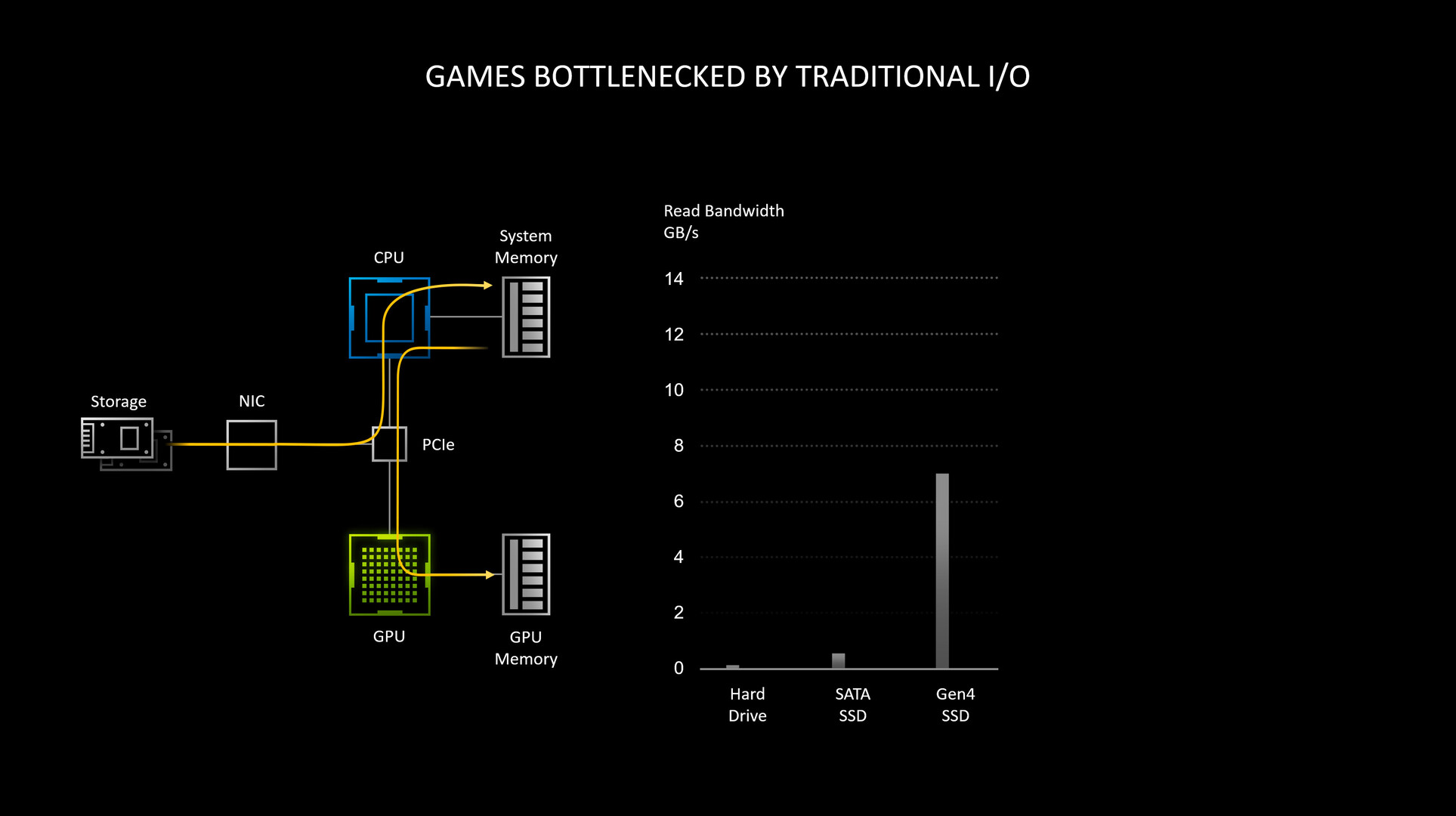
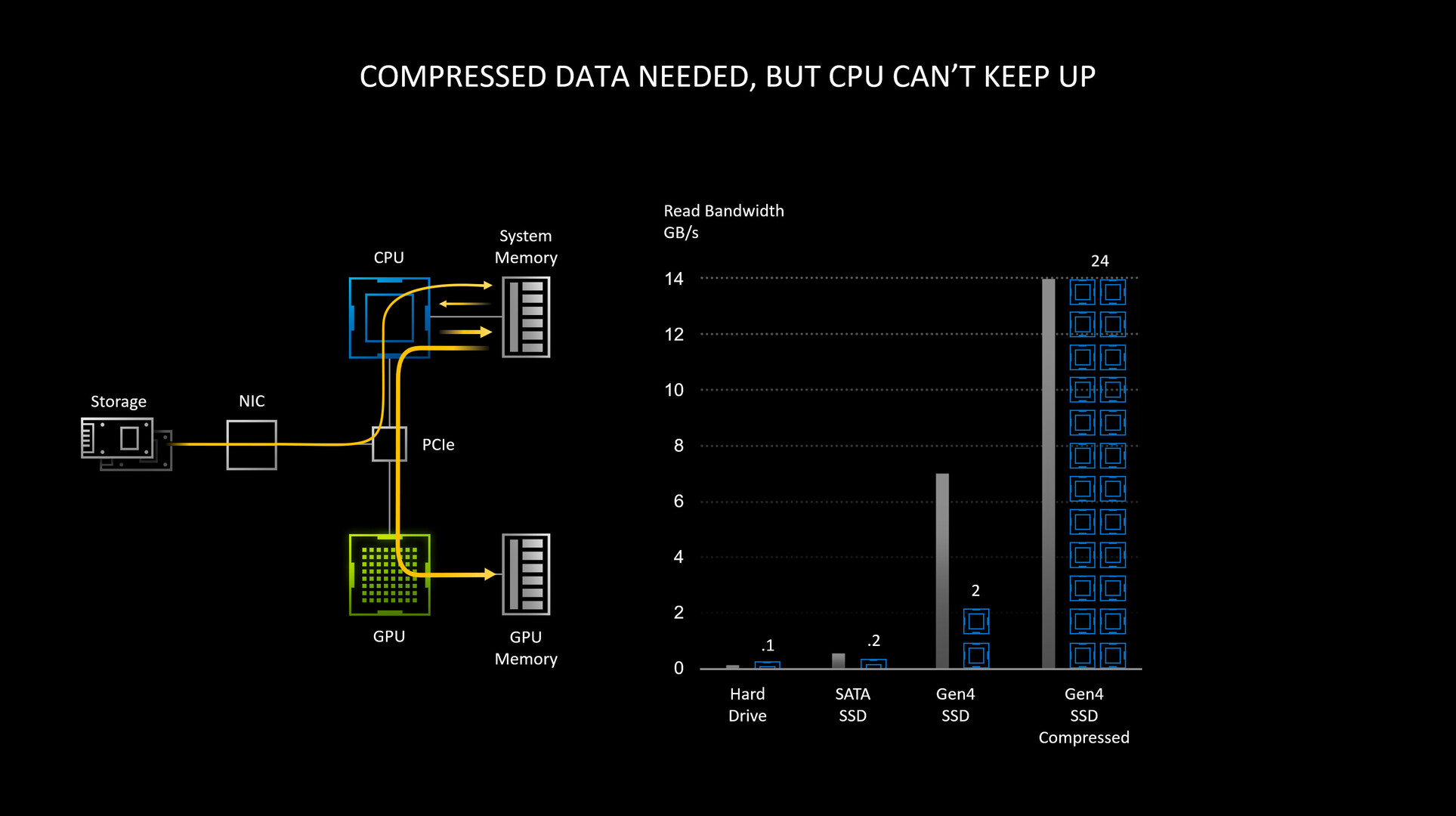
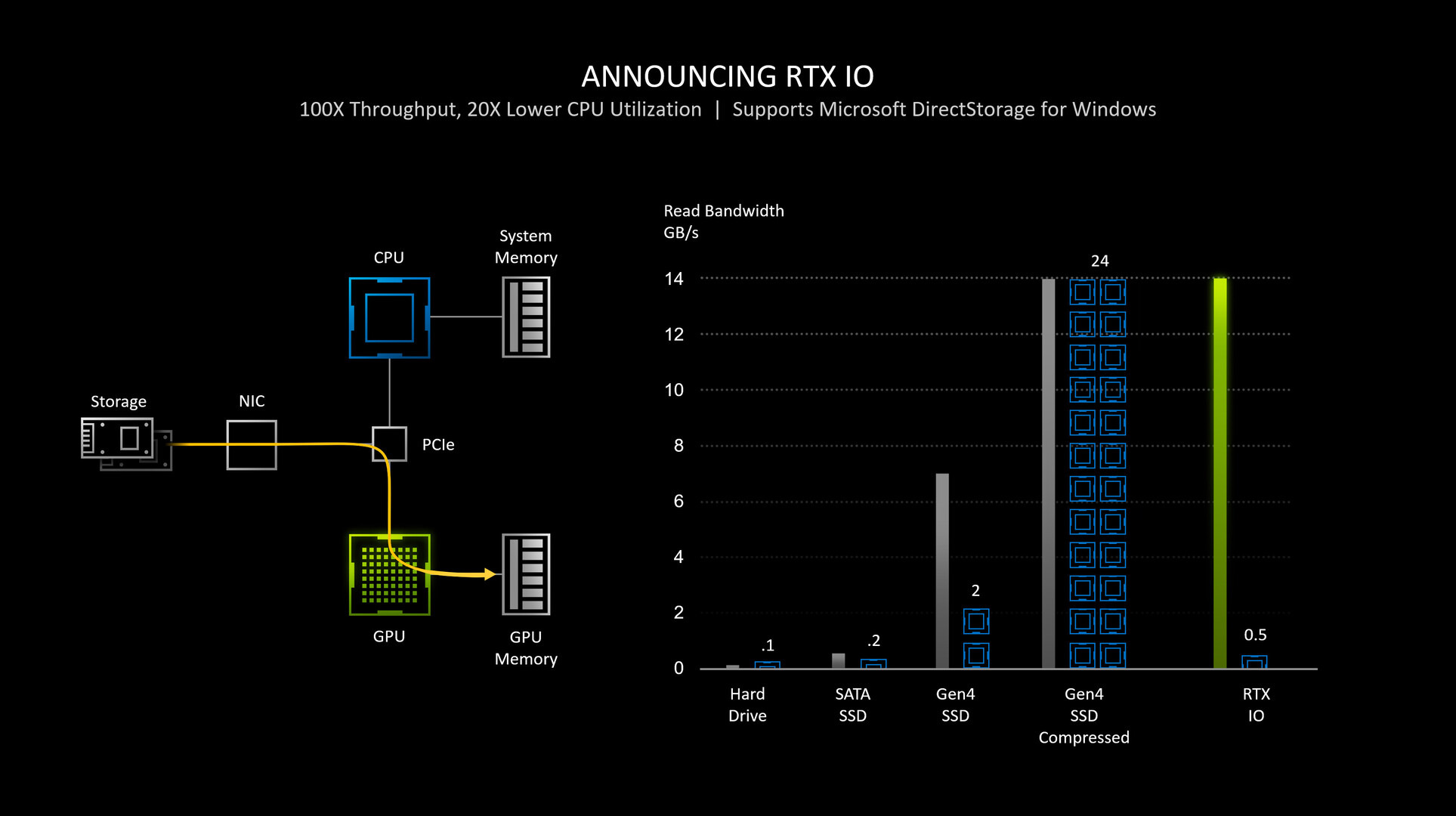
NVIDIA at its GeForce "Ampere" launch event announced the RTX IO technology. Storage is the weakest link in a modern computer, from a performance standpoint, and SSDs have had a transformational impact. With modern SSDs leveraging PCIe, consumer storage speeds are now bound to grow with each new PCIe generation doubling per-lane IO bandwidth. PCI-Express Gen 4 enables 64 Gbps bandwidth per direction on M.2 NVMe SSDs, AMD has already implemented it across its Ryzen desktop platform, Intel has it on its latest mobile platforms, and is expected to bring it to its desktop platform with "Rocket Lake." While more storage bandwidth is always welcome, the storage processing stack (the task of processing ones and zeroes to the physical layer), is still handled by the CPU. With rise in storage bandwidth, the IO load on the CPU rises proportionally, to a point where it can begin to impact performance. Microsoft sought to address this emerging challenge with the DirectStorage API, but NVIDIA wants to build on this.

According to tests by NVIDIA, reading uncompressed data from an SSD at 7 GB/s (typical max sequential read speeds of client-segment PCIe Gen 4 M.2 NVMe SSDs), requires the full utilization of two CPU cores. The OS typically spreads this workload across all available CPU cores/threads on a modern multi-core CPU. Things change dramatically when compressed data (such as game resources) are being read, in a gaming scenario, with a high number of IO requests. Modern AAA games have hundreds of thousands of individual resources crammed into compressed resource-pack files.

QNAP Launches the Quad-core 9-bay TS-932PX NAS

QNAP Systems, Inc., a leading computing, networking and storage solution innovator, today launched the TS-932PX, a compact 9-bay NAS featuring two 10 GbE SFP+ and 2.5 GbE RJ45 ports with four 2.5-inch SATA 6 Gb/s bays for dedicated SSD caching. The TS-932PX supports multi-cloud backup, cloud storage gateways, remote access, AI photo management and additional features for SMB to build an efficient high-speed network environment.

With a quad-core 1.70 GHz processor, 4 GB DDR4 RAM (expandable to 16 GB), two 10 GbE SFP+ ports, and two 2.5 GbE ports, the TS-932PX provides the performance and connectivity to make next-generation networking a reality for businesses and organizations. The TS-932PX marks QNAP's continued commitment to high-speed networking alongside other solutions like QNAP's 10 GbE/2.5 GbE managed/unmanaged switches and network adapters.

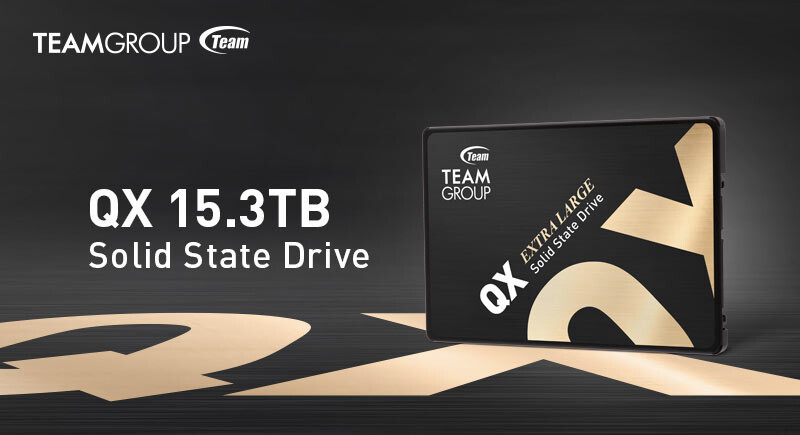
TEAM GROUP Launches QX, the First and Largest Consumer-Grade, 15.3TB 2.5" SATA SSD

TEAMGROUP today launches QX, the industry's first and largest consumer-grade, 15.3 TB 2.5" SATA solid state drive, shaking the industry with its powerful debut. The QX uses the latest 3D QLC flash memory and has up to 2,560 TBW of write life. It is super durable compared to other products in the industry, lightweight and compact, yet offers a high 15.3 TB storage capacity. The QX will revolutionize the consumer-grade 2.5" SATA SSD market with its market dominating specification.

The QX uses the latest 3D QLC flash memory, which not only has the industry's first and largest 15.3 TB storage capacity but also has industry's first write life up to 2,560 TBW. The ultra-high durability provides consumers with stability and reliability. The powerful QX supports smart dual Cache, including SLC Caching technology and DRAM Cache Buffer, delivering 560/480 MB per second of ultra-fast read/write speed for smooth user experience. At the same time, it also excellent features such as low power consumption, shock resistance, noise-free, etc. With the huge terabyte storage capacity of a mechanical hard drive and the read/write performance not found in traditional mechanical hard drives, it can revolutionize and redefine the consumer-grade 2.5" SATA SSD with its massive 15.3 TB storage capacity.

Seagate Updates IronWolf and IronWolf Pro NAS HDD Portfolio with New 18TB HDD and two new SSDs

Seagate Technology, a world leader in data storage and management solutions, today announced the results of a global survey of 3,000 small and medium sized business (SMB) decision-makers. The survey, commissioned by Seagate, reveals that despite economic headwinds, existing SMB IT infrastructure for many SMBs has shown resilience, and a majority of SMBs believe business data will play an important role in their long-term recovery plans. The company also announced an update to its IronWolf and IronWolf Pro Network Attached Storage (NAS) drive lines, aimed at home and small office environments, with new 18 TB capacity HDD and new SATA SSD models. These new drives deliver unrivaled speed, capacity, and stamina to bring reliable, scalable, and consistent performance to NAS solutions.

Despite the rapid and unexpected shift to remote working during the COVID-19 pandemic, existing SMB IT infrastructure proved resilient, according to Seagate research. More than half (54%) of SMB decision-makers reported no difficulty in accessing files or company data remotely, and 61% reported similar productivity levels to when their employees are in the office. 45% of SMB decision-makers reported their company's existing data infrastructure was more resilient than expected during the pandemic. All SMBs included in the study have fewer than 250 employees, and the majority have fewer than 50.

SSD Becomes a System Requirement, 100GB SSD Required for WoW Shadowlands

PC game minimum system requirements have until now prescribed minimum storage space. Blizzard's upcoming "World of Warcraft: Shadowlands" changes this, with the game specifically calling for at least 100 GB of SSD storage. Windows already has a way of telling an HDD from an SSD, and game developers can in theory enforce the requirement. With "Shadowlands," though, there doesn't appear to be any enforcement, with numerous VIPs on the Blizzard forums reporting that the game should launch from HDDs, albeit game load times could hurt. With next-generation game consoles implementing SSD for their higher transfer rates - but more importantly - for their significantly lower access times compared to HDDs, SSD as a system requirement on the PC platform was bound to happen. The gaming industry is designing its next-generation gaming experiencing around the low access times of SSD, and an HDD would fall short. The game's other system requirements are listed below.

Sabrent Announces Next-Generation Rocket 4 Plus PCIe 4.0 SSD

Sabrent have recently announced the Rocket 4 Plus NVMe SSD which they claim is the fastest available. The Sabrent Rocket 4 Plus utilizes the next-generation Phison PS5018-E18 SSD controller which enables significantly faster performance with 7,000 MB/s sequential read and 6850 MB/s sequential write speeds. These speeds are just above the recently announced Samsung 980 PRO and beat virtually all other PCIe 4.0 SSD's using the Phison PS5016-E16 controller which maxes out at sequential read speeds of ~5,000 MB/s.

The Sabrent Rocket 4 Plus is available in 500 GB, 1 TB, and 2 TB variants which is double the max available capacity offered by Samsung on the 980 PRO. These speeds from Samsung and Sabrent are now approaching the bandwidth limits of PCIe 4.0 x4 slots, however the practical applications of such speeds are minimal for most users. Pricing and availability was not announced.

QNAP Launches GM-1000 QuTS Hero NAS

Running the ZFS-based QuTS hero operating system, the GM-1000 focuses on data integrity and features powerful block-level inline data deduplication and compression. Near-limitless snapshots, real-time SnapSync, and many more business-oriented features are also included to achieve reliable service-level agreement performance and Big Data storage.

"The GM-1000 features a unique dual-NAS architecture that delivers cost-efficient and space-saving advantages, ideal for offloading services between the two NAS nodes or running cross backup," said David Tsao, Product Manager of QNAP, adding "Its ZFS storage and performance makes it perfect for massive file storage, virtualization, and post-production with outstanding reliability and cost-effectiveness."

Samsung 980 PRO NVMe SSD Uses TLC NAND Flash with Half the Endurance of 970 PRO: Product Page

Samsung's hotly anticipated 980 PRO M.2 NVMe flagship client-segment SSD is the company's first "PRO" branded SSD to feature TLC NAND flash memory, breaking from a unique tradition of using MLC (2 bits per cell) NAND flash. Product pages of the drive went live, and its specifications clearly state the use of "Samsung V-NAND 3-bit MLC," which is another way of saying TLC. "MLC" generally referred to as NAND flash memory that stores 2 bits per cell, even through the term "Multi-level" is amorphous.

The product page lists other juicy specs of Samsung's first M.2 NVMe client SSD that takes advantage of PCI-Express gen 4. The drive uses Samsung's in-house design "Elpis" controller, which uses NVMe 1.3 protocol over PCI-Express 4.0 x4, and an LPDDR4 DRAM cache. The 980 PRO comes in capacities of up to 1 TB, with up to 1 GB of DRAM cache. Samsung rates the 1 TB version as capable of up to 7000 MB/s sequential reads, up to 5000 MB/s sequential writes, and up to 1 million IOPS 4K random reads/writes at QD32. The use of TLC impacts endurance adversely in comparison to that of the drive's immediate predecessor, the 970 PRO, with the 1 TB 980 PRO warranty covering only up to 600 TBW, in comparison to 1200 TBW of the 970 PRO 1 TB, and the 500 GB 980 PRO offering just 300 TBW warranty coverage in comparison to 600 TBW of the 970 PRO 512 GB.

NAND Flash Revenue Rises 6.5% QoQ in 2Q20 Due to Pandemic-Induced Demand Growth for Cloud Services, Says TrendForce

The NAND Flash industry benefitted from strong demand for PCs and servers in 2Q20 as the COVID-19 pandemic caused a demand surge for cloud services and technologies that are related to working from home, according to TrendForce's latest investigations. This, in turn, kept demand high for SSDs. However, the smartphone and consumer electronics markets had not recovered from the impact of the pandemic. The demand for these products therefore declined compared to the previous quarter. In 2Q20, total NAND Flash bit shipment and ASP both experienced a minor increase of about 3% QoQ, while NAND Flash revenue reached US$14.5 billion, a 6.5% increase QoQ.
Return to Keyword Browsing
Nov 18th, 2026 23:08 PST change timezone

New Forum Posts

Popular Reviews

TPU on YouTube

Controversial News Posts