 14
ACEMAGIC Retro X5 Review
Value & Conclusion »Power and Noise Levels
Power and efficiency can be just as important as raw performance in a more compact system, so I measured how much the ACEMAGIC Retro X5 draws under CPU stress, during GPU-heavy tests, while gaming, and during a 24-hour idle period.24-Hour Power Draw
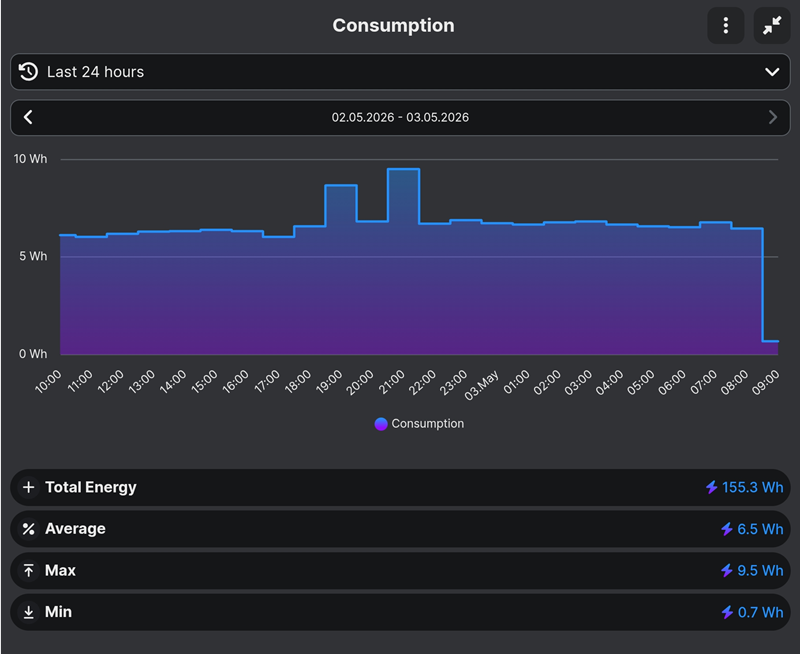
Over a full 24-hour idle period, the ACEMAGIC Retro X5 averages 6.5 W, with a peak of 9.5 W and a minimum of 0.7 W, resulting in a total of 0.16 kWh of energy used over the day. For most of the run, power draw stays in the 6 to 7 W range, with a couple of short spikes in the evening likely tied to background activity or maintenance tasks.
This is a very good idle result for a Mini-PC in this class and puts the Retro X5 among the more efficient systems I've tested. At this average, the system would consume roughly 57 kWh per year, which works out to about $9 to $11 annually, depending on local electricity rates.
CPU and GPU Power Draw
I looked at three different power scenarios to see how the system behaves under different types of load: an esports gaming run with Dota 2 to observe real-world gaming power and consistency, a GPU-focused pass using 3DMark Night Raid to show how the system ramps under heavy graphics demand, and a Cinebench multicore run that fully loads the CPU to measure sustained power delivery over time.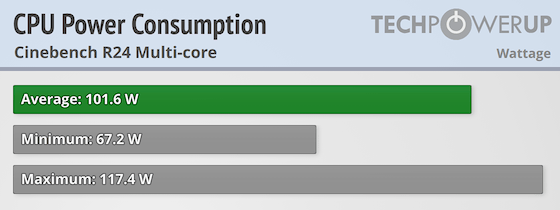
Cinebench (Multicore)
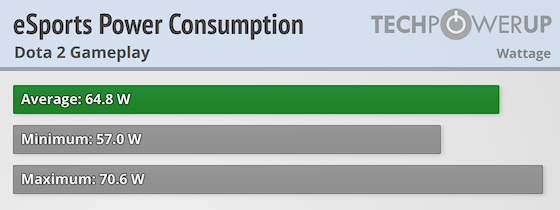
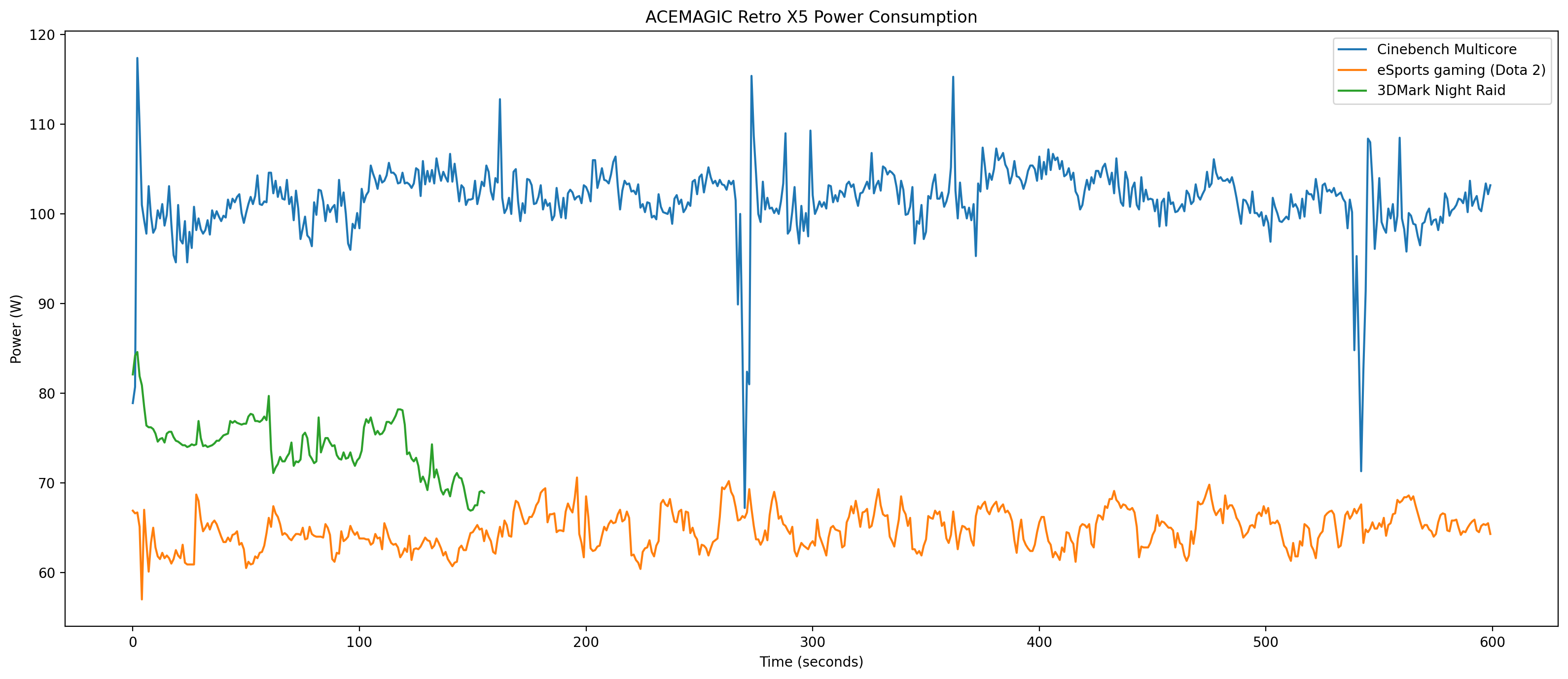
During the Cinebench multicore test, the Retro X5 averages 101.6 W, with readings ranging from 67.2 W to 117.4 W. The higher sustained draw is expected for a heavy all-core CPU workload, while the dips and spikes reflect boost behavior and workload transitions throughout the run.
eSports (Dota 2)
In the Dota 2 workload, the system averages 64.8 W, with readings between 57.0 W and 70.6 W. Power usage remains fairly stable during gameplay, reflecting a balanced CPU and GPU load typical of lighter competitive titles.
3DMark (Night Raid)
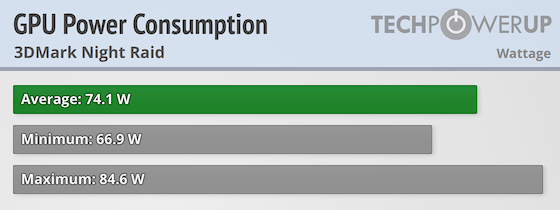
Running 3DMark Night Raid, the system averages 74.1 W, with readings between 66.9 W and 84.6 W. The wider range reflects the burst-heavy nature of the benchmark, where GPU-intensive scenes briefly increase power draw before dropping during lighter portions of the test.
Here's a full view of the ACEMAGIC X5 Retro's power draw across all three profiles:
Noise Levels
Noise was measured using the usual digital sound level meter placed about 30 cm from the front of the case. During idle and lighter everyday tasks, the system generally stays in the mid to low 30 dB(A) range, which keeps it very quiet in a normal office or living room environment.Under heavier workloads such as gaming, benchmarking, or sustained CPU and GPU activity, fan noise ramps up more noticeably, reaching up to 51.1 dB(A). At that level, the system is clearly audible, though the increase is expected given the cooling demands of the hardware and the smaller enclosure. Most importantly, the fan profile never became overly high-pitched or irritating during testing, instead producing more of a steady, dull airflow sound under load.
Nov 22nd, 2026 19:57 CST
change timezone
Latest GPU Drivers
New Forum Posts
- Increasing Power Limit? (8)
- DTS DCH Driver for Realtek HDA [DTS:X APO4 + DTS Interactive] (2818)
- Honestly, do you care about GTA VI? (266)
- What are you playing? (26240)
- UPS what one to get? (48)
- Your PC ATM (36458)
- Gacha Games - Discussions, Pulls, Updates, etc. (1157)
- Last game you purchased? (1414)
- Making a game in Godot engine (19)
- Intel D270 (5)
Popular Reviews
- Microsoft Surface Laptop Ultra Review - The Next-gen Arm Laptop
- Corsair RM1200e (Second Generation) Review
- Upcoming Hardware Launches 2027 (Updated Nov 2026)
- Pulsar Office Tour & First Look at P1 Dual-Sensor Mouse
- Ugreen NASync DXP4800 GT Review
- AMD Ryzen 7 9800X3D Review - The Best Gaming Processor
- AMD Zen 6 Technical Deep Dive
- AMD Ryzen 7 5800X3D 10th Anniversary Review
- Phantom Blade Zero Performance Benchmark Review - 35 GPUs Tested
- Biwin Black Opal NV7400 2 TB Review
TPU on YouTube
Controversial News Posts
- NVIDIA Co-Founder and CEO Jensen Huang Officially Resigns (492)
- Report: Jensen Huang Eyes NVIDIA Comeback (266)
- Open Letter Asking NVIDIA to Reinstate Jensen Huang Passes 115,000 Signatures (184)
- OpenAI CEO Argues Home PCs Waste the World's Limited DRAM Supply (152)
- NVIDIA Launches Investigation Into Jensen Huang's Relationship With Suspected Chinese Spy (136)
- Intel "Raptor Lake Next" 16-Core and 20-Core CPUs Surface (130)
- NVIDIA GeForce RTX 50-Series Scheduled for up to $500 Price Hike This Week (89)
- Intel Razor Lake Gets a 12 P-Core bLLC Chip With No E-Cores, Per Leak (86)