 67
AMD Ryzen 7 9800X3D Memory Performance Scaling
AMD Ryzen 7 9800X3D: Relative Performance »Cyberpunk 2077 Performance Results

Released: 2020 — API: DirectX 12 — Engine: RED Engine
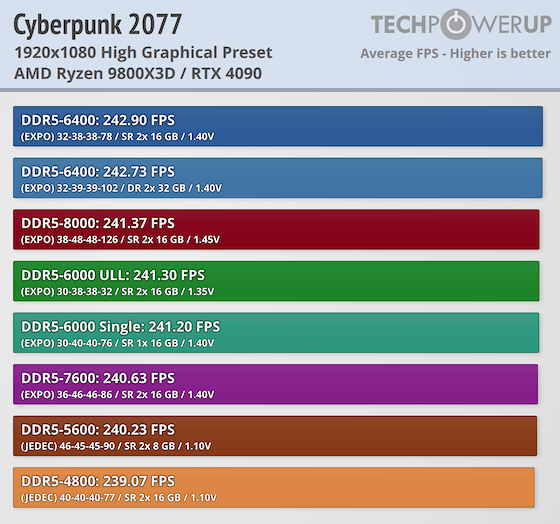
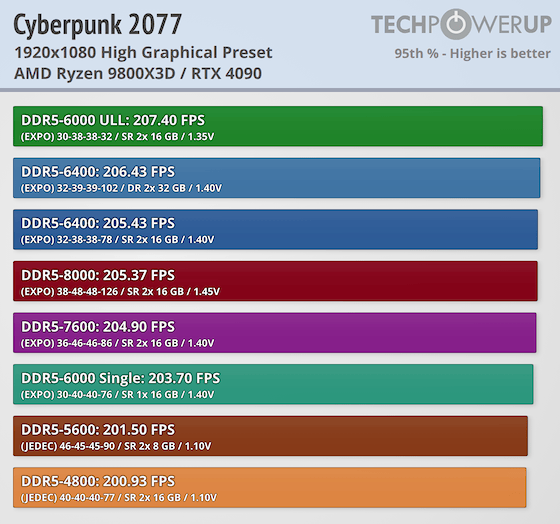
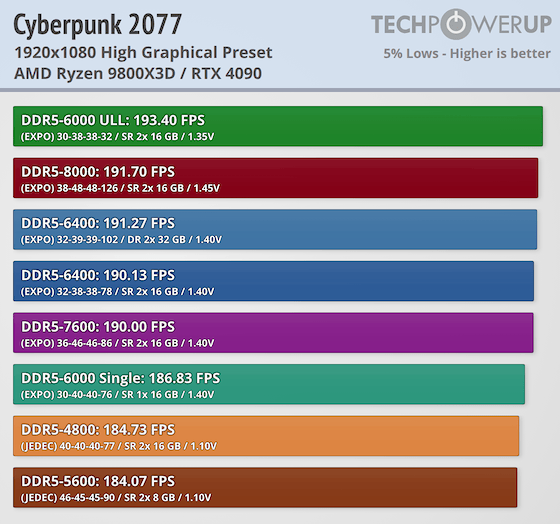
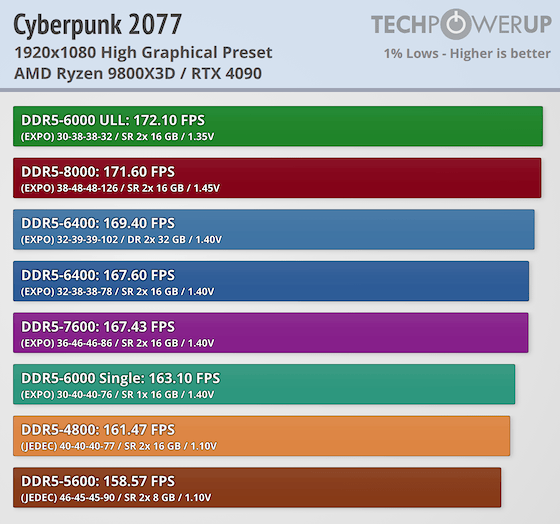
Cyberpunk 2077 continues to be a prime example of a CPU-bound game, especially when played at lower resolutions. The game's intricate crowd simulation and traffic system create a demanding memory access pattern that can challenge even the most robust systems. On pre-X3D Ryzen processors, the game's performance is notably influenced by memory latency, offering valuable insights for those looking to optimize their setup for this title. At 1080p, the game demonstrates significant percentile differences, rivaled only by titles like Forza Horizon 6. However, as the resolution increases, these differences diminish, aligning with the typical performance trends seen in other games.
Cyberpunk 2077 1920 x 1080
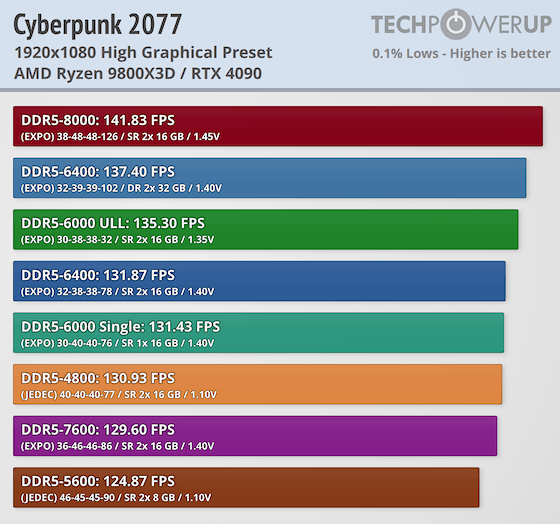
The performance differences are quite minimal when looking at the average frame rates, ranging from 239.07 FPS to 242.90 FPS. However, the percentiles provide a clearer picture of how memory speeds impact performance. The 1% lows show a more significant variation, with DDR5-5600 2x 8 GB delivering 158.57 FPS, while DDR5-6000 ULL reaches up to 172.10 FPS, marking an 8.5% difference. The 0.1% lows are even more telling, with a range from 124.87 FPS to 141.83 FPS, a 13.6% spread led by DDR5-8000.Cyberpunk's demanding crowd system is a factor here, as it was scaled down on consoles due to the systems CPU limitations. On PC, this NPC AI system still exceeds the L3 cache, making the deepest percentiles sensitive to latency. Interestingly, DDR5-4800 JEDEC manages to achieve 130.93 FPS in the 0.1% lows, outperforming DDR5-7600, which sits at 129.60 FPS. This demonstrates that higher memory speeds don't always translate to better performance in every scenario, especially when latency comes into play.
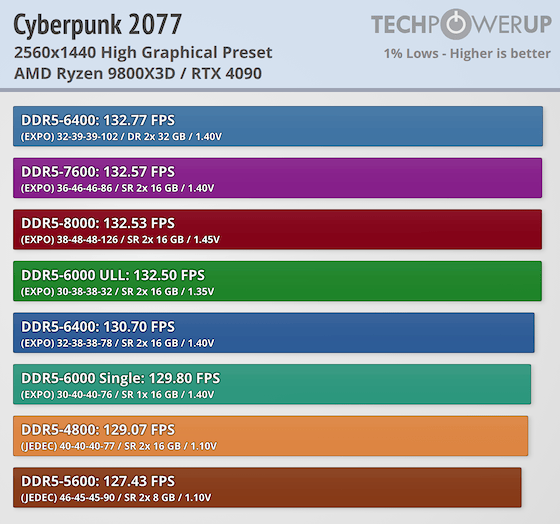
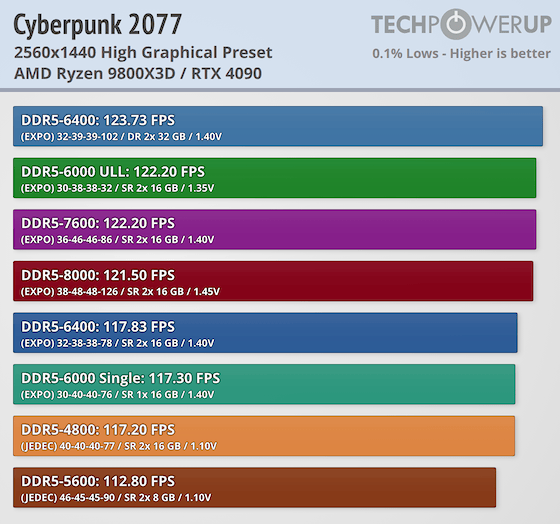
Cyberpunk 2077 2560 x 1440
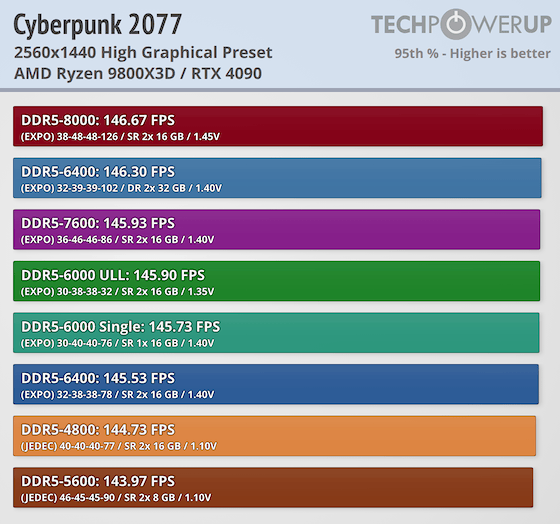
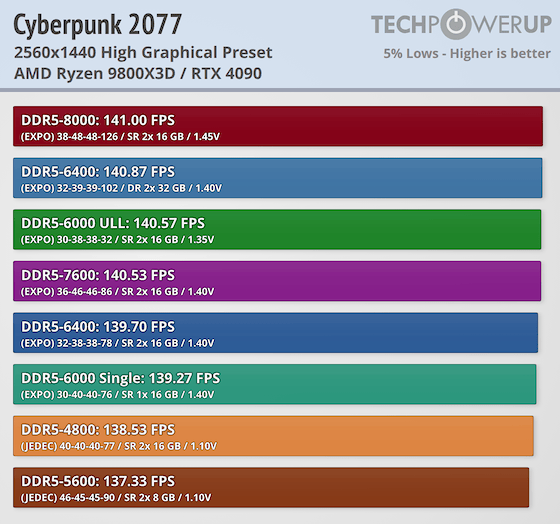
The 1440p performance in Cyberpunk is impressively stable, with frame rates between 160.80 and 161.90 FPS, leading to just a 0.7% variance across all eight configurations. The rankings align with expectations, particularly with the X3D V-Cache, which shows inconsistent results. This suggests that the RTX 4090 is the key player here, rendering the memory subsystem's influence on performance negligible.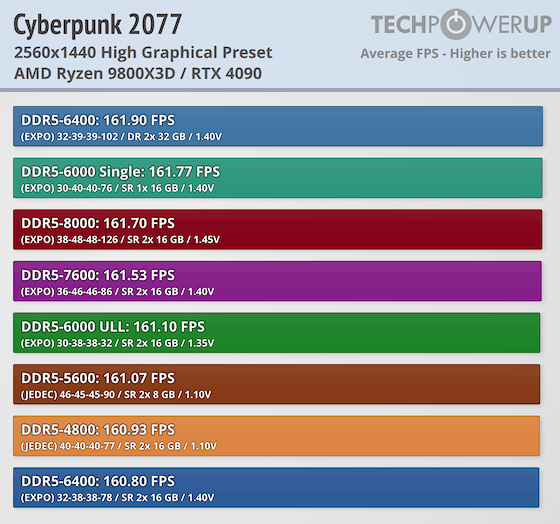
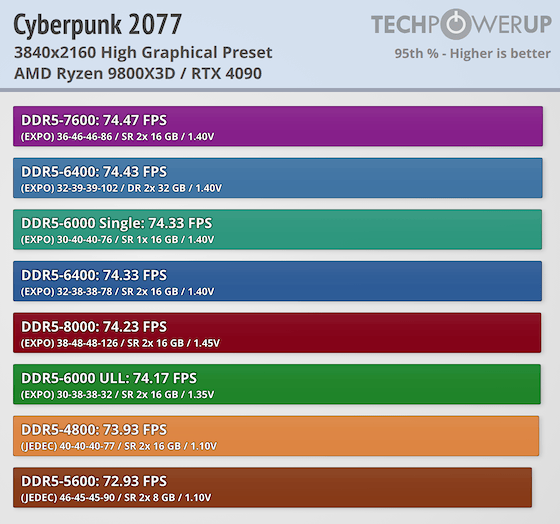
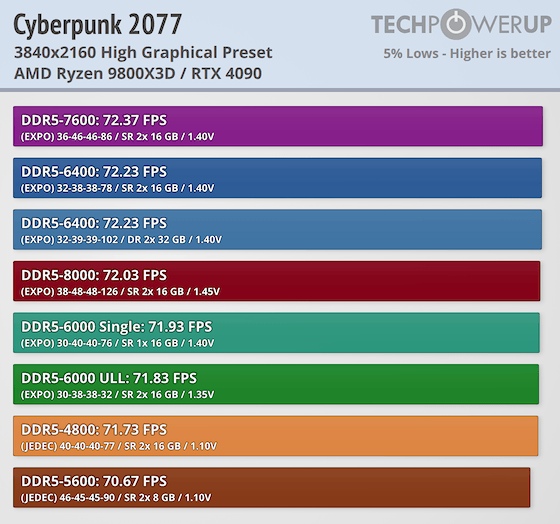
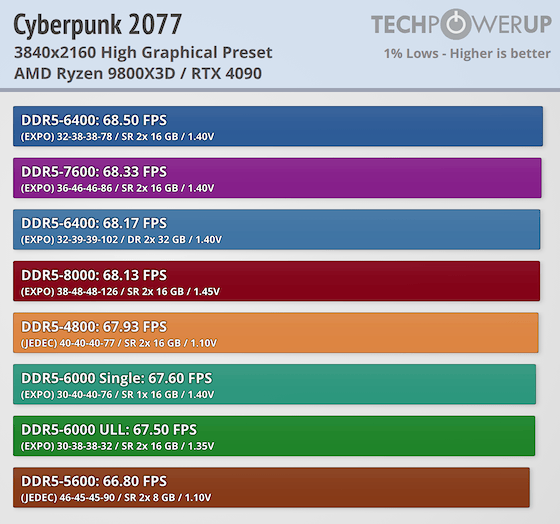
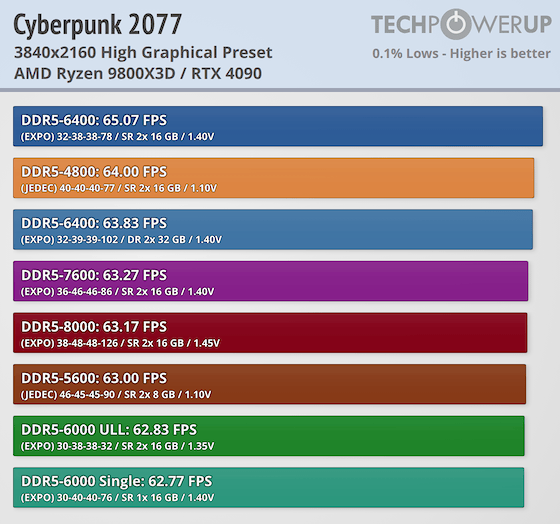
Cyberpunk 2077 3840 x 2160
The performance at 4K resolution sees frame rates dipping into the 78 to 80 FPS range, with a minimal spread of just 1.7%. This consistency indicates that the bottleneck isn't related to memory. When a single 16 GB stick outperforms a high-end 1.45 V DDR5-8000 kit in the charts, it's a clear sign that other factors are at play, and memory isn't the key variable being tested in this scenario.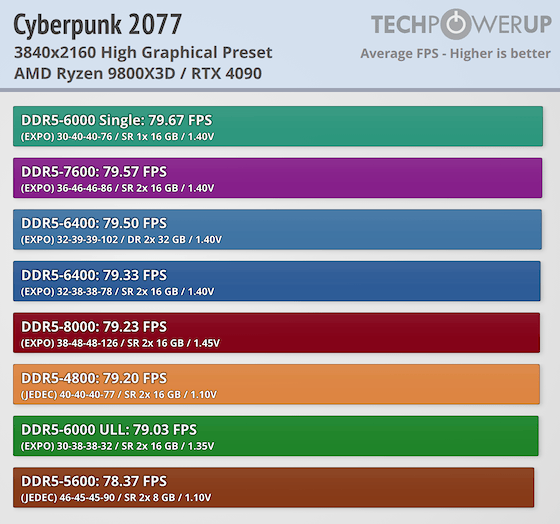
Nov 18th, 2026 13:50 PST
change timezone
Latest GPU Drivers
New Forum Posts
- Honestly, do you care about GTA VI? (145)
- What are you playing? (26234)
- Can i play GTA 6 now? (Joke) (6)
- Very unusual two gaming-pc scenarios. (12)
- Dell Workstation Owners Club (3513)
- Any other old-timers here planning to play WoW Forever? (151)
- Time to upgrade CPU and MOBO (33)
- The Filthy, Rotten, Nasty, Helpdesk-Nightmare picture clubhouse (2876)
- WarpCoreBench scores! (67)
- Acer Predator BiFrost Radeon RX 9070 OC (9)
Popular Reviews
- Acemagic Retro X3 Review
- Upcoming Hardware Launches 2027 (Updated Nov 2026)
- AMD Zen 6 Technical Deep Dive
- ASUS ROG Strix B850-I Gaming Wi-Fi7 W Review
- Corsair HX1000i Shift Crystal Review
- Biwin Black Opal NV7400 2 TB Review
- Chieftec Iceberg PRO 360 DARK Review
- AMD Ryzen 7 9800X3D Review - The Best Gaming Processor
- Pulsar Office Tour & First Look at P1 Dual-Sensor Mouse
- Phantom Blade Zero Performance Benchmark Review - 35 GPUs Tested
TPU on YouTube
Controversial News Posts
- NVIDIA Co-Founder and CEO Jensen Huang Officially Resigns (478)
- Report: Jensen Huang Eyes NVIDIA Comeback (187)
- Open Letter Asking NVIDIA to Reinstate Jensen Huang Passes 115,000 Signatures (184)
- OpenAI CEO Argues Home PCs Waste the World's Limited DRAM Supply (152)
- NVIDIA Launches Investigation Into Jensen Huang's Relationship With Suspected Chinese Spy (136)
- Intel "Raptor Lake Next" 16-Core and 20-Core CPUs Surface (130)
- Legendary Game Studio BioWare Shuts Down Following EA Layoffs (104)
- Dell CEO Says the Memory Shortage Will Get Worse in 2027 (95)