 67
AMD Ryzen 7 9800X3D Memory Performance Scaling
AMD Ryzen 7 9800X3D: Palworld Benchmarks »AMD CPU Performance Results
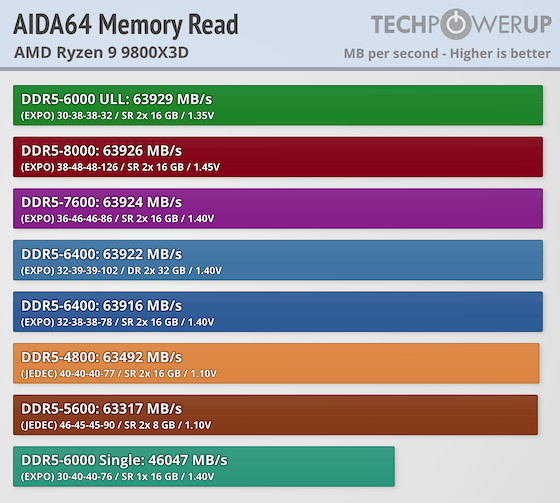
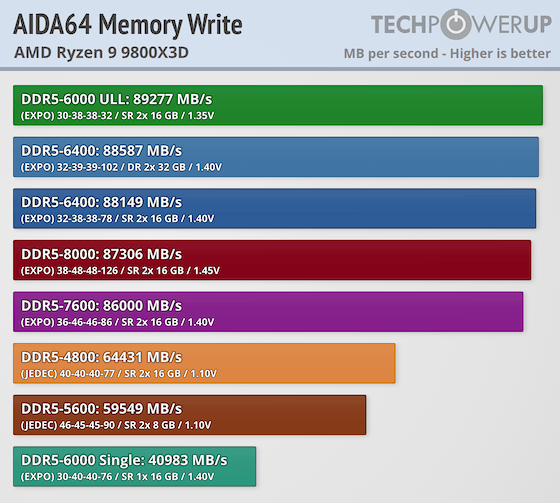
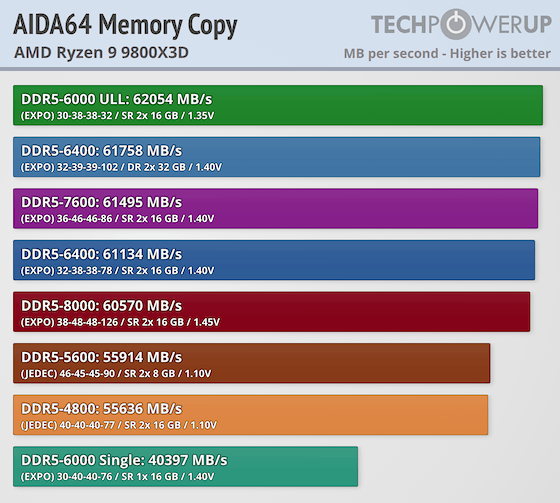
Before diving into game results, it's essential to examine the synthetic and productivity benchmarks, as they reveal the memory's performance on a 3D V-Cache part. AIDA64 Memory Read is arguably the most insightful chart in this section. Every dual-channel setup, from DDR5-4800 JEDEC to DDR5-8000, achieves between 63,317 and 63,929 MB/s. This isn't a data error; it's due to the Infinity Fabric and AMD chiplet design.The 9800X3D features a single-CCD chiplet, and the GMI link between the core complex and the input/output die limits read bandwidth to around 64 GB/s. DDR5-4800 already surpasses what this link can handle, so faster kits are effectively bottlenecked by the Infinity Fabric (FCLK). Increasing the Infinity Fabric clock can boost bandwidth, but to truly leverage DDR5-8000 alongside a higher FCLK frequency, a second CCD chiplet is necessary. The only result that drops below that range is the single-DIMM DDR5-6000 setup at 46,047 MB/s. One stick means a single memory channel, and in that case the memory itself really is the bottleneck.
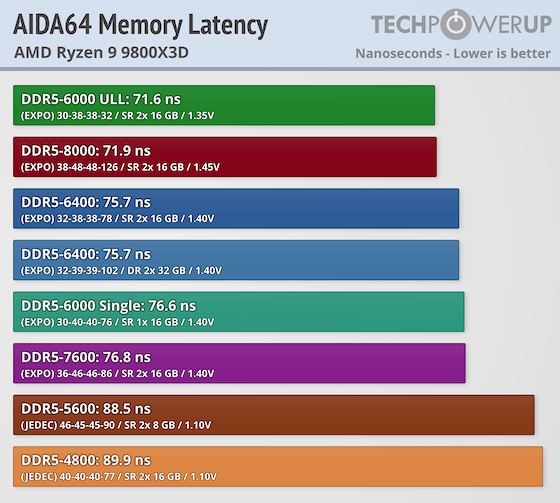
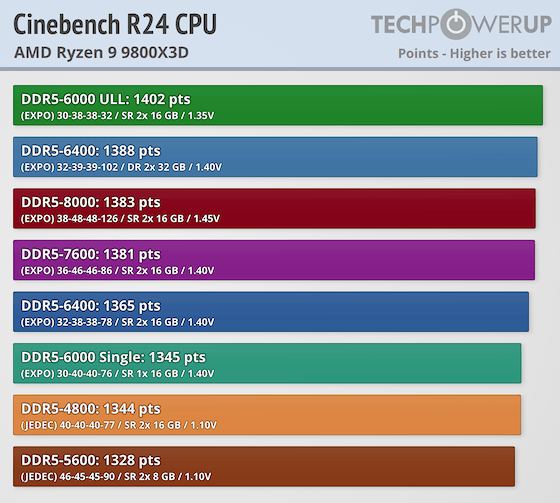
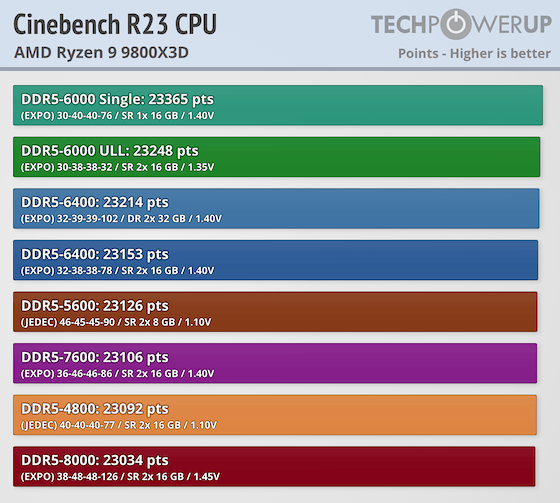
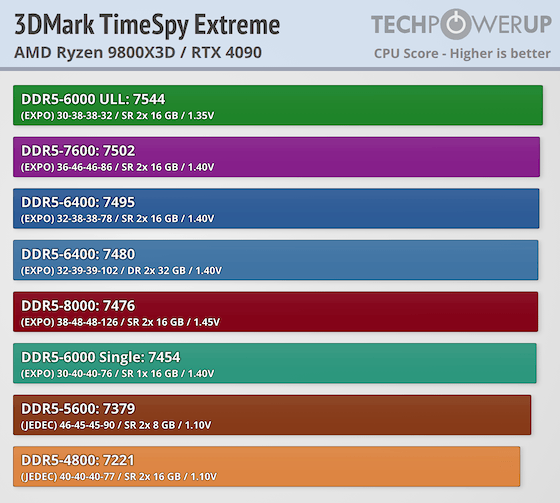
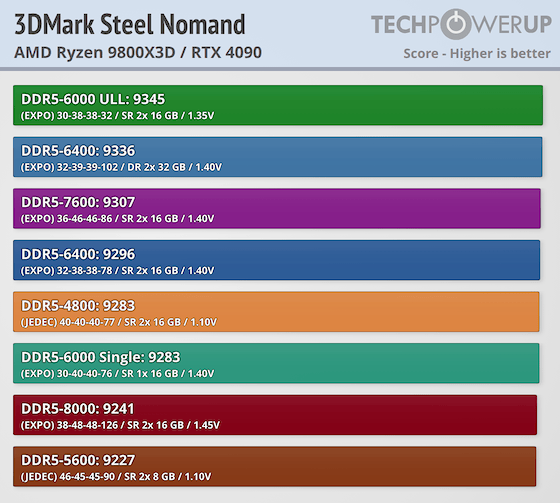
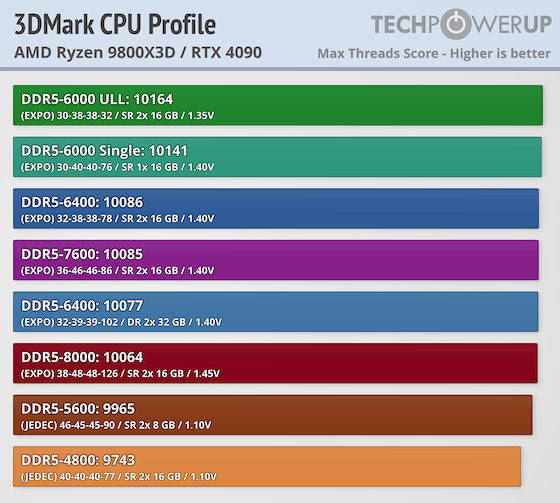
Latency is where the kits actually separate. The DDR5-6000 CL30 ULL posts a latency of 71.6 ns, while the DDR5-8000 comes in slightly higher at 71.9 ns. Meanwhile, the two JEDEC kits sit at 88.5 ns and 89.9 ns, respectively. This represents a gap of roughly 25%, which is significant and highlights the advantage of tuned memory, particularly in scenarios involving 0.1% lows. When it comes to CPU tests, there's minimal deviation. Cinebench R23 shows a spread of just 1.4%, with the single-stick configuration finishing first and DDR5-8000 finishing last. This variation is likely due to run-to-run variance rather than actual scaling. Cinebench R24 presents a cleaner picture, possibly because of the longer benchmark duration. Tests like 3DMark Time Spy Extreme, Steel Nomad, and CPU Profile all display a similar shallow performance curve. Notably, the single-DIMM setup performs near the top in CPU Profile, indicating that memory bandwidth has little impact on the results.
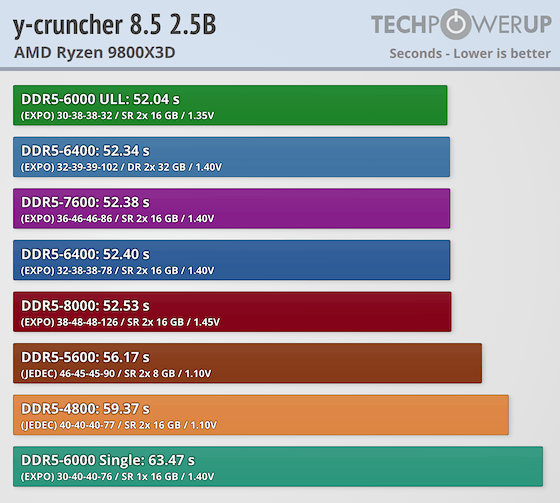
y-cruncher 2.5B is the one real exception. It is a bandwidth and latency-bound workload with a working set far larger than any CPU cache, so the results separate cleanly: 52.04 s for DDR5-6000 ULL, 59.37 s for DDR5-4800, and 63.47 s for the single 16 GB stick. That is a 22% penalty, almost exactly in line with the AIDA64 latency gap.
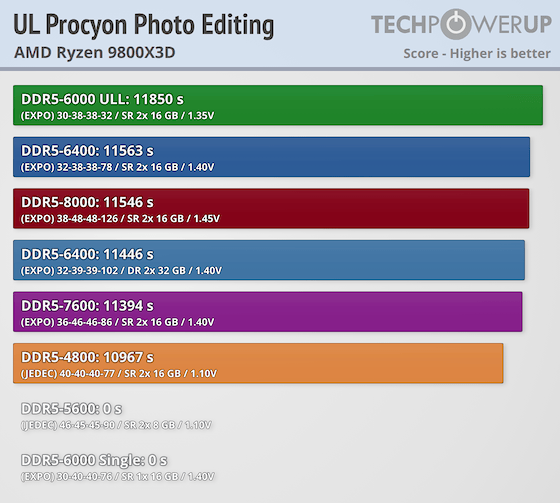
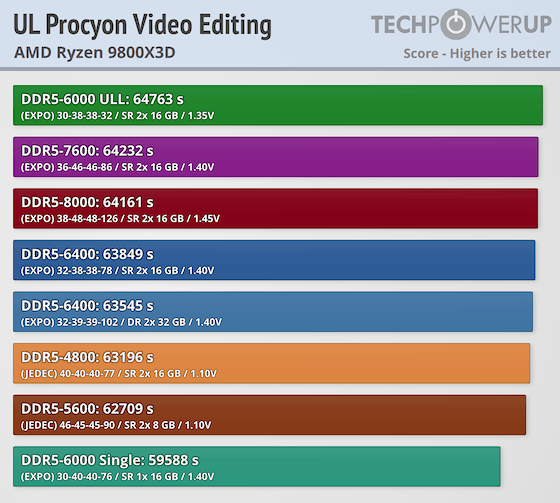
Lastly, it's important to note a caveat with the UL Procyon Photo Editing benchmark. The configurations using DDR5-5600 2x 8 GB and a single 16 GB DDR5-6000 failed to complete the run for unknown reasons. While the tests executed, the results were blank. The leading theory is that there wasn't enough memory to finish the entire benchmark set, resulting in the absence of a final score. For the configurations that did complete, Photo Editing scores ranged from 10,967 to 11,850, while Video Editing scores fell between 59,588 and 64,763. These results are comfortably within the expected range for typical test-to-test variation.
AMD Results: AIDA64
AMD Results: Cinebench
AMD Results: Y-Cruncher 2.5B
AMD Results: UL 3DMark & Procyon
Nov 21st, 2026 23:36 PST
change timezone
Latest GPU Drivers
New Forum Posts
- How to prevent OLED burn damage due to PC freezes or power outtages? (53)
- Your PC ATM (36447)
- Honestly, do you care about GTA VI? (238)
- SATA drive 1.4 GBps with Intel X25-E on Windows 98! (41)
- TPU's Nostalgic Hardware Club (22191)
- Ryzen or Intel system (11)
- AI generated images... (231)
- RX 9000 series GPU Owners Club (2252)
- Introducing DST Bench : one of the most advanced disk benchmark and storage analyzer real-time software (7)
- UPS what one to get? (26)
Popular Reviews
- Microsoft Surface Laptop Ultra Review - The Next-gen Arm Laptop
- Corsair RM1200e (Second Generation) Review
- Pulsar Office Tour & First Look at P1 Dual-Sensor Mouse
- Upcoming Hardware Launches 2027 (Updated Nov 2026)
- Ugreen NASync DXP4800 GT Review
- AMD Ryzen 7 9800X3D Review - The Best Gaming Processor
- Biwin Black Opal NV7400 2 TB Review
- AMD Zen 6 Technical Deep Dive
- Phantom Blade Zero Performance Benchmark Review - 35 GPUs Tested
- AMD Ryzen 7 5800X3D 10th Anniversary Review
TPU on YouTube
Controversial News Posts
- NVIDIA Co-Founder and CEO Jensen Huang Officially Resigns (492)
- Report: Jensen Huang Eyes NVIDIA Comeback (262)
- Open Letter Asking NVIDIA to Reinstate Jensen Huang Passes 115,000 Signatures (184)
- OpenAI CEO Argues Home PCs Waste the World's Limited DRAM Supply (152)
- NVIDIA Launches Investigation Into Jensen Huang's Relationship With Suspected Chinese Spy (136)
- Intel "Raptor Lake Next" 16-Core and 20-Core CPUs Surface (130)
- NVIDIA GeForce RTX 50-Series Scheduled for up to $500 Price Hike This Week (89)
- Intel Razor Lake Gets a 12 P-Core bLLC Chip With No E-Cores, Per Leak (86)