 67
AMD Ryzen 7 9800X3D Memory Performance Scaling
AMD Ryzen 7 9800X3D: Elden Ring Benchmarks »Baldur's Gate 3 Performance Results

Released: 2023 — API: DirectX 11 — Engine: Divinity Engine 4.0
Baldur's Gate 3 is a standout title when it comes to memory sensitivity, especially on traditional processors. The game leverages the Larian engine, which manages a vast array of simulated objects and frequently navigates through complex game states. This type of workload typically benefits more from low latency than sheer bandwidth, although the balance can shift depending on the in-game location. The game is a perfect candidate for showcasing the capabilities of the 9800X3D's 96 MB of L3 cache, as it allows much of the active game state to be retained within the cache. This makes Baldur's Gate 3 an excellent benchmark for evaluating whether 3D V-Cache effectively neutralizes memory scaling issues or merely reduces them.
Baldur's Gate 3 1920 x 1080
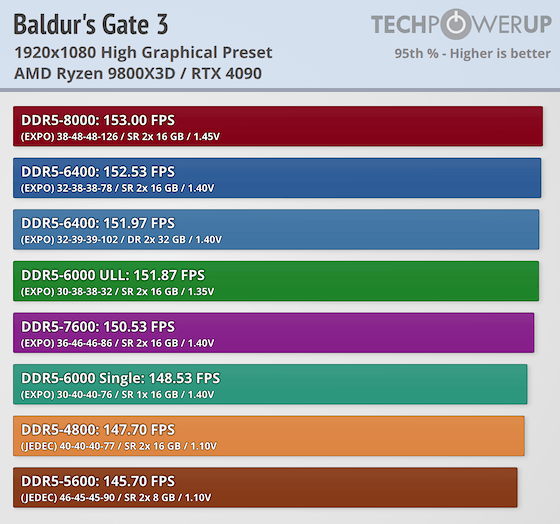
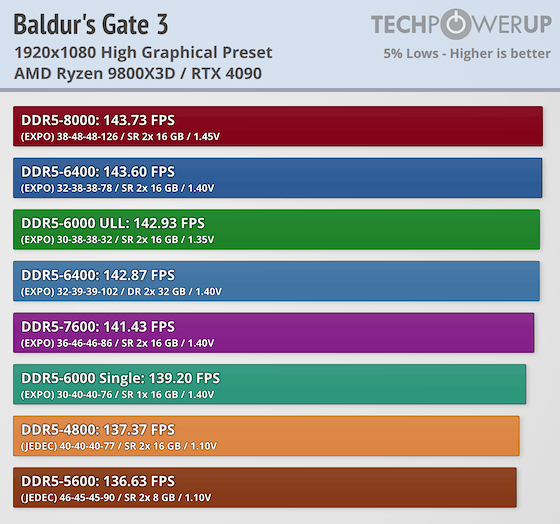
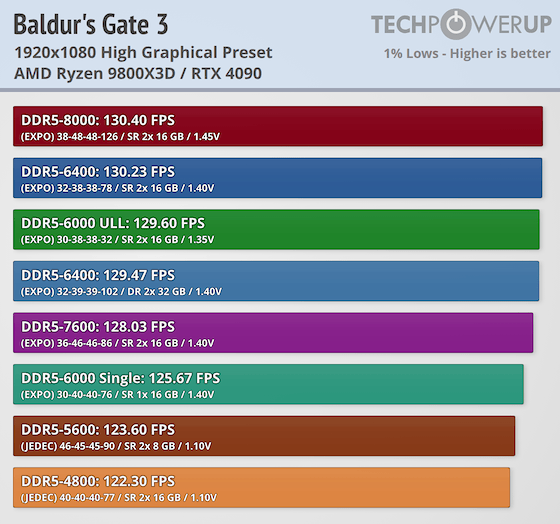
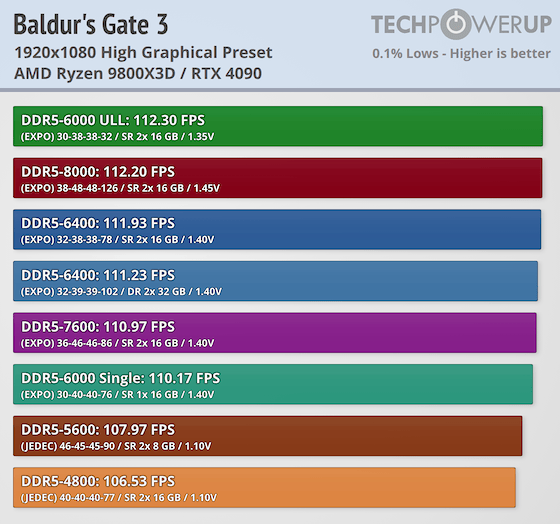
At 1080p, this title exhibits the largest average frame rate spread among all tested, though it's a modest 3.6%. Leading the pack is the DDR5-8000 with a frame rate of 178.97 FPS, closely followed by the DDR5-6400 2x 16 GB at 178.67 FPS, the DDR5-6000 ULL at 178.23 FPS, and the dual-rank DDR5-6400 kit at 178.10 FPS. On the lower end, the DDR5-5600 2x 8 GB comes in at 172.73 FPS, just below the DDR5-4800 JEDEC at 174.67 FPS. In simpler terms, upgrading from the JEDEC DDR5-4800, typically found in prebuilt systems, to a 1.45 V DDR5-8000 kit nets an average gain of about 4 FPS. The 95th percentile results mirror this order, ranging from 145.70 FPS to 153.00 FPS, while the 1% lows span from 122.30 FPS on DDR5-4800 to 130.40 FPS on DDR5-8000, marking a 6.6% difference. An interesting anomaly in our data, given that these results, averaged over three runs, are consistent and reproducible. Looking at the single 16 GB DDR5-6000 stick, which beats DDR5-4800 in the 1% lows, this is despite having half the memory bandwidth of a dual-channel kit. This suggests that memory latency plays a more significant role than frequency alone for this in-game area and game title.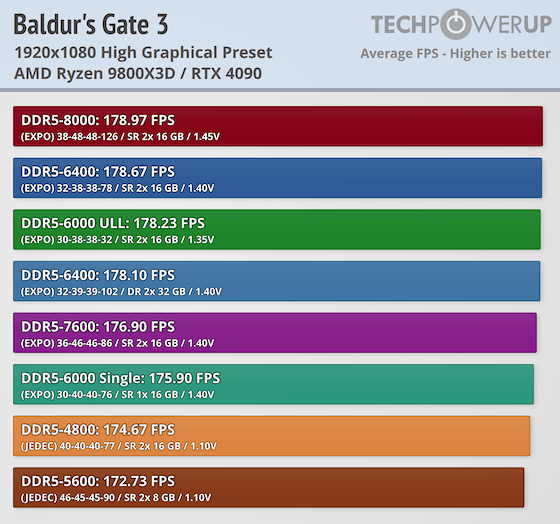
Baldur's Gate 3 2560 x 1440
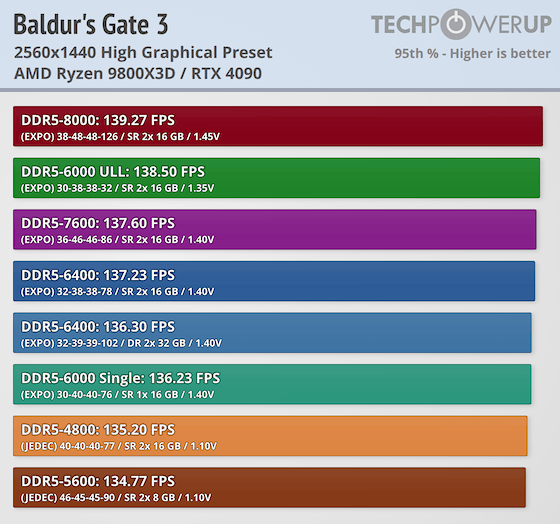
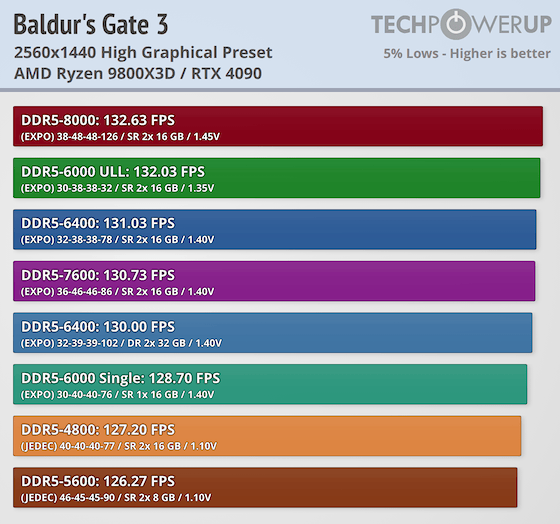
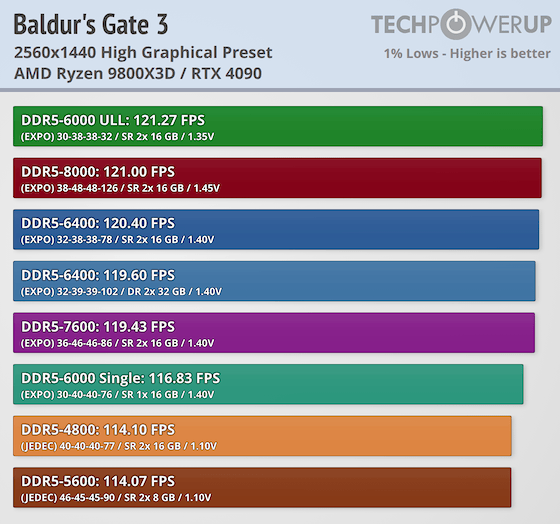
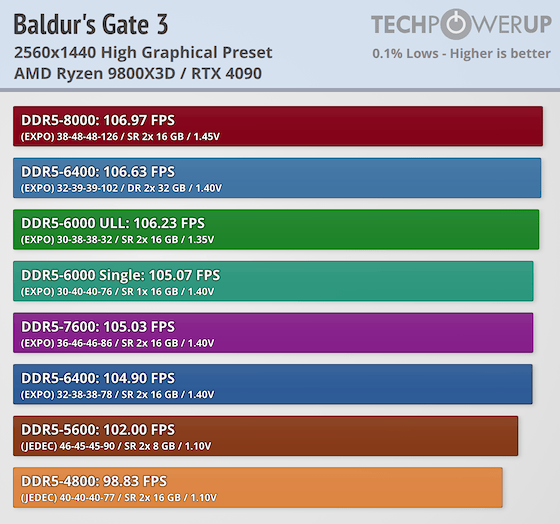
At 1440p, the game becomes distinctly GPU-limited, with performance differences narrowing to a mere 2 FPS window and a total spread of just 1.3%. The rankings are so close that they appear more like measurement noise than a definitive pattern. Interestingly, the DDR5-4800 JEDEC configuration slightly outperforms a DDR5-6400 EXPO kit, and a single 16 GB stick matches the performance of a DDR5-6400 2x 16 GB setup exactly. By this resolution, the 3.6% average performance boost observed with faster memory at 1080p has vanished. This is significant since 1440p is a resolution that many gamers prefer for its balance between visual fidelity and performance.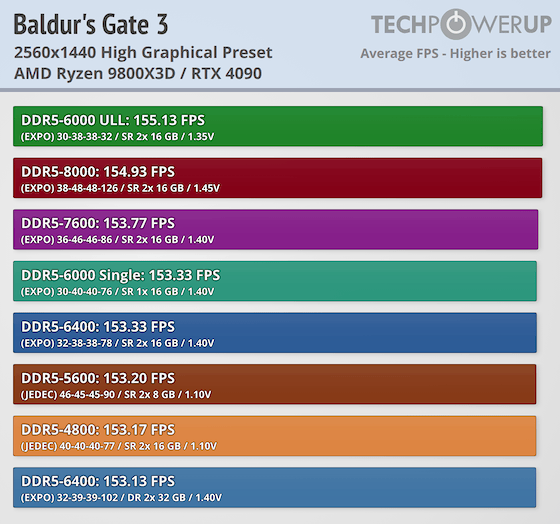
Baldur's Gate 3 3840 x 2160
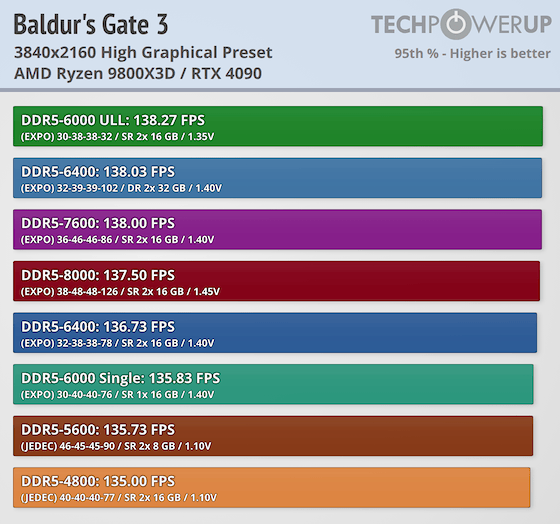
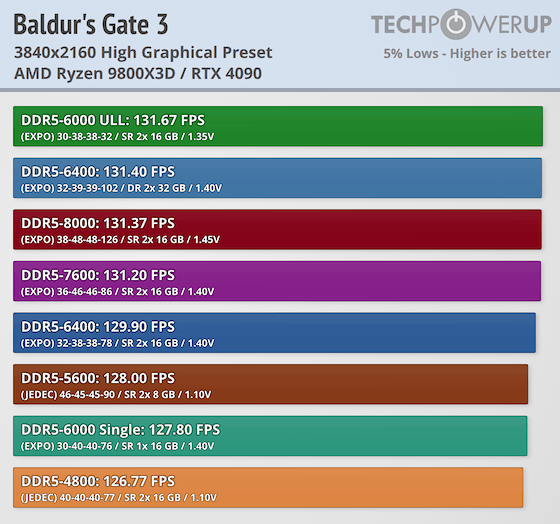
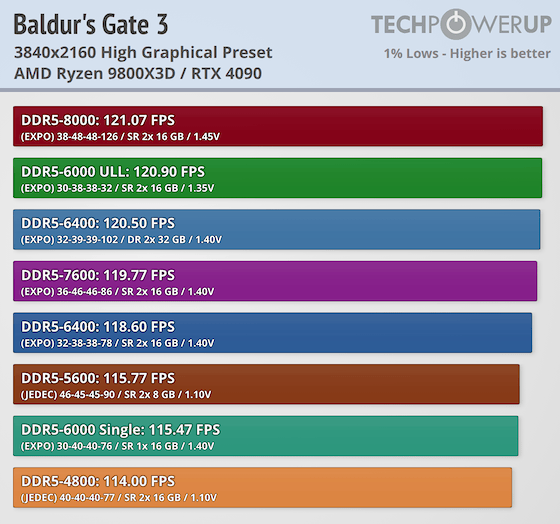
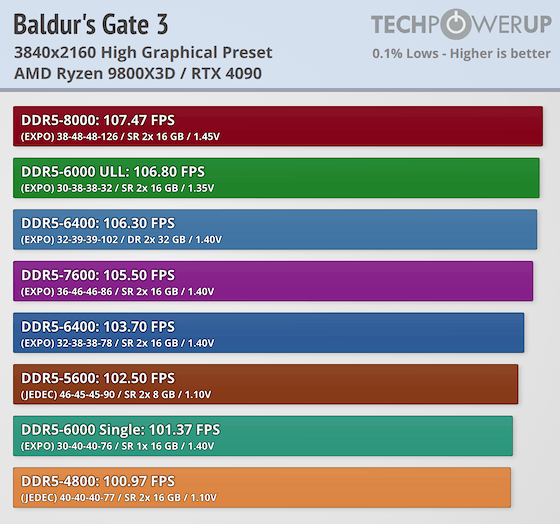
In typical fashion, the performance at 4K mirrors what we see at 1440p, indicating that the RTX 4090 is already hitting its limits. The differences here are so minimal that most gamers would find it challenging to distinguish between the setups based on gameplay alone. The ranking deviates significantly from the 1080p results, suggesting that what we're observing is more likely run-to-run variation rather than true scaling.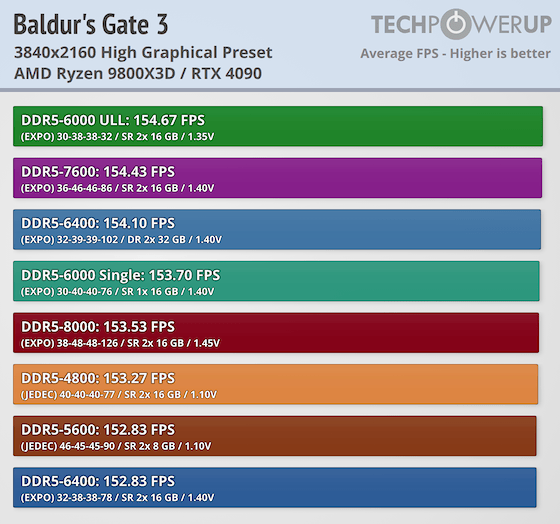
Nov 26th, 2026 06:38 CST
change timezone
Latest GPU Drivers
New Forum Posts
- Wireless Internet sharing between PC and router both-ways, is it possible? (20)
- GTA VI (51)
- Current Sales, Bundles, Giveaways (10451)
- Without Jensen, PC gaming will be (61)
- WarpCoreBench scores! (105)
- Which ryzen am5 cpu ? (220)
- Exploring Local LLMs: Models, Hardware and Setup Experiences (2)
- Radeon driver death (2)
- Claude credits purchased on or after Dec. 7 now have an expiry date (19)
- Smokin Hot Lappy (14)
Popular Reviews
- ASRock X870E Challenger Wi-Fi White Review
- VZMORE AX9 Max Review
- Upcoming Hardware Launches 2027 (Updated Nov 2026)
- Microsoft Surface Laptop Ultra Review - The Next-gen Arm Laptop
- AMD Ryzen 7 9800X3D Review - The Best Gaming Processor
- AMD Zen 6 Technical Deep Dive
- Corsair RM1200e (Second Generation) Review
- Phantom Blade Zero Performance Benchmark Review - 35 GPUs Tested
- Pulsar Office Tour & First Look at P1 Dual-Sensor Mouse
- Montech CyberFlow ARGB 360 Review
TPU on YouTube
Controversial News Posts
- Jensen Huang Reinstated as CEO of NVIDIA (582)
- NVIDIA Co-Founder and CEO Jensen Huang Officially Resigns (492)
- Report: Jensen Huang Eyes NVIDIA Comeback (281)
- Open Letter Asking NVIDIA to Reinstate Jensen Huang Passes 115,000 Signatures (184)
- OpenAI CEO Argues Home PCs Waste the World's Limited DRAM Supply (152)
- NVIDIA Launches Investigation Into Jensen Huang's Relationship With Suspected Chinese Spy (136)
- Intel "Raptor Lake Next" 16-Core and 20-Core CPUs Surface (130)
- Intel Razor Lake Gets a 12 P-Core bLLC Chip With No E-Cores, Per Leak (94)