 67
AMD Ryzen 7 9800X3D Memory Performance Scaling
AMD Ryzen 7 9800X3D: Forza Horizon 6 Benchmarks »Spider-Man Remastered Performance Results

Released: 2022 — API: DirectX 12 — Engine: Insomniac Engine
Spider-Man Remastered serves as the ultimate traversal stress test. Swinging through the bustling streets of Manhattan at high speeds demands relentless asset streaming and a hefty amount of draw call submissions, which has historically made this one of the more memory-intensive PC ports of a PS5 game available. This is precisely why it remains a staple in the testing suite; if any game is going to push slow DRAM on a modern AMD platform to its limits, it's this one. However, with the advent of 3D V-Cache, the landscape of requiring low latency memory has shifted significantly.
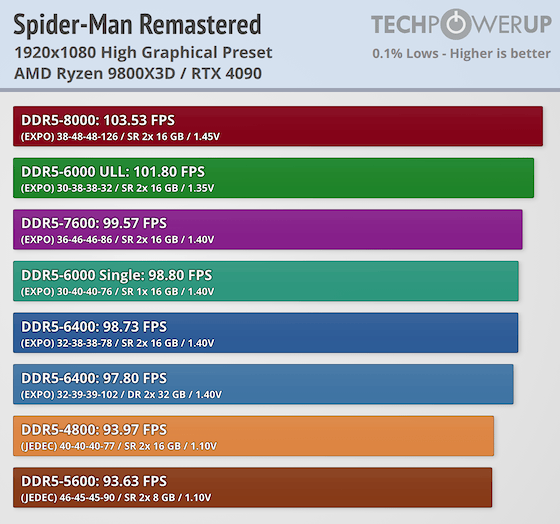
Spider-Man Remastered 1920 x 1080
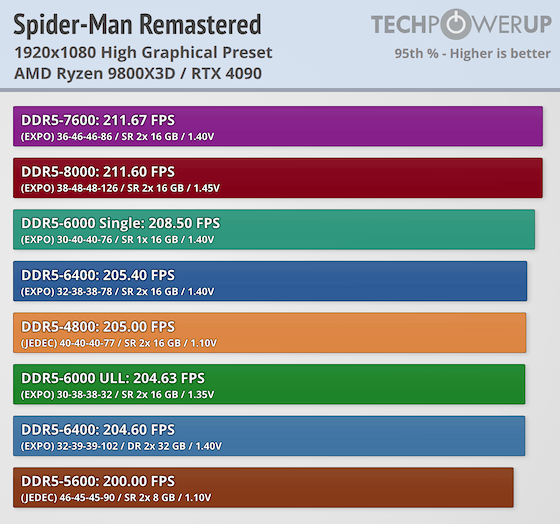
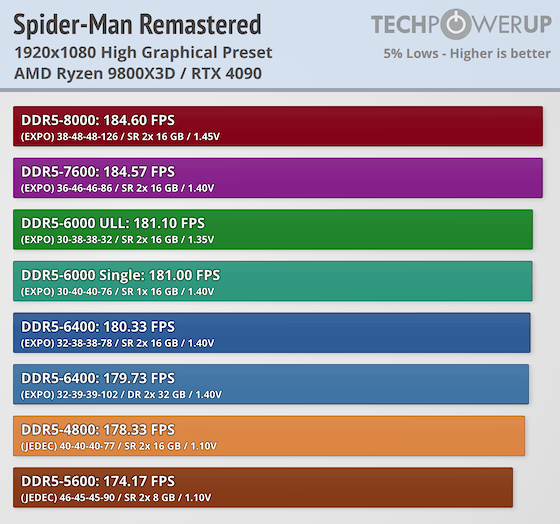
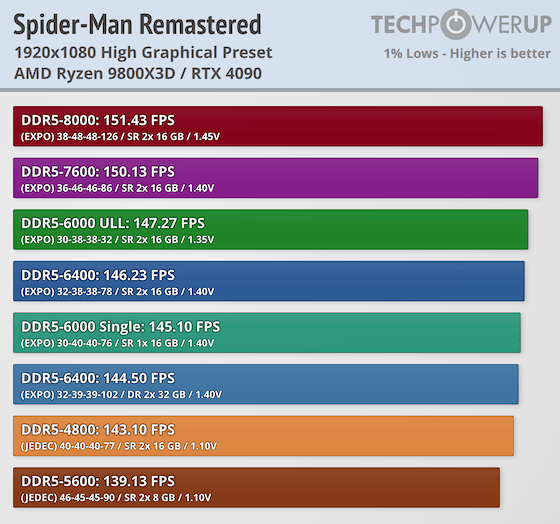
The averages paint a familiar picture: DDR5-5600 2x 8 GB finds itself near the bottom, with a modest 2.0% spread compared to DDR5-4800 JEDEC, which surprisingly takes 4th place ahead of both DDR5-6400 and DDR5-6000 ULL kits. This reaffirms what we've seen before that memory latency doesn't scale significantly with 3D V-Cache. However, the percentiles are where this game truly showcases its sensitivity to memory. The 1% lows range from 139.13 FPS to 151.43 FPS, marking an 8.8% gap, with a clear hierarchy: the two JEDEC configurations at the bottom, followed by the single stick, and then the EXPO kits in ascending order, with DDR5-8000 leading and DDR5-7600 in second place. The 0.1% lows mirror this pattern, ranging from 93.63 to 103.53 FPS, a 10.6% spread, which is the second-largest range in the entire article. This is a clear example of how memory speed can enhance frame consistency. It's important to be upfront about spending money on ULL memory: if you're into streaming-heavy open-world games, lower latency RAM can provide slightly smoother gameplay. However, it won't significantly boost your frame rates.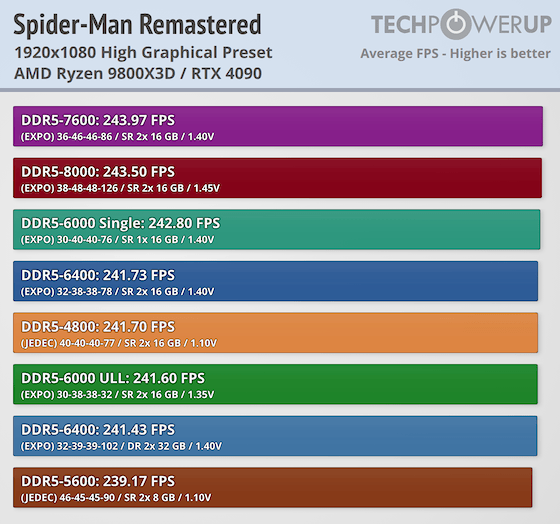
Spider-Man Remastered 2560 x 1440
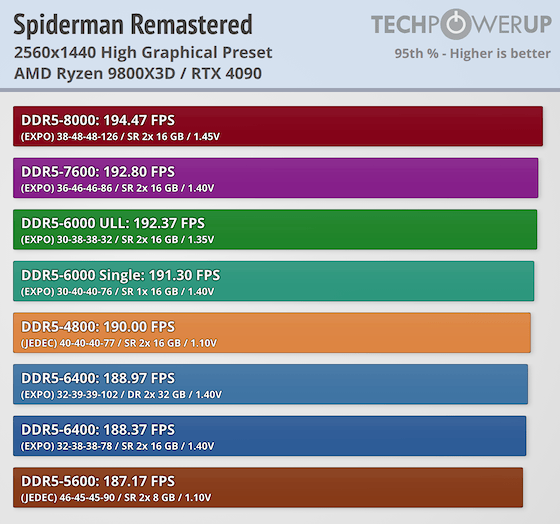
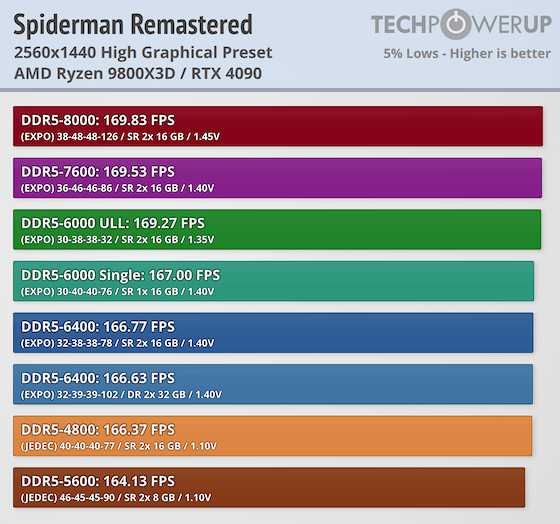
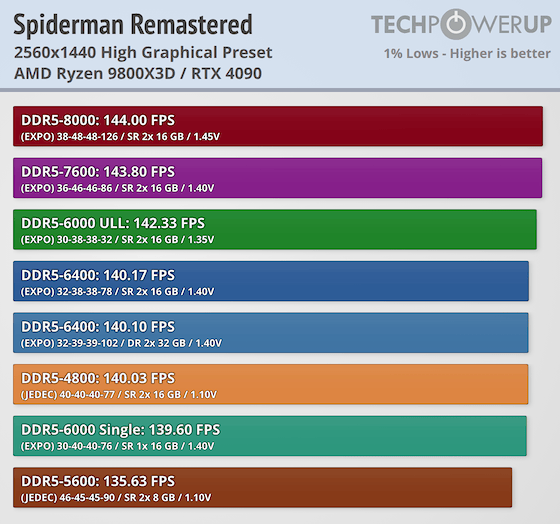
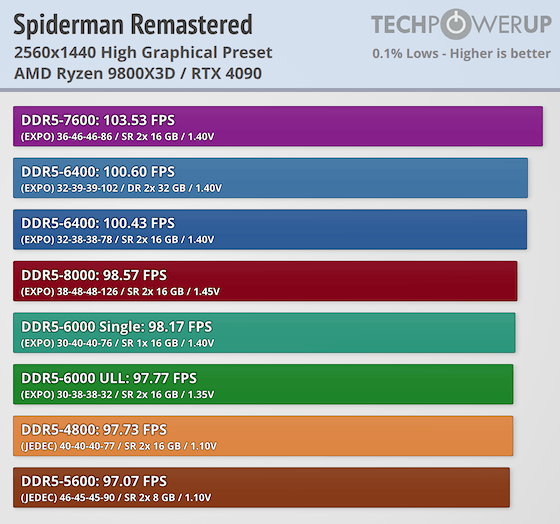
At 1440p, the performance differences become less pronounced, with only a 1.6% spread between the kits, and the rankings start to shift unexpectedly. The DDR5-6400 2x 16 GB kit ends up at the bottom, achieving 235.07 FPS, just behind the DDR5-5600 2x 8 GB. Surprisingly, DDR5-4800 JEDEC finds itself in the middle of the pack with 236.30 FPS, outperforming both DDR5-6400 configurations. Leading the group is the DDR5-8000, which reaches 238.87 FPS, a mere 1.1% ahead of the most affordable setup in the test. The significant 8.8% advantage in 1% lows seen at 1080p has diminished to a level where only a detailed frame time graph would reveal the difference and not the human eye.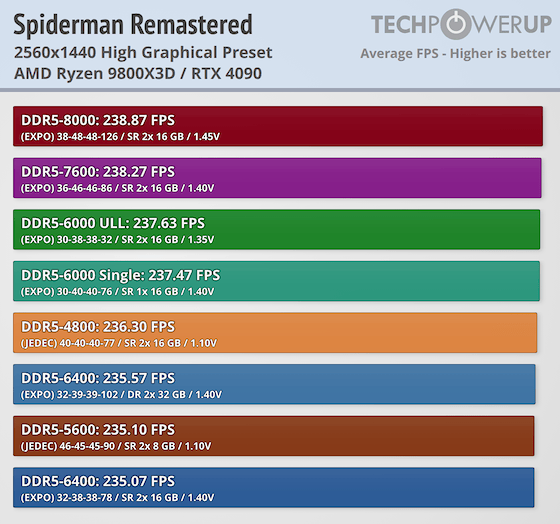
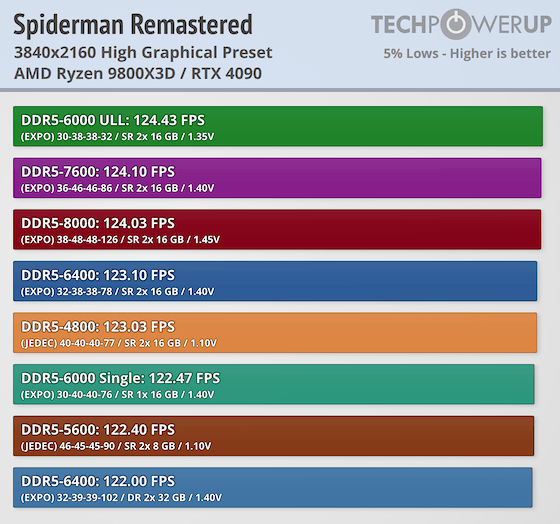
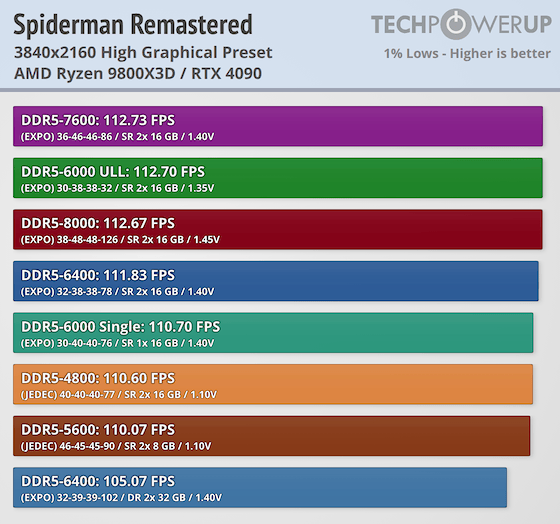
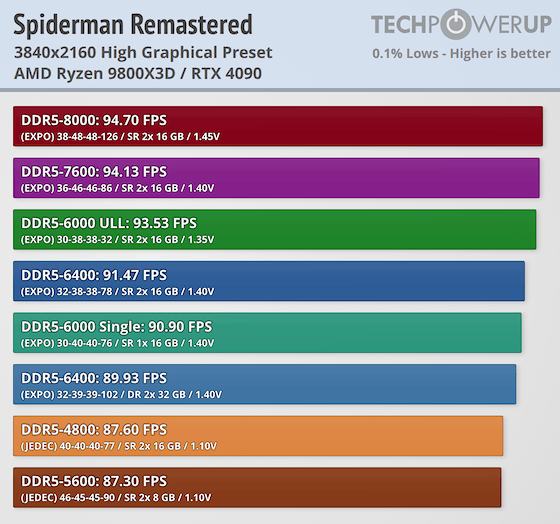
Spider-Man Remastered 3840 x 2160
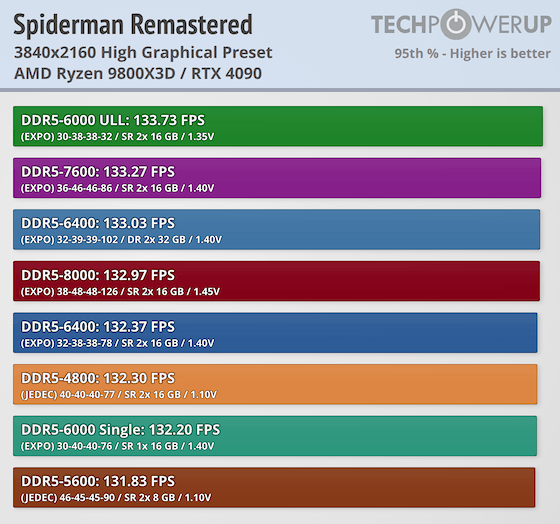
The performance spread at 4K is minimal, with only a 1.3% difference between the lowest and highest frame rates, ranging from 163.83 FPS to 165.90 FPS. This slight variance highlights that even in the most memory-sensitive title of our suite, the difference between a standard 1.10 V JEDEC configuration and a high-end 1.45 V enthusiast kit is just two frames per second. This is particularly relevant for RTX 4090 owners, who are likely to be gaming at this resolution. The results suggest that, at least in this scenario, the benefits of more aggressive memory settings are beyond minimal at best.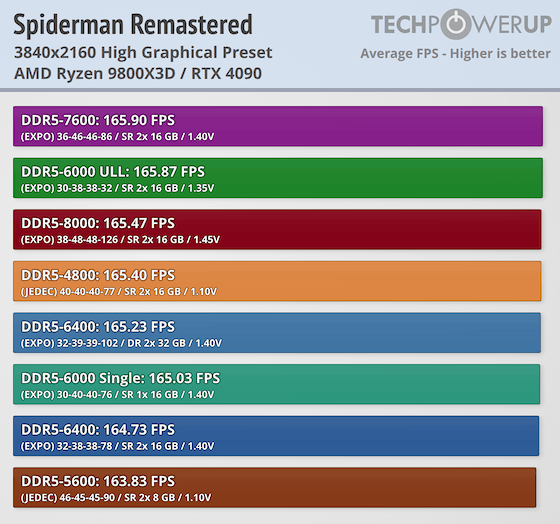
Nov 18th, 2026 13:38 PST
change timezone
Latest GPU Drivers
New Forum Posts
- Can i play GTA 6 now? (Joke) (6)
- Very unusual two gaming-pc scenarios. (12)
- Dell Workstation Owners Club (3513)
- Any other old-timers here planning to play WoW Forever? (151)
- Time to upgrade CPU and MOBO (33)
- The Filthy, Rotten, Nasty, Helpdesk-Nightmare picture clubhouse (2876)
- WarpCoreBench scores! (67)
- Honestly, do you care about GTA VI? (144)
- Acer Predator BiFrost Radeon RX 9070 OC (9)
- DTS DCH Driver for Realtek HDA [DTS:X APO4 + DTS Interactive] (2814)
Popular Reviews
- Acemagic Retro X3 Review
- Upcoming Hardware Launches 2027 (Updated Nov 2026)
- AMD Zen 6 Technical Deep Dive
- ASUS ROG Strix B850-I Gaming Wi-Fi7 W Review
- Corsair HX1000i Shift Crystal Review
- Biwin Black Opal NV7400 2 TB Review
- Chieftec Iceberg PRO 360 DARK Review
- AMD Ryzen 7 9800X3D Review - The Best Gaming Processor
- Pulsar Office Tour & First Look at P1 Dual-Sensor Mouse
- Phantom Blade Zero Performance Benchmark Review - 35 GPUs Tested
TPU on YouTube
Controversial News Posts
- NVIDIA Co-Founder and CEO Jensen Huang Officially Resigns (478)
- Report: Jensen Huang Eyes NVIDIA Comeback (187)
- Open Letter Asking NVIDIA to Reinstate Jensen Huang Passes 115,000 Signatures (184)
- OpenAI CEO Argues Home PCs Waste the World's Limited DRAM Supply (152)
- NVIDIA Launches Investigation Into Jensen Huang's Relationship With Suspected Chinese Spy (136)
- Intel "Raptor Lake Next" 16-Core and 20-Core CPUs Surface (130)
- Legendary Game Studio BioWare Shuts Down Following EA Layoffs (104)
- Dell CEO Says the Memory Shortage Will Get Worse in 2027 (95)