 284
AMD FSR 5 Scarlet Cortex Preview - Published April 1st
(284 Comments) »Introduction

AMD's upcoming FSR 5 "Scarlet Cortex" is a real-time neural rendering technology that represents the company's most ambitious leap in visual quality to date. AMD provided us with early access to a pre-release driver build ahead of official availability, so we can bring you the full technical details and hands-on impressions. With FSR 5, AMD moves beyond traditional upscaling and frame generation into the realm of AI-driven visual enhancement—improving lighting, materials, reflections, and atmospheric effects on fully rendered frames in real time. This is AMD's direct response to NVIDIA's recently announced DLSS 5, and in several key areas, it goes further than what we've seen from NVIDIA so far.
NVIDIA's DLSS 5, unveiled at GTC in mid-March, takes a game's rendered 2D frame and motion vectors as input and uses a pre-trained generative AI model to "infuse pixels with photoreal lighting and materials." It's impressive technology, but has drawn criticism for potentially overriding artistic intent, and it requires NVIDIA's engineers to build per-game profiles—a process that doesn't scale well and may leave game developers somewhat out of the loop.
AMD's approach with Scarlet Cortex is fundamentally different. Instead of relying on a static model trained offline on curated cinematic datasets, FSR 5 uses an adaptive neural renderer that learns from the game itself as you play. There are no game-specific profiles to download and no offline training pipeline. The model ships with baseline weights trained on general rendering principles, then continuously refines its understanding of each game's visual identity—its color palette, material properties, lighting language, and artistic intent—using data gathered in real time from the rendering pipeline. Because the model adapts to whatever the game is actually doing, it attempts to inherently respect the developer's art direction rather than imposing an external notion of "photorealism."
The key capabilities of FSR 5 Scarlet Cortex are:
- Real-time neural rendering that enhances lighting, materials, and atmospheric effects on rendered frames without altering geometry or art direction.
- Adaptive online learning that progressively improves visual quality as you play—no game-specific profiles or downloads required.
- INT8 quantized inference and training on RDNA 4 AI accelerators, running on dedicated hardware without competing for shader resources.
- A deep driver-level analysis pipeline that intercepts textures, geometry, and shader programs at load time to pre-classify materials, surfaces, and rendering intent before the first frame is drawn.
- A two-tier integration model: universal driver-level support for all games, plus an optional SDK for developers who want to provide additional rendering data to the algorithm, for significantly better results, or to limit FSR 5's abilities, for multiplayer or to preserve visual styles.
In this review, we'll explain how FSR 5 works under the hood, examine its visual impact across several games, measure the performance cost of each quality mode, and compare its output to standard rendering.
Hardware Requirements
FSR 5 Scarlet Cortex is exclusive to Radeon RX 9000-series GPUs based on the RDNA 4 architecture. The technology depends on the dedicated AI accelerators in RDNA 4, specifically their support for high-throughput INT8 matrix operations. The neural rendering model runs entirely on these AI cores, separate from the shader units, so it does not directly compete with the game's rendering workload.The reason older RDNA generations cannot support FSR 5 is not simply a matter of inference speed. The adaptive learning system performs both neural inference and weight updates—effectively running training and inference simultaneously at 60+ FPS. This dual workload requires hardware-accelerated INT8 matrix throughput that only RDNA 4's AI accelerators can deliver. There is no shader-based fallback; the computational demands are too high for software emulation at real-time frame rates.
FSR 5 sits alongside the existing FSR 4 feature set (ML upscaling, frame generation, ray regeneration, radiance caching) and can be used in combination with any of them. It operates as a post-process enhancement stage that runs after the game's rendering pipeline but before final output, making it compatible with upscaling and frame generation workflows.
At launch, FSR 5 uses a whitelist—FSR 5 Neural Rendering only activates for games AMD has explicitly validated and added to their driver profile database. The supported game list will grow with each driver update. AMD has told us they plan to eventually transition to a blacklist approach once the technology matures, where FSR 5 is enabled by default in all games except known competitive multiplayer titles that AMD maintains on an exclusion list. The feature is controlled through the Radeon Software overlay, where users can select from three quality/performance presets and monitor the real-time status of the adaptive learning system.
How It Works — Driver-Level Pipeline
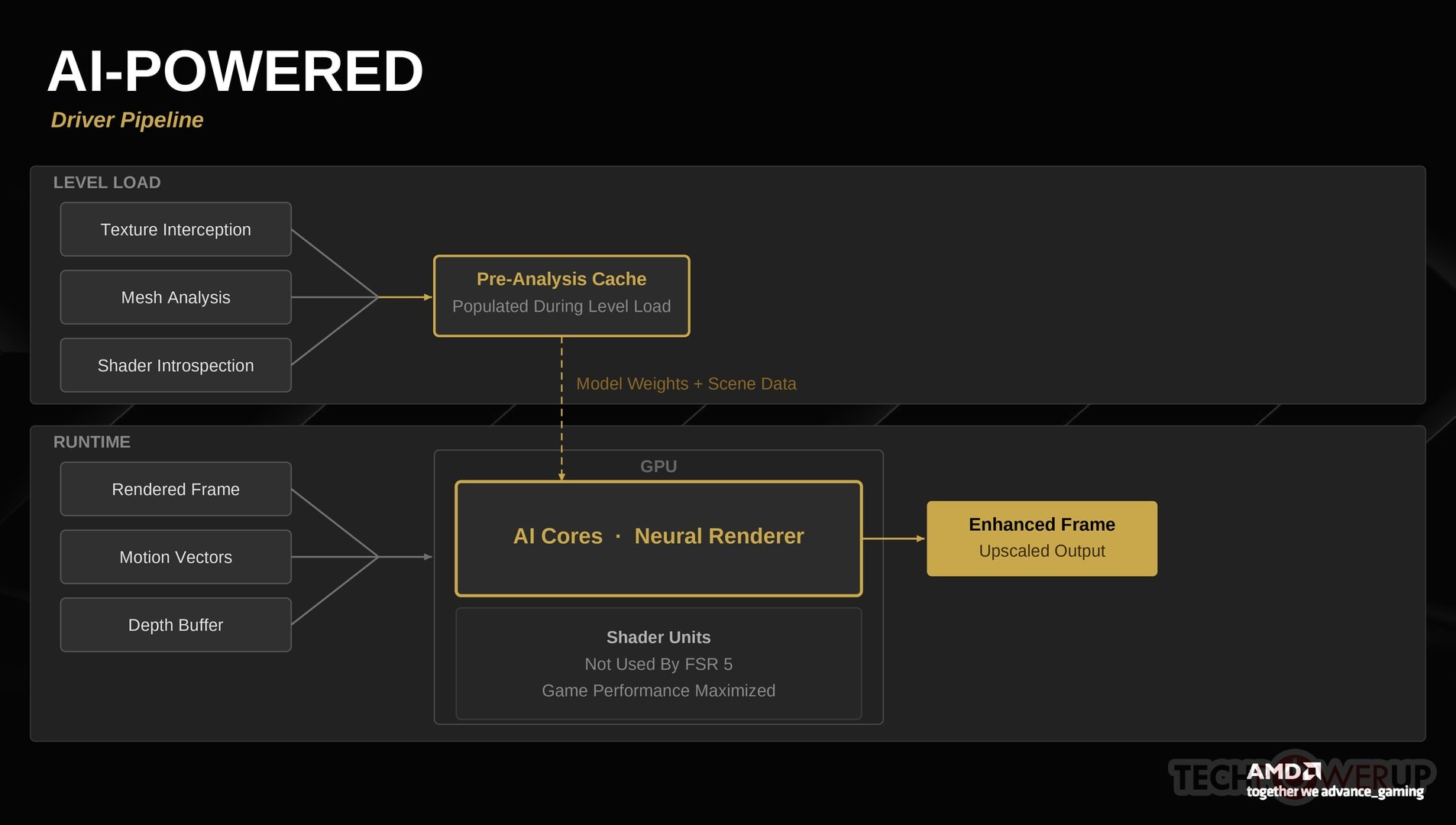
One of the most impressive aspects of FSR 5 is how much the driver can figure out about a game's rendering intent without any developer cooperation. AMD's driver already sits in the middle of every draw call, every texture upload, and every shader compilation—Scarlet Cortex simply puts that position to use.
Our Patreon Silver Supporters can read articles in single-page format.
Nov 15th, 2026 00:37 CST
change timezone
Latest GPU Drivers
New Forum Posts
- Bought MAX-P495 - Which model? (32)
- "Legacy Control Panel" won't install (1)
- Tell me about your favourite graphics card (84)
- Honestly, do you care about GTA VI? (25)
- WarpCoreBench scores! (45)
- Planning for Prolonged High Prices and Maintaining What You Already Have (72)
- What can the FX 8320 do today? Here is the answer. (47)
- Recommendations Wanted - Affordable Enterprise SSD for Boot (3)
- [INTEL]-How To Update Your Microcode for Intel HX 13/14th Gen. CPUs Laptops/Mobile Easily. (260)
- [Intel AX1xx/AX2xx/AX4xx/AX16xx/BE2xx/BE17xx] Intel Modded Wi-Fi Driver with Intel® Killer™ Features (632)
Popular Reviews
- AMD Zen 6 Technical Deep Dive
- ASUS ROG Strix B850-I Gaming Wi-Fi7 W Review
- Corsair HX1000i Shift Crystal Review
- Upcoming Hardware Launches 2027 (Updated Nov 2026)
- Montech King 95 3D PRO Review
- NZXT C1200 Platinum Review
- NZXT H7 RGB+ Review
- NZXT H5 Review
- Phantom Blade Zero Performance Benchmark Review - 35 GPUs Tested
- AMD Ryzen 7 9800X3D Review - The Best Gaming Processor
TPU on YouTube
Controversial News Posts
- NVIDIA Co-Founder and CEO Jensen Huang Officially Resigns (408)
- OpenAI CEO Argues Home PCs Waste the World's Limited DRAM Supply (152)
- NVIDIA Launches Investigation Into Jensen Huang's Relationship With Suspected Chinese Spy (136)
- Intel "Raptor Lake Next" 16-Core and 20-Core CPUs Surface (130)
- Legendary Game Studio BioWare Shuts Down Following EA Layoffs (104)
- Dell CEO Says the Memory Shortage Will Get Worse in 2027 (95)
- NVIDIA GeForce RTX 50-Series Scheduled for up to $500 Price Hike This Week (89)
- Modder Fits RTX 5090 With Four 8-Pin Connectors, Halving Current per Wire (80)