 54
AMD HD 7950 Boost Clock BIOS Update Review
(54 Comments) »Introduction

AMD's Radeon HD 7950 was introduced in January 2012. The GPU was the second design using the company's Graphics Core Next shader architecture and was, also, one of the first with the 28 nanometer production process.
Now AMD has released a BIOS update that will improve the clock speeds of the card to provide a performance advantage against NVIDIA's upcoming GeForce GTX 660 Ti.
AMD's new PowerTune "boost" is an improvement to their existing power limiting algorithm which promises higher clocks/performance without exceeding the board's power limit.

The new specifications see the GPU core-frequency increased to 850 MHz (from 800 MHz), and introduces PowerTune with Boost, which sends the GPU clock speed up to 925 MHz when applications demand it. The memory frequency stays unchanged, at 1250 MHz, as do the physical specifications of the GPU such as stream processor, TMU, and ROP counts.
All newly manufactured HD 7950 graphics cards will feature the updated specifications - prices will remain unchanged.
If you have a reference design HD 7950 (compare the PCB design using our original review), you can flash your card to use these improvements with the BIOS located here.
Test System
| Test System - VGA Rev. 17 | |
|---|---|
| Processor: | Intel Core i7-3770K @ 4.7 GHz (Ivy Bridge, 8192 KB Cache) |
| Motherboard: | ASUS Maximus V Gene Intel Z77 |
| Memory: | 2x 4096 MB Corsair Vengeance PC3-12800 DDR3 @ 1600 MHz 9-9-9-24 |
| Harddisk: | WD Caviar Blue WD5000AAKS 500 GB |
| Power Supply: | Antec HCP-1200 1200W |
| Software: | Windows 7 64-bit Service Pack 1 |
| Drivers: | NVIDIA: 304.79 Beta ATI: Catalyst 12.7 Beta |
| Display: | LG Flatron W3000H 30" 2560x1600 3x Hanns.G HL225DBB 21.5" 1920x1080 |
- All video card results were obtained on this exact system with exactly the same configuration.
- All games were set to their highest quality setting unless indicated otherwise.
- AA and AF are applied via in-game settings - not via the driver's control panel.
- 1280 x 800, 2x Anti-aliasing. Common resolution for most small flatscreens today (17" - 19"). A bit of eye candy turned on in the drivers.
- 1680 x 1050, 4x Anti-aliasing. Most common widescreen resolution on larger displays (19" - 22"). Very good looking driver graphics settings.
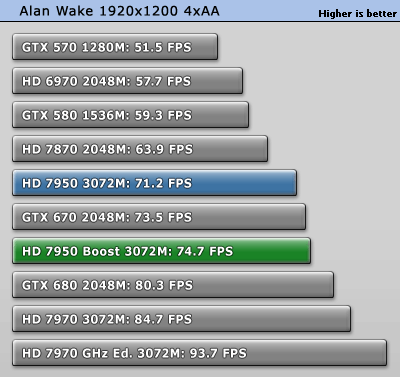
- 1920 x 1200, 4x Anti-aliasing. Typical widescreen resolution for large displays (22" - 26"). Very good looking driver graphics settings.
- 2560 x 1600, 4x Anti-aliasing. Highest possible resolution for commonly available displays (30"). Very good looking driver graphics settings.
Alan Wake

Alan Wake, released in 2012 for the PC, is a highly successful third-person horror shooter that revolves around the adventures of novelist Alan Wake who has to battle the "darkness" which takes over living and dead things. Alan's signature flashlight is used to strip the forces of darkness of their protection, to make them vulnerable to conventional weapons.
The engine of Alan Wake uses DirectX 9, but features complex lighting effects, making it a quite demanding title. We benchmarked with the highest settings possible.



Our Patreon Silver Supporters can read articles in single-page format.
Nov 14th, 2026 06:11 CST
change timezone
Latest GPU Drivers
New Forum Posts
- No screen and keyboard with mouse not being powered on (0)
- Unallocated space in ssd , is it normal? (19)
- What can the FX 8320 do today? Here is the answer. (2)
- Planning for Prolonged High Prices and Maintaining What You Already Have (63)
- Requesting original VBIOS for Gigabyte RX 5700 XT GAMING OC 8G Rev 2.0 (Micron) (2)
- Tell me about your favourite graphics card (43)
- What are you playing? (26218)
- I'll flash a ASUS ROG Strix RX480 O8G in Cause of Code 43, as a Newbie (4)
- [INTEL]-How To Update Your Microcode for Intel HX 13/14th Gen. CPUs Laptops/Mobile Easily. (259)
- Ryzen 7 8700G OC (7)
Popular Reviews
- AMD Zen 6 Technical Deep Dive
- Corsair HX1000i Shift Crystal Review
- NZXT C1200 Platinum Review
- ASUS ROG Strix B850-I Gaming Wi-Fi7 W Review
- Upcoming Hardware Launches 2027 (Updated Nov 2026)
- Montech King 95 3D PRO Review
- NZXT H7 RGB+ Review
- NZXT H5 Review
- Phantom Blade Zero Performance Benchmark Review - 35 GPUs Tested
- XPG NIMBUS PLUS Review - Mid-range Chair With Strong Competitors
TPU on YouTube
Controversial News Posts
- NVIDIA Co-Founder and CEO Jensen Huang Officially Resigns (384)
- OpenAI CEO Argues Home PCs Waste the World's Limited DRAM Supply (152)
- NVIDIA Launches Investigation Into Jensen Huang's Relationship With Suspected Chinese Spy (136)
- Intel "Raptor Lake Next" 16-Core and 20-Core CPUs Surface (130)
- Legendary Game Studio BioWare Shuts Down Following EA Layoffs (104)
- Dell CEO Says the Memory Shortage Will Get Worse in 2027 (95)
- NVIDIA GeForce RTX 50-Series Scheduled for up to $500 Price Hike This Week (89)
- Modder Fits RTX 5090 With Four 8-Pin Connectors, Halving Current per Wire (80)