 16
AMD Radeon R9 270X 2 GB Review
(16 Comments) »Introduction

With a market presence of close to two years and counting, the Radeon HD 7000 series kept AMD afloat in the discrete PC graphics market. The company pretty much sat out 2012, probably focusing its efforts on getting its next-generation console chips right. Come Q4 2013 and a product stack update is long overdue for AMD. The company feels that the silicon it built its HD 7000 on is still fit for due provided they're repositioned in the product stack much in the same way NVIDIA shuffled its with the GeForce GTX 700 series. Much like NVIDIA, AMD is going into its new generation with just one new chip it codenamed "Hawaii" while repositioning "Tahiti" and "Pitcairn" based SKUs one tier lower.

The R9 290 series will succeed the HD 7900 series in the product stack, and the R9 280 series succeeds the HD 7800 series (sub-$300 class) while the R9 270 series succeeds the HD 7700 series (sub-$200 class). Since such an arbitrary product stack repositioning would create unreal price-performance increments at the price points AMD's HD 7000 series products launched, AMD also tweaked pricing a little, so there really is a different and equally valid way of looking at AMD's new product stack by using price points.
The $199 AMD Radeon R9 270X then draws its lineage more from the Radeon HD 7800 series than any other. The R9 270X is, for all intents and purposes, identical to the Radeon HD 7870 GHz Edition which launched at $350, but settled down to around $250, holding on to that price-point quite well, and for quite long. At 1050 MHz, its GPU core clock speed is 5 percent higher, and at 1400 MHz (5.60 GT/s effective), it has a significant 16 percent higher memory clock speed than the HD 7870.
The 28 nm "Pitcairn" silicon on which the Radeon R9 270X is based features 1,280 stream processors based on the Graphics CoreNext micro-architecture, 80 texture memory units (TMUs), 32 raster operations units (ROPs), and a 256-bit wide GDDR5 memory interface holding 2 GB of memory. Interestingly, it doesn't meet the recommended system requirements for "Battlefield 4," the season's most hotly anticipated game for the PC platform. AMD is trying to project the card as an ideal buy for gaming at 1080p display resolution.
| Radeon R7 260X | GeForce GTX 650 Ti Boost | GeForce GTX 660 | Radeon HD 7870 | GeForce GTX 580 | Radeon R9 270X | GeForce GTX 660 Ti | GeForce GTX 760 | Radeon HD 7950 | GeForce GTX 670 | Radeon HD 7970 | Radeon R9 280X | |
|---|---|---|---|---|---|---|---|---|---|---|---|---|
| Shader Units | 896 | 768 | 960 | 1280 | 512 | 1280 | 1344 | 1152 | 1792 | 1344 | 2048 | 2048 |
| ROPs | 16 | 24 | 24 | 32 | 48 | 32 | 24 | 32 | 32 | 32 | 32 | 32 |
| Graphics Processor | Bonaire | GK106 | GK106 | Pitcairn | GF110 | Pitcairn | GK104 | GK104 | Tahiti | GK104 | Tahiti | Tahiti |
| Transistors | 2080M | 2540M | 2540M | 2800M | 3000M | 2800M | 3500M | 3500M | 4310M | 3500M | 4310M | 4310M |
| Memory Size | 2048 MB | 2048 MB | 2048 MB | 2048 MB | 1536 MB | 2048 MB | 2048 MB | 2048 MB | 3072 MB | 2048 MB | 3072 MB | 3072 MB |
| Memory Bus Width | 128 bit | 192 bit | 192 bit | 256 bit | 384 bit | 256 bit | 192 bit | 256 bit | 384 bit | 256 bit | 384 bit | 384 bit |
| Core Clock | 1100 MHz | 980 MHz+ | 980 MHz+ | 1000 MHz | 772 MHz | 1050 MHz | 915 MHz+ | 980 MHz+ | 800 MHz | 915 MHz+ | 925 MHz | 1000 MHz |
| Memory Clock | 1625 MHz | 1502 MHz | 1502 MHz | 1200 MHz | 1002 MHz | 1400 MHz | 1502 MHz | 1502 MHz | 1250 MHz | 1502 MHz | 1375 MHz | 1500 MHz |
| Price | $140 | $150 | $190 | $170 | $310 | $200 | $235 | $250 | $205 | $295 | $300 | $300 |
Packaging & Contents
We only received a card from AMD. Retail products will include the usual accessories, like driver CD and adapters.The Card


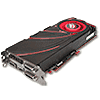
AMD's R9 270X reference design cooler uses a new design that adds a bit more detail through its red highlights while still adhering to AMD's typical reference cooler design.

Installation requires two slots in your system.

Display connectivity options include two DVI ports, one HDMI port, and one DisplayPort. Triple-monitor surround gaming is possible with the card.
The GPU also includes an HDMI sound device. It is HDMI 1.4a compatible, which includes HD audio and Blu-ray 3D movies support.

One CrossFire connector allows you to combine up to two R9 270X cards in a CrossFire configuration.


Pictured above are the front and back, showing the disassembled board. High-res versions are also available (front, back). If you choose to use these images for voltmods, etc., please include a link back to this site or let us post your article.
A Closer Look


AMD's reference cooler uses a large copper baseplate that is connected to heatpipes for the transfer of heat. You can also see the thermal pads that cool memory chips and voltage regulation circuitry.

The card requires two 6-pin PCI-Express power connectors. This configuration is good for up to 225 W of power draw.

AMD uses a CHiL CHL8225G, a very common and popular voltage controller that offers software voltage control and monitoring, and is well supported by most software.

The GDDR5 memory chips are made by SK Hynix and carry the model number H5GQ2H24AFR-R0C. They are specified to run at 1500 MHz (6000 MHz GDDR5 effective).

AMD's Pitcairn graphics processor uses the GCN shader architecture. It is produced on a 28 nm process at TSMC. The transistor count is 2.8 billion.
Our Patreon Silver Supporters can read articles in single-page format.
Nov 13th, 2026 07:17 PST
change timezone
Latest GPU Drivers
New Forum Posts
- To AiO CPU Cooler users? (3)
- Microsoft Exchange/365 outages? (35)
- I won't download games that are larger than 30–40 GB. (107)
- Slow SSD read speeds - help! (2)
- Any other old-timers here planning to play WoW Forever? (150)
- Requesting original VBIOS for Gigabyte RX 5700 XT GAMING OC 8G Rev 2.0 (Micron) (0)
- Home page search by category (6)
- Windows 11 General Discussion (7727)
- Warning for Windows 10 and 11 users running newer AMD GPU drivers (58)
- TPU's Nostalgic Hardware Club (22150)
Popular Reviews
- AMD Zen 6 Technical Deep Dive
- Corsair HX1000i Shift Crystal Review
- NZXT C1200 Platinum Review
- Upcoming Hardware Launches 2027 (Updated Nov 2026)
- Montech King 95 3D PRO Review
- NZXT H7 RGB+ Review
- NZXT H5 Review
- Phantom Blade Zero Performance Benchmark Review - 35 GPUs Tested
- XPG NIMBUS PLUS Review - Mid-range Chair With Strong Competitors
- Gigabyte Z890I Aorus Ultra Review
TPU on YouTube
Controversial News Posts
- NVIDIA Co-Founder and CEO Jensen Huang Officially Resigns (351)
- OpenAI CEO Argues Home PCs Waste the World's Limited DRAM Supply (152)
- NVIDIA Launches Investigation Into Jensen Huang's Relationship With Suspected Chinese Spy (136)
- Intel "Raptor Lake Next" 16-Core and 20-Core CPUs Surface (130)
- Legendary Game Studio BioWare Shuts Down Following EA Layoffs (104)
- Dell CEO Says the Memory Shortage Will Get Worse in 2027 (95)
- NVIDIA GeForce RTX 50-Series Scheduled for up to $500 Price Hike This Week (89)
- Modder Fits RTX 5090 With Four 8-Pin Connectors, Halving Current per Wire (80)