 40
AMD Ryzen AI Halo Review - Local-AI Powerhouse with 128 GB of Memory
Value & Conclusion »When 128 GB Isn't Enough
Released in August 2026, GLM-5.3-Flash is a brand new open-source model with impressive capabilities. Like the other mixture-of-experts models in this review, it only activates a small piece of the whole thing at a time—about 18 billion of its 320 billion parameters. That means it runs quickly, but the full 320 billion still have to be held in memory the whole time, so it is very memory-hungry. Heavy on memory, light on compute: that is exactly what Ryzen AI Halo is good at, because it has plenty of memory but only modest processing power. The weights for GLM-5.3-Flash are open-source under the MIT license and free to download, and nothing is ever sent to the cloud. It also offers a large 1 million token context window, and it takes images and video as input alongside text. This is a model that can compete with cloud-based frontier models.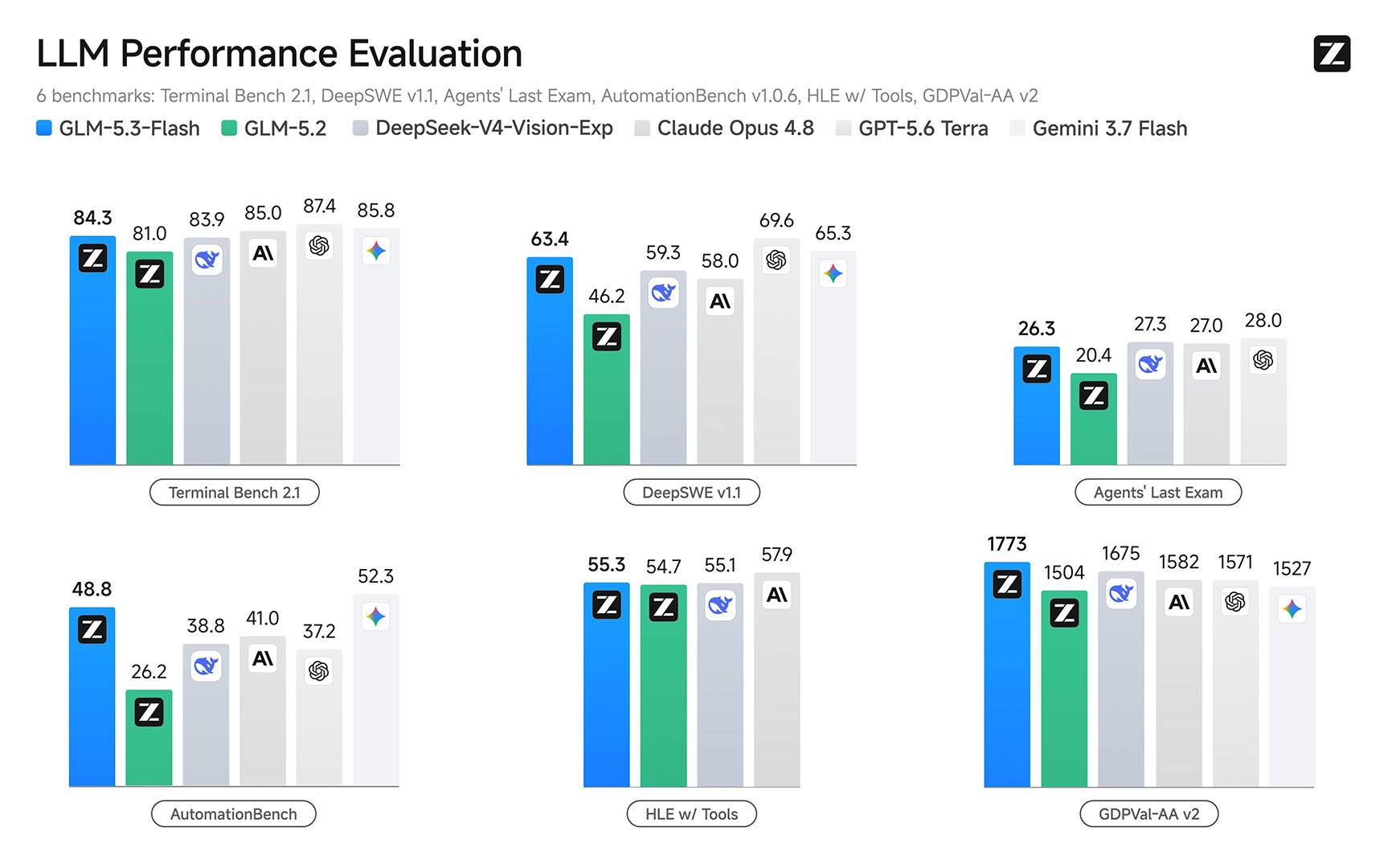
On Z.ai's own benchmarks we can see that GLM-5.3-Flash trades blows with Claude Opus 4.8, GPT-5.6 and Gemini 3.7 across agentic coding and reasoning: it lands within a point of Claude on Terminal-Bench, leads the field on AutomationBench, and tops all of them, including the much larger DeepSeek-V4 on GDPval-AA agentic reasoning. Other benchmarks are lower, and of course the benchmark list is somewhat cherry-picked, but what's important is that a model you can run at home is even close in these tests.
But there's a catch: you cannot run it with 128 GB. In 4-bit the weights come to roughly 186 GB, so neither the Ryzen AI Halo, nor the DGX Spark can load this model. At least not on their own.
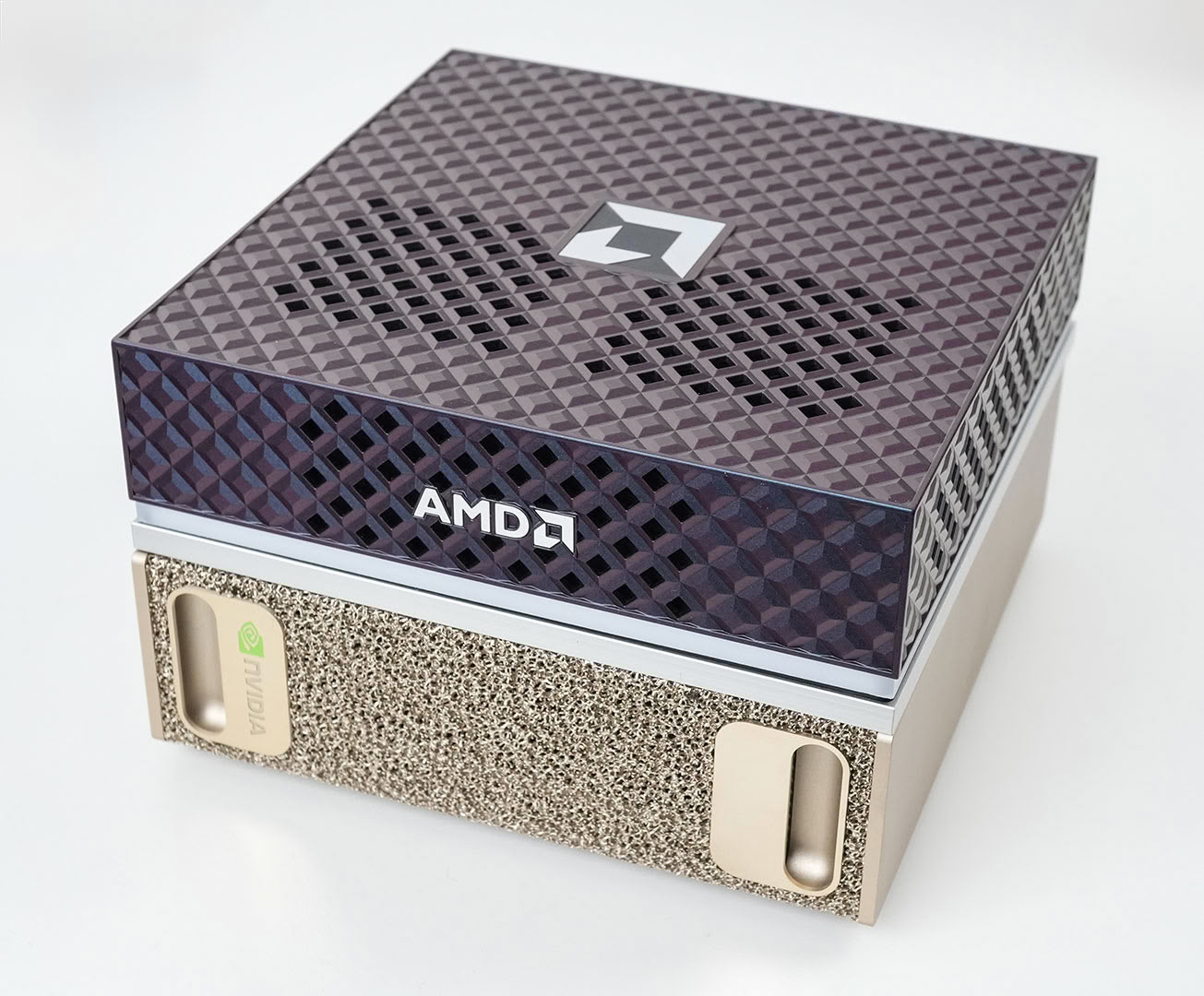
Both vendors have a solution for this. AMD documents multi-node clustering over RPC using Ethernet in its Playbooks, and NVIDIA will let you link two DGX Sparks over their integrated 100G port using ConnectX. This doesn't help us though. I had only one of each, not two of either—so I got curious. Could an AMD box and an NVIDIA box be pooled into a single machine, across my existing 2.5 Gb Ethernet?
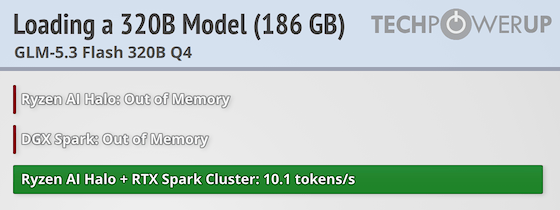
Turns out this is possible using llama.cpp, running ROCm on the Halo and CUDA on the Spark, with a bit of tweaking, and it even runs happily over a classic Ethernet LAN. The memory of both boxes pools and combines, offering a massive 256 GB of memory for workloads. I was able to load the full 320B GLM-5.3 Flash model and generate output at about 10 tokens/second, which is a very decent rate.
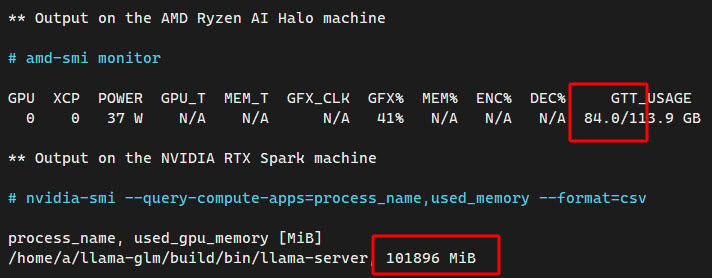
While running, I fetched the memory stats to confirm. These are two separate outputs on two machines, I just combined them in Photoshop and added the red highlight. As you can see, the 84 GB is allocated on the Ryzen AI Halo and 100 GB on the DGX Spark, which confirms that our model is fully loaded and running in a cluster of AMD and NVIDIA Mini-PCs!
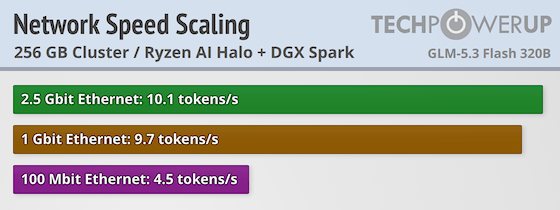
I was surprised that performance was quite good, even with the slow 2.5 Gbps link, so I tested various other link speeds. Interestingly, switching to 1 Gbps Ethernet only costs a few percent in performance. The reason is that at least for this kind of workload, network load is pretty low. I measured a few KB per token going between the two boxes; most of the work is isolated to each nodes' memory.
I also tried adding an RTX 5090 for a 3-node, mixed, cluster, but this kept failing. Memory was pooling fine to 288 GB, but the RPC backend could not build the compute graph across three nodes for this particular model. Still, being able to mix two completely different compute architectures, from competing vendors, which both never claimed to support anything like this, is pretty amazing.
Nov 22nd, 2026 19:37 CST
change timezone
Latest GPU Drivers
New Forum Posts
- DTS DCH Driver for Realtek HDA [DTS:X APO4 + DTS Interactive] (2818)
- Honestly, do you care about GTA VI? (266)
- Increasing Power Limit? (6)
- What are you playing? (26240)
- UPS what one to get? (48)
- Your PC ATM (36458)
- Gacha Games - Discussions, Pulls, Updates, etc. (1157)
- Last game you purchased? (1414)
- Making a game in Godot engine (19)
- Intel D270 (5)
Popular Reviews
- Microsoft Surface Laptop Ultra Review - The Next-gen Arm Laptop
- Corsair RM1200e (Second Generation) Review
- Upcoming Hardware Launches 2027 (Updated Nov 2026)
- Pulsar Office Tour & First Look at P1 Dual-Sensor Mouse
- Ugreen NASync DXP4800 GT Review
- AMD Ryzen 7 9800X3D Review - The Best Gaming Processor
- AMD Zen 6 Technical Deep Dive
- AMD Ryzen 7 5800X3D 10th Anniversary Review
- Phantom Blade Zero Performance Benchmark Review - 35 GPUs Tested
- Biwin Black Opal NV7400 2 TB Review
TPU on YouTube
Controversial News Posts
- NVIDIA Co-Founder and CEO Jensen Huang Officially Resigns (492)
- Report: Jensen Huang Eyes NVIDIA Comeback (266)
- Open Letter Asking NVIDIA to Reinstate Jensen Huang Passes 115,000 Signatures (184)
- OpenAI CEO Argues Home PCs Waste the World's Limited DRAM Supply (152)
- NVIDIA Launches Investigation Into Jensen Huang's Relationship With Suspected Chinese Spy (136)
- Intel "Raptor Lake Next" 16-Core and 20-Core CPUs Surface (130)
- NVIDIA GeForce RTX 50-Series Scheduled for up to $500 Price Hike This Week (89)
- Intel Razor Lake Gets a 12 P-Core bLLC Chip With No E-Cores, Per Leak (86)