 21
ASRock X570S PG Riptide Review
Value & Conclusion »Power Consumption and Temperatures
| Ryzen 9 3900X Stock CPU | |
|---|---|
| CPU Voltage: | 1.025 V - 1.494 V |
| DRAM Voltage: | 1.35 V |
| Idle Power: | 19 W |
| Load Power: | 130 W |
| VRM Temp Idle (1): | 28.3 °C |
| VRM Temp Idle (2): | 31.2 °C |
| Chipset Temp Idle: | 60.0 °C |
| Room Temp Idle: | 21.5 °C |
| Ryzen 9 3900X 3.8 GHz CPU | |
|---|---|
| CPU Voltage: | 1.4 V |
| DRAM Voltage: | 1.35 V |
| Idle Power: | 25 W |
| Load Power: | 211 W |
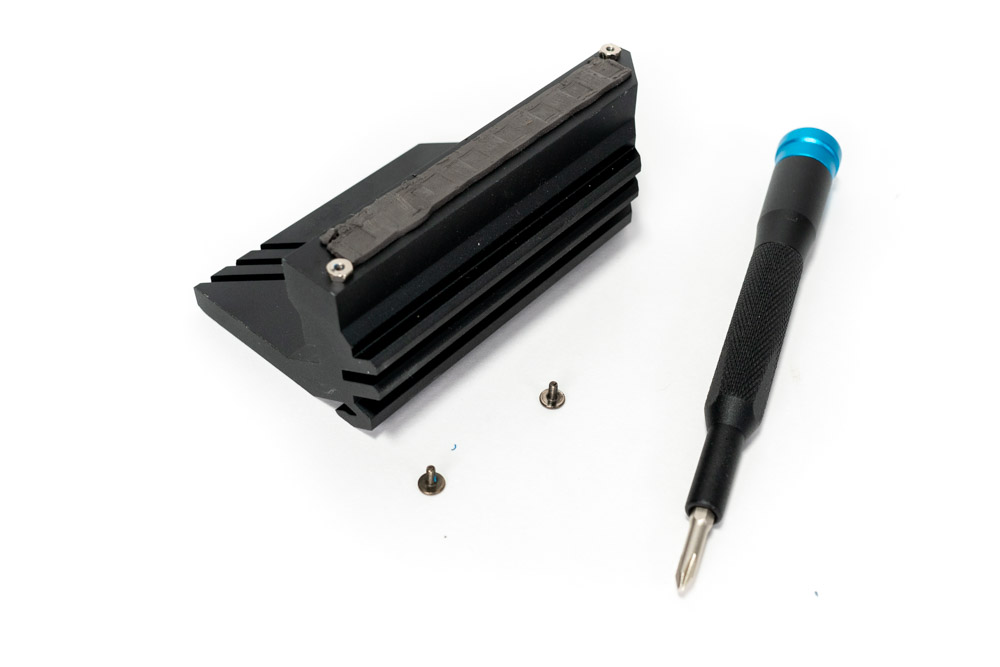
The ASRock X570S PG Riptide uses a single large heatsink for the CPU VRM section. Due to the size, heat absorption takes longer, but without a set of small fins, heat will also linger for a longer period of time. No heatsink is present for the SoC section.

For temperature measurement, I use a Reed SD-947 4 channel Data Logging Thermometer paired with four Omega Engineering SA1 Self Adhesive Thermocouple probes. One probe directly touches the chipset and two are placed on select power stages. The last probe actively logs the ambient temperature.
For the ASRock X570S PG Riptide, one probe is placed along each bank of power stages. A probe is left out to log the ambient temperature. All temperatures are presented as Delta-T normalized to 20 °C, which is the measured temperature minus the ambient temperature plus 20 °C. The end result accounts for variation in ambient temperature, including changes over the course of a test, while presenting the data as if the ambient were a steady 20 °C for easy presentation. Additionally, there is direct airflow over the VRM for the first five minutes, after which the fan is removed. This gives an idea of what to expect with and without moderate case airflow.
Prime95's Small FFT is used for maximum power consumption over a 30 minute period. For testing, I used a Ryzen 9 3900X set to 3.8 GHz and locked at 1.4 V and 1.15 V for the SoC. This allows the benchmark to run longer and avoids overheating the CPU. A common misconception is that the maximum clock frequency inherently has higher power draw. While this certainly can be true most of the time, it also comes with an abundance of generated heat. Therefore, a lower clock speed with a higher voltage actually draws more current in this instance, which allows me to run tests longer without fear of burning out the CPU as it approaches 90°C from a long sustained power load. Temperatures are logged every second, and the two probes are then averaged for a cleaner presentation before subtracting the ambient to calculate the Delta-T. The results are charted below.
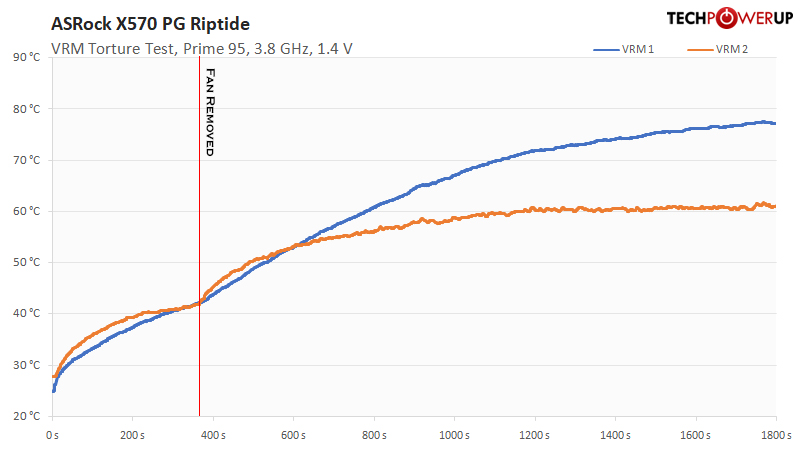
The ASRock X570S PG Riptide did mediocre at best in my VRM torture test. Even after regular testing was finished, I let it go for longer as I was curious about the outcome. Without any direct airflow, the CPU section was heading toward a thermal runaway scenario, which makes the lack of a better cooling solution on such a critical component a poor decision on ASRock's part. Because the SoC usually plays a minor role in most setups, a heatsink isn't necessary, as shown in the torture test. However, if you intend to use high-frequency system memory or a high FCLK, you will most likely need to set the voltage above 1.1 V for stability in some instances.
With a fan directly over the SoC VRM phases, it plateaued at around 40 °C. Once the fan was removed, it settled at 60 °C after 20 minutes, only raising slightly after that as the room temperature increased. I want to point out that the data sheets for these Vishay SIC654 power stages do not specify any thermal parameters. I therefore cannot comment on the longevity of said component at these operating temperatures under a forced, stressed load scenario.
Nov 23rd, 2026 23:51 CST
change timezone
Latest GPU Drivers
New Forum Posts
- The time has come to upgrade...my desktop (0)
- Which ryzen am5 cpu ? (198)
- Your PC ATM (36481)
- SATA drive 1.4 GBps with Intel X25-E on Windows 98! (42)
- RAM overclock cause worse feeling than JEDEC (10)
- DTS DCH Driver for Realtek HDA [DTS:X APO4 + DTS Interactive] (2819)
- WarpCoreBench scores! (96)
- Increasing Power Limit? (20)
- Gacha Games - Discussions, Pulls, Updates, etc. (1162)
- RX 580 2048SP 8GB - SK Hynix - Ardiyes - BIOS Needed (4)
Popular Reviews
- Microsoft Surface Laptop Ultra Review - The Next-gen Arm Laptop
- ASRock X870E Challenger Wi-Fi White Review
- Upcoming Hardware Launches 2027 (Updated Nov 2026)
- Corsair RM1200e (Second Generation) Review
- AMD Ryzen 7 9800X3D Review - The Best Gaming Processor
- AMD Zen 6 Technical Deep Dive
- AMD Ryzen 7 7700X3D Review
- Pulsar Office Tour & First Look at P1 Dual-Sensor Mouse
- Ugreen NASync DXP4800 GT Review
- Phantom Blade Zero Performance Benchmark Review - 35 GPUs Tested
TPU on YouTube
Controversial News Posts
- NVIDIA Co-Founder and CEO Jensen Huang Officially Resigns (492)
- Jensen Huang Reinstated as CEO of NVIDIA (393)
- Report: Jensen Huang Eyes NVIDIA Comeback (278)
- Open Letter Asking NVIDIA to Reinstate Jensen Huang Passes 115,000 Signatures (184)
- OpenAI CEO Argues Home PCs Waste the World's Limited DRAM Supply (152)
- NVIDIA Launches Investigation Into Jensen Huang's Relationship With Suspected Chinese Spy (136)
- Intel "Raptor Lake Next" 16-Core and 20-Core CPUs Surface (130)
- NVIDIA GeForce RTX 50-Series Scheduled for up to $500 Price Hike This Week (89)