 0
Asus Cerberus V2 Review
(0 Comments) »Introduction

I don't have any hard data that would give me an idea about the popularity of the first edition of the Asus Cerberus headset, but hey – it's Asus, and it's a gaming peripheral named after a monstrous three-headed dog that guards the gates of the Underworld. For your average gamer, that alone is going to be more than enough to make them whip out their wallet and spend some cash.
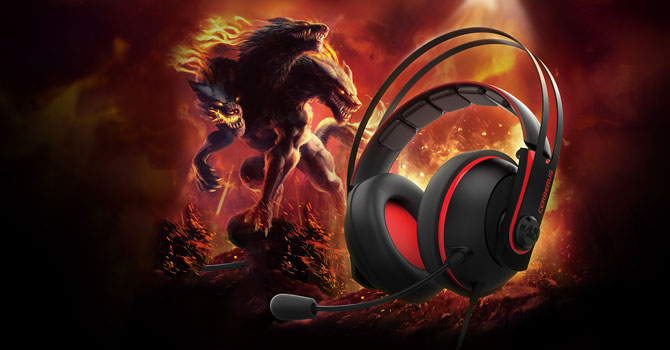
In case you seem to remember seeing different peripherals going by the name of "Cerberus", other than the headset, you're not in the wrong: the Cerberus line also includes a membrane keyboard and an optical mouse.
In Asus's own words, the Cerberus V2 is the long awaited follow-up to their best-selling gaming headset, now equipped with better audio drivers - Asus calls them "Essence drivers" - capable of digging even deeper into the lowest part of the sound spectrum. The headband is now made out of stainless steel, and the ear cushions also got some upgrades in order to improve overall comfort and durability. If you're mainly interested in the differences between the Asus Cerberus V2 and its predecessor, I directly compared the two further on in the review.
However, we're not here only for that, but also to find out if the Cerberus V2 can keep up with its competitors and live up to its $75 price tag. That's not cheap, and when you decide to spend that kind of money on a gaming headset, you have every right to set your expectations high, both in terms of sound and microphone quality and additional features.
When it comes to non-standard features, the Cerberus V2 offers two microphones: a detachable boom microphone and an in-line microphone affixed to a surprisingly stiff, braided cord that comes out of the left ear cup. Before you ask - no, the cord itself isn't detachable, which means you won't have an easy way out should you break it.

The fact that the Cerberus V2 is equipped with two microphones clearly tells us that Asus would like for us to use it with PCs, consoles, and mobile devices; we should take it with us when we leave our homes. I don't find it particularly suitable for the latter, though - more on that later.

The Cerberus V2 comes in red, green, or blue to better match your personal preference or perfectly fit into your game room, in case your color scheme features one of these colors. Don't take it too literally, though - we're only talking about the color of its accents, such as the stitching on the headband, the fabric on the inner side of the ear cups, and the rings that sit between the ear cups and the cushions. In all three cases, the base color of the headset is black.
Specifications
- 53 mm dynamic driver (neodymium magnet)
- 32 Ω impedance
- 20-20,000 Hz frequency response (specified by the manufacturer)
- Closed back, over-ear design
- Detachable uni-directional boom microphone
- Omni-directional in-line microphone
- 1.2 m + 1.4 m braided cable
- Weight: 344 g
The Package

The Asus Cerberus V2 comes in a transparent plastic box, which allows you to see most of its contents without opening it. Namely, you'll see the headset itself and the boom microphone to its right - a nice way to bring attention to the fact that it can be detached from the headset. For added bling, there's a background picture of the mythical Cerberus with its pointy teeth and flaming heads, surrounded by featureless faces of dead souls and other motifs you might find on the cover of your favorite death metal record.

The rear of the box contains a picture of the headset and both microphones, as well as a list of its main features and specifications. As for sturdiness, the box strikes me as solid enough for you to be able to wait for its delivery without having to worry about the device arriving broken.
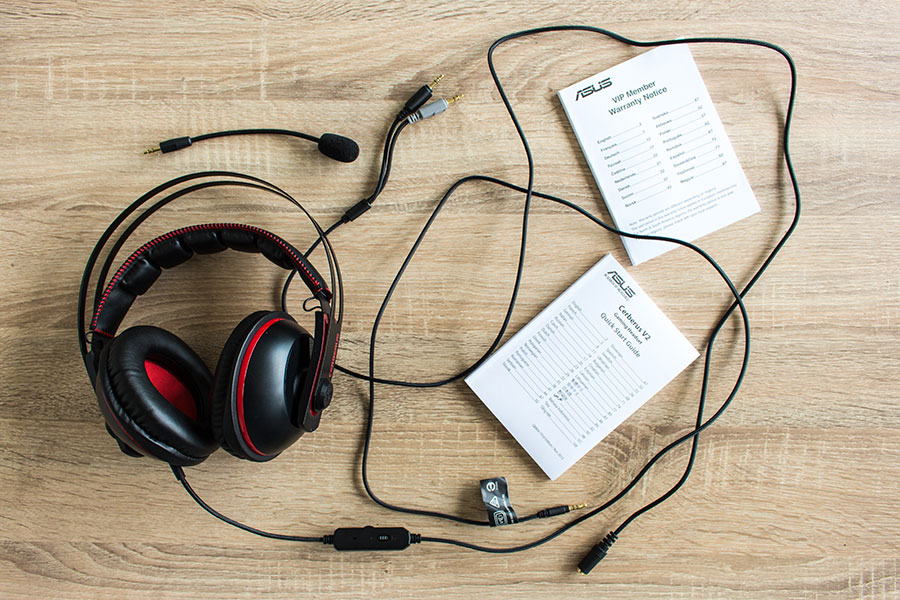
These are the contents of the box. What you get is the headset with an attached in-line microphone, a detachable boom microphone, a braided splitter cable that is 1.4 m long, which you'll use to connect the headset to your PC or any other device with a separate 3.5-mm audio input and output, a warranty notice, and a quick start guide. The guide is printed in almost forty different languages. Honestly, it seems unnecessary given the plug-and-play nature of the device, but if you've ever wanted to learn how to say "plug it in to make it work" in forty different languages, you're in luck!
Our Patreon Silver Supporters can read articles in single-page format.
Nov 14th, 2026 09:09 CST
change timezone
Latest GPU Drivers
New Forum Posts
- What can the FX 8320 do today? Here is the answer. (5)
- Tell me about your favourite graphics card (49)
- Gacha Games - Discussions, Pulls, Updates, etc. (1154)
- No screen and keyboard with mouse not being powered on (6)
- What are you playing? (26219)
- 3D Printer Club (851)
- Folding Pie and Milestones!! (10202)
- a note from zachary85's son (9)
- Have you got pie today? (17083)
- Requesting original VBIOS for Gigabyte RX 5700 XT GAMING OC 8G Rev 2.0 (Micron) (3)
Popular Reviews
- AMD Zen 6 Technical Deep Dive
- Corsair HX1000i Shift Crystal Review
- ASUS ROG Strix B850-I Gaming Wi-Fi7 W Review
- NZXT C1200 Platinum Review
- Upcoming Hardware Launches 2027 (Updated Nov 2026)
- Montech King 95 3D PRO Review
- NZXT H7 RGB+ Review
- NZXT H5 Review
- Phantom Blade Zero Performance Benchmark Review - 35 GPUs Tested
- XPG NIMBUS PLUS Review - Mid-range Chair With Strong Competitors
TPU on YouTube
Controversial News Posts
- NVIDIA Co-Founder and CEO Jensen Huang Officially Resigns (387)
- OpenAI CEO Argues Home PCs Waste the World's Limited DRAM Supply (152)
- NVIDIA Launches Investigation Into Jensen Huang's Relationship With Suspected Chinese Spy (136)
- Intel "Raptor Lake Next" 16-Core and 20-Core CPUs Surface (130)
- Legendary Game Studio BioWare Shuts Down Following EA Layoffs (104)
- Dell CEO Says the Memory Shortage Will Get Worse in 2027 (95)
- NVIDIA GeForce RTX 50-Series Scheduled for up to $500 Price Hike This Week (89)
- Modder Fits RTX 5090 With Four 8-Pin Connectors, Halving Current per Wire (80)