 84
ASUS GeForce RTX 5090 Matrix Platinum Review - 800 W Powerhouse
Value & Conclusion »Power Detector+
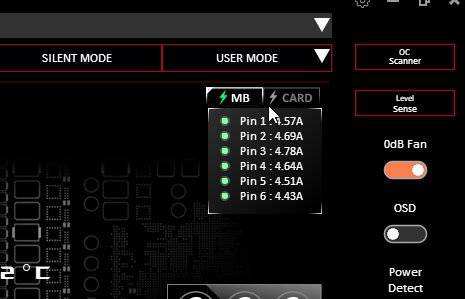
We first reviewed this feature on the RTX 5090 Astral, and it's present on the Matrix as well. Power Detector+ is a monitoring circuit that measures the current flowing across each individual wire of the 16-pin 12V-2x6 power connector. If it detects anything abnormal—a loose connector, uneven current distribution, excessive resistance—GPU Tweak III alerts you before it becomes a problem. Given the history of melting 12VHPWR connectors on previous-generation cards, this is a genuinely useful safety feature, not just a marketing gimmick. You do need to install GPU Tweak III for the alerts to work.
Please note that there are two sections: "MB" for the BTF motherboard power connector and "CARD" for the power delivered through the card's 16-pin input.
Level Sense (Sag Detection)
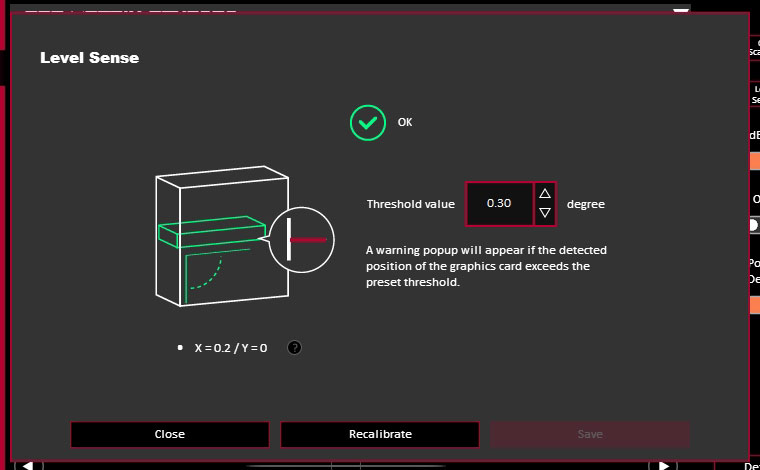
At four slots and 37 cm, this is a heavy card, and GPU sag is a real concern. ASUS integrates a tiny inertial measurement unit (IMU)—essentially an accelerometer and gyroscope—directly onto the PCB. Through GPU Tweak III, you can calibrate the card's resting position after installation and set an alert threshold, down to 0.1° of tilt. If the card sags beyond your configured limit, you get a popup notification. We first saw this feature as "Equipment Installation Check" on the Astral series, and it works well. Practically speaking, it's a nice insurance policy—you install the card, calibrate, and if your GPU support bracket ever slips or the card settles over time, you'll know.
Memory Defroster
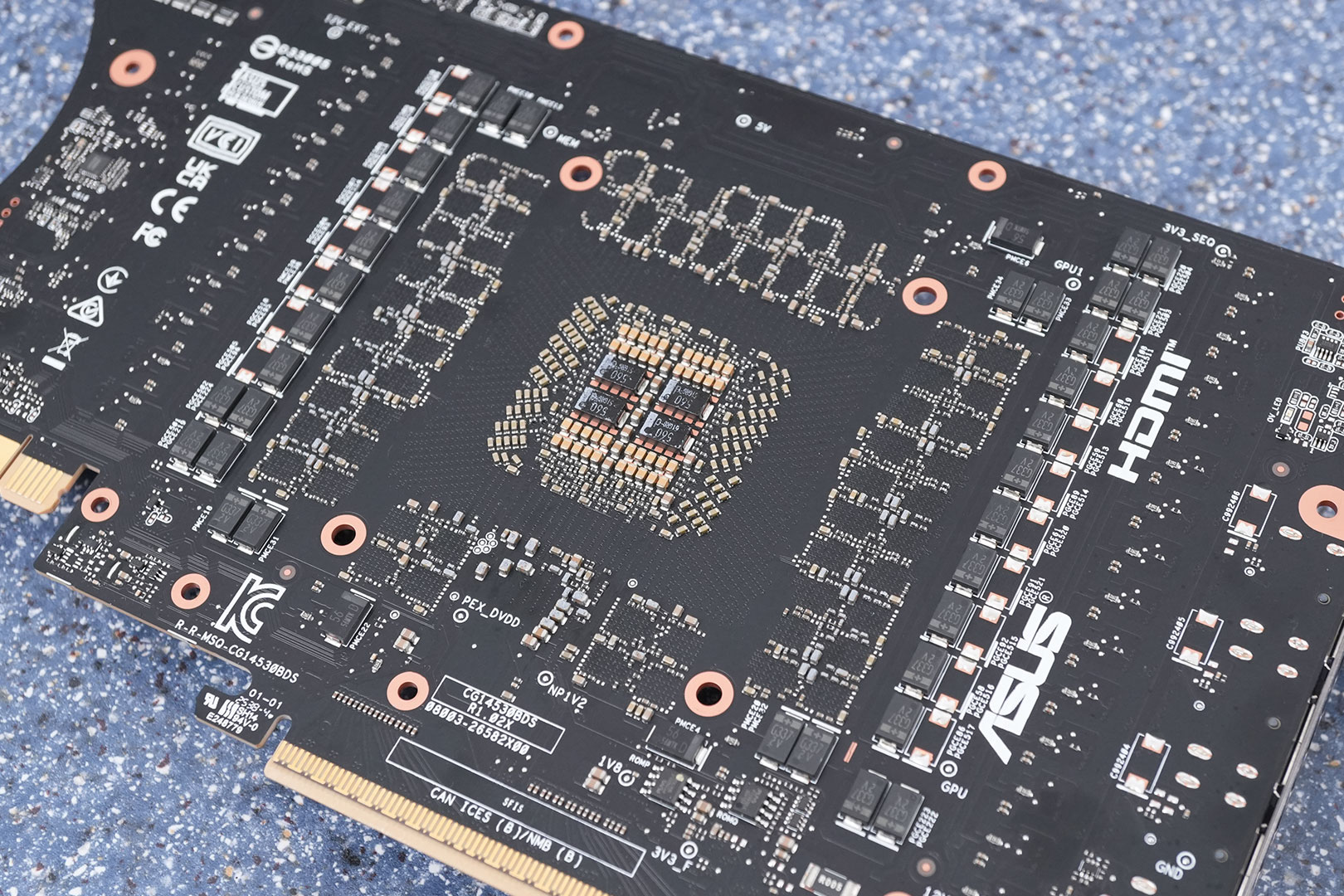
A feature with a long Matrix heritage. When using liquid nitrogen to overclock, the back of the card freezes with ice due to condensation, which can short circuits and cause "cold bugs"—instability caused by the memory chips getting too cold. The Memory Defroster is a special heating circuit that automatically activates when temperature is getting close to 0°C, keeping the GDDR7 memory chips at a positive temperature while the GPU itself is chilled to extreme sub-zero temperatures. Unlike earlier Matrix cards where you had to bridge solder pads and wire a button to activate the defroster, on this card it's fully automatic. Obviously this feature is only relevant for extreme LN2 overclocking—during normal operation, it won't ever activate.
GPU Tweak III
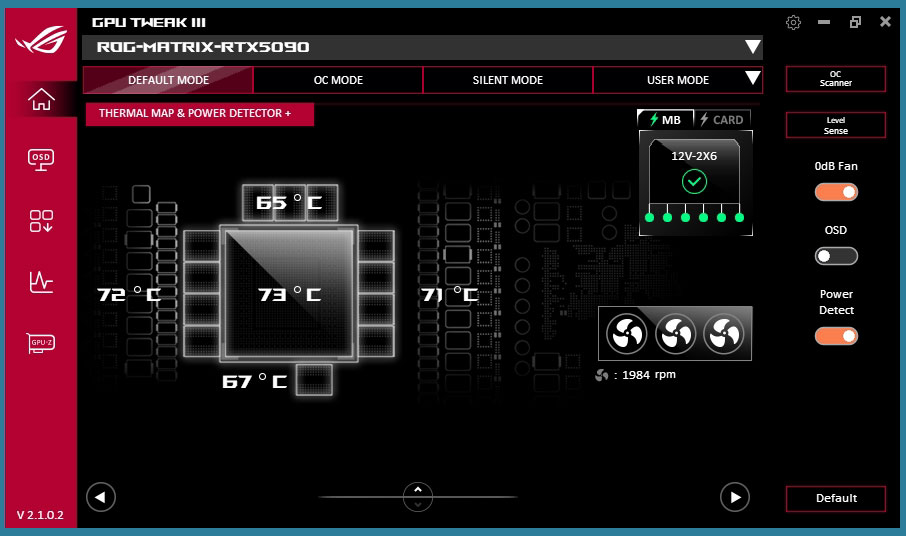
ASUS GPU Tweak III ties all the special features together. Besides the Level Sense and Power Detector+ integrations described above, you get the standard overclocking controls—GPU clock offset, memory clock offset, power limit slider, and fan curve customization. Telemetry is comprehensive, showing voltage, temperatures across multiple sensors, real-time clock speeds, and power consumption. RGB lighting is controlled through the Aura Sync integration.
Nov 25th, 2026 01:36 CST
change timezone
Latest GPU Drivers
New Forum Posts
- GTA VI (40)
- Asus Rog Maximus Z890 Extreme. (Various questions). (37)
- X79 and/or rampage IV OC'ing thread for those of us still left.... (2454)
- WarpCoreBench scores! (100)
- Which ryzen am5 cpu ? (211)
- The time has come to upgrade...my desktop (15)
- AMD ULL settings tinkering thread - post settings and Zen pics (90)
- TPU's F@H Team (20570)
- Can you guess Which game it is? (352)
- Ryzen Owners Zen Garden (8562)
Popular Reviews
- ASRock X870E Challenger Wi-Fi White Review
- Microsoft Surface Laptop Ultra Review - The Next-gen Arm Laptop
- Upcoming Hardware Launches 2027 (Updated Nov 2026)
- VZMORE AX9 Max Review
- AMD Ryzen 7 9800X3D Review - The Best Gaming Processor
- Corsair RM1200e (Second Generation) Review
- AMD Zen 6 Technical Deep Dive
- Phantom Blade Zero Performance Benchmark Review - 35 GPUs Tested
- Pulsar Office Tour & First Look at P1 Dual-Sensor Mouse
- Ocypus lota P1000 Review
TPU on YouTube
Controversial News Posts
- Jensen Huang Reinstated as CEO of NVIDIA (541)
- NVIDIA Co-Founder and CEO Jensen Huang Officially Resigns (492)
- Report: Jensen Huang Eyes NVIDIA Comeback (281)
- Open Letter Asking NVIDIA to Reinstate Jensen Huang Passes 115,000 Signatures (184)
- OpenAI CEO Argues Home PCs Waste the World's Limited DRAM Supply (152)
- NVIDIA Launches Investigation Into Jensen Huang's Relationship With Suspected Chinese Spy (136)
- Intel "Raptor Lake Next" 16-Core and 20-Core CPUs Surface (130)
- Intel Razor Lake Gets a 12 P-Core bLLC Chip With No E-Cores, Per Leak (94)