 114
ASUS Radeon HD 6990 4 GB Review
(114 Comments) »Radeon HD 6990 Review Introduction

It is quite understandable that AMD and NVIDIA slog it out in key price segments under $500, at price points wheregraphics card as a component competes in the market with gaming consoles. Almost every household has a PC with a PCI-Express slot these days, and consumers opt for a simple hardware upgrade by buying that graphics card to turn their MS Excel boxes into Games for Windows PCs. What happens at price points above $500? Pitched battles between the two GPU vendors for paper supremacy, even when no graphics card in the upper price points can really make volumes. For GPU vendors, having the fastest graphics card, like the Radeon HD 6990 in the market has two distinct advantages: the PR weapon of "we make the fastest in the market", and being able to capture the high-end PC and enthusiast markets. After its previous high-end graphics card, the Radeon HD 5970 got challenged by NVIDIA's GeForce GTX 580, which is unnoticeably slower, while being a lot more energy-efficient (since it's a single GPU graphics card). The red team just had to come up with something that makes up for that with a significant performance leadership over the GTX 580, so the 580's performance per watt advantage could be trumped with sheer performance.
In comes the Radeon HD 6990, the very peak of AMD's Northern Islands family of GPUs. It carries the codename "Antilles", and is a dual-GPU graphics card making use of two of AMD's "Cayman" graphics processors. Cayman in its single-GPU board designs make up for the rest of the HD 6900 series, namely HD 6950 and HD 6970. On AMD Radeon HD 6990, the Cayman chips have all 1536 of their stream processors based on the VLIW4 design enabled. Each GPU is backed by 2 GB of fast GDDR5 memory over a 256-bit wide memory interface each, totaling to 4 GB of total memory, the highest for a reference consumer graphics card launch.

Each of the Radeon HD 6990 GPUs are clocked at 830 MHz, with the memory at 1250 MHz (5000 MHz effective).
The ASUS EAH6990 we are testing today is a stick-to-the-book reference design Radeon HD 6990 from the company. It combines AMD’s fine choice of electrical components with a refreshingly clean visual appearance of the cooler and a complete set of accessories.
We also have a quad-GPU CrossFireX review of two of these cards here.
| GeForce GTX 480 | Radeon HD 6970 | GeForce GTX 580 | Radeon HD 5970 | Radeon HD 6990 | |
| Shader units | 480 | 1536 | 512 | 2x 1600 | 2x 1536 |
| ROPs | 48 | 32 | 48 | 2x 32 | 2x 32 |
| GPU | GF100 | Cayman | GF110 | 2x Cypress | 2x Cayman |
| Transistors | 3200M | 2640M | 3000M | 2x 2154M | 2x 2640M |
| Memory Size | 1536 MB | 2048 MB | 1536 MB | 2x 1024 MB | 2x 2048 MB |
| Memory Bus Width | 384 bit | 256 bit | 384 bit | 2x 256 bit | 2x 256 bit |
| Core Clock | 700 MHz | 880 MHz | 772 MHz | 725 MHz | 830 MHz |
| Memory Clock | 924 MHz | 1375 MHz | 1002 MHz | 1000 MHz | 1250 MHz |
| Price | $400 | $370 | $500 | $580 | $699 |
The Card
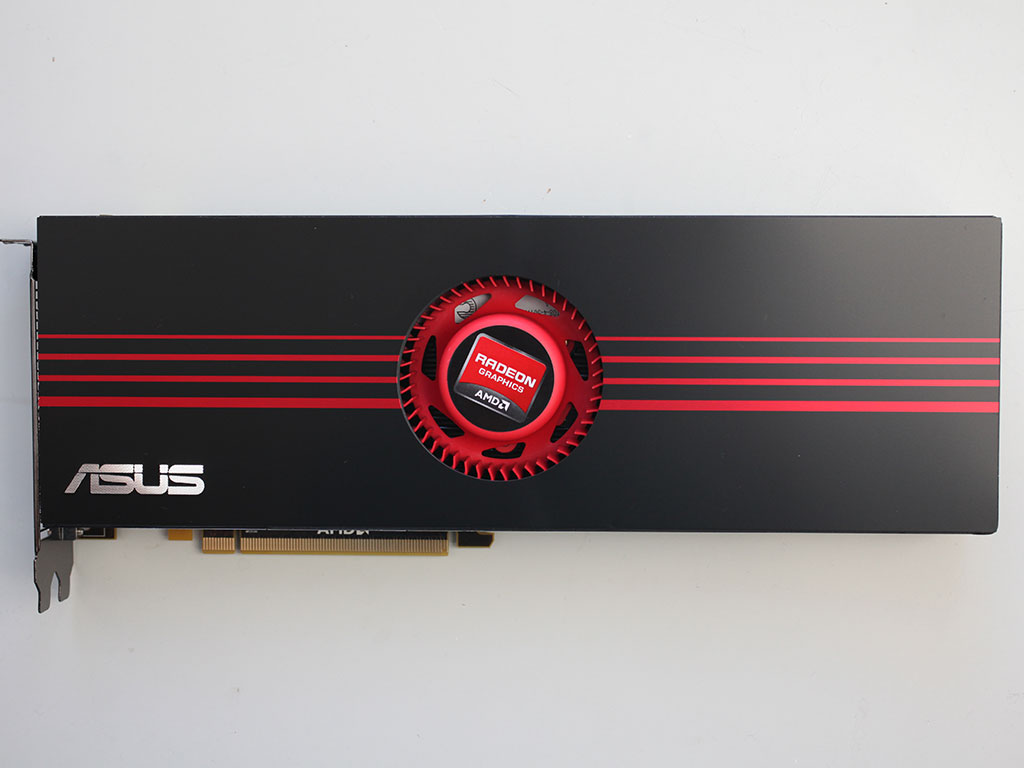

AMD's Radeon HD 6990 is a huge card, which is about the same length as the Radeon HD 5970. ASUS has added a metal plate on the front - instead of the colorful stickers other AIBs use. A small ASUS logo highlight adds to the stylish appearance of the front of the card.

The card requires two slots in your system.

The card has one DVI port and four mini-DisplayPort ports. In the package you will find numerous adapters to convert a DP output to DVI or HDMI. AMD's display output logic is clearly superior to what NVIDIA has to offer at this time. Vendors are free to combine six TMDS links into any output configuration they want (dual-link DVI consuming two links) - and use them all at the same time. AMD has also introduced DisplayPort 1.2 support with their new cards which allows the use of a DisplayPort hub to connect multiple monitors, or daisy chain them together.
An HDMI sound device is also included in the GPU. The HDMI interface is HDMI 1.4a compatible which includes Dolby TrueHD, DTS-HD, AC-3, DTS and up to 7.1 channel audio with 192 kHz / 24-bit output. The new revision also brings support for Blu-ray 3D movies which will become important later this year when we will see first Blu-ray 3D titles shipping.

You may combine up to two HD 6990 cards from any vendor in CrossFire. More on the yellow sticker on the next page.


Here are the front and the back of the card, high-res versions are also available (front, back). If you choose to use these images for voltmods etc, please include a link back to this site or let us post your article.
A Closer Look


AMD is using a big and complex heatsink which cools all components at the same time: GPU 1, GPU 2, memory of both GPUs, voltage regulation circuitry and the PCI-Express bridge chip. AMD claims to use a special "phase change" thermal interface material, and they say once removed you will not be able to get the same temperatures with your own TIM. If you take a close look at the second picture you can see that the paste is not liquid, but more like brittle wax.
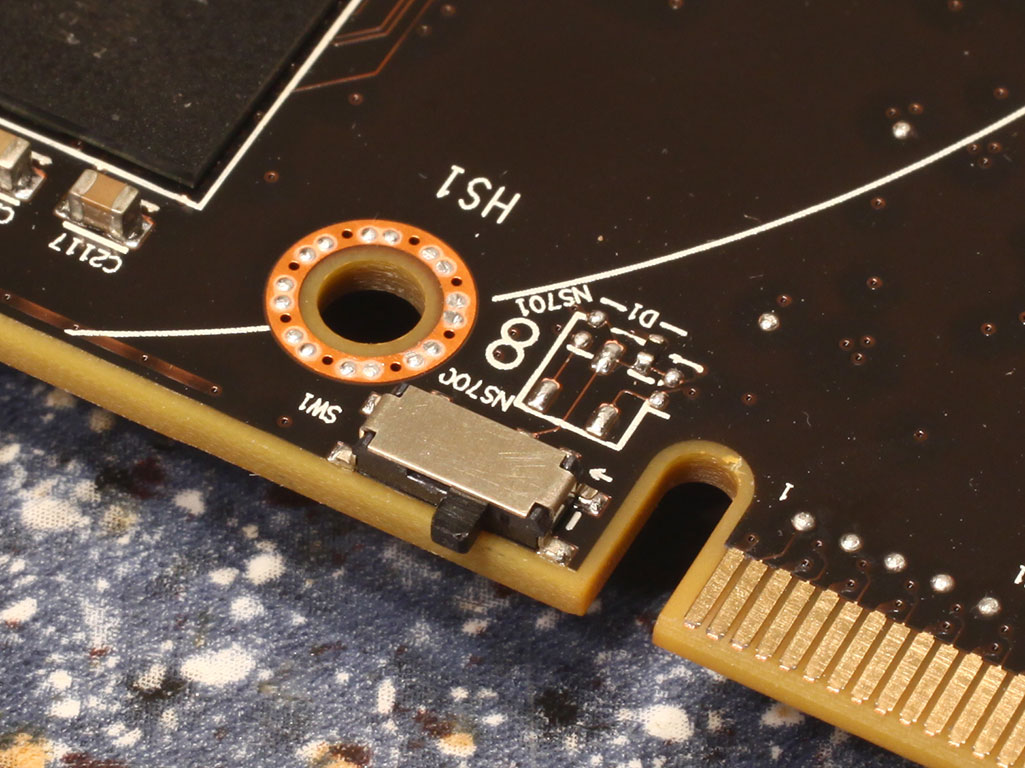
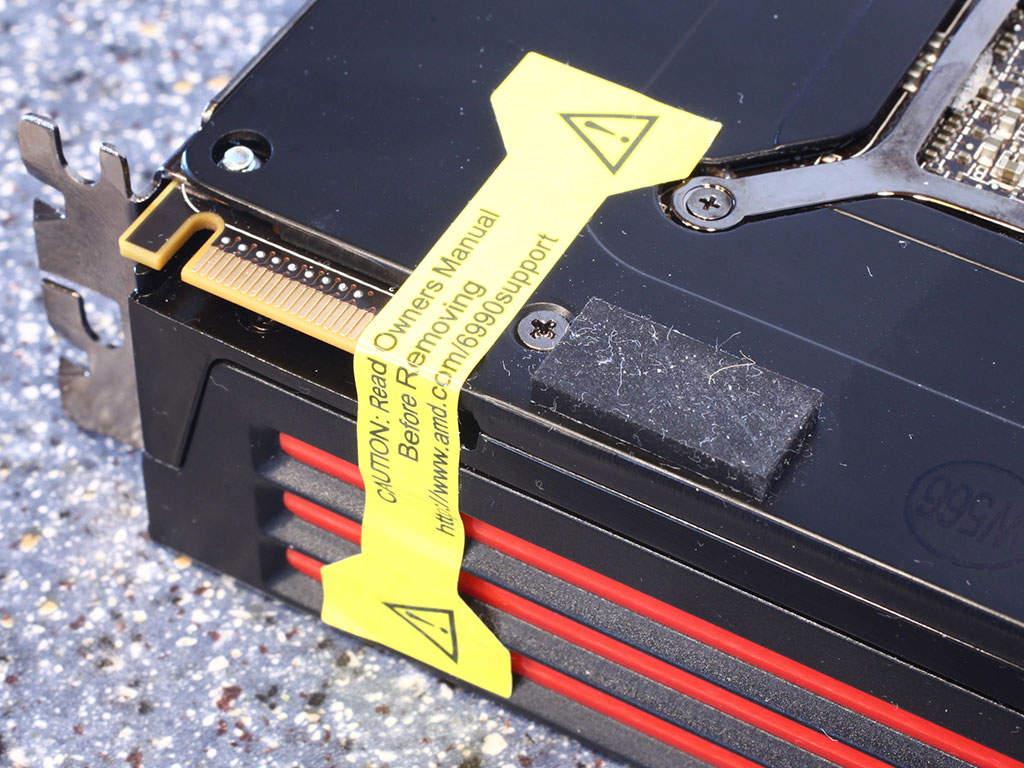
This little switch is present on the HD 6950 and HD 6970 cards, too. Originally it was designed as a backup feature, so you have a second BIOS in case you manage to destroy your main BIOS.
AMD has changed the behaviour on the HD 6990 and turned it into an overclocking feature. When left in the default position, the card uses the normal settings of 830 MHz core and 1.12 V GPU voltage. When set to the second position, the card will use a BIOS that's clocked at 880 MHz core and 1.175 V. The switch is covered by a scary big, yellow sticker which basically tells you that switching the BIOS will void your warranty.
During production AMD does a "bootup" test at the overclocked settings, but they do not guarantee stability of the card in this mode. The sticker itself did not pose a big problem, it can be removed, moved and put back easily.
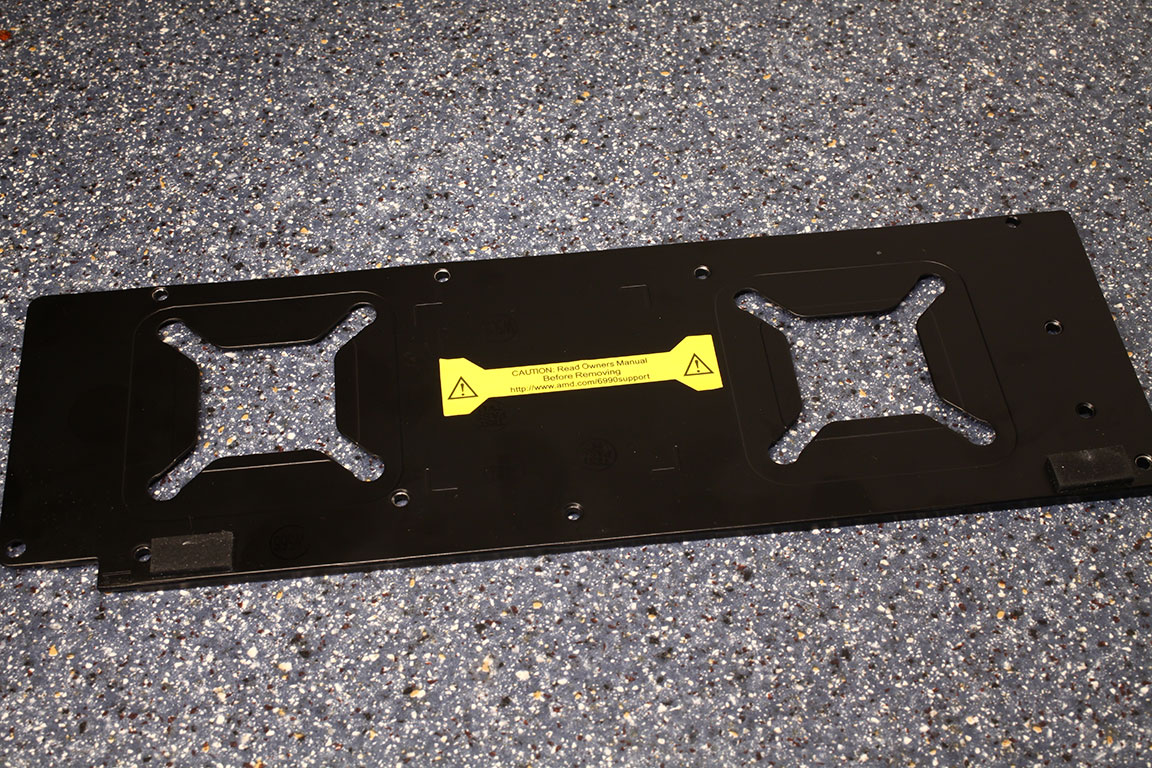

The backplate is made from metal and serves to protect the components on the back from damage. It also helps with cooling the memory chips and acts as a general heatspreader. Warning: This plate gets quite hot when the card is heavily loaded. I moved the yellow sticker from the switch to the middle of the backplate where it's hard to lose, still visible and out of the way.
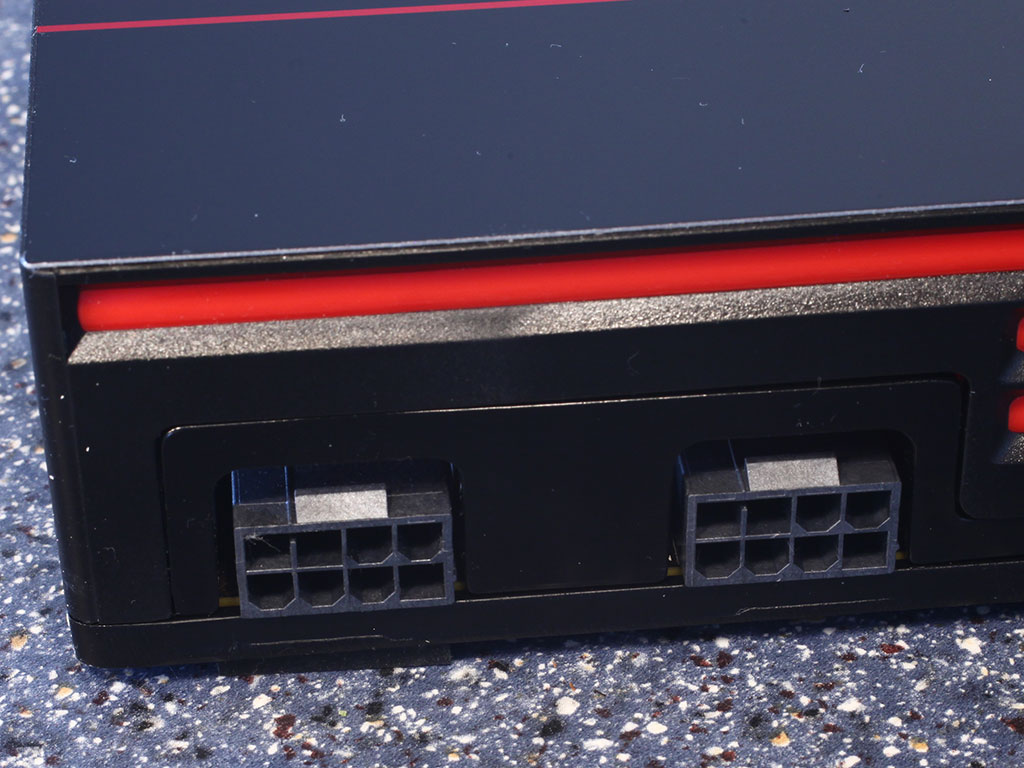
The card requires two 8-pin PCI-Express power connectors. Together with the PCI-Express x16 slot this configuration is good for 375 W of power - AMD says their board can draw up to 375 W in "normal" mode and up to 450 W when overclocked.

The GDDR5 memory chips are made by Hynix, and carry the model number H5GQ2H24MFR-T2C. They are specified to run at 1250 MHz (5000 MHz GDDR5 effective).
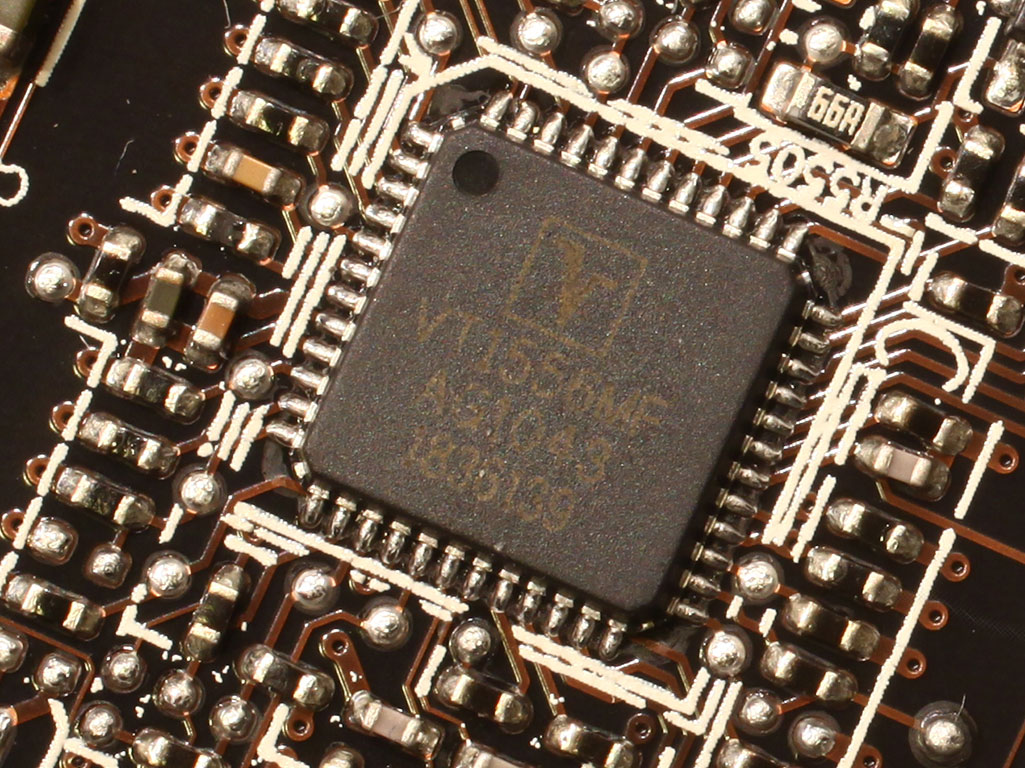
AMD is using two Volterra's VT1556 voltage controllers on their HD 6990 (one for each GPU). The VT1556 is also present on the reference designs for HD 6950 and HD 6970.

The PCI-Express bridge chip which connects the two GPUs and interfaces with the system via PCI-Express 2.0 is made by PLX. Apparently PLX lets ATI rebrand their product. According to AMD the bridge chip supports PCI-Express 2.1 x16 which supplies enough bandwidth to both GPUs for any situation. This is the same bridge chip as used on the Radeon HD 5970.

AMD's new Cayman graphics processor is made on a 40 nm process at TSMC Taiwan. It uses approximately 2.64 billion transistors on a die area of 389 mm².
Our Patreon Silver Supporters can read articles in single-page format.
Nov 14th, 2026 05:34 CST
change timezone
Latest GPU Drivers
New Forum Posts
- Planning for Prolonged High Prices and Maintaining What You Already Have (63)
- Tell me about your favourite graphics card (43)
- What can the FX 8320 do today? Here is the answer. (1)
- What are you playing? (26218)
- I'll flash a ASUS ROG Strix RX480 O8G in Cause of Code 43, as a Newbie (4)
- [INTEL]-How To Update Your Microcode for Intel HX 13/14th Gen. CPUs Laptops/Mobile Easily. (259)
- Ryzen 7 8700G OC (7)
- Post your Cinebench R23 Score (3172)
- AI generated images... (225)
- 3D Printer Club (850)
Popular Reviews
- AMD Zen 6 Technical Deep Dive
- Corsair HX1000i Shift Crystal Review
- NZXT C1200 Platinum Review
- ASUS ROG Strix B850-I Gaming Wi-Fi7 W Review
- Upcoming Hardware Launches 2027 (Updated Nov 2026)
- Montech King 95 3D PRO Review
- NZXT H7 RGB+ Review
- NZXT H5 Review
- Phantom Blade Zero Performance Benchmark Review - 35 GPUs Tested
- XPG NIMBUS PLUS Review - Mid-range Chair With Strong Competitors
TPU on YouTube
Controversial News Posts
- NVIDIA Co-Founder and CEO Jensen Huang Officially Resigns (384)
- OpenAI CEO Argues Home PCs Waste the World's Limited DRAM Supply (152)
- NVIDIA Launches Investigation Into Jensen Huang's Relationship With Suspected Chinese Spy (136)
- Intel "Raptor Lake Next" 16-Core and 20-Core CPUs Surface (130)
- Legendary Game Studio BioWare Shuts Down Following EA Layoffs (104)
- Dell CEO Says the Memory Shortage Will Get Worse in 2027 (95)
- NVIDIA GeForce RTX 50-Series Scheduled for up to $500 Price Hike This Week (89)
- Modder Fits RTX 5090 With Four 8-Pin Connectors, Halving Current per Wire (80)