 13
ASUS ROG GR70 Mini PC Review
(13 Comments) »Value and Conclusion
- The closest retail configuration to our pre-production review sample is the ASUS ROG GR70-N90066AN, which has a MSRP of US$2,800. Our review unit shipped with 64 GB of RAM, while the highest retail configuration currently available is 32 GB.
- Excellent overall performance and a frequent leader in our charts
- Strong RTX 5070 Laptop GPU results for a compact gaming desktop
- Our sample included a very fast Samsung PM9E1 PCIe Gen 5.0 SSD
- Polished ROG design with a slim vertical chassis
- Strong creator, AI, storage, CPU, and synthetic gaming results
- Beat the AtomMan G7 Pro in many of our tested workloads
- Passed the 3DMark Speed Way Stress Test with 98.4% frame rate stability
- Good I/O layout, with USB4, HDMI 2.1, DisplayPort 2.1, 2.5 GbE, Wi-Fi 7, and support for up to five displays
- Expensive
- Current pricing does not undercut the AtomMan G7 Pro
- Our review sample shipped with 64 GB of RAM, but the closest retail model is limited to 32 GB
- This RTX 5070 Laptop GPU variant still has an 8 GB VRAM limit
- Larger desktops with higher-end GPUs will still win in heavier graphics workloads
- Large 330 W external power adapter
Technology and Positioning
The ASUS ROG GR70 is a compact gaming desktop with a much different build than the smaller office-focused Mini-PCs we usually review. It uses high-end mobile hardware, a slim vertical chassis, ROG lighting, and an RTX 5070 Laptop GPU, so it is meant for someone who wants real gaming performance in a smaller system than a traditional tower. It is much closer to a condensed gaming desktop than a basic Mini-PC.
The closest direct comparison is the MINISFORUM AtomMan G7 Pro, since both systems use RTX 5070 Laptop graphics. The GR70 performed better in many of our tests, including CPU-heavy workloads, storage, AI, Photoshop, Blender CPU, and several 3DMark runs. SPECviewperf was more mixed, and larger desktops like the NZXT H2 still have an advantage in some workstation and heavier GPU tests, but the GR70 did very well across the full benchmark suite.
Our review unit is also a pre-production configuration with 64 GB of RAM. ASUS confirmed that the closest retail model is the GR70-N90066AN at $2,800, with the main confirmed difference being the retail unit's 32 GB RAM configuration. Since the retail model still uses dual-channel memory, most results should be similar, although workloads that use more than 32 GB of memory could favor our review sample.
Performance and Everyday Use
The GR70 scored very well in Cinebench, 7-Zip, y-cruncher, Geekbench, PCMark 10, Procyon Office, Photoshop, Blender, HandBrake, and Procyon AI, often placing near the top of our charts. It also beat the AtomMan G7 Pro in many of those same tests, which is a strong result since both systems use the same GPU class.
The Samsung PM9E1 PCIe Gen 5 SSD reached 14,740.92 MB/s read and 13,516.52 MB/s write in CrystalDiskMark, which is far ahead of the PCIe Gen 4 drives in the rest of our Mini-PC charts. The GR70 also placed first in 3DMark Storage with a score of 3,130, so large file transfers, game installs, project loads, and storage-heavy work should all feel very fast.
The NZXT H2 is a useful comparison here because its platform supports Gen 5 storage, but our tested unit came with a WD SN5000 PCIe 4.0 NVMe SSD instead. That drive performed well for a Gen 4 model, but it is in a totally different speed class from the PM9E1 in the GR70.
Gaming Performance
The GR70's 3DMark results put it near the top of our charts, which was expected for a system with an RTX 5070 Laptop GPU inside. It scored 13,711 in Time Spy, placing second overall, with 13,675 in Graphics and 13,923 in CPU. Fire Strike was also strong at 35,310 overall, 37,042 in Graphics, and 46,197 in Physics, placing second in all three. Night Raid came in at 76,706 overall, 139,780 in Graphics, and 21,565 in CPU, placing second overall, third in Graphics, and second in CPU.
Against the MINISFORUM AtomMan G7 Pro, the GR70 came out ahead in most of the 3DMark runs. It beat the AtomMan in Time Spy overall and graphics, all three Fire Strike results, Night Raid overall, and Night Raid CPU. The AtomMan held the edge in Time Spy CPU and Night Raid Graphics, but the GR70 had the better showing across the full 3DMark set.
I also ran Speed Way, Speed Way Stress Test, and Wild Life in addition to our normal 3DMark tests. Speed Way scored 3,470, Wild Life scored 20,002, and the Speed Way Stress Test passed at 98.4% over 20 loops, with a best loop score of 3,470 and a worst loop score of 3,414. That is a good result for a compact gaming system because the GR70 did not drop much during a longer graphics load.
In game testing, the GR70 is a great fit for 1080p and 1440p gaming, especially in titles with DLSS support. Baldur's Gate 3 averaged 191.4 FPS at 1080p Medium and 145.4 FPS at 1080p High, while Cyberpunk 2077 averaged 172.28 FPS at 1080p Medium and 144.55 FPS at 1080p High. At 1440p, the extra testing also looked good, with ARC Raiders at 120.9 FPS on Ultra, PUBG at 128.1 FPS on Highest, and Baldur's Gate 3 at 86.8 FPS on High and 80.3 FPS on Ultra.
The 8 GB VRAM limit is still something to watch for heavy ray tracing, higher-resolution texture packs, or future games that demand more graphics memory. That said, the RTX 5070 Laptop GPU gives the GR70 enough GPU performance to handle modern games well in this size range.
Design, I/O, and Usability
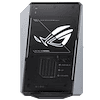
The GR70 has a polished ROG look and feel. The vertical chassis keeps the desk footprint narrow, while the side lighting, large ROG logo, and darker gray frame give it more of a small gaming desktop look. There is some real weight to it as well, so when you pick it up, it feels dense and high-end instead of hollow or plasticky. Physically, this system feels premium.
I/O includes a front USB-C port, two front USB-A ports, four rear USB-A ports, and one rear USB-C port. The rear Type-C port is USB4 with DisplayPort 1.4s, not Thunderbolt 4. Along with that, the GR70 has two HDMI 2.1 ports, two DisplayPort 2.1 ports, 2.5 GbE, DC input, and a Kensington lock slot. ASUS also lists support for up to five displays at once, which gives the GR70 a lot of flexibility for multi-monitor gaming, streaming, productivity, or a heavier desk setup.
Internal access is also much better than I expected from a slim gaming Mini-PC. Removing one side screw and one rear screw lets the side panel pull away, exposing the memory area, SSD heatsink, fan, Wi-Fi card, and board connectors. Compared with the AtomMan G7 Pro, the GR70 is much easier to open and service. The SSD heatsink is secured by two screws, and the wireless card is also easy to reach once the panel is off.
The 330 W external adapter is the main physical tradeoff. It keeps the system itself smaller, but it is still a large brick that needs to be hidden or managed on the desk. That is normal for compact gaming systems using this level of hardware, but it may bother anyone trying to keep a very minimal setup.
Pricing and Competition
The GR70 is fast and feels like a premium ROG system, but the price is high. ASUS confirmed the closest retail configuration to our sample is the GR70-N90066AN at $2,800, although our pre-production unit has 64 GB of RAM while the retail model ships with 32 GB. The AtomMan G7 Pro has been available for around $2,400 on sale with 32 GB of RAM, but it also appears to be sold out in some channels, which makes the comparison a little less direct.
The higher price is easier to accept because the GR70 was faster than the AtomMan G7 Pro in many of our tests. ASUS also gives it a nicer chassis, easier internal access, and, in our sample, an excellent PCIe Gen 5 SSD. The RAM difference still has to be mentioned, though, since our review unit has twice the memory of both the retail GR70-N90066AN and the AtomMan G7 Pro configuration used for comparison.
Against the NZXT H2, the GR70 is not going to replace a larger desktop with an RTX 5080, but it did beat the H2 in some areas, including Photoshop, Blender CPU, Procyon AI, 3DMark Storage, and y-cruncher. That is a good showing for a compact gaming system, even though the H2 still has the higher graphics ceiling in heavier GPU workloads.
Bottom Line
Overall, the ASUS ROG GR70 is one of the strongest compact gaming systems we have tested so far. It delivers excellent CPU performance, strong RTX 5070 Laptop GPU results, fast storage, good AI and creator performance, useful I/O, and a polished ROG design that feels very refined. It also proved to be a frequent leader in our charts, including several wins over the AtomMan G7 Pro.
The GR70 performs very well, but that performance comes with a high price. At $2,800 for the closest retail configuration ASUS confirmed, it costs more than the current AtomMan G7 Pro sale pricing, although the ASUS system was also faster in many of our tests and has a nicer chassis design. The main caveat is that our review sample had 64 GB of RAM, while the retail GR70-N90066AN ships with 32 GB, so the tested unit is not a perfect one-to-one match with the retail model.
If the price fits your budget, and you want a compact gaming desktop with strong 1080p and 1440p performance, fast storage, useful I/O, easy internal access, and a polished ROG design, the GR70 is easy to recommend.


The ASUS ROG GR70 is a compact gaming desktop with a much different build than the smaller office-focused Mini-PCs we usually review. It uses high-end mobile hardware, a slim vertical chassis, ROG lighting, and an RTX 5070 Laptop GPU, so it is meant for someone who wants real gaming performance in a smaller system than a traditional tower. It is much closer to a condensed gaming desktop than a basic Mini-PC.
The closest direct comparison is the MINISFORUM AtomMan G7 Pro, since both systems use RTX 5070 Laptop graphics. The GR70 performed better in many of our tests, including CPU-heavy workloads, storage, AI, Photoshop, Blender CPU, and several 3DMark runs. SPECviewperf was more mixed, and larger desktops like the NZXT H2 still have an advantage in some workstation and heavier GPU tests, but the GR70 did very well across the full benchmark suite.
Our review unit is also a pre-production configuration with 64 GB of RAM. ASUS confirmed that the closest retail model is the GR70-N90066AN at $2,800, with the main confirmed difference being the retail unit's 32 GB RAM configuration. Since the retail model still uses dual-channel memory, most results should be similar, although workloads that use more than 32 GB of memory could favor our review sample.
Performance and Everyday Use
The GR70 scored very well in Cinebench, 7-Zip, y-cruncher, Geekbench, PCMark 10, Procyon Office, Photoshop, Blender, HandBrake, and Procyon AI, often placing near the top of our charts. It also beat the AtomMan G7 Pro in many of those same tests, which is a strong result since both systems use the same GPU class.
The Samsung PM9E1 PCIe Gen 5 SSD reached 14,740.92 MB/s read and 13,516.52 MB/s write in CrystalDiskMark, which is far ahead of the PCIe Gen 4 drives in the rest of our Mini-PC charts. The GR70 also placed first in 3DMark Storage with a score of 3,130, so large file transfers, game installs, project loads, and storage-heavy work should all feel very fast.
The NZXT H2 is a useful comparison here because its platform supports Gen 5 storage, but our tested unit came with a WD SN5000 PCIe 4.0 NVMe SSD instead. That drive performed well for a Gen 4 model, but it is in a totally different speed class from the PM9E1 in the GR70.
Gaming Performance
The GR70's 3DMark results put it near the top of our charts, which was expected for a system with an RTX 5070 Laptop GPU inside. It scored 13,711 in Time Spy, placing second overall, with 13,675 in Graphics and 13,923 in CPU. Fire Strike was also strong at 35,310 overall, 37,042 in Graphics, and 46,197 in Physics, placing second in all three. Night Raid came in at 76,706 overall, 139,780 in Graphics, and 21,565 in CPU, placing second overall, third in Graphics, and second in CPU.
Against the MINISFORUM AtomMan G7 Pro, the GR70 came out ahead in most of the 3DMark runs. It beat the AtomMan in Time Spy overall and graphics, all three Fire Strike results, Night Raid overall, and Night Raid CPU. The AtomMan held the edge in Time Spy CPU and Night Raid Graphics, but the GR70 had the better showing across the full 3DMark set.
I also ran Speed Way, Speed Way Stress Test, and Wild Life in addition to our normal 3DMark tests. Speed Way scored 3,470, Wild Life scored 20,002, and the Speed Way Stress Test passed at 98.4% over 20 loops, with a best loop score of 3,470 and a worst loop score of 3,414. That is a good result for a compact gaming system because the GR70 did not drop much during a longer graphics load.
In game testing, the GR70 is a great fit for 1080p and 1440p gaming, especially in titles with DLSS support. Baldur's Gate 3 averaged 191.4 FPS at 1080p Medium and 145.4 FPS at 1080p High, while Cyberpunk 2077 averaged 172.28 FPS at 1080p Medium and 144.55 FPS at 1080p High. At 1440p, the extra testing also looked good, with ARC Raiders at 120.9 FPS on Ultra, PUBG at 128.1 FPS on Highest, and Baldur's Gate 3 at 86.8 FPS on High and 80.3 FPS on Ultra.
The 8 GB VRAM limit is still something to watch for heavy ray tracing, higher-resolution texture packs, or future games that demand more graphics memory. That said, the RTX 5070 Laptop GPU gives the GR70 enough GPU performance to handle modern games well in this size range.
Design, I/O, and Usability
The GR70 has a polished ROG look and feel. The vertical chassis keeps the desk footprint narrow, while the side lighting, large ROG logo, and darker gray frame give it more of a small gaming desktop look. There is some real weight to it as well, so when you pick it up, it feels dense and high-end instead of hollow or plasticky. Physically, this system feels premium.
I/O includes a front USB-C port, two front USB-A ports, four rear USB-A ports, and one rear USB-C port. The rear Type-C port is USB4 with DisplayPort 1.4s, not Thunderbolt 4. Along with that, the GR70 has two HDMI 2.1 ports, two DisplayPort 2.1 ports, 2.5 GbE, DC input, and a Kensington lock slot. ASUS also lists support for up to five displays at once, which gives the GR70 a lot of flexibility for multi-monitor gaming, streaming, productivity, or a heavier desk setup.
Internal access is also much better than I expected from a slim gaming Mini-PC. Removing one side screw and one rear screw lets the side panel pull away, exposing the memory area, SSD heatsink, fan, Wi-Fi card, and board connectors. Compared with the AtomMan G7 Pro, the GR70 is much easier to open and service. The SSD heatsink is secured by two screws, and the wireless card is also easy to reach once the panel is off.
The 330 W external adapter is the main physical tradeoff. It keeps the system itself smaller, but it is still a large brick that needs to be hidden or managed on the desk. That is normal for compact gaming systems using this level of hardware, but it may bother anyone trying to keep a very minimal setup.
Pricing and Competition
The GR70 is fast and feels like a premium ROG system, but the price is high. ASUS confirmed the closest retail configuration to our sample is the GR70-N90066AN at $2,800, although our pre-production unit has 64 GB of RAM while the retail model ships with 32 GB. The AtomMan G7 Pro has been available for around $2,400 on sale with 32 GB of RAM, but it also appears to be sold out in some channels, which makes the comparison a little less direct.
The higher price is easier to accept because the GR70 was faster than the AtomMan G7 Pro in many of our tests. ASUS also gives it a nicer chassis, easier internal access, and, in our sample, an excellent PCIe Gen 5 SSD. The RAM difference still has to be mentioned, though, since our review unit has twice the memory of both the retail GR70-N90066AN and the AtomMan G7 Pro configuration used for comparison.
Against the NZXT H2, the GR70 is not going to replace a larger desktop with an RTX 5080, but it did beat the H2 in some areas, including Photoshop, Blender CPU, Procyon AI, 3DMark Storage, and y-cruncher. That is a good showing for a compact gaming system, even though the H2 still has the higher graphics ceiling in heavier GPU workloads.
Bottom Line
Overall, the ASUS ROG GR70 is one of the strongest compact gaming systems we have tested so far. It delivers excellent CPU performance, strong RTX 5070 Laptop GPU results, fast storage, good AI and creator performance, useful I/O, and a polished ROG design that feels very refined. It also proved to be a frequent leader in our charts, including several wins over the AtomMan G7 Pro.
The GR70 performs very well, but that performance comes with a high price. At $2,800 for the closest retail configuration ASUS confirmed, it costs more than the current AtomMan G7 Pro sale pricing, although the ASUS system was also faster in many of our tests and has a nicer chassis design. The main caveat is that our review sample had 64 GB of RAM, while the retail GR70-N90066AN ships with 32 GB, so the tested unit is not a perfect one-to-one match with the retail model.
If the price fits your budget, and you want a compact gaming desktop with strong 1080p and 1440p performance, fast storage, useful I/O, easy internal access, and a polished ROG design, the GR70 is easy to recommend.
Nov 19th, 2026 17:58 CST
change timezone
Latest GPU Drivers
New Forum Posts
- Building a hardware monitor, diagnostics and benchmark tool – would you use it? (29)
- Dual B70 or Dual R9700 Pro on Linux (11)
- How to prevent OLED burn damage due to PC freezes or power outtages? (30)
- TPU's Nostalgic Hardware Club (22170)
- Security Apps (3)
- Got the EOL 32GB TridentZ 6000 CL26 1.4V (12)
- Honestly, do you care about GTA VI? (167)
- Dell Workstation Owners Club (3517)
- Making a game in Godot engine (6)
- Introducing DST Bench : one of the most advanced disk benchmark and storage analyzer real-time software (6)
Popular Reviews
- Acemagic Retro X3 Review
- Ugreen NASync DXP4800 GT Review
- Upcoming Hardware Launches 2027 (Updated Nov 2026)
- Pulsar Office Tour & First Look at P1 Dual-Sensor Mouse
- AMD Zen 6 Technical Deep Dive
- Biwin Black Opal NV7400 2 TB Review
- Corsair RM1200e (Second Generation) Review
- Sapphire Radeon RX 7700 XT Pure Review
- Sapphire Radeon RX 7700 XT Pulse Review
- AMD Ryzen 7 9800X3D Review - The Best Gaming Processor
TPU on YouTube
Controversial News Posts
- NVIDIA Co-Founder and CEO Jensen Huang Officially Resigns (489)
- Report: Jensen Huang Eyes NVIDIA Comeback (223)
- Open Letter Asking NVIDIA to Reinstate Jensen Huang Passes 115,000 Signatures (184)
- OpenAI CEO Argues Home PCs Waste the World's Limited DRAM Supply (152)
- NVIDIA Launches Investigation Into Jensen Huang's Relationship With Suspected Chinese Spy (136)
- Intel "Raptor Lake Next" 16-Core and 20-Core CPUs Surface (130)
- Legendary Game Studio BioWare Shuts Down Following EA Layoffs (104)
- Dell CEO Says the Memory Shortage Will Get Worse in 2027 (95)