 13
ASUS ROG GR70 Mini PC Review
Web & Office Productivity »General Performance
AIDA64 Cache & Memory
The AIDA64 memory benchmark measures how quickly data moves between system memory and the CPU's cache hierarchy. For the GR70, it is mainly a check on DDR5 memory bandwidth, latency, and cache behavior behind the Ryzen 9 9955HX3D.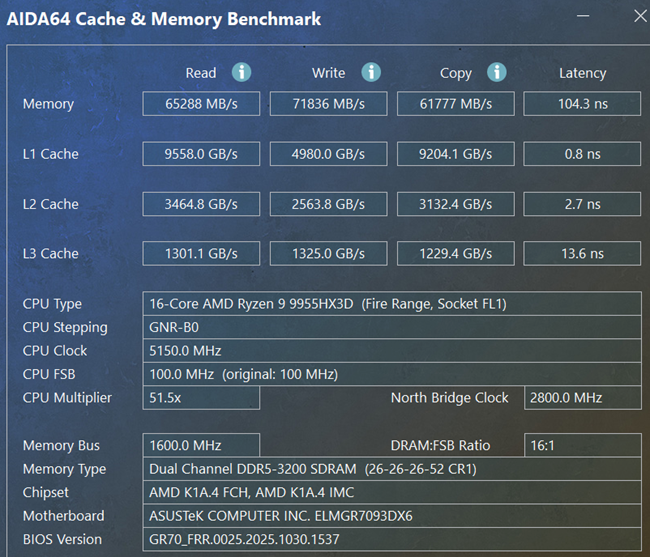
The GR70 posted 65,288 MB/s read, 71,836 MB/s write, and 61,777 MB/s copy, with memory latency at 104.3 ns.
The cache results are much stronger than the memory latency figure, especially at L1 where the GR70 reached 9,558.0 GB/s read, 4,980.0 GB/s write, and 9,204.1 GB/s copy at 0.8 ns. L2 came in at 3,464.8 GB/s read, 2,563.8 GB/s write, and 3,132.4 GB/s copy at 2.7 ns, while L3 posted 1,301.1 GB/s read, 1,325.0 GB/s write, and 1,229.4 GB/s copy at 13.6 ns. The bandwidth numbers are strong across the cache hierarchy, but the 104.3 ns memory latency is the one result here that is a little higher than I would like to see from a performance-focused gaming desktop.
Cinebench
Cinebench is a CPU rendering benchmark based on Maxon's Cinema 4D engine. It evaluates both single-threaded and multi-threaded workloads, giving a clear picture of how a processor handles everyday tasks as well as heavier rendering scenarios.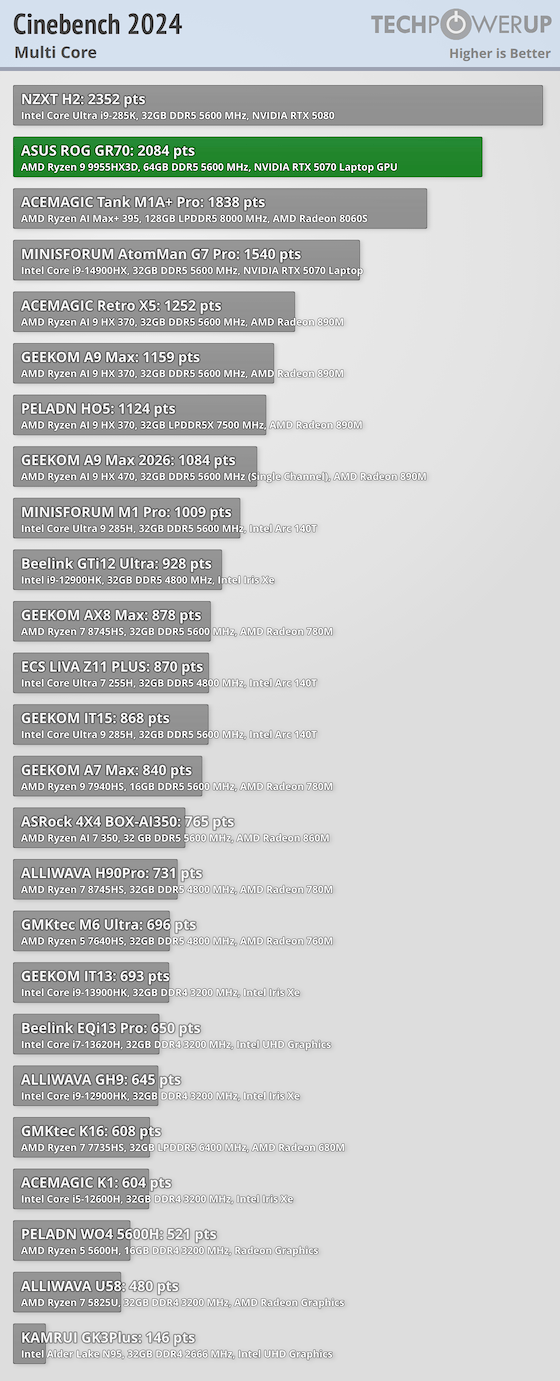
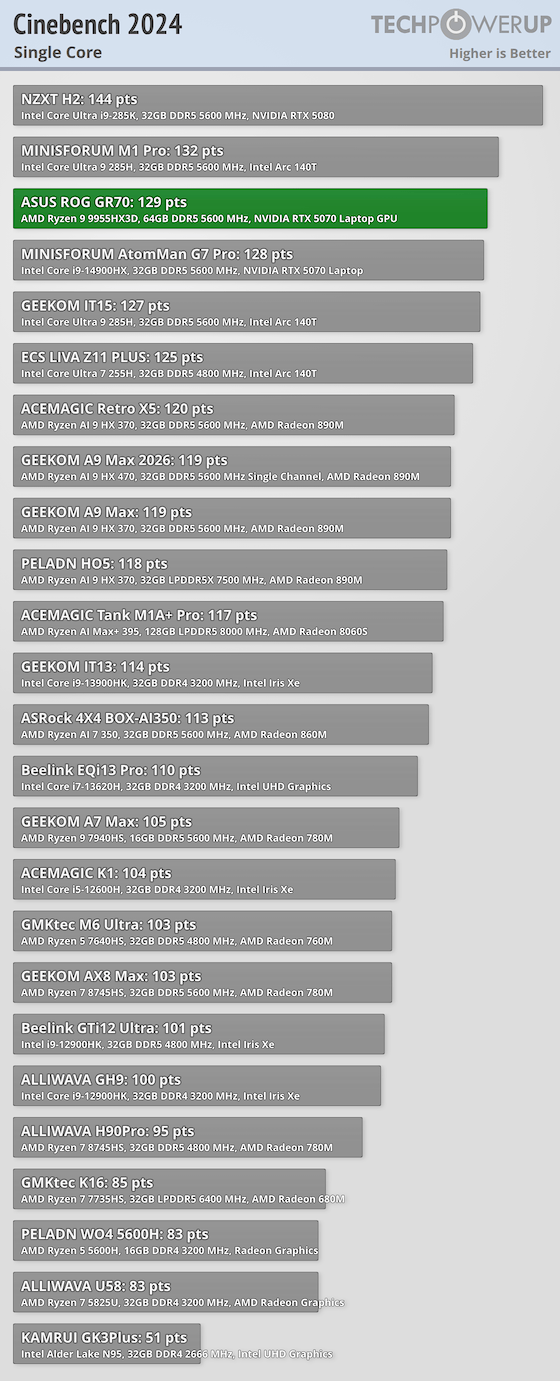
The GR70 scores 2,084 in Cinebench 2024 Multi Core, putting it well ahead of the AtomMan G7 Pro's 1,540. Single Core is much closer, with the GR70 at 129 and the AtomMan at 128, while the larger NZXT H2 leads both tests with 2,352 Multi Core and 144 Single Core.
7-Zip
7-Zip's built-in benchmark measures CPU performance when compressing and decompressing data. It's a good indicator of how a system handles file-heavy workloads such as packing archives, installing software, or building projects.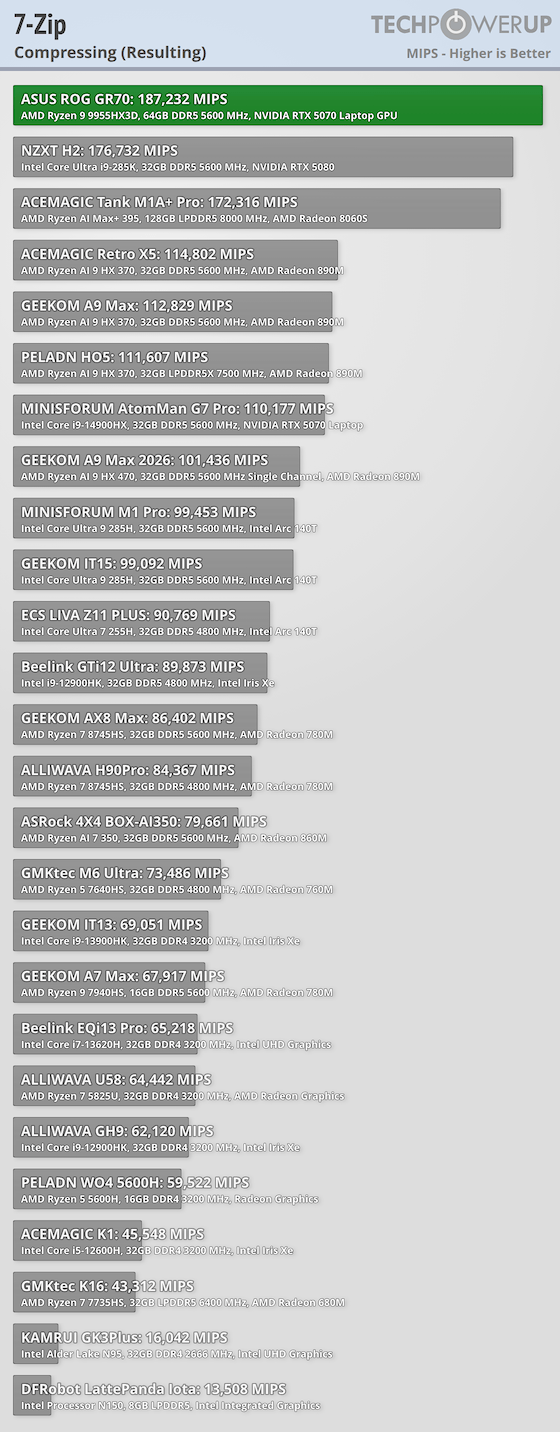
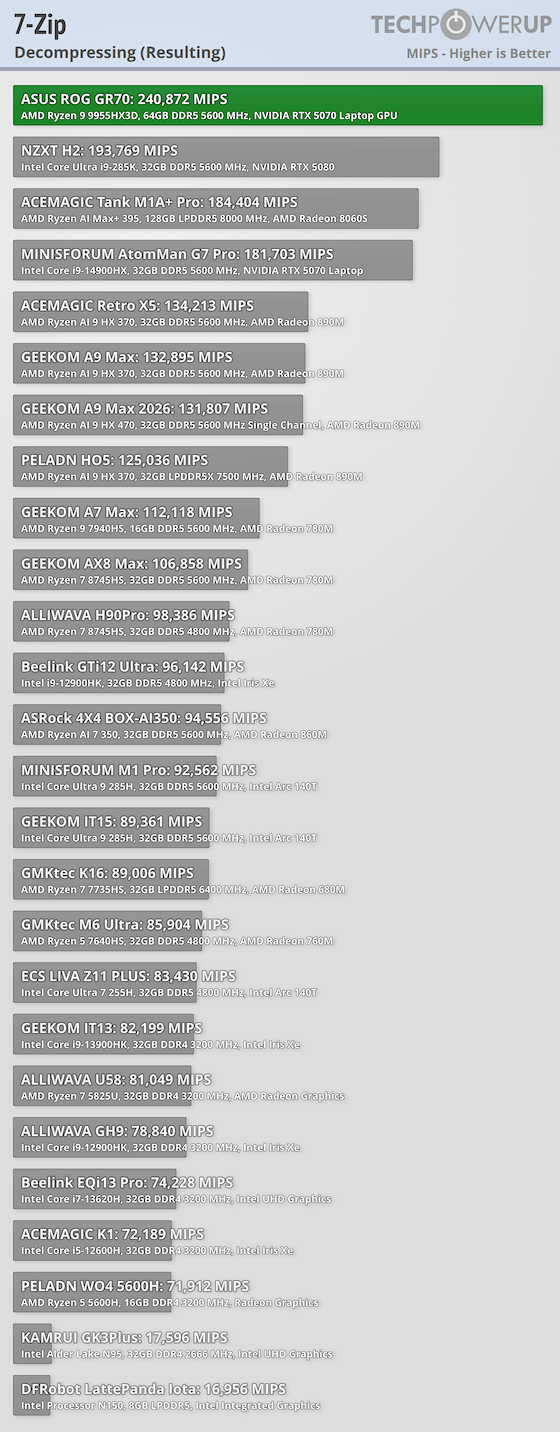
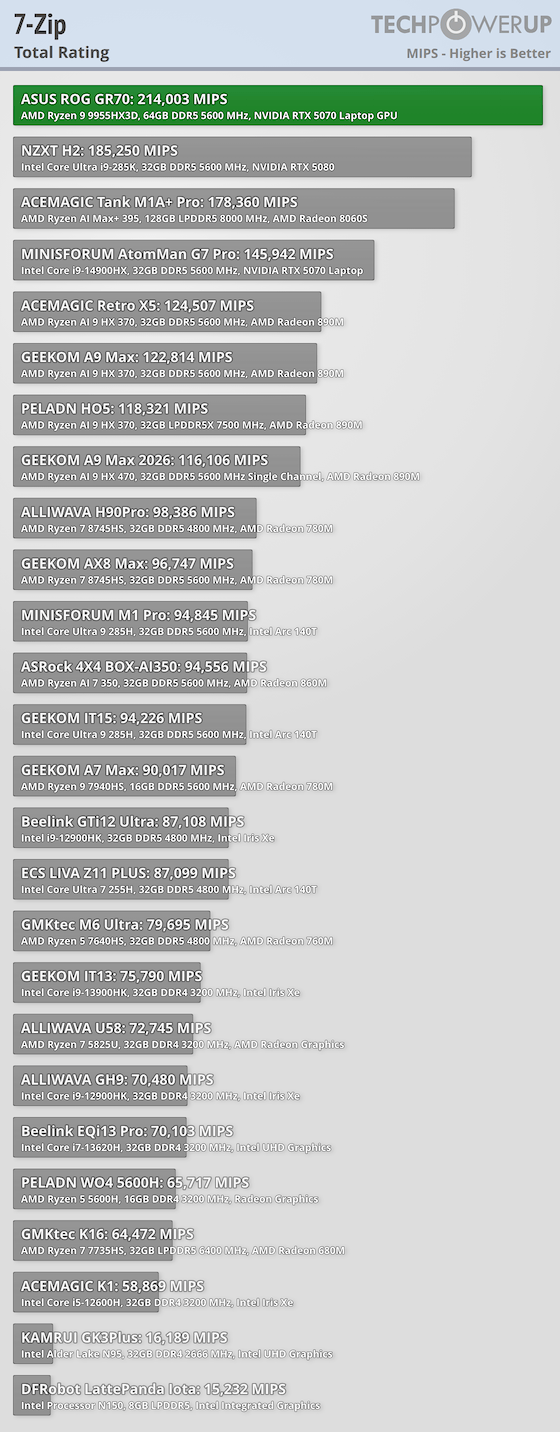
The GR70 does extremely well in 7-Zip, scoring 187,232 in Compressing, 240,872 in Decompressing, and 214,003 overall. That is far ahead of the AtomMan G7 Pro's 110,177, 181,703, and 145,942, and it even beats the NZXT H2's 185,250 total score.
PCMark 10
PCMark simulates common desktop activities across browsing, video conferencing, office apps, and media workflows. It gives a broad look at day-to-day desktop performance.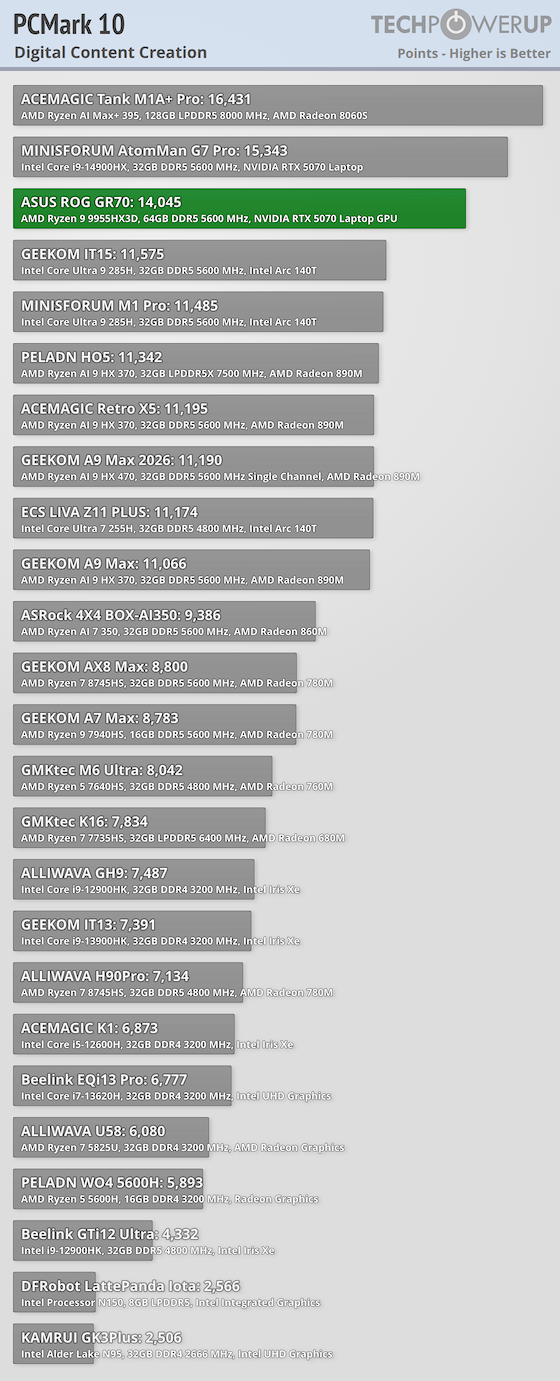
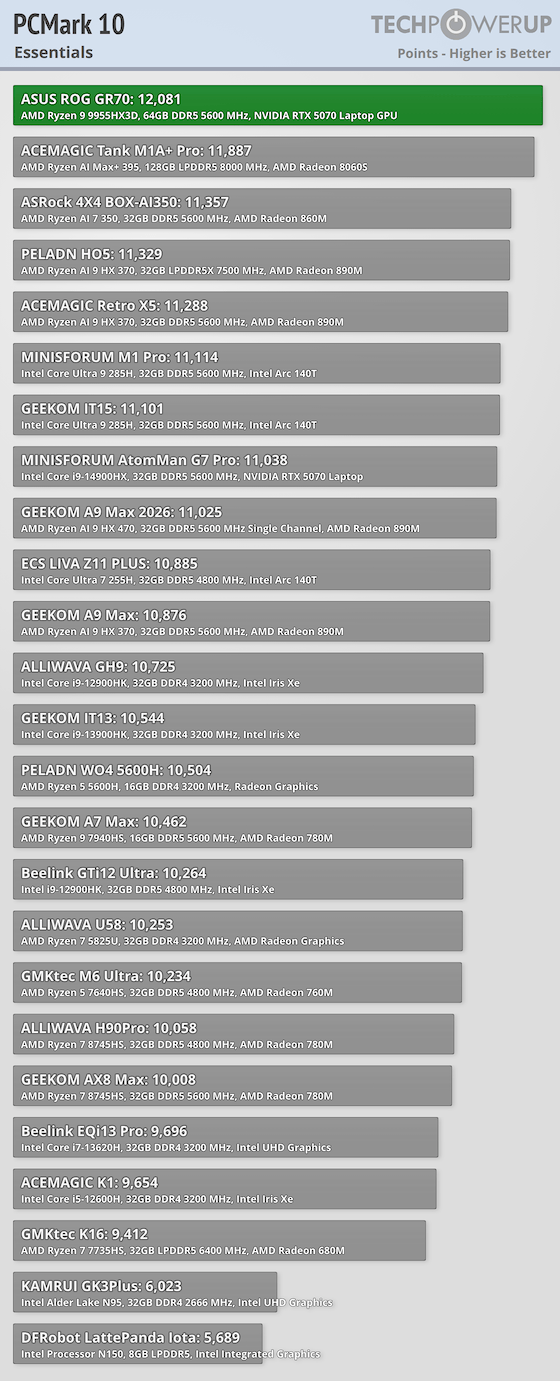
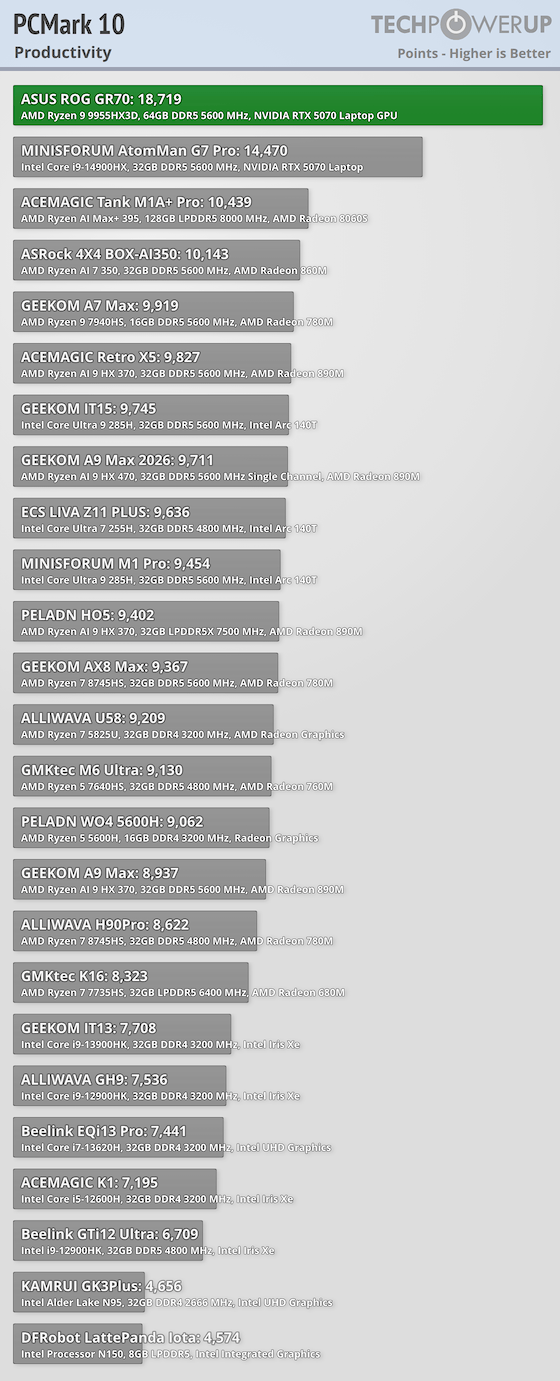
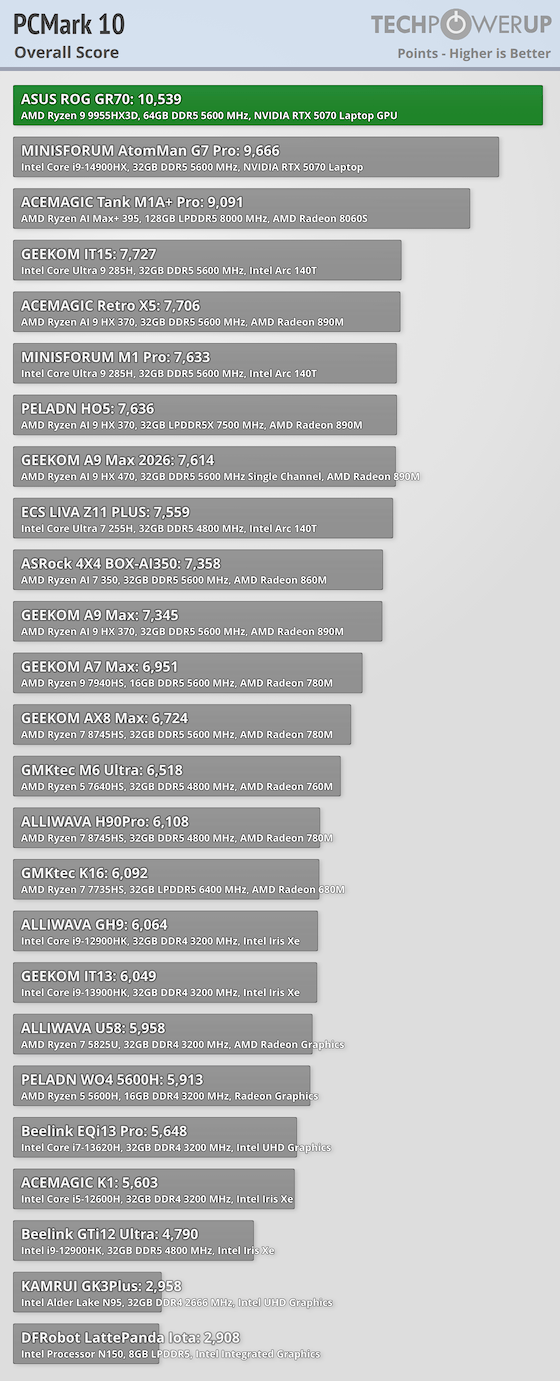
The GR70 scores 10,539 overall in PCMark 10, ahead of the AtomMan G7 Pro at 9,666. It leads in Essentials and Productivity, especially Productivity at 18,719 versus 14,470, though the AtomMan is higher in Digital Content Creation at 15,343 versus 14,045.
Y-Cruncher
Y-Cruncher calculates digits of Pi with extreme precision and puts a heavy load on both the CPU and memory. It's useful for gauging raw compute ability and stability under heavy math workloads.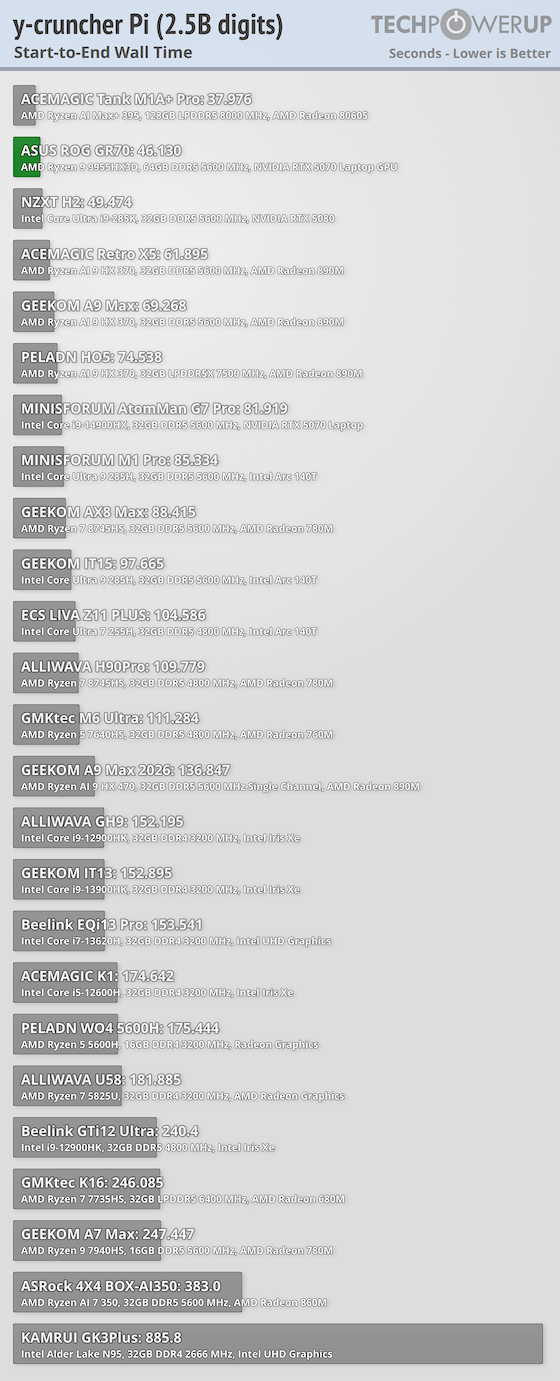
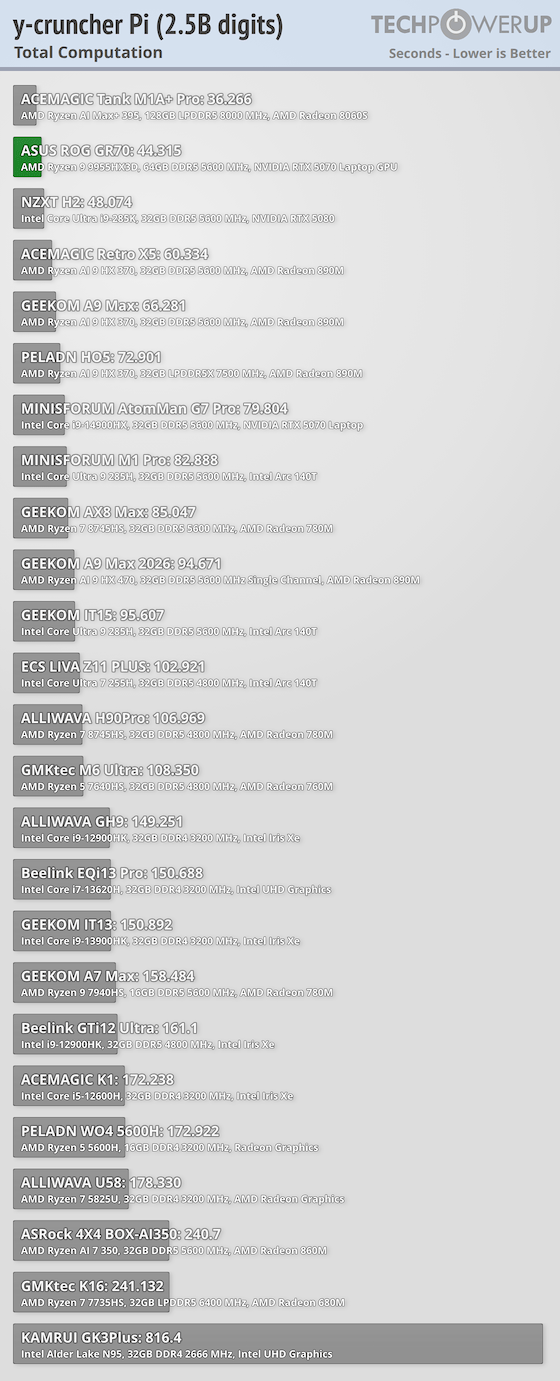
The GR70 finishes the y-cruncher 2.5B run in 44.315 seconds for Total Computation and 46.130 seconds for Start-to-End Wall Time. That is much faster than the AtomMan G7 Pro at 79.804 and 81.919 seconds, and it also beats the NZXT H2's 48.074 and 49.474 seconds.
Geekbench
Geekbench tests a wide variety of workloads, from encryption and machine learning to office productivity and photo editing. It also includes a GPU compute test, which gives a useful look at how the RTX 5070 Laptop GPU performs outside of games.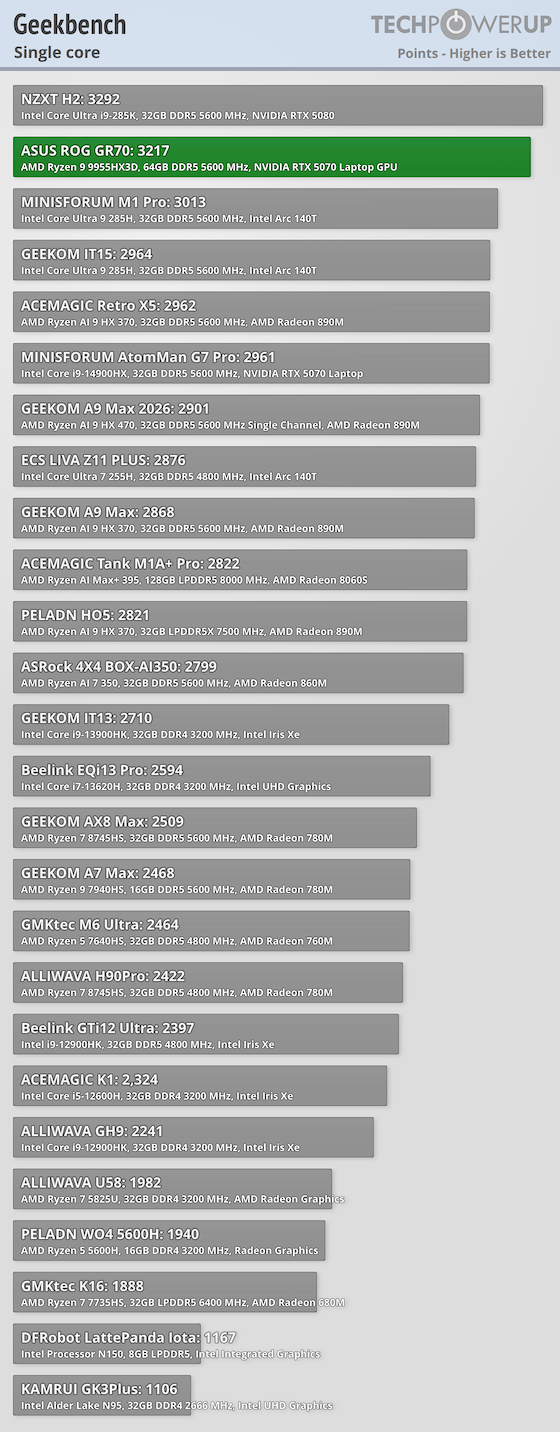
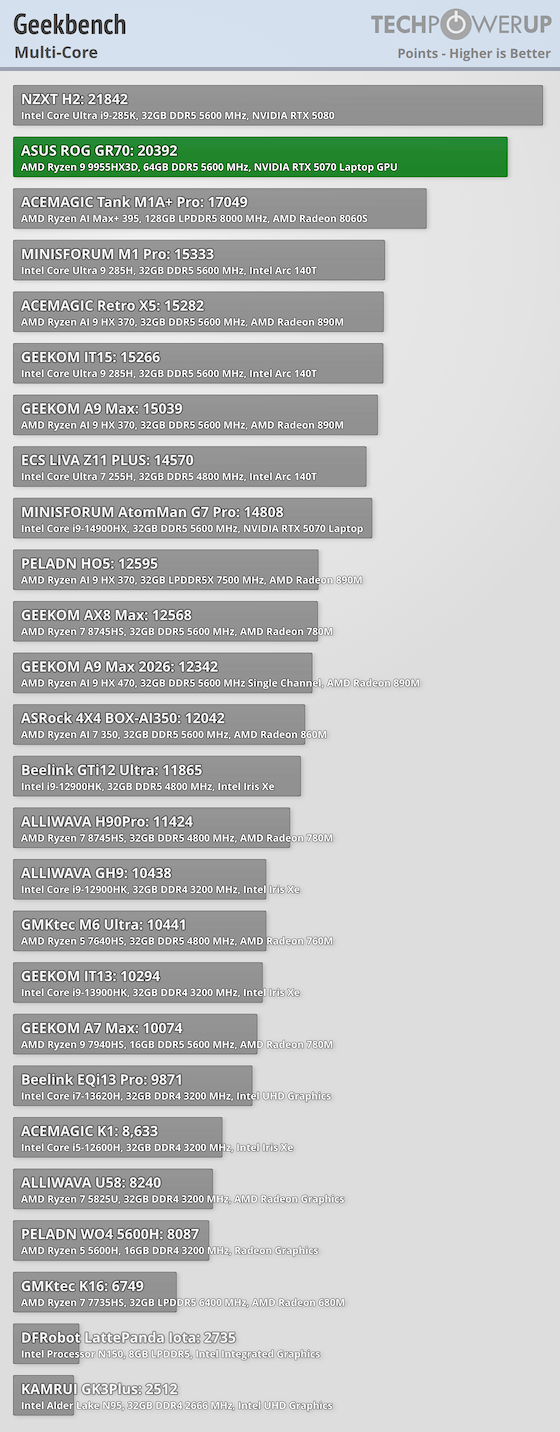
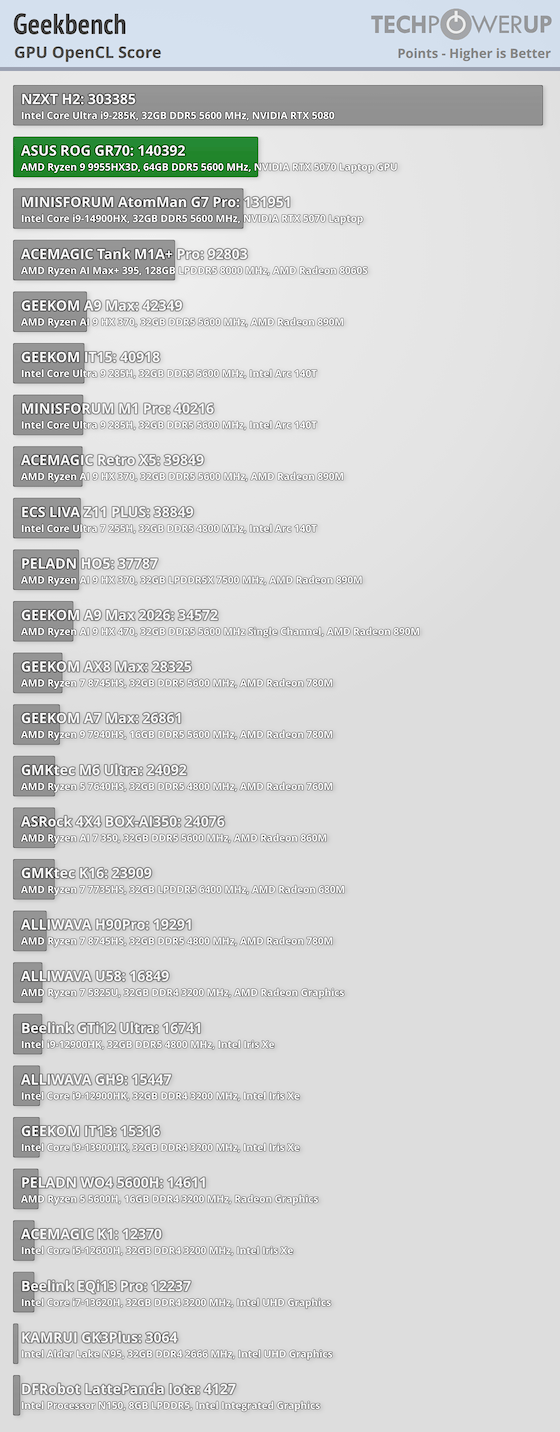
The GR70 scores 3,217 in Geekbench Single Core and 20,392 in Multi-Core, ahead of the AtomMan G7 Pro's 2,961 and 14,808. GPU OpenCL also favors the GR70, with 140,392 versus 131,951 for the AtomMan.
Nov 19th, 2026 16:08 CST
change timezone
Latest GPU Drivers
New Forum Posts
- Honestly, do you care about GTA VI? (164)
- Windows 11 General Discussion (7736)
- Current Sales, Bundles, Giveaways (10448)
- Last game you purchased? (1409)
- WarpCoreBench scores! (76)
- Got the EOL 32GB TridentZ 6000 CL26 1.4V (12)
- Dell Workstation Owners Club (3516)
- Making a game in Godot engine (4)
- DTS DCH Driver for Realtek HDA [DTS:X APO4 + DTS Interactive] (2815)
- Security Apps (2)
Popular Reviews
- Acemagic Retro X3 Review
- Ugreen NASync DXP4800 GT Review
- Upcoming Hardware Launches 2027 (Updated Nov 2026)
- Pulsar Office Tour & First Look at P1 Dual-Sensor Mouse
- AMD Zen 6 Technical Deep Dive
- Biwin Black Opal NV7400 2 TB Review
- Sapphire Radeon RX 7700 XT Pure Review
- Sapphire Radeon RX 7700 XT Pulse Review
- AMD Ryzen 7 9800X3D Review - The Best Gaming Processor
- Chieftec Iceberg PRO 360 DARK Review
TPU on YouTube
Controversial News Posts
- NVIDIA Co-Founder and CEO Jensen Huang Officially Resigns (489)
- Report: Jensen Huang Eyes NVIDIA Comeback (223)
- Open Letter Asking NVIDIA to Reinstate Jensen Huang Passes 115,000 Signatures (184)
- OpenAI CEO Argues Home PCs Waste the World's Limited DRAM Supply (152)
- NVIDIA Launches Investigation Into Jensen Huang's Relationship With Suspected Chinese Spy (136)
- Intel "Raptor Lake Next" 16-Core and 20-Core CPUs Surface (130)
- Legendary Game Studio BioWare Shuts Down Following EA Layoffs (104)
- Dell CEO Says the Memory Shortage Will Get Worse in 2027 (95)