 35
ASUS ROG Xbox Ally X Review
Gaming Performance: Windows Desktop vs. Xbox Full Screen Experience »Gaming Performance
3DMark
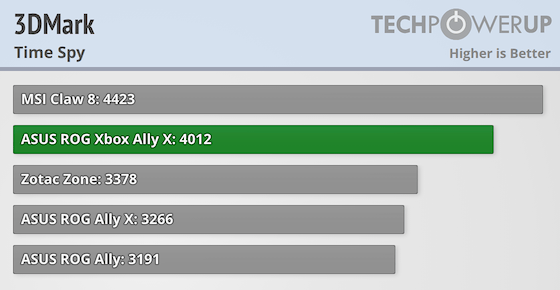
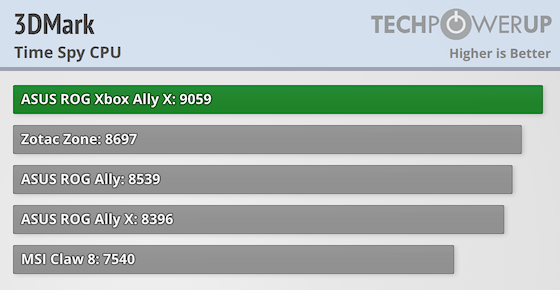
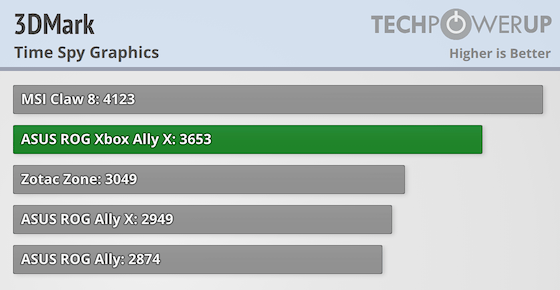
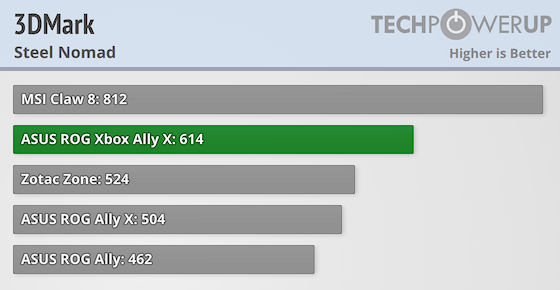
Cyberpunk 2077
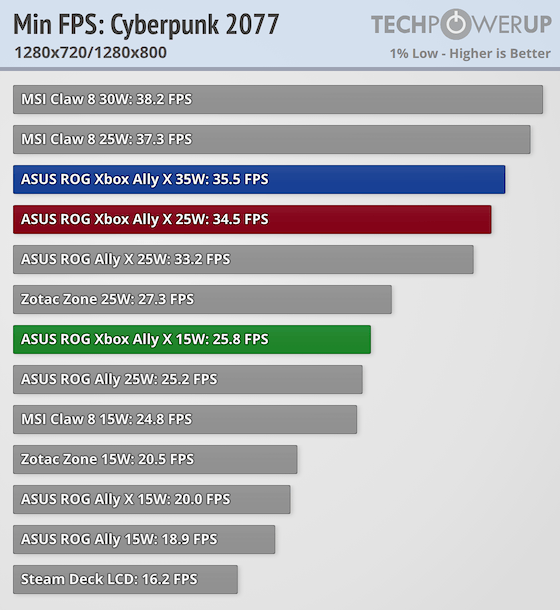
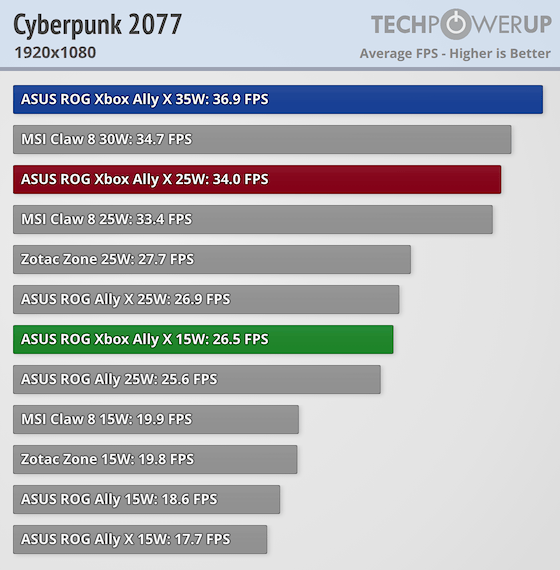
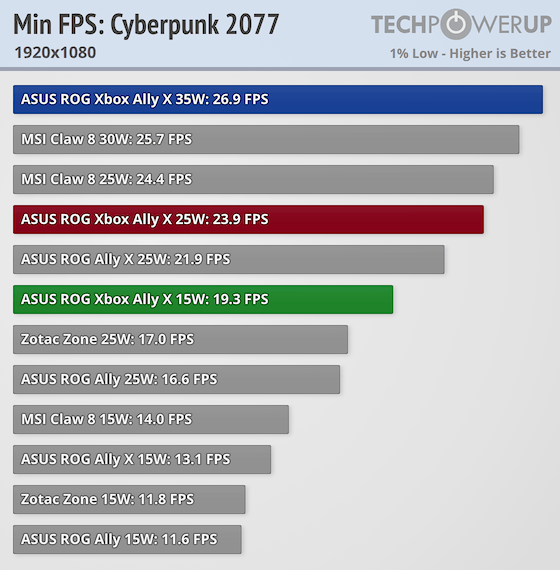
Steam Deck preset, no upscaling.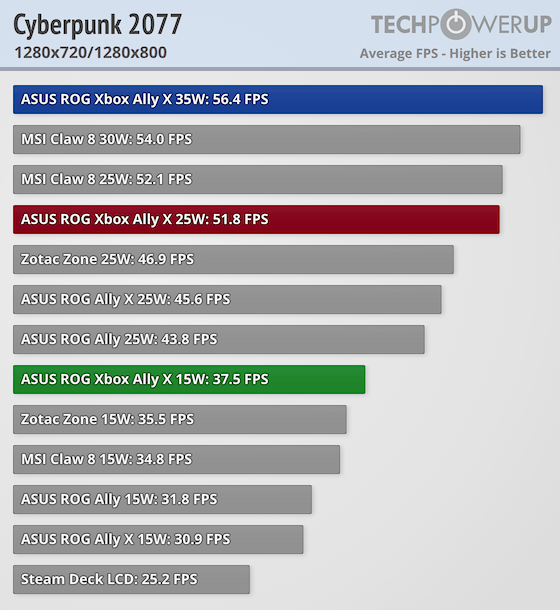
Hogwarts Legacy
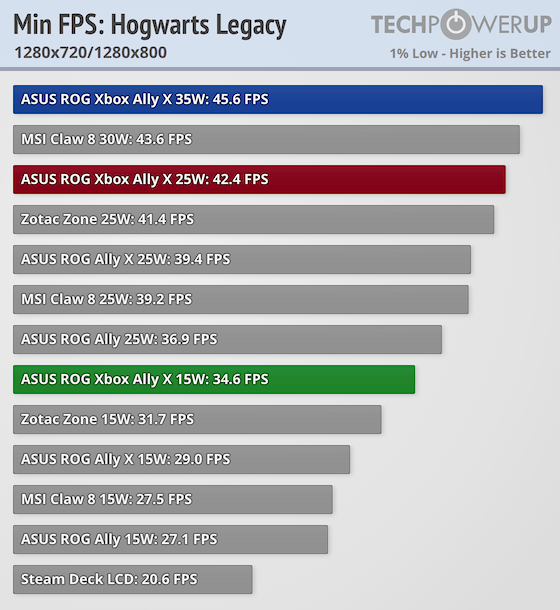
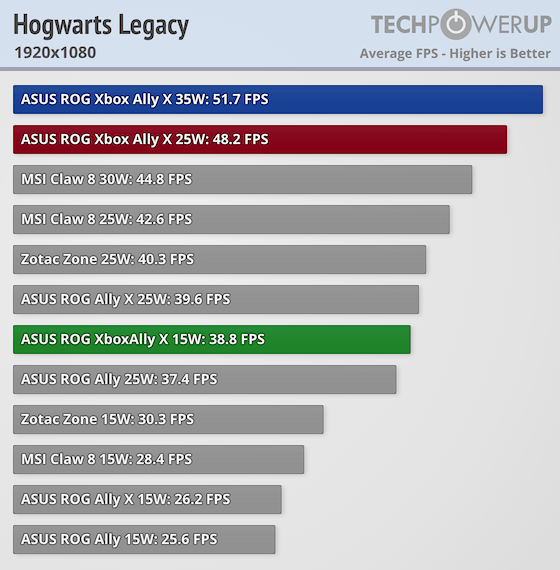
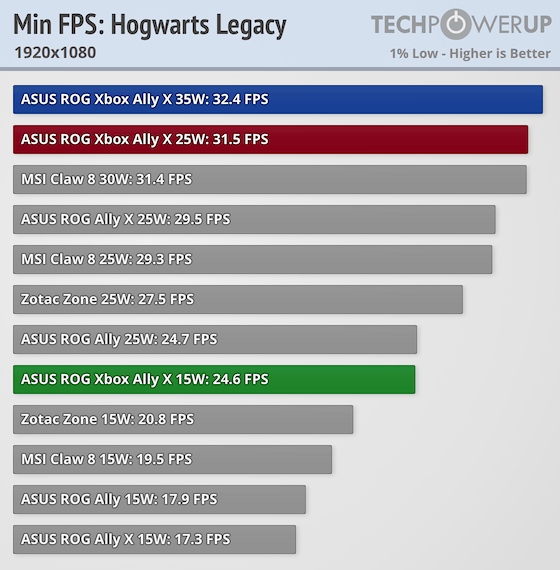
Low preset, TAA.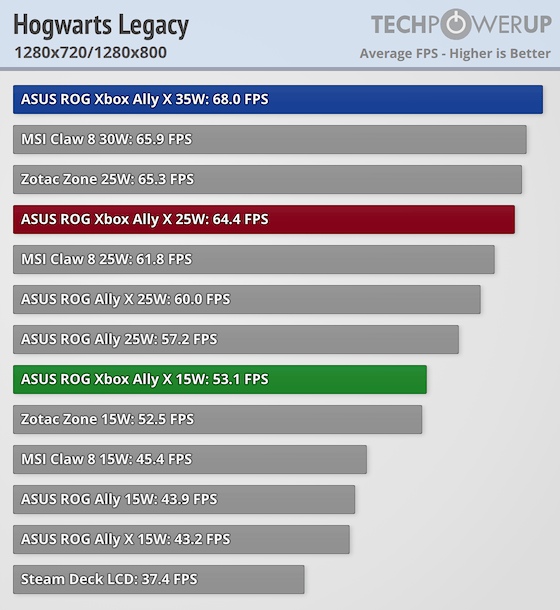
Control
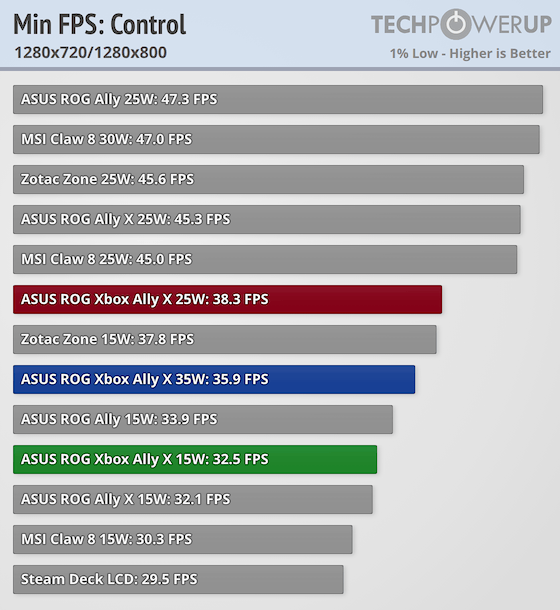
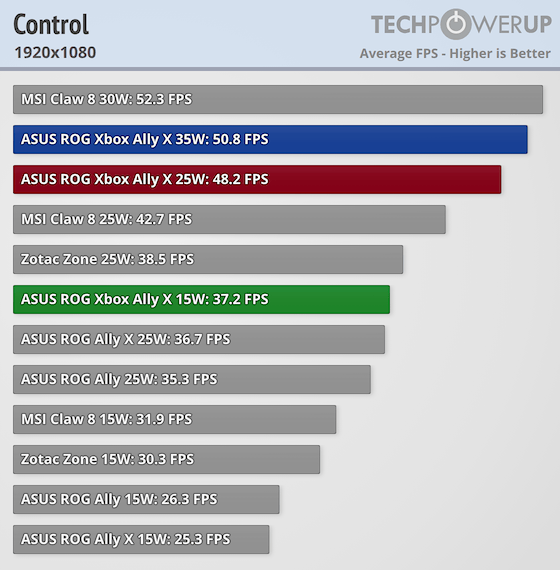
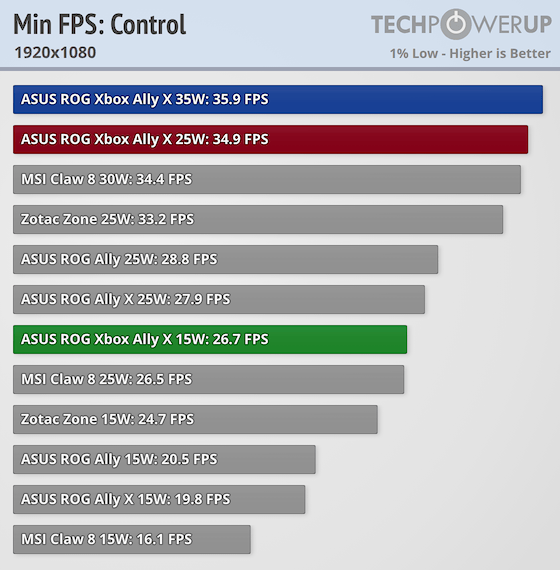
Medium preset, no AA, DX11.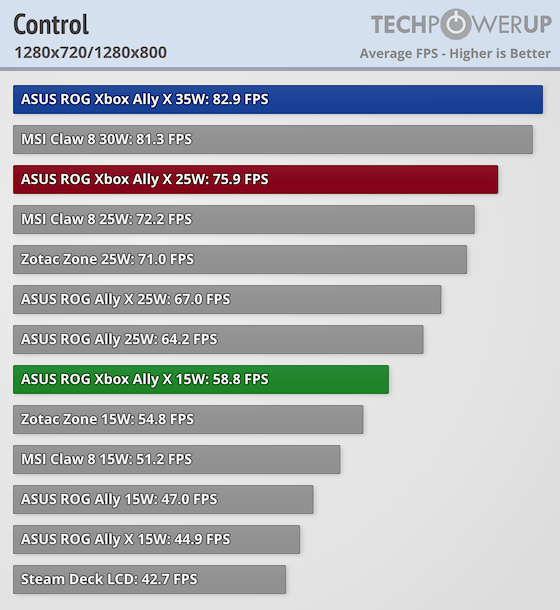
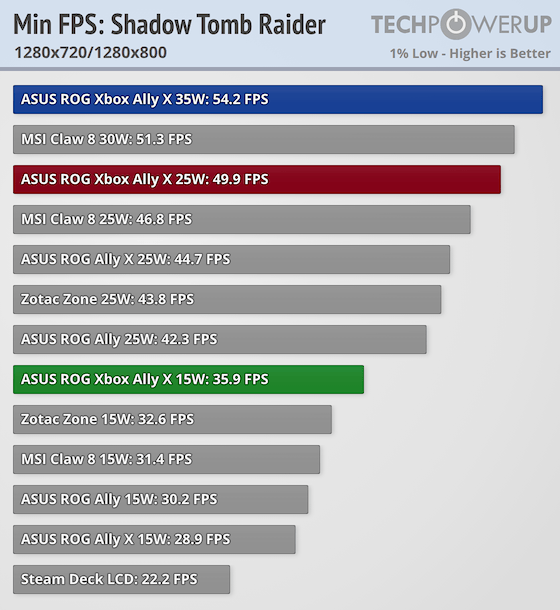
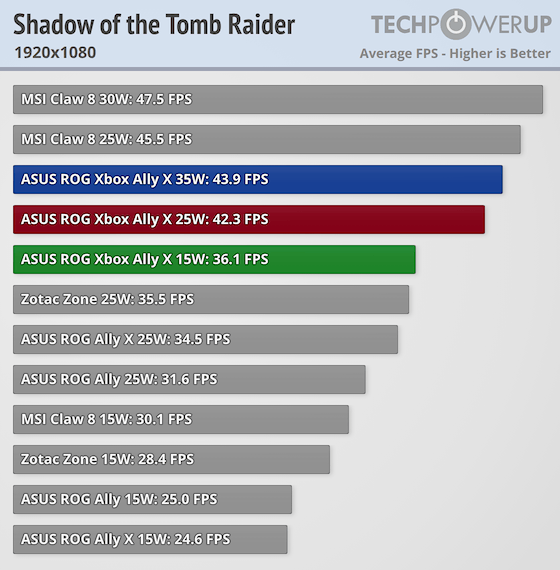
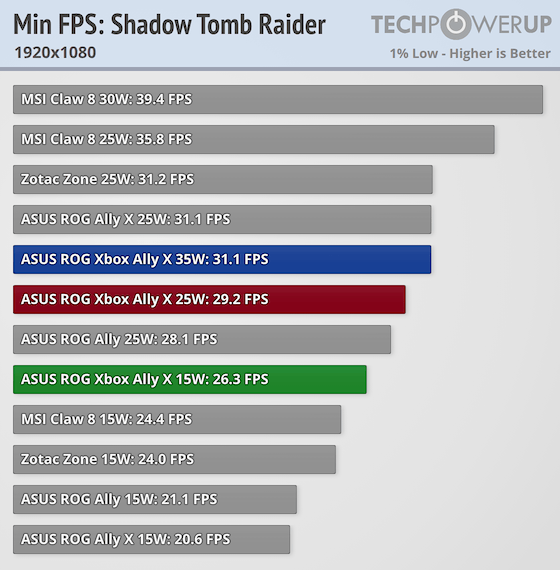
Shadow of the Tomb Raider
High preset, TAA, DX12.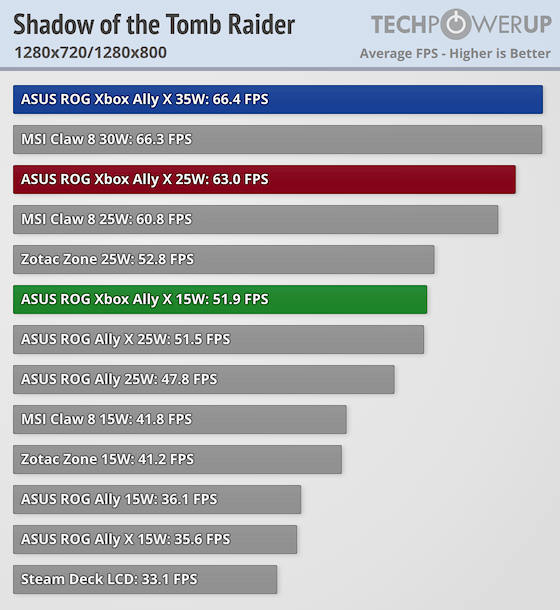
Space Marine 2
Low preset, TAA.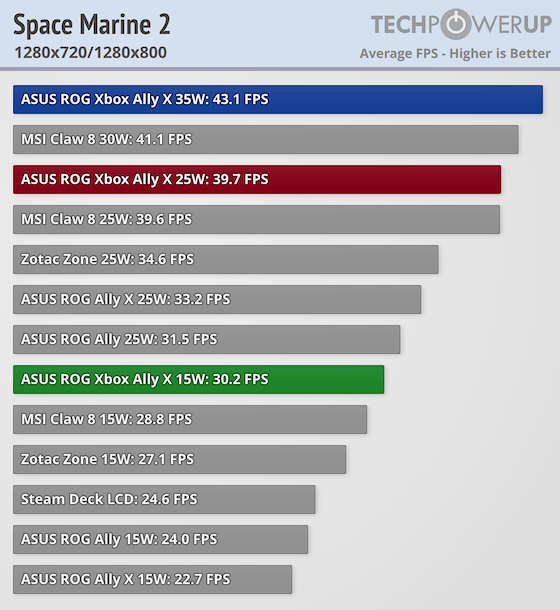
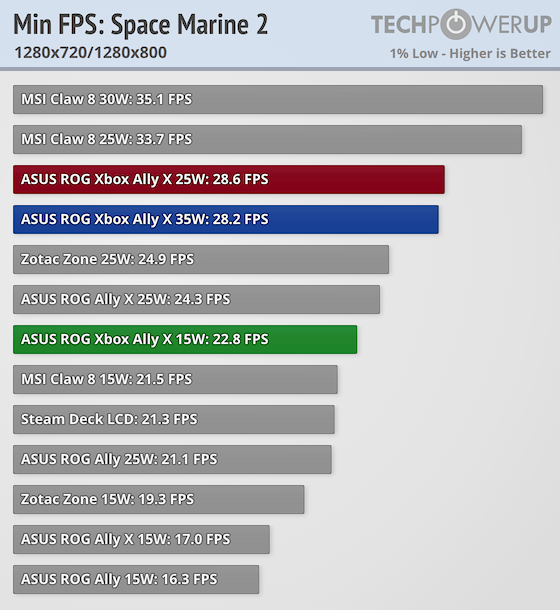
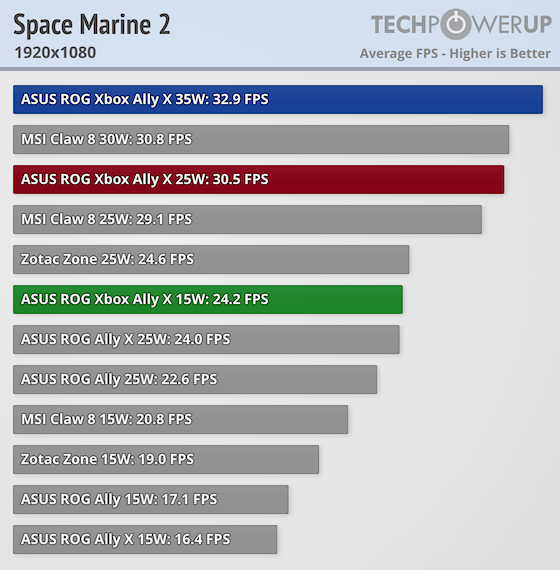
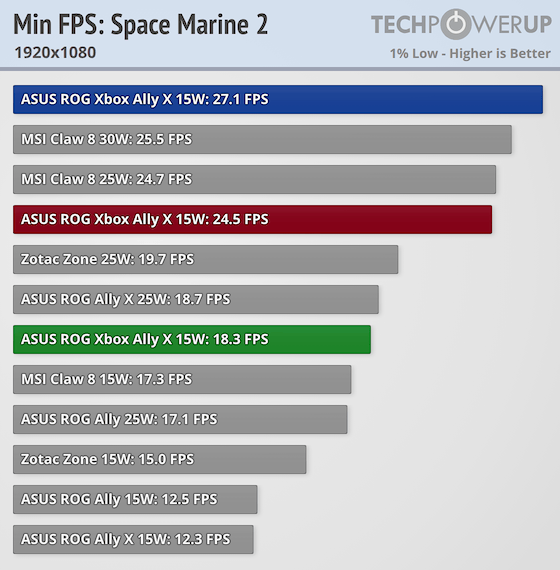
Only three full-fledged Zen 5 CPU cores combined with five Zen 5c cores with a lower boost clock don't hamper the ROG Xbox Ally X's gaming performance. If anything, AMD could've gotten rid of two Zen 5c cores, and we reckon the Z2 Extreme's CPU would still be overkill for the Radeon 890M integrated graphics. Compared to the Z1 Extreme, the Z2 AI Extreme brings a generational improvement, at least at lower power (17 W and below), where it can be almost 50% faster than its predecessor and often match Z1E's 25 W performance at 15 W, especially at 1080p, which is indeed impressive. Above 18 W, though, gains are much humbler, with the Z2E pulling ahead only about 10-20% on average.
It's clear AMD focused on improving Z1E's biggest pain point, gaming performance at low power envelopes, which it managed to accomplish. But once you go above 18 W, the 890M gets out of breath, and while it still keeps a healthy lead over the Z1E, the gains aren't that exciting. The 1% low gains are substantial though. Although the Z2 AI Extreme did stumble occasionally (Control at 720p and to an extent SoTR at 1080p), it often delivers the same gains over the Z1E in 1% lows as it does with regard to average performance.
The Z2E trades blows with the Core Ultra 7 258V powering the MSI Claw 8. At 15 W, the Z2E is a clear winner, but at higher wattages, the Intel Arc 140V proves to be a much more capable challenger. Don't forget that the ROG Xbox Ally features slower, 8000 MT/s RAM than the Claw 8's 8533 MT/s RAM. On the flip side, the Core Ultra 7 258V has on-package memory, meaning its APU actually uses a few watts less than the Z2E at the same TDP values, since it needs to allocate a few watts to the RAM chips. The MoP design is more efficient overall, however, since the ROG Xbox Ally still needs to allocate power to its separate RAM, which takes more energy due to the losses over the greater distance, which is also the reason it's 8000 and not 8533 MT/s. Overall, the Z2E comes out on top more often in terms of average frame rate, while the Core Ultra 7 258V is the 1% low champion. Regarding synthetic benchmarks, as long as the CPU isn't in focus, the Intel Arc 140V leaves the Radeon 890M in the dirt. With all that said, the MSI Claw 8 has received a few GPU driver updates since our review, and while we don't believe it closed the gap at 15 W, the differences at 25 W may be smaller than what our data shows. Also, the ROG Xbox Ally X is limited to FSR 3, which looks much worse than the ML-based XeSS the Claw 8 has access to. Sure, you can inject INT8 FSR 4 with Optiscaler, but performance gains are much lower than with FSR 3 and older versions of the upscaler, making FSR 4 hardly worth it in many cases. It's a crying shame AMD decided not to create an RDNA 4-based mobile APU.
While we aren't impressed with the gains at 18 W and above, we love how the ROG Xbox Ally X performs at low power. We managed to get around 100 FPS in The Rogue Prince of Persia and Ball X Pit at 10 W, with both games staying playable even at 8 W. Tetris Effect ran much better at 15 W than on the ROG Ally X, allowing us to enjoy the game at 60 FPS+ without hitches, unlike on the ROG Ally X. In general, the ROG Xbox Ally X can give you the same level of performance at 9 W or 10 W as the ROG Ally X at 15 W. The handheld also often comes mighty close, or even matches the Ally X's 25 W performance at just 15 W. This makes the ROG Xbox Ally X a great choice for handheld gamers who focus on 2D and less demanding 3D games, since they will be able to enjoy them at or below 15 W, resulting in an inaudible gaming experience combined with at least three hours of battery life.
We played Forza Horizon 5 at 1080p native with 2x MSAA and the "Ultra" preset (we only dropped shadows to High), with the frame rate never dipping below 40 FPS, which was the first time we experienced Forza Horizon 5 at 1080p native and Ultra LOD at 40 FPS+ on a handheld PC. The ROG Xbox Ally X even managed to run Double Fine's Keeper at nearly 30 FPS with Medium settings while drawing only 17 W, which is impressive given how demanding the game is. The Outer Worlds 2, another UE5 heavy hitter, ran at 900p with TSR set to 85% resolution scaling and the "Medium" preset, without dipping below 30 FPS at 30 W, but you can also play the game with low settings and native 720p resolution at 15 W, a remarkable achievement for a PC handheld.
The 24 GB of memory in total, with 8 GB allocated to the iGPU, was enough for the games we played. Still, we would've preferred 32 GB of memory since many modern games can use more than 8 GB of video memory at 1080p with textures set to high. With 32 GB of RAM, you could allocate 12 GB to the GPU, leaving 20 GB for the OS and games, which would've made the Xbox Ally X more future-proof. Don't get us wrong, 24 GB of RAM isn't bad by any stretch, but we believe that a $1,000 PC handheld should come with 32 GB.
Nov 28th, 2026 01:48 CST
change timezone
Latest GPU Drivers
New Forum Posts
- What's your main Black Friday / Cyber Monday purchase? (44)
- Wireless Internet sharing between PC and router both-ways, is it possible? (35)
- -18C on GPU by moving it to the front of the case. (22)
- Rare GPUs / Unreleased GPUs (2273)
- Mouse Pad advice - Shidenkai out of production? (22)
- Unigine Superposition GPU Benchmark (1080P Extreme) (463)
- Unigine Superposition on Linux (21)
- CPU Database (305)
- Exit Adobe - PDF reader, and PDF editor recommendations (11)
- TPU's WCG/BOINC Team (34815)
Popular Reviews
- Upcoming Hardware Launches 2027 (Updated Nov 2026)
- AMD Ryzen 7 9800X3D Review - The Best Gaming Processor
- Moaiplay Ora Pro G1 850 Review
- VZMORE AX9 Max Review
- Montech CyberFlow ARGB 360 Review
- ASRock X870E Challenger Wi-Fi White Review
- AMD Zen 6 Technical Deep Dive
- ORICO Obook15 AI Review
- Microsoft Surface Laptop Ultra Review - The Next-gen Arm Laptop
- Phantom Blade Zero Performance Benchmark Review - 35 GPUs Tested
TPU on YouTube
Controversial News Posts
- Jensen Huang Reinstated as CEO of NVIDIA (627)
- NVIDIA Co-Founder and CEO Jensen Huang Officially Resigns (492)
- Report: Jensen Huang Eyes NVIDIA Comeback (281)
- Open Letter Asking NVIDIA to Reinstate Jensen Huang Passes 115,000 Signatures (184)
- OpenAI CEO Argues Home PCs Waste the World's Limited DRAM Supply (152)
- NVIDIA Launches Investigation Into Jensen Huang's Relationship With Suspected Chinese Spy (136)
- Intel Razor Lake Gets a 12 P-Core bLLC Chip With No E-Cores, Per Leak (94)
- NVIDIA GeForce RTX 50-Series Scheduled for up to $500 Price Hike This Week (89)