 9
Asustor Drivestor 2 Gen2 AS1202T Review
Value & Conclusion »Power
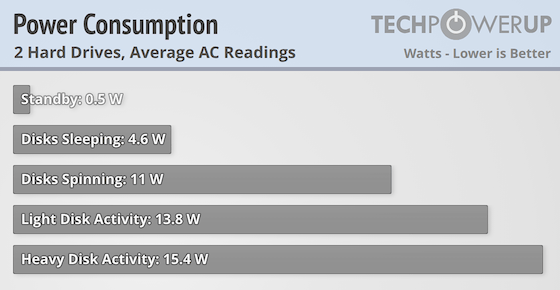
The Realtek RTD1619B SoC is quite power frugal with its four Arm Cortex-A55 cores, although we don't have an official power consumption or TDP for the chip. With the two Seagate IronWolf 4 TB drives spinning, the AS1202T was sitting at around 11 W, which seems quite reasonable, but that's almost 1 W more than the Ugreen NASync DH2300. Likewise, power draw under load was about 1 W higher than the DH2300 for both light and heavy loads. Idle power draw was around 4.6 W, again higher than the Ugreen NASync DH2300, which was quite surprising, considering that the Realtek SoC has fewer and more power efficient cores compared to the Rockchip RK3576. It's possible that the RTD1619B is manufactured on an older process node, resulting in higher power usage. The Delta power brick was also not as efficient in standby mode at 0.5 W, but this is still well within the EU standby power regulations. We should note that the power brick appeared to behave a bit oddly at times, since when we powered off the NAS, the power brick would draw 1.5 W in standby, something we haven't noticed on any other NAS we've tested so far. Overall, the AS1202T was using about 1 W more than the DH2300, which is a fairly small amount of extra power, and it's not something we'd factor in as a disadvantage for the AS1202T.
Noise
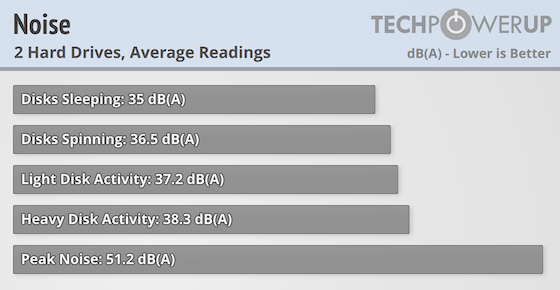
In general use, the AS1202T is quiet, not as quiet as the DH2300 maybe, but keep in mind that we couldn't really measure the noise right above the fan, as we normally do with the DH2300. The fan speed normally rotates at around 900 rpm, but it peaks at 1060 rpm if you turn on the high speed fan setting. This results in a lot of noise, as the noise meter peaked at above 51 dBA, which is quite loud. However, during normal use, it never really went over 38 dBA and the fan speed was stable during our testing and even though it was set to the default auto mode, never spun up. Overall, we wouldn't worry about the noise that comes from the AS1202T in a normal home environment, but its traditional NAS shape means you get a bit more audible noise than something like the vertical design of the DH2300, as there's nothing in the way to muffle the fan.
Temperature
Unlike some of its competitors, Asustor offers full on system monitoring with multiple temperature sensors, and during our testing, the system never seemed to get particularly hot. Idle CPU temperature sat around 36 degrees Celsius, with the hard drives at 29 to 30 degrees, with the fan operating at just over 900 RPM. This didn't really change under a light load, but the hard drive temperatures went up towards 35 degrees during more intense testing, but we never saw the SoC temperature go over 36 degrees. As such, this is the coolest running NAS we've tested to date, despite the rather small 70 mm fan.
Nov 14th, 2026 22:03 CST
change timezone
Latest GPU Drivers
New Forum Posts
- WarpCoreBench scores! (40)
- What can the FX 8320 do today? Here is the answer. (47)
- Tell me about your favourite graphics card (82)
- Recommendations Wanted - Affordable Enterprise SSD for Boot (3)
- Planning for Prolonged High Prices and Maintaining What You Already Have (71)
- [INTEL]-How To Update Your Microcode for Intel HX 13/14th Gen. CPUs Laptops/Mobile Easily. (260)
- [Intel AX1xx/AX2xx/AX4xx/AX16xx/BE2xx/BE17xx] Intel Modded Wi-Fi Driver with Intel® Killer™ Features (632)
- Optical Disc Drive owners club (208)
- Game Soundtracks You Love (1287)
- 9070 GRE 3.9ghz validation reached. (11)
Popular Reviews
- AMD Zen 6 Technical Deep Dive
- ASUS ROG Strix B850-I Gaming Wi-Fi7 W Review
- Corsair HX1000i Shift Crystal Review
- Upcoming Hardware Launches 2027 (Updated Nov 2026)
- Montech King 95 3D PRO Review
- NZXT C1200 Platinum Review
- NZXT H7 RGB+ Review
- NZXT H5 Review
- Phantom Blade Zero Performance Benchmark Review - 35 GPUs Tested
- AMD Ryzen 7 9800X3D Review - The Best Gaming Processor
TPU on YouTube
Controversial News Posts
- NVIDIA Co-Founder and CEO Jensen Huang Officially Resigns (408)
- OpenAI CEO Argues Home PCs Waste the World's Limited DRAM Supply (152)
- NVIDIA Launches Investigation Into Jensen Huang's Relationship With Suspected Chinese Spy (136)
- Intel "Raptor Lake Next" 16-Core and 20-Core CPUs Surface (130)
- Legendary Game Studio BioWare Shuts Down Following EA Layoffs (104)
- Dell CEO Says the Memory Shortage Will Get Worse in 2027 (95)
- NVIDIA GeForce RTX 50-Series Scheduled for up to $500 Price Hike This Week (89)
- Modder Fits RTX 5090 With Four 8-Pin Connectors, Halving Current per Wire (80)