 14
Asustor Lockerstor 2 Gen2+ AS6702T v2 Review
Power, Noise & Thermals »Game Data
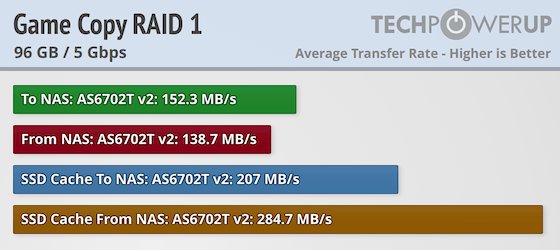
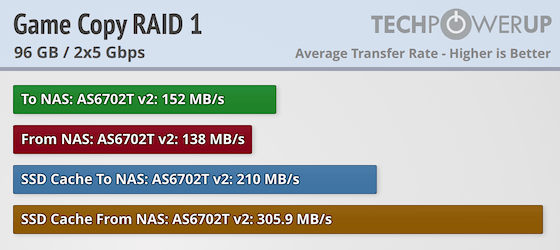
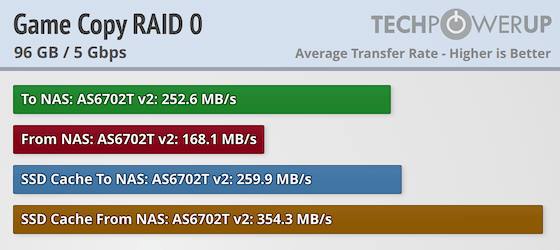
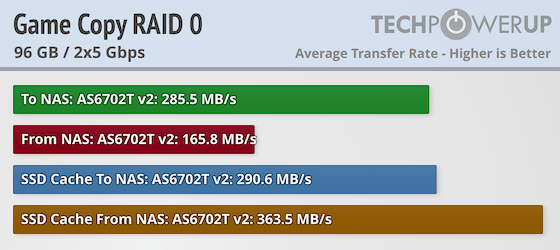
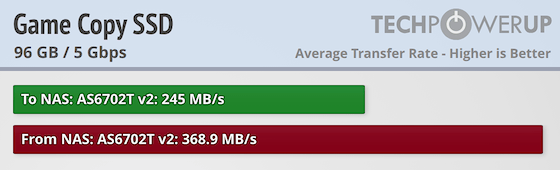
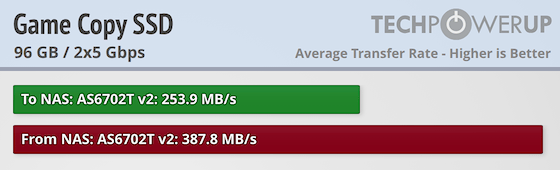
This test consists of a 96.2 GB game library that is copied as is from an NVMe SSD on the host computer to the NAS and then back from the NAS to the host PC. Everything is timed and converted to transfer speeds in MB/s. In this first real world test, the Asustor Lockerstor 2 Gen2+ AS6702T v2 managed to beat the TerraMaster F4-425 Pro in RAID 1 without caching, as well as in RAID 0 with caching and when reading data straight from an SSD. This is somewhat surprising considering the older hardware, but a lot of this might also be software related, especially as we had some issues with TOS 7 on the TerraMaster F4-425 Pro, as it was technically in a late stage beta release.
Single Large File
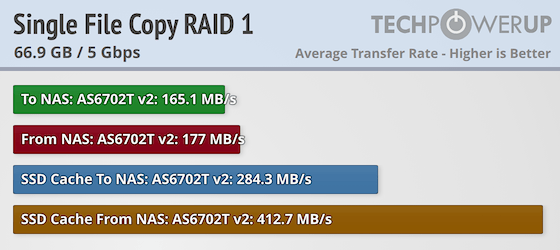
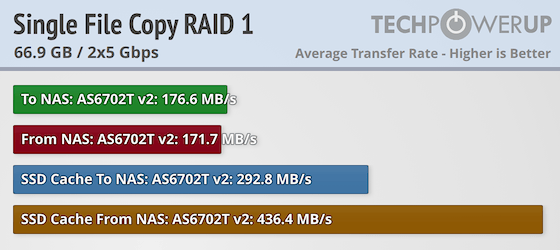
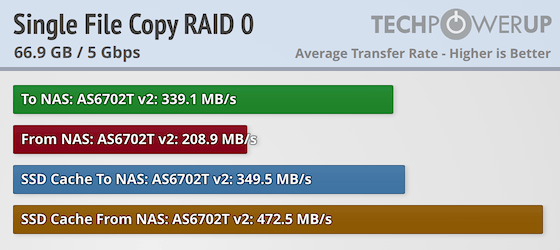
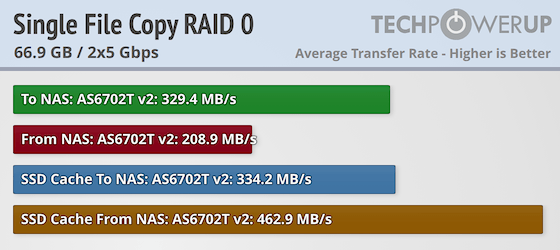
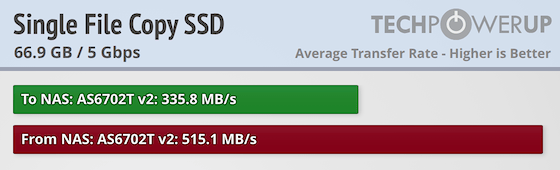
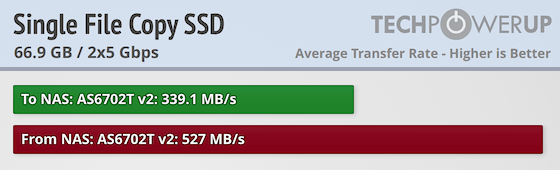
The next test involves copying a single 66.9 GB large file to simulate something like a large video file or a compressed backup file being copied to and from the NAS. A similar scenario in RAID 1 played out here, with Asustor beating TerraMaster until caching is thrown into the mix. As the TerraMaster has two more drives in RAID 0, the Asustor simply can't compete here, but once again it comes out on top once we add SSD caching in the RAID 0 read test and the same applies when reading data straight from an SSD.
Photos
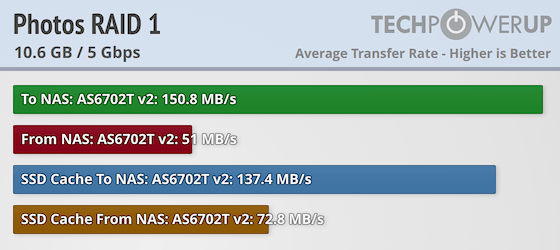
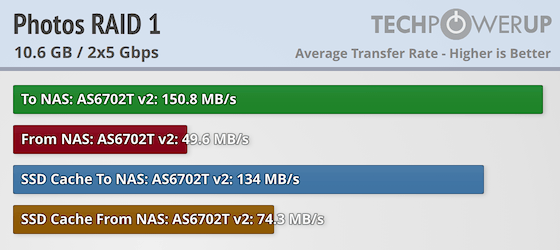
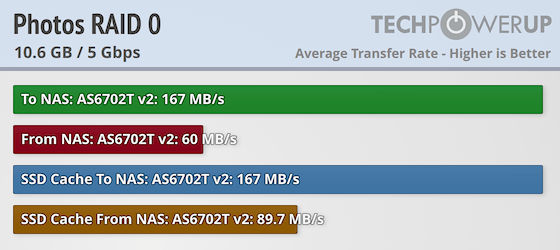
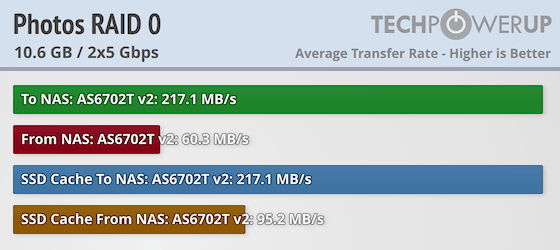
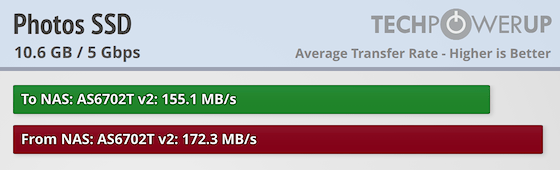
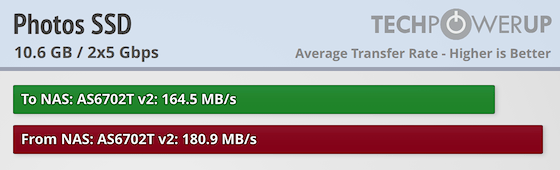
Our third and final test consists of 10.6 GB of photos across 4,084 files. This is the test that makes every NAS struggle and the AS6702T v2 is no different. Here, Asustor comes out in front in the write test in RAID 1 and some of the other tests, but it's also a dead race in many of the tests, with TerraMaster only coming out ahead in a few of the tests by any meaningful margin. This shows that it's not all about having the latest hardware if you're looking at getting a NAS mainly for storage.
Overall, the Lockerstor 2 Gen2+ AS6702T v2 did a good job, despite the older hardware and lower overall specs compared to the F4-425 Pro, although it's not an entirely fair comparison as we also used different drives due to the 2 vs. 4 drive bay configuration. However, we're also a bit disappointed that SMB multichannel didn't appear to bring any apparent real world benefits, even when reading and writing data to an SSD. This is admittedly only the second NAS from Asustor that we've tested where we've been able to take advantage of SMB multichannel, but the AS5404T showed big gains, whereas here we saw none. Hopefully this is just related to our test setup or something Microsoft has changed in some update to Windows 11, but at the same time, we did see it working in CDM 9, so it should work across the board. The potential for 10 Gbps like performance is there, but we'd rather have seen a single 10 Gbps port, as 5 Gbps Ethernet doesn't seem to gain a lot of traction and the lack of 5 Gbps switches is another reason not to invest in the 5 Gbps ecosystem. Even more so, the cost difference between 5 Gbps and 10 Gbps switches doesn't make it a worthwhile investment, but it's possible this will change in the future.
Nov 14th, 2026 21:47 CST
change timezone
Latest GPU Drivers
New Forum Posts
- Tell me about your favourite graphics card (82)
- WarpCoreBench scores! (38)
- Recommendations Wanted - Affordable Enterprise SSD for Boot (3)
- Planning for Prolonged High Prices and Maintaining What You Already Have (71)
- What can the FX 8320 do today? Here is the answer. (45)
- [INTEL]-How To Update Your Microcode for Intel HX 13/14th Gen. CPUs Laptops/Mobile Easily. (260)
- [Intel AX1xx/AX2xx/AX4xx/AX16xx/BE2xx/BE17xx] Intel Modded Wi-Fi Driver with Intel® Killer™ Features (632)
- Optical Disc Drive owners club (208)
- Game Soundtracks You Love (1287)
- 9070 GRE 3.9ghz validation reached. (11)
Popular Reviews
- AMD Zen 6 Technical Deep Dive
- ASUS ROG Strix B850-I Gaming Wi-Fi7 W Review
- Corsair HX1000i Shift Crystal Review
- Upcoming Hardware Launches 2027 (Updated Nov 2026)
- Montech King 95 3D PRO Review
- NZXT C1200 Platinum Review
- NZXT H7 RGB+ Review
- NZXT H5 Review
- Phantom Blade Zero Performance Benchmark Review - 35 GPUs Tested
- AMD Ryzen 7 9800X3D Review - The Best Gaming Processor
TPU on YouTube
Controversial News Posts
- NVIDIA Co-Founder and CEO Jensen Huang Officially Resigns (408)
- OpenAI CEO Argues Home PCs Waste the World's Limited DRAM Supply (152)
- NVIDIA Launches Investigation Into Jensen Huang's Relationship With Suspected Chinese Spy (136)
- Intel "Raptor Lake Next" 16-Core and 20-Core CPUs Surface (130)
- Legendary Game Studio BioWare Shuts Down Following EA Layoffs (104)
- Dell CEO Says the Memory Shortage Will Get Worse in 2027 (95)
- NVIDIA GeForce RTX 50-Series Scheduled for up to $500 Price Hike This Week (89)
- Modder Fits RTX 5090 With Four 8-Pin Connectors, Halving Current per Wire (80)