 47
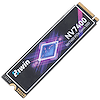
Biwin Black Opal NV7400 2 TB Review
(47 Comments) »Value and Conclusion
- The 2 TB version of the Biwin Black Opal NV7400 sells for $341 in the States, and €280 in Germany including VAT, which converts to around $263 without tax, so much cheaper.
- Outstanding sustained write performance
- Excellent value at European pricing
- Very good real-life performance
- Low power consumption
- No throttling in everyday use, even without a heatsink
- Single-sided M.2 2280 (fits thin laptops and the PS5)
- 4 TB variant available
- Five-year warranty
- PCIe Gen 4, not Gen 5
- No DRAM cache
- Very weak fSync performance
- Flash varies between batches—YMTC on our sample, Micron on others
- No heatsink included
Technology & Positioning
The Black Opal NV7400 is BIWIN's first SSD that we're reviewing. Over the years we've tested many drives that are actually produced by BIWIN, under the Acer and HP brands. With the NV7400, the company is focusing on offering a trusted Gen 4 design, at a price point that beats currently shipping Gen 5 SSDs, while still offering good performance. The hardware is the well-established value recipe: Maxio's MAP1602 controller, a four-channel, DRAM-less 12 nm design with four Arm Cortex-R5 cores, paired with YMTC's modern X4-9060 flash. As expected, a DRAM cache is not included, but the drive uses 40 MB from the system for its Host Memory Buffer feature, which caches the mapping tables of the SSD. A typical competitor in this space is the Lexar NM790 and the various other drives using MAP1602. One thing to be aware of is that NV7400 variants have been spotted with Micron B58R TLC, too, so YMTC is not guaranteed, but performance should be similar.
Synthetic Performance
Synthetic performance results are good, comparable to the best Gen 4 SSDs, slightly behind the Crucial T500 and WD Black SN850X, not by enough to matter. Random IO works very well, but 4K random mixed is weaker than expected. What's also low is fSync performance at just 500 IOPS, which is a typical trait of the MAP1602 controller—databases and other durability-sensitive workloads will hate this drive; everything else will run great as our real-life performance testing shows.
Real-Life Performance
Real-life results are solid across the board, and in a few places better than that. The drive sits roughly in the upper third of our test group, clearly behind the Gen 5 SSDs, but the differences are small, tiny sometimes. Everything lands right in the middle of the Gen 4 field, close to the NM790, Samsung 990 Pro and Crucial T500. This makes the NV7400 a great choice for a power user PC that still has to respect some budget, and where Gen 5 support isn't essential. Averaged over all tests, the NV7400 ends up around 5 to 9% behind the leading Gen 5 drives—not a huge difference, but the price has to match this. As always, all of this is measured with the drive 80% full, which makes the controller work harder, not on an empty SSD, like some other reviewers test to get flashy scores that won't matter in reality.
SLC Cache/Sustained Performance
This is where the NV7400 really stands out. The pSLC cache is relatively standard-sized with 300 GB, but what impresses is how well performance is sustained even with the cache full. Instead of falling off a cliff, the drive writes directly to TLC at a sustained 3.3 GB/s for another 950 GB, and only drops to roughly 1 GB/s once the raw flash is exhausted and pSLC data has to be folded down. Filling the whole 2 TB averaged 2224 MB/s—better than the WD Black SN850X, the Hynix P41 Platinum and the Kingston KC3000, all of which carry a DRAM cache, and far ahead of the Lexar NM790's 1450 MB/s. For anyone who regularly moves very large files around, this is the single best reason to buy this drive.
Power Consumption/Heat
The DRAM-less, four-channel, Gen 4, design pays off here. Peak draw is around 5 W, idle sits at less than 1 W and 0.16 W in laptop mode. While that's not the lowest in our test group, it's still close enough and makes the NV7400 a reasonable choice for a laptop upgrade. In our real-life thermal test the drive peaked at 62°C with no heatsink at all, nowhere near its 79°C throttle point, so for everyday use the bare drive is fine and thermals are no problem. If we hammer it with sustained sequential transfers on a bare board, it will start throttling fairly quickly though. Out of the box there is no heatsink, and the sticker is just a sticker, no metal or anything that can absorb a lot of heat. While thermal throttling works well, I feel like the throttle point was set too conservatively. 79°C is very low for a hardware config that can easily sustain 100+ degrees, just another 10°C more would help avoid a lot of throttle scenarios. Plopping any cheap M.2 heatsink onto the NV7400 fixes this instantly though, even the compact Thermalright TR-M2 held full speed without slowdowns in our thermal stress test.
Pricing & Alternatives
The NV7400 launched at around $120 for 2 TB, which would have made it a no-brainer. That price is long gone—the NAND shortage has pushed it to $341, or $170 per TB, and the numbers still change every week. Everything on the market has gotten expensive, so this isn't BIWIN being greedy. Among the drives you can actually buy in the US right now, only the QLC Kingston NV3 at $295 undercuts it: the Lexar NM790 on the same controller is $330, the WD Black SN850X $440 and the Crucial T500 $499—much more expensive. The Hynix P41 Platinum and XPG Gammix S70 Blade look cheaper in our charts, but neither is in US retail anymore, so those are European prices standing in for them.
What's interesting is how affordable the NV7400 is in Europe: German listings have the 2 TB at €280 including VAT, against €349 for the Lexar NM790, which is using the same controller. Apart from the QLC Kingston NV3 at €264 there is nothing cheaper in the entire test group: the XPG Gammix S70 Blade is €322, the Kingston KC3000 €330, the Hynix P41 Platinum €344, the WD Black SN850X €369. If you're buying in Europe the NV7400 is an easy recommendation and the best value Gen 4 drive here. In the US, where it costs more than the NM790 instead of less, it's merely a good one.


The Black Opal NV7400 is BIWIN's first SSD that we're reviewing. Over the years we've tested many drives that are actually produced by BIWIN, under the Acer and HP brands. With the NV7400, the company is focusing on offering a trusted Gen 4 design, at a price point that beats currently shipping Gen 5 SSDs, while still offering good performance. The hardware is the well-established value recipe: Maxio's MAP1602 controller, a four-channel, DRAM-less 12 nm design with four Arm Cortex-R5 cores, paired with YMTC's modern X4-9060 flash. As expected, a DRAM cache is not included, but the drive uses 40 MB from the system for its Host Memory Buffer feature, which caches the mapping tables of the SSD. A typical competitor in this space is the Lexar NM790 and the various other drives using MAP1602. One thing to be aware of is that NV7400 variants have been spotted with Micron B58R TLC, too, so YMTC is not guaranteed, but performance should be similar.
Synthetic Performance
Synthetic performance results are good, comparable to the best Gen 4 SSDs, slightly behind the Crucial T500 and WD Black SN850X, not by enough to matter. Random IO works very well, but 4K random mixed is weaker than expected. What's also low is fSync performance at just 500 IOPS, which is a typical trait of the MAP1602 controller—databases and other durability-sensitive workloads will hate this drive; everything else will run great as our real-life performance testing shows.
Real-Life Performance
Real-life results are solid across the board, and in a few places better than that. The drive sits roughly in the upper third of our test group, clearly behind the Gen 5 SSDs, but the differences are small, tiny sometimes. Everything lands right in the middle of the Gen 4 field, close to the NM790, Samsung 990 Pro and Crucial T500. This makes the NV7400 a great choice for a power user PC that still has to respect some budget, and where Gen 5 support isn't essential. Averaged over all tests, the NV7400 ends up around 5 to 9% behind the leading Gen 5 drives—not a huge difference, but the price has to match this. As always, all of this is measured with the drive 80% full, which makes the controller work harder, not on an empty SSD, like some other reviewers test to get flashy scores that won't matter in reality.
SLC Cache/Sustained Performance
This is where the NV7400 really stands out. The pSLC cache is relatively standard-sized with 300 GB, but what impresses is how well performance is sustained even with the cache full. Instead of falling off a cliff, the drive writes directly to TLC at a sustained 3.3 GB/s for another 950 GB, and only drops to roughly 1 GB/s once the raw flash is exhausted and pSLC data has to be folded down. Filling the whole 2 TB averaged 2224 MB/s—better than the WD Black SN850X, the Hynix P41 Platinum and the Kingston KC3000, all of which carry a DRAM cache, and far ahead of the Lexar NM790's 1450 MB/s. For anyone who regularly moves very large files around, this is the single best reason to buy this drive.
Power Consumption/Heat
The DRAM-less, four-channel, Gen 4, design pays off here. Peak draw is around 5 W, idle sits at less than 1 W and 0.16 W in laptop mode. While that's not the lowest in our test group, it's still close enough and makes the NV7400 a reasonable choice for a laptop upgrade. In our real-life thermal test the drive peaked at 62°C with no heatsink at all, nowhere near its 79°C throttle point, so for everyday use the bare drive is fine and thermals are no problem. If we hammer it with sustained sequential transfers on a bare board, it will start throttling fairly quickly though. Out of the box there is no heatsink, and the sticker is just a sticker, no metal or anything that can absorb a lot of heat. While thermal throttling works well, I feel like the throttle point was set too conservatively. 79°C is very low for a hardware config that can easily sustain 100+ degrees, just another 10°C more would help avoid a lot of throttle scenarios. Plopping any cheap M.2 heatsink onto the NV7400 fixes this instantly though, even the compact Thermalright TR-M2 held full speed without slowdowns in our thermal stress test.
Pricing & Alternatives
The NV7400 launched at around $120 for 2 TB, which would have made it a no-brainer. That price is long gone—the NAND shortage has pushed it to $341, or $170 per TB, and the numbers still change every week. Everything on the market has gotten expensive, so this isn't BIWIN being greedy. Among the drives you can actually buy in the US right now, only the QLC Kingston NV3 at $295 undercuts it: the Lexar NM790 on the same controller is $330, the WD Black SN850X $440 and the Crucial T500 $499—much more expensive. The Hynix P41 Platinum and XPG Gammix S70 Blade look cheaper in our charts, but neither is in US retail anymore, so those are European prices standing in for them.
What's interesting is how affordable the NV7400 is in Europe: German listings have the 2 TB at €280 including VAT, against €349 for the Lexar NM790, which is using the same controller. Apart from the QLC Kingston NV3 at €264 there is nothing cheaper in the entire test group: the XPG Gammix S70 Blade is €322, the Kingston KC3000 €330, the Hynix P41 Platinum €344, the WD Black SN850X €369. If you're buying in Europe the NV7400 is an easy recommendation and the best value Gen 4 drive here. In the US, where it costs more than the NM790 instead of less, it's merely a good one.
Nov 19th, 2026 12:43 CST
change timezone
Latest GPU Drivers
New Forum Posts
- How to prevent OLED burn damage due to PC freezes or power outtages? (15)
- Windows HDR on = Tinted colors (8)
- Anthrophics IPO (4)
- Dual B70 or Dual R9700 Pro on Linux (10)
- GTA VI (5)
- FINAL FANTASY XIV: Dawntrail Official Benchmark (226)
- Help with fixing Overclock (11)
- Why my RX 6800 XT read that it operate at x8 not x16 ? (47)
- Got the EOL 32GB TridentZ 6000 CL26 1.4V (10)
- Honestly, do you care about GTA VI? (162)
Popular Reviews
- Acemagic Retro X3 Review
- Ugreen NASync DXP4800 GT Review
- Upcoming Hardware Launches 2027 (Updated Nov 2026)
- Pulsar Office Tour & First Look at P1 Dual-Sensor Mouse
- AMD Zen 6 Technical Deep Dive
- Biwin Black Opal NV7400 2 TB Review
- Sapphire Radeon RX 7700 XT Pure Review
- Sapphire Radeon RX 7700 XT Pulse Review
- AMD Ryzen 7 9800X3D Review - The Best Gaming Processor
- Chieftec Iceberg PRO 360 DARK Review
TPU on YouTube
Controversial News Posts
- NVIDIA Co-Founder and CEO Jensen Huang Officially Resigns (484)
- Report: Jensen Huang Eyes NVIDIA Comeback (221)
- Open Letter Asking NVIDIA to Reinstate Jensen Huang Passes 115,000 Signatures (184)
- OpenAI CEO Argues Home PCs Waste the World's Limited DRAM Supply (152)
- NVIDIA Launches Investigation Into Jensen Huang's Relationship With Suspected Chinese Spy (136)
- Intel "Raptor Lake Next" 16-Core and 20-Core CPUs Surface (130)
- Legendary Game Studio BioWare Shuts Down Following EA Layoffs (104)
- Dell CEO Says the Memory Shortage Will Get Worse in 2027 (95)