 12
Bosgame M5 Review
Workstation Performance »Adobe Photoshop
PugetBench for Photoshop measures performance through real editing actions, including filter stacks, layer adjustments, and complex compositing tasks. It measures both interactive responsiveness and how long demanding edits take to apply.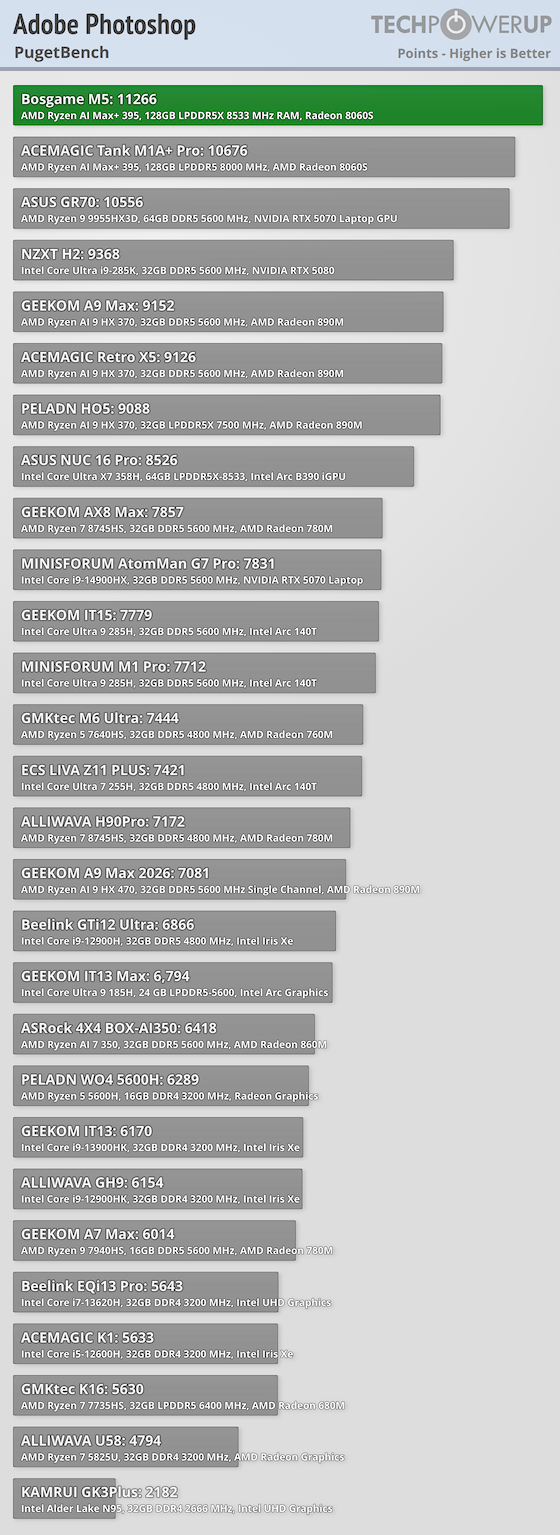
The M5 reached 11,266 points in Photoshop, taking the highest position in this comparison and finishing ahead of the Tank M1A+ Pro at 10,676. This is one of the M5's stronger results, showing that its performance carries over well to a demanding real-world creative workload.
Blender
Blender's benchmark measures 3D rendering performance across several detailed scenes that place different demands on the processor. The CPU test provides a useful look at processor performance in creative and technical workloads.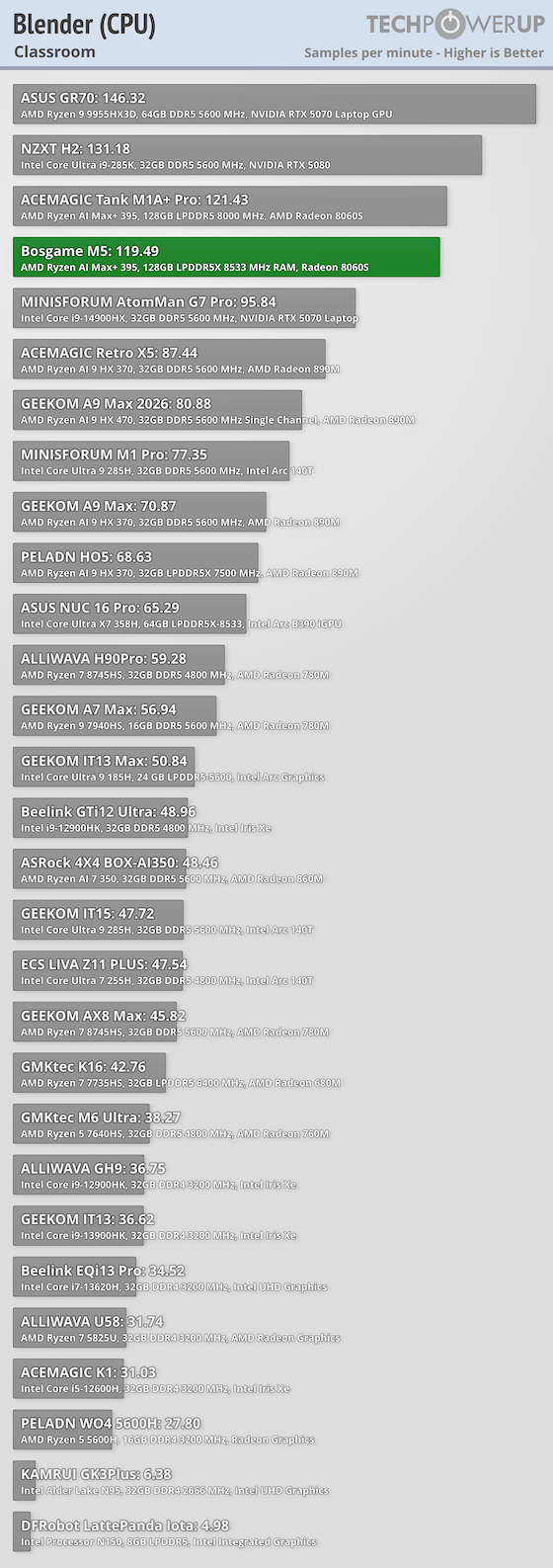
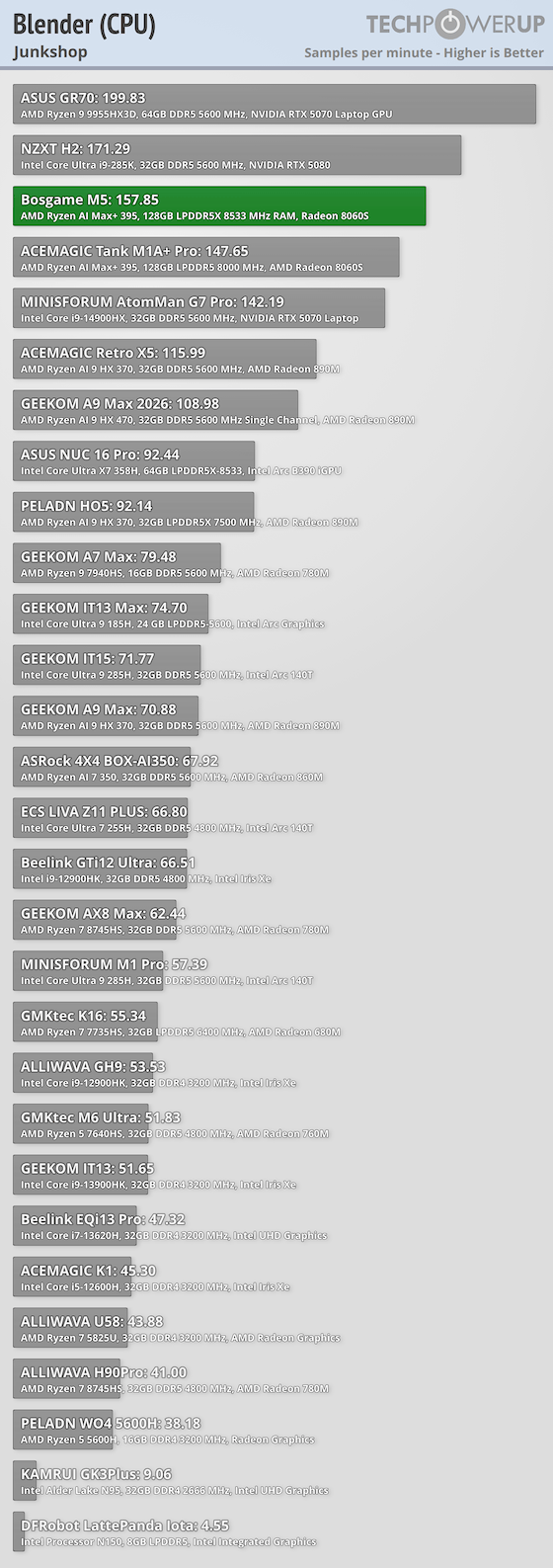
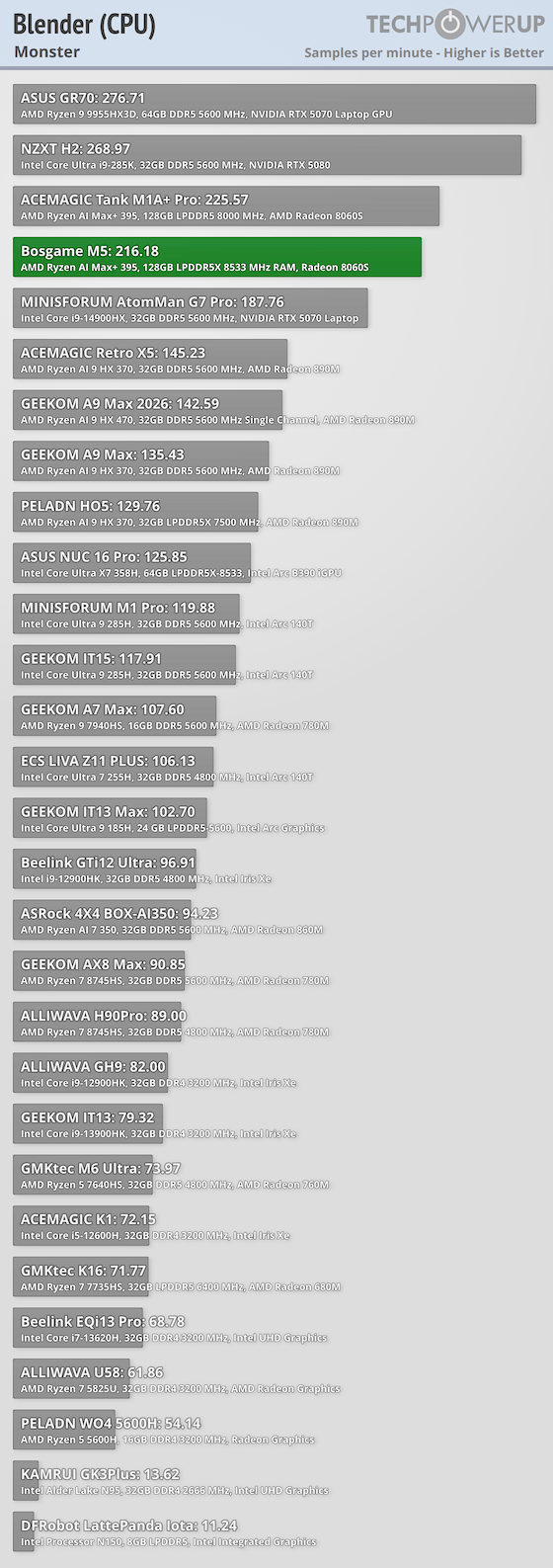
The M5 rendered 216.18 samples per minute in Monster, 119.49 in Classroom, and 157.85 in Junkshop across the CPU tests. The Tank M1A+ Pro is slightly faster in Monster and Classroom at 225.57 and 121.43, while the M5 reverses the order in Junkshop against the Tank's 147.65.
Blender responded more strongly to Performance Mode, as Monster rose from 216.18 to 241.71 samples per minute, Junkshop from 157.85 to 174.82, and Classroom from 119.49 to 131.35, improvements of roughly 10% to 12% across all three scenes.
Media Encoding
HandBrake is a popular open-source transcoder, and its benchmark tests how quickly a system can convert video using the x264 H.264 encoder. It's a real-world scenario for streamers and media professionals.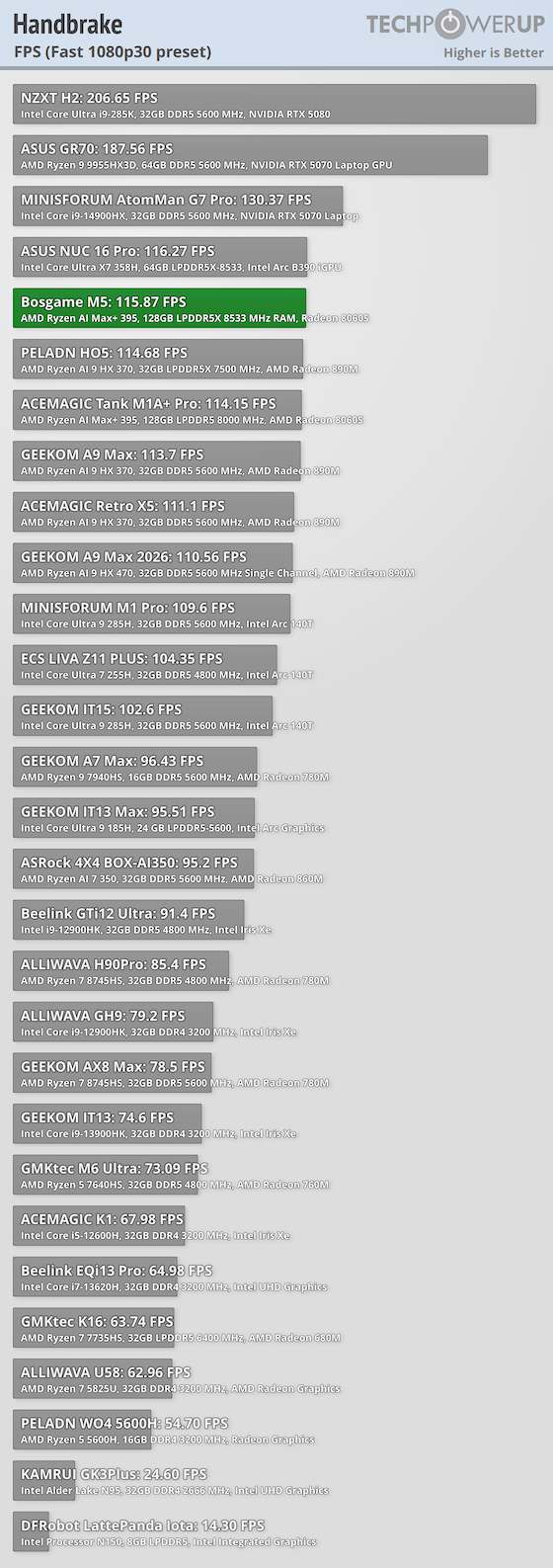
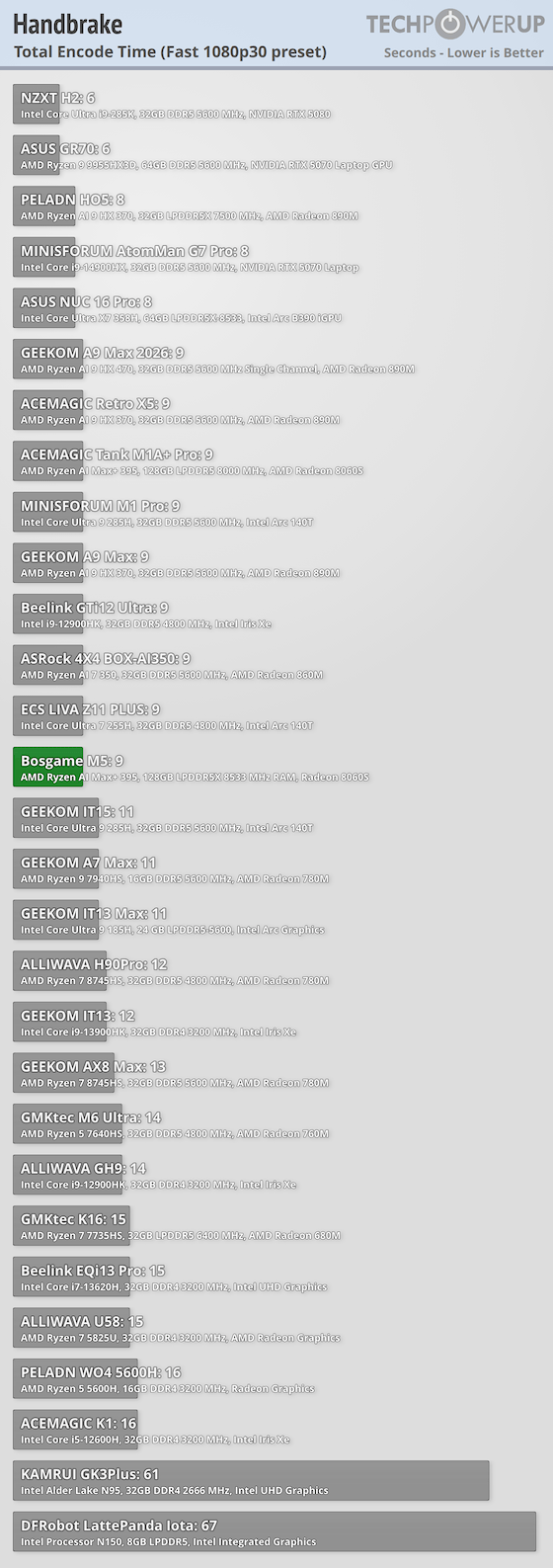
The M5 averaged 115.87 FPS in HandBrake and completed the encode in 9 seconds, essentially matching the Tank M1A+ Pro at 114.15 FPS and 9 seconds. Media encoding performance is therefore almost identical between these two systems in this workload.
Nov 19th, 2026 16:08 CST
change timezone
Latest GPU Drivers
New Forum Posts
- Honestly, do you care about GTA VI? (164)
- Windows 11 General Discussion (7736)
- Current Sales, Bundles, Giveaways (10448)
- Last game you purchased? (1409)
- WarpCoreBench scores! (76)
- Got the EOL 32GB TridentZ 6000 CL26 1.4V (12)
- Dell Workstation Owners Club (3516)
- Making a game in Godot engine (4)
- DTS DCH Driver for Realtek HDA [DTS:X APO4 + DTS Interactive] (2815)
- Security Apps (2)
Popular Reviews
- Acemagic Retro X3 Review
- Ugreen NASync DXP4800 GT Review
- Upcoming Hardware Launches 2027 (Updated Nov 2026)
- Pulsar Office Tour & First Look at P1 Dual-Sensor Mouse
- AMD Zen 6 Technical Deep Dive
- Biwin Black Opal NV7400 2 TB Review
- Sapphire Radeon RX 7700 XT Pure Review
- Sapphire Radeon RX 7700 XT Pulse Review
- AMD Ryzen 7 9800X3D Review - The Best Gaming Processor
- Chieftec Iceberg PRO 360 DARK Review
TPU on YouTube
Controversial News Posts
- NVIDIA Co-Founder and CEO Jensen Huang Officially Resigns (489)
- Report: Jensen Huang Eyes NVIDIA Comeback (223)
- Open Letter Asking NVIDIA to Reinstate Jensen Huang Passes 115,000 Signatures (184)
- OpenAI CEO Argues Home PCs Waste the World's Limited DRAM Supply (152)
- NVIDIA Launches Investigation Into Jensen Huang's Relationship With Suspected Chinese Spy (136)
- Intel "Raptor Lake Next" 16-Core and 20-Core CPUs Surface (130)
- Legendary Game Studio BioWare Shuts Down Following EA Layoffs (104)
- Dell CEO Says the Memory Shortage Will Get Worse in 2027 (95)