 2
Boulies OP180 Review
(2 Comments) »Value and Conclusion
- The Boulies OP180 is priced at US$239.99/£169.99/€200
- Decent adjustability
- Quite well-designed for shorter users
- Quick and easy assemble
- Lack of a headrest
- Average comfort at best for taller users
- Generally firm
We've reached the final part of the Boulies OP180 review, where it's time to bring together everything I've learned after spending the past few weeks using this chair. Going into this test, I was particularly curious about one thing: what it's actually like to use an office chair without a headrest. It didn't take long for me to find the answer. But before we get to that, let's start from the very beginning.
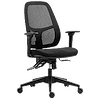
As expected, the chair arrives in a standard cardboard box and is well protected for transport. In my case, the packaging even survived what appeared to be a fairly significant impact during shipping, yet everything inside remained completely intact and undamaged. The package includes all the necessary accessories, and the assembly process—although somewhat unconventional in a few places—is straightforward and surprisingly enjoyable. In fact, the only components that actually require screwing into place are the armrests, making the entire process quicker than with most chairs I've tested. Once assembled, the OP180 immediately gives the impression of being a relatively compact office chair. Despite its modest dimensions, however, it offers a generous range of adjustment for both the seat and the backrest, making it easy to adapt to users of different heights. My first impressions were therefore quite positive, particularly when it came to its apparent suitability for both shorter and taller users. As for the overall build quality, it's simply decent. This isn't a premium chair, but it also doesn't feel cheaply made and generally lives up to what you'd expect at its price point. Of course, there are areas that could be improved—most notably the side-to-side movement of the backrest and, to a lesser extent, the armrests—but fortunately, neither of these issues has much impact on everyday use.
What happens when we take a closer look at the individual components? Starting with the drawbacks, the most obvious one is, unsurprisingly, the lack of a headrest. After spending several weeks with the chair, it became clear just how much of a difference proper support for the head and cervical spine makes to overall comfort. The taller you are, the more noticeable this becomes. In addition, although the backrest is shaped to provide lumbar support, the effect is fairly average and doesn't quite make up for the lack of any dedicated adjustment. On the positive side, however, the height-adjustable backrest deserves praise, as it allows the chair to accommodate users of different heights much better than many competing office chairs.
The tilt mechanism also performs well overall. While it can occasionally produce louder noises in certain situations, these are relatively infrequent and don't affect how the mechanism works. More importantly, the movement itself is smooth and precise, and the levers used for adjusting the seat height, recline, and tilt are intuitive and comfortable to operate. Comfort, however, is where this chair becomes a little more difficult to judge. On one hand, it's certainly not uncomfortable, but on the other, I constantly found myself wishing it had a headrest. Without one, the chair simply feels incomplete, especially during longer sessions. At the same time, I'm convinced that the shorter the user, the more likely they are to find the OP180 genuinely comfortable. As for the armrests, they offer a good range of adjustment and are easy to position, but they're mounted too far forward. As a result, I found it surprisingly difficult to rest my elbows naturally, which became one of my biggest practical complaints during everyday use.
With all that said, let's move on to the topic of price. The Boulies OP180 is available in the U.S. for $239 and in the U.K. for £169. That places it somewhere in the middle of the market—it isn't particularly expensive, but it's also priced above the typical budget office chair. Since Boulies also ships to most European Union countries, the U.K. price translates to roughly €200, making it easier to compare with models available across Europe. So let's begin with one of its closest rivals: the Sharkoon OfficePal C10, a chair I've already had the opportunity to review. It costs around €150, making it noticeably cheaper than the OP180. The lower price isn't its only advantage. The OfficePal C10 also offers adjustable lumbar support, an integrated headrest, and a softer seat, all of which can have a positive impact on everyday comfort. That doesn't mean it's a better chair across the board, however. Users taller than 180 cm (5'11") may struggle to find a truly comfortable seating position, its maximum weight capacity is lower at 110 kg (243 lbs) compared to the OP180's 135 kg (298 lbs), and the backrest doesn't recline independently, instead moving together with the seat. The armrests are also much simpler, offering only height adjustment. Even so, despite its shortcomings, I still remember my experience with the OfficePal C10 a little more fondly overall.
Another competitor worth considering is the Razer Iskur V2 X, which is available in both Europe and the United States. It sells for around €170 in Europe and $250 in the U.S., placing it in a very similar price bracket to the Boulies OP180 reviewed here. The most obvious difference between the two is their overall size, as the Razer model is noticeably larger and designed with bigger users in mind. At the same time, however, it offers a more limited range of adjustments. You can't change the height of the backrest, the armrests don't allow angle adjustment, and the seat itself doesn't feature front-to-back sliding. On the other hand, taller users will likely find it easier to achieve a comfortable seating position, while the predominantly steel frame also gives the chair a more robust overall construction.
The last item on the list is the Sihoo M57, which is also available to users in both the U.S. and Europe. It is priced at around €180/$190, so once again we are dealing with a more budget-friendly option compared to many ergonomic chairs on the market. First and foremost, it comes with a headrest, which is already a significant advantage over the Boulies OP180, as well as adjustable lumbar support that allows users to better tailor the chair to their needs. In addition, the base is made of aluminium rather than plastic, which gives it a more premium feel and potentially better durability. The frame is designed to support users weighing up to 150 kg (330 lbs), which is higher than the 135 kg (298 lbs) capacity offered by the Boulies model. It is also worth mentioning the three-year warranty, which is another positive aspect. Of course, it does not have the same advantage as the star of this review when it comes to the independent backrest tilt adjustment, as the OP180 still offers more flexibility in this particular area.
We've reached the final paragraphs of this review and, most importantly, the answer to the question everyone is waiting for—can I recommend the Boulies OP180? Well… taking the competition into account, I would say that it's a model I could consider recommending, but mainly for shorter users. For taller people, however, I would be much more cautious. The lack of a headrest simply had too much of an impact on my experience, as I started feeling the consequences of spending long hours at my work and entertainment setup much faster than I would with a chair offering proper head and neck support.
Because of that, I won't be giving the Boulies OP180 a recommendation, although I also wouldn't say that this is a model you should completely avoid. If you're a shorter user looking for a relatively affordable office chair, and you have the opportunity to try it before purchasing, then it can still be an interesting option. However, I would definitely recommend taking a look at my reviews of other chairs as well, because there are alternatives available that may offer a more complete experience—for example, the Sharkoon OfficePal C10, which left me with a more positive overall impression and would be the model I'd be more likely to suggest.
Nov 14th, 2026 03:13 CST
change timezone
Latest GPU Drivers
New Forum Posts
- Ryzen 7 8700G OC (7)
- What are you playing? (26217)
- Post your Cinebench R23 Score (3172)
- Tell me about your favourite graphics card (38)
- AI generated images... (225)
- 3D Printer Club (850)
- Browser Bechmark scores (132)
- MSI RTX 4090 SUPRIM X: FBPA5 training failure; seeking signed 20 GB VBIOS with 0x20 mask (0)
- Requesting original VBIOS for Gigabyte RX 5700 XT GAMING OC 8G Rev 2.0 (Micron) (1)
- no "PhysX" workable (9)
Popular Reviews
- AMD Zen 6 Technical Deep Dive
- Corsair HX1000i Shift Crystal Review
- NZXT C1200 Platinum Review
- ASUS ROG Strix B850-I Gaming Wi-Fi7 W Review
- Upcoming Hardware Launches 2027 (Updated Nov 2026)
- Montech King 95 3D PRO Review
- NZXT H7 RGB+ Review
- NZXT H5 Review
- Phantom Blade Zero Performance Benchmark Review - 35 GPUs Tested
- XPG NIMBUS PLUS Review - Mid-range Chair With Strong Competitors
TPU on YouTube
Controversial News Posts
- NVIDIA Co-Founder and CEO Jensen Huang Officially Resigns (382)
- OpenAI CEO Argues Home PCs Waste the World's Limited DRAM Supply (152)
- NVIDIA Launches Investigation Into Jensen Huang's Relationship With Suspected Chinese Spy (136)
- Intel "Raptor Lake Next" 16-Core and 20-Core CPUs Surface (130)
- Legendary Game Studio BioWare Shuts Down Following EA Layoffs (104)
- Dell CEO Says the Memory Shortage Will Get Worse in 2027 (95)
- NVIDIA GeForce RTX 50-Series Scheduled for up to $500 Price Hike This Week (89)
- Modder Fits RTX 5090 With Four 8-Pin Connectors, Halving Current per Wire (80)