 53
Corsair CX750F RGB 750 W Review
(53 Comments) »Introduction

We would like to thank Corsair for supplying the review sample.

Looking for a PSU with RGB across Corsair's massive product portfolio has inevitably led to disappointment in the past. However, with the CX-F line, their first PSU line with RGB, that won't be the case anymore. This new series consists of three models with capacities ranging from 550 to 750 W. All are 80 PLUS Bronze and Cybenetics ETA-A- rated for efficiency. In terms of noise output, Cybenetics rated all of them as LAMBDA-Standard++.
In this review, I will look at the strongest CX-F unit with 750 W maximum power output. Corsair currently lists it at $110, with the white version costing an additional $5, which I wouldn't call affordable for the efficiency rating. That having been said, RGB lighting does increase the production cost. Besides manual RGB control, these units also feature control through their optional Corsair iCUE RGB lighting controller or a compatible motherboard—Corsair does include a 5 V ARGB adapter in the bundle should it have the proper header. As such, you may configure the RGB lighting in the motherboard software, which isn't the case with other Corsair products, including the new Capellix AIO whose lighting can only be controlled via the new mini Commander module. The fully modular cable design and modern platform with an LLC resonant converter and VRMs to generate the minor rails also contribute significantly to the price. Typically, well-performing 80 PLUS Bronze PSUs manage the entry-level ETA-Standard Cybenetics efficiency certification, but all CX-F models fared better.
Specifications
| Features & Specifications | |
|---|---|
| Max. DC Output | 750 W |
| PFC | Active PFC |
| Efficiency | 80 PLUS Bronze, ETA-A- (85%–88%) |
| Noise | LAMBDA-S++ (30–35 dBA) |
| Modular | Yes (fully) |
| Intel C6/C7 Power State Support | Yes |
| Operating Temperature | 0–40 °C |
| Protections | Over Voltage Protection Under Voltage Protection Over Power Protection Over Temperature Protection Over Current Protection Short Circuit Protection |
| Cooling | 120 mm rifle bearing fan (NR120L) |
| Semi-passive Operation | No |
| Dimensions (W x H x D) | 150 x 85 x 140 mm |
| Weight | 1.38 kg (3.04 lb) |
| Compliance | ATX12V v2.4, EPS 2.92 |
| Warranty | 5 years |
| Price at Time of Review (excl. VAT) | $109.99 (black), $114.99 (white) |
| Power Specifications | |||||||
|---|---|---|---|---|---|---|---|
| Rail | 3.3 V | 5 V | 12 V | 5 VSB | -12 V | ||
| Max. Power | 20 A | 20 A | 62.5 A | 3 A | 0.3 A | ||
| 130 W | 750 W | 15 W | 3.6 W | ||||
| Total Max. Power | 750 W | ||||||
Photos


The box shows a quarter-shot of the PSU with the RGB fan in operation.


The USB stick is not included in the normal package. It contains information on these units reviewers may find useful.


A push button at the face of the PSU allows for the manual control of the fan's RGB lighting. If you press and hold the button for about three seconds, the lighting mode will change; short press it and it will cycle through the colors if not set to rainbow mode. The available lighting modes are listed below.
- Rainbow wave
- Rainbow
- Rainbow breathe
- Rainbow blink
- Sequential
- Solid
- Single blink
- Pulse
- Off


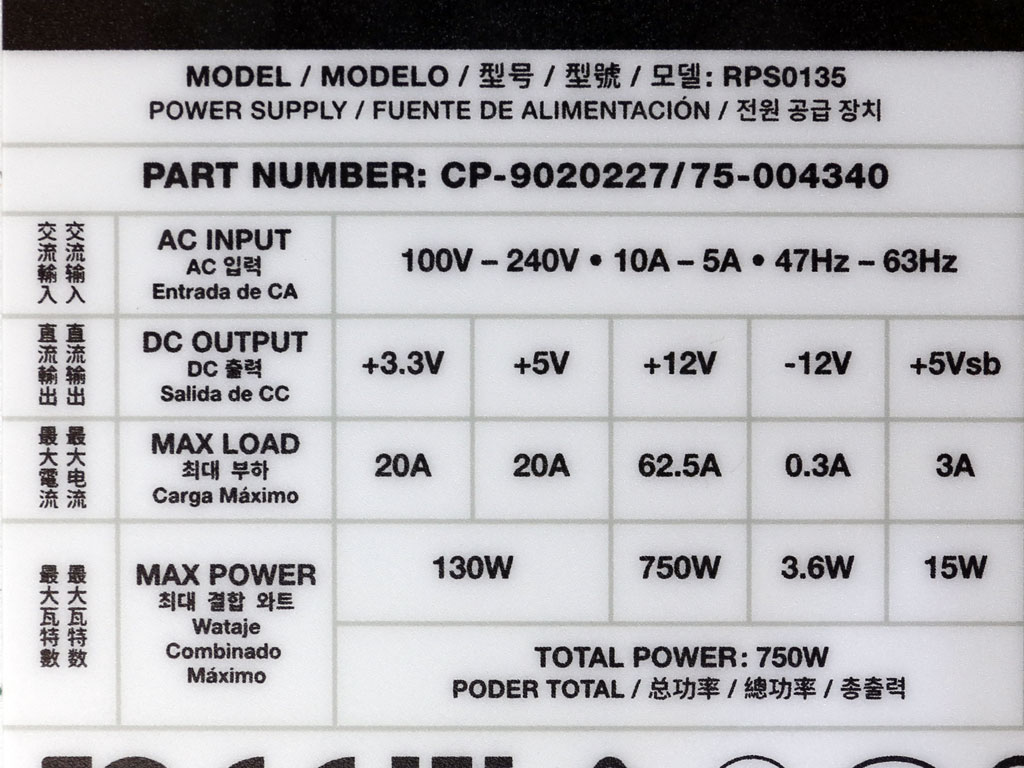
As per usual, the power specifications sticker is on the bottom.

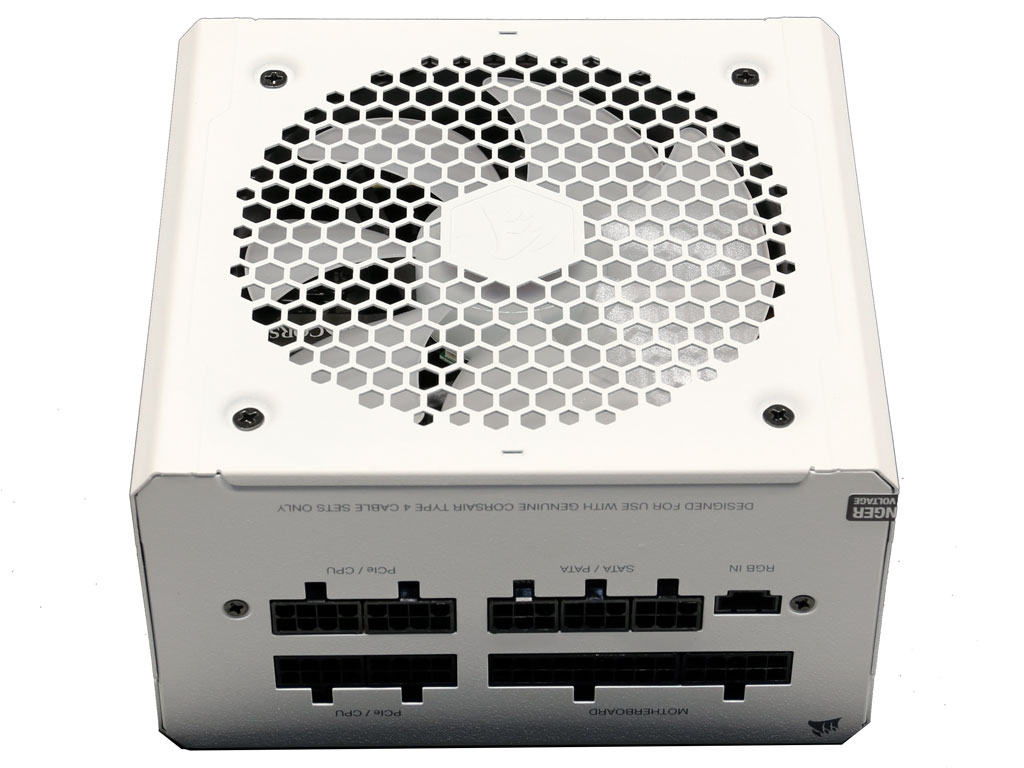

Around the back you will find the modular sockets, which include an RGB in port for the provided cable. This port allows you to connect the PSU to a compatible motherboard or the optional Corsair controller for RGB lighting control.

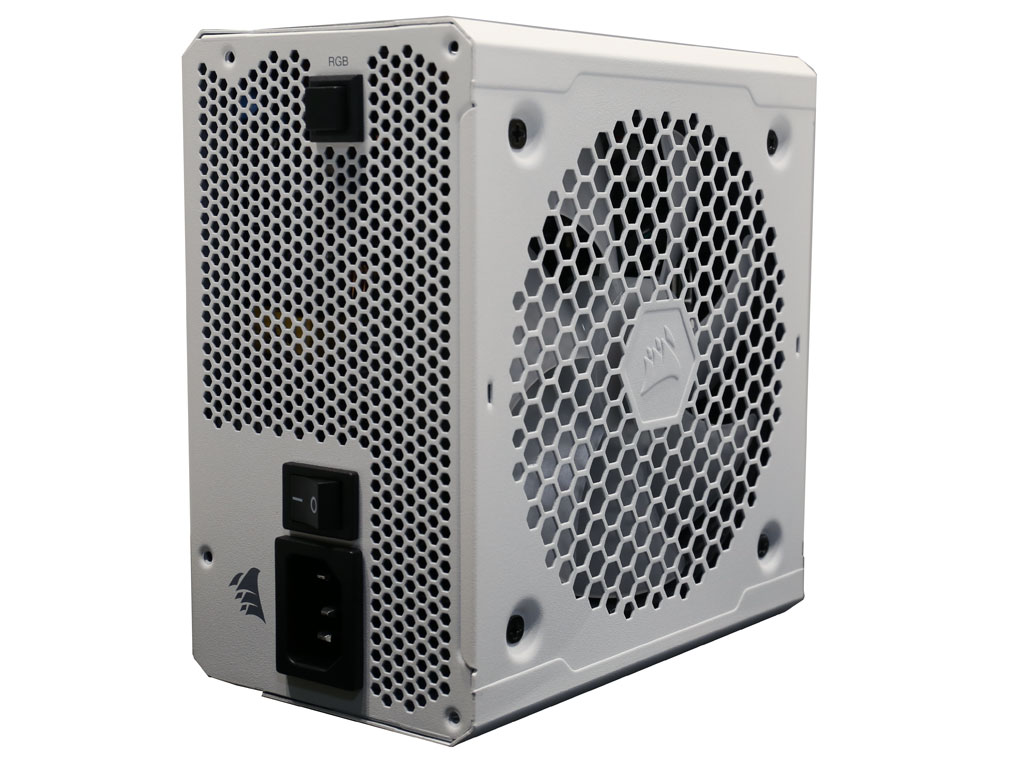
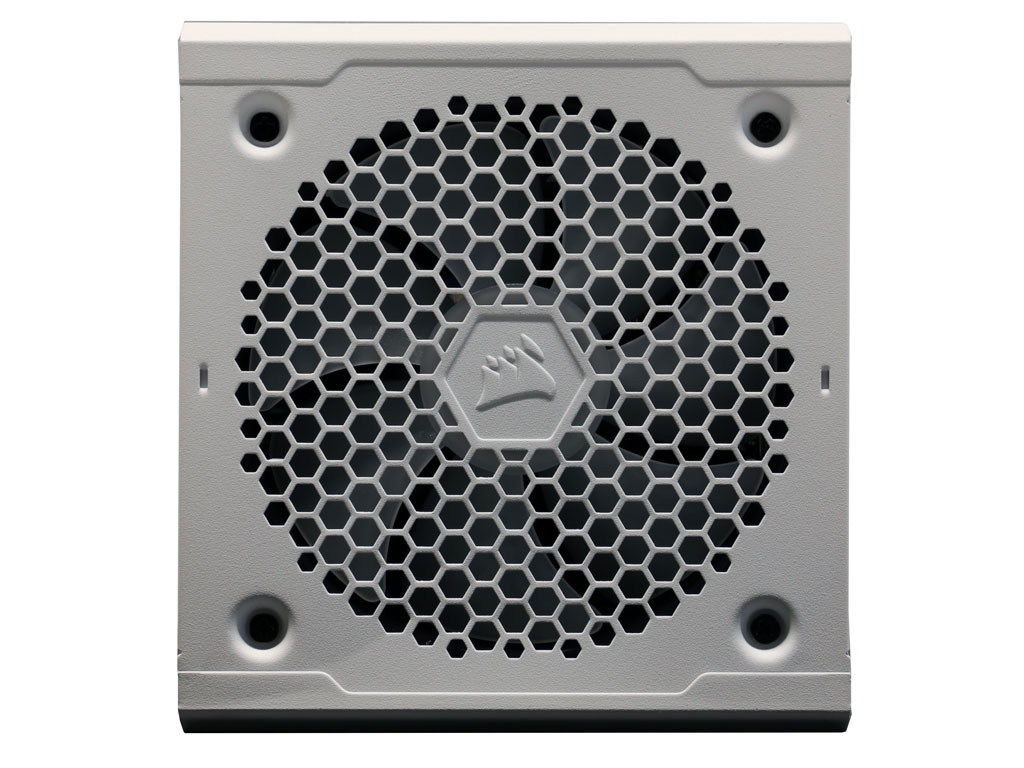
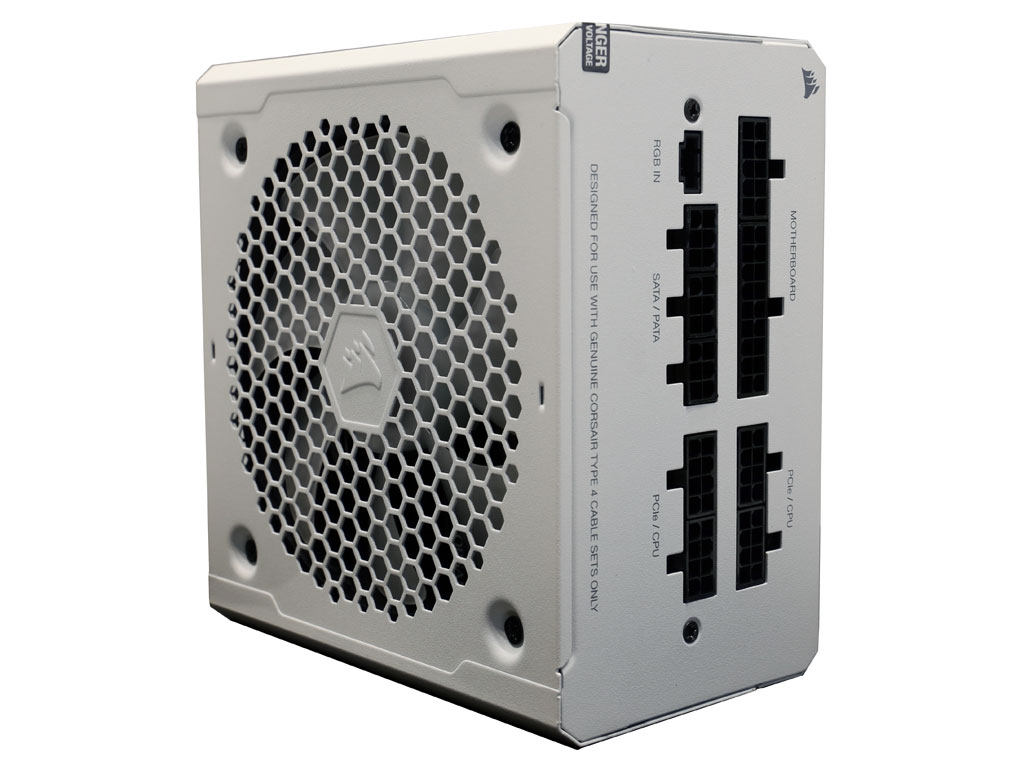
Some more photos of the PSU. It looks nice with its white paint job.
Cables and Connectors
| Modular Cables | ||||
|---|---|---|---|---|
| Description | Cable Count | Connector Count (Total) | Gauge | In Cable Capacitors |
| ATX connector 20+4 pin (610 mm) | 1 | 1 | 18-20AWG | No |
| 4+4 pin EPS12V (650 mm) | 2 | 2 | 18AWG | No |
| 6+2 pin PCIe (600 mm+150 mm) | 2 | 4 | 16-18AWG | No |
| SATA (450 mm+115 mm+115 mm+115 mm) | 2 | 8 | 18AWG | No |
| 4-pin Molex (450 mm+100 mm+100 mm+100 mm) | 1 | 4 | 18AWG | No |
| iCUE RGB cable (500 mm) | 1 | 1 | 28AWG | No |
| Motherboard ARGB cable (300 mm) | 1 | 1 | 28AWG | No |
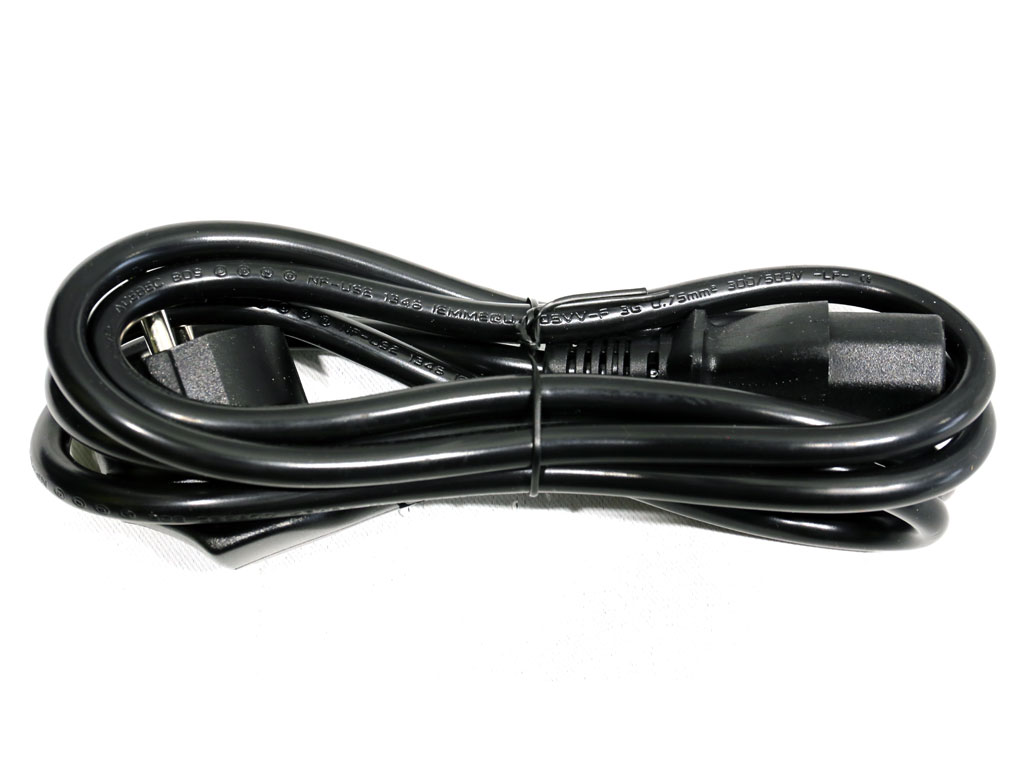
| AC Power Cord (1380 mm) - C13 coupler | 1 | 1 | 18AWG | - |
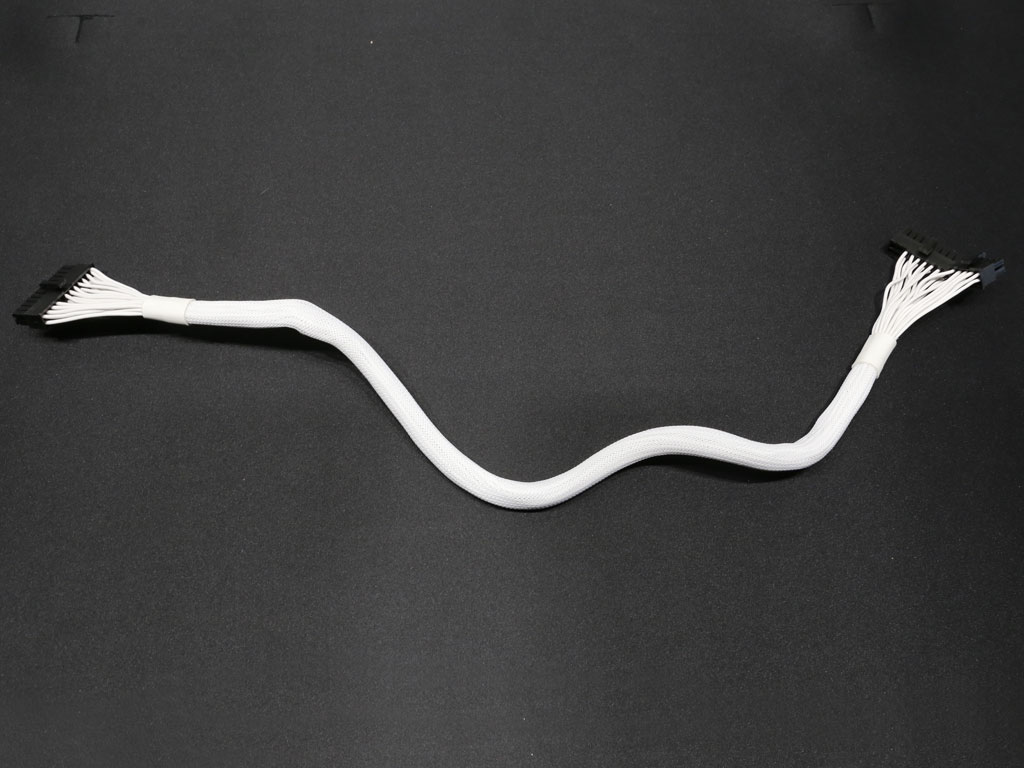
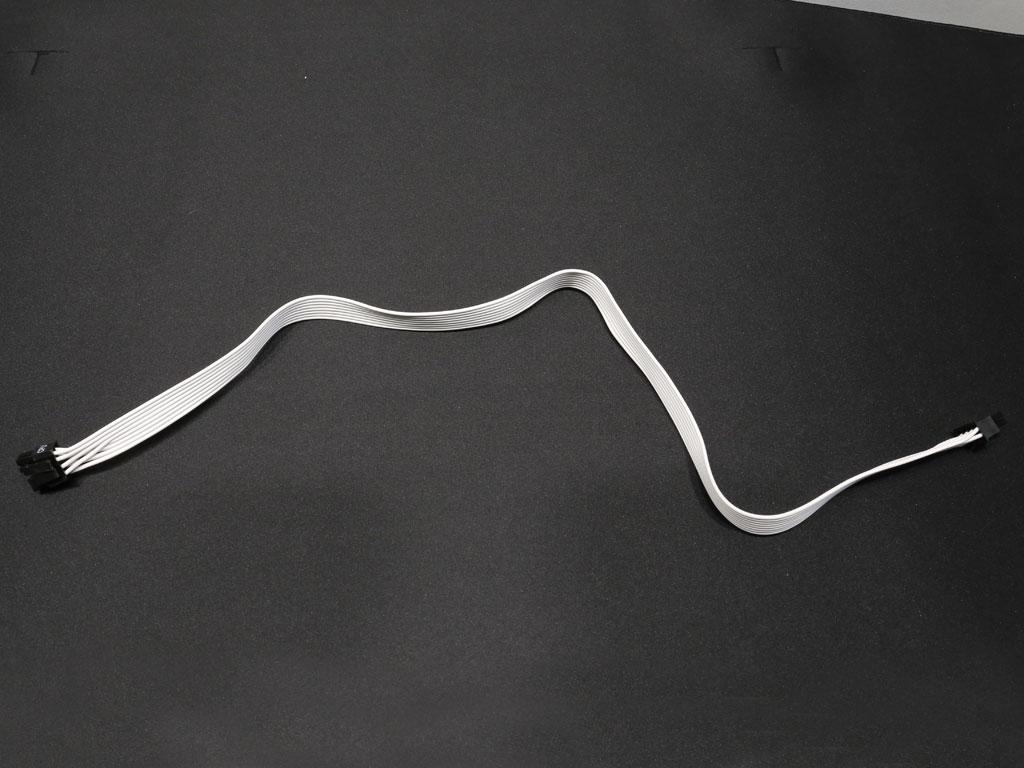

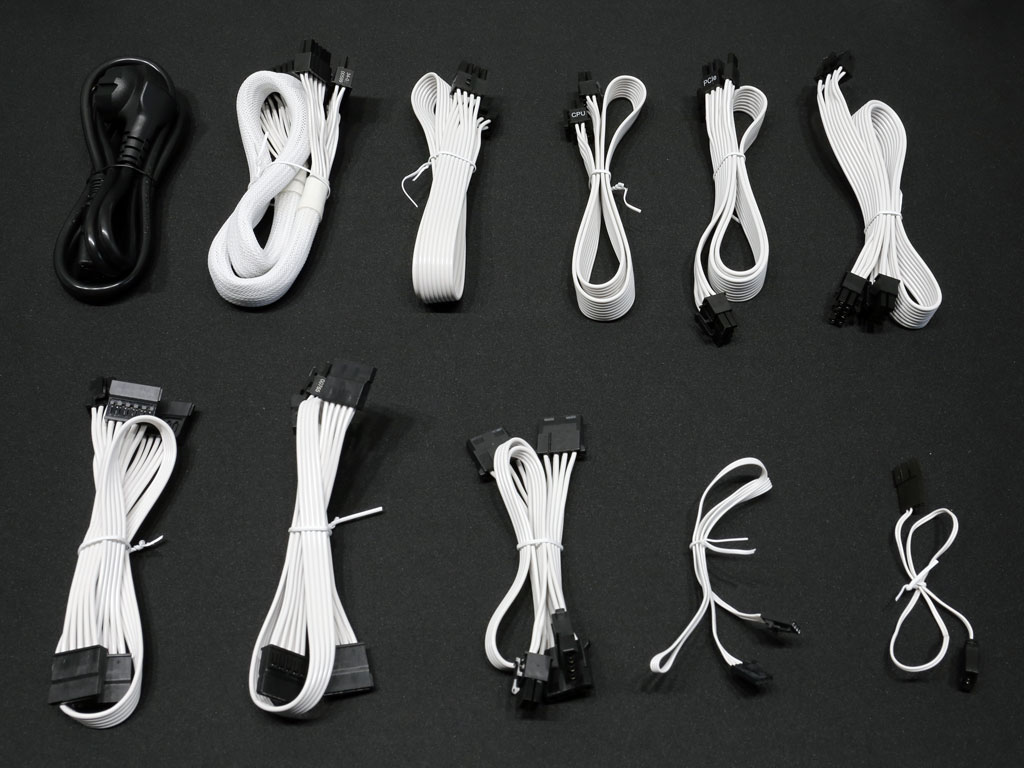
The white CX-F comes with matching cables, which is a nice detail.
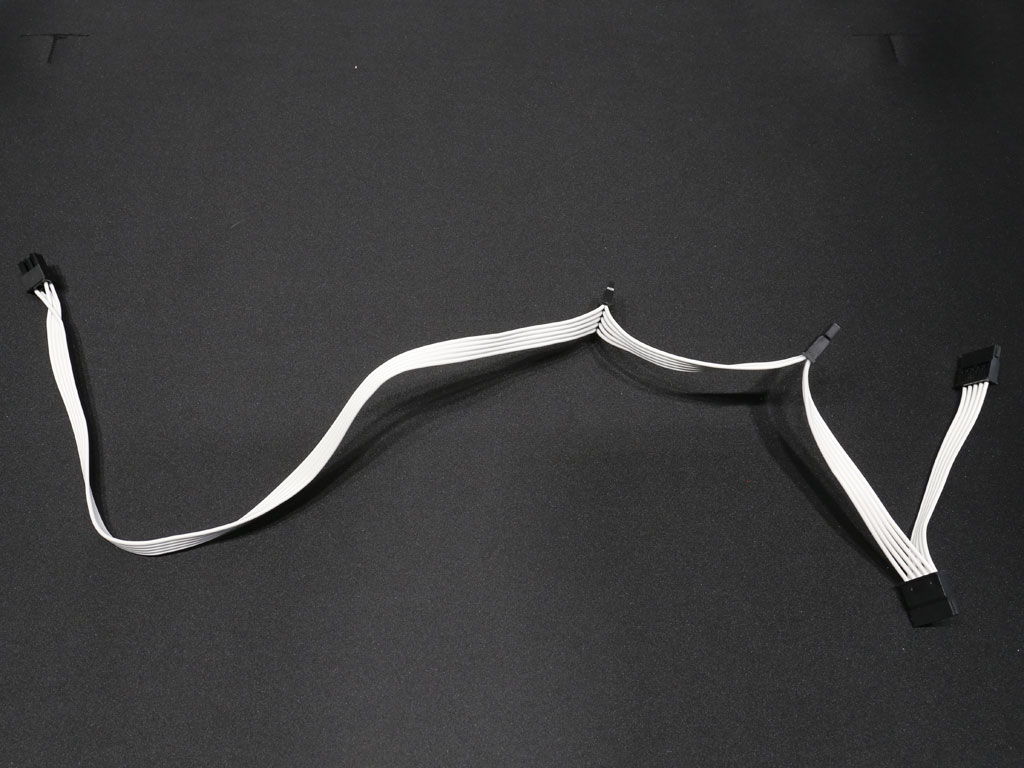
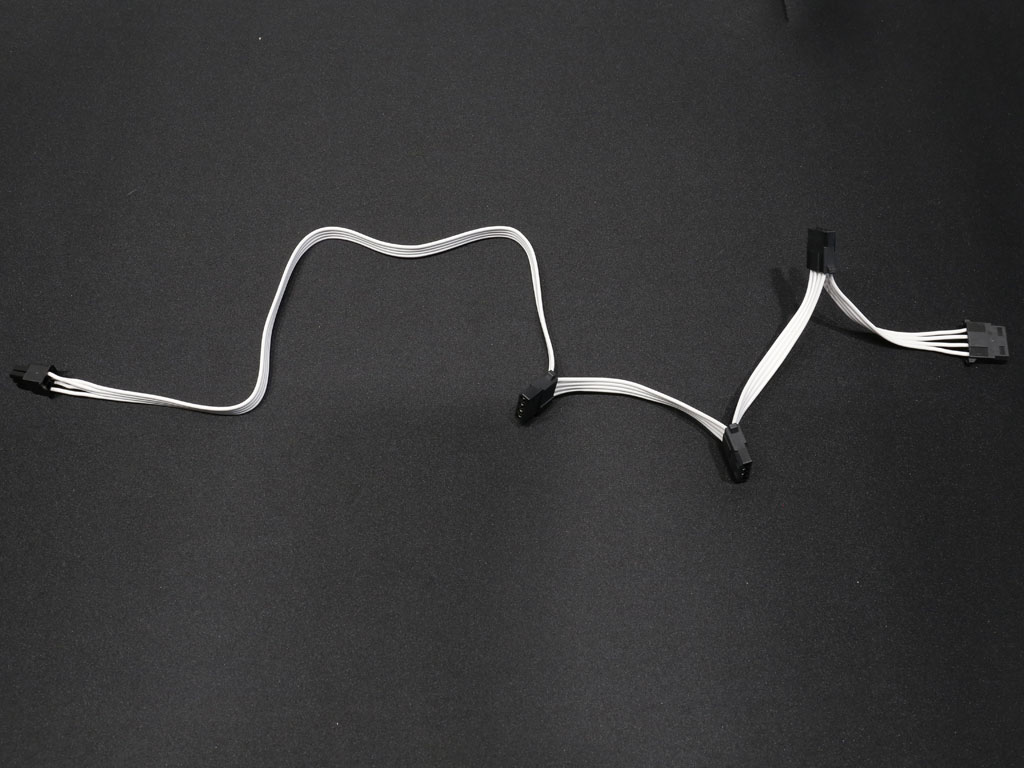
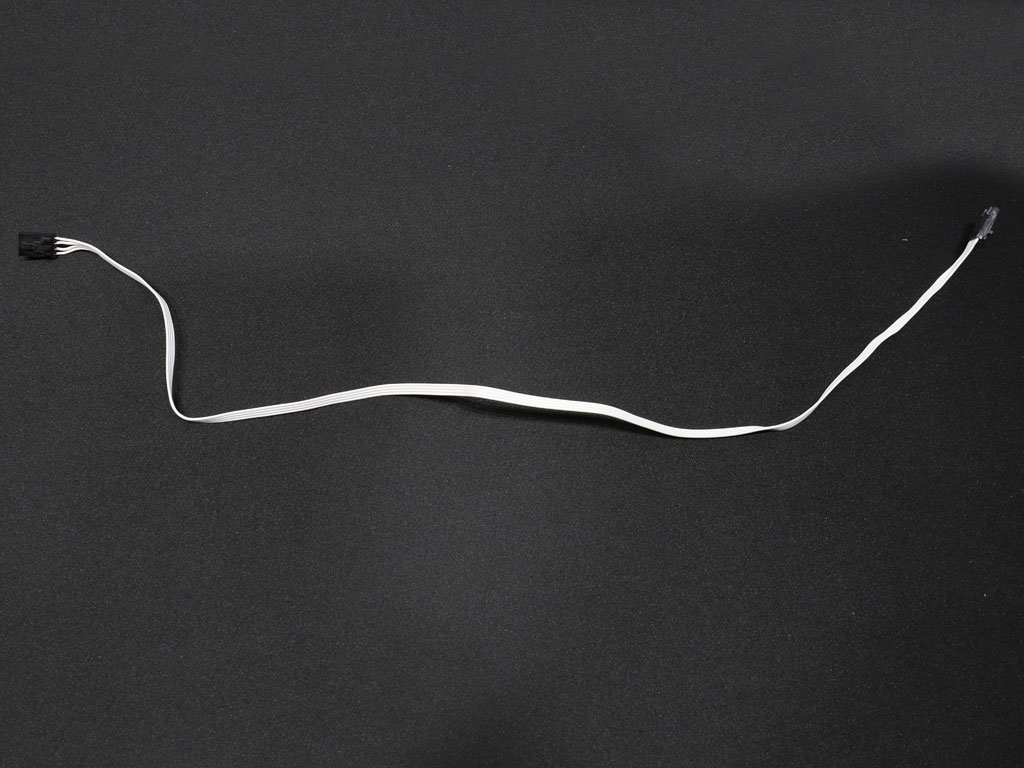

There are enough connectors, including two EPS and four PCIe connectors. Cable length is satisfactory as well, but the distance between peripheral connectors is too short, especially for the 4-pin Molex. Finally, it is good to see 16AWG gauges up to the first PCIe connector because it restricts voltage drops, which results in less energy lost.
Component Analysis
Before reading this page, we strongly suggest a look at this article, which will help you understand the insides of a PSU better.| Corsair CX750F RGB Parts Description | |
|---|---|
| General Data | |
| Manufacturer (OEM) | HEC |
| PCB Type | Single-sided |
| Primary Side | |
| Transient Filter | 4x Y caps, 3x X caps, 1x CM chokes, 1x DM chokes, 1x MOV, 1x Discharge IC (CAP200DG) |
| Bridge Rectifier(s) | 2x GBU15K (800 V, 15 A @ 100 °C) |
| Inrush Current Protection | NTC Thermistor (SCK-2R58) (2.5 ohm) |
| APFC MOSFETs | 2x Infineon IPA60R120P7 (650 V, 16 A @ 100 °C, Rds (on): 0.12 ohm) |
| APFC Boost Diode | 1x Infineon IDH06G65C6 (650 V, 6 A @ 145 °C) |
| Bulk Cap(s) | 1x Hitachi (400 V, 470 uF, 2,000 h @ 105 °C HU) |
| Main Switchers | 2x Alpha & Omega AOTF22N50 (600 V, 15 A @ 100°C, Rds (on): 0.26 ohm) |
| APFC Controller | Champion CM6500UNX Champion CM03X |
| Switching Controller | MPS HR1001C |
| Topology | Primary side: APFC, Half-bridge & LLC converter Secondary side: Synchronous rectification & DC-DC converters |
| Secondary Side | |
| +12 V MOSFETs | 4x Nexperia PSMN2R6-40YS (40 V, 100 A @ 100 °C, Rds (on): 5.3 mOhm @ 175 °C) |
| +5 V & +3.3 V | DC-DC Converters: 8x Potens Semiconductor PDD3906 (30 V, 51 A @ 100 °C, Rds (on): 6 mOhm) PWM Controllers: ANPEC APW7073 |
| Filtering Capacitors | Electrolytic: 12x Teapo (1 - 3,000 h @ 105 °C, SC), 2x Nippon Chemi-Con (1–5,000 h @ 105 °C, KZE) Polymer: 18x Teapo |
| Supervisor IC | Weltrend WT7527 (OCP, OVP, UVP, SCP, and PG) |
| Fan Model | Corsair NR120L (120 mm, 12 V, 0.22 A, RGB, rifle bearing fan) |
| 5VSB Circuit | |
| Rectifier(s) | 1x MCC PS1060L SBR (60 V, 10 A) |
| Standby PWM Controller | Power Integrations TNY290PG |
| -12V | |
| Rectifier(s) | 1x KEC KIA7912PI SBR (-12 V, 1 A) |


HEC provides the platform, but I am sure Corsair's engineers asked for many modifications and didn't just relabel a design. To the best of my knowledge, Corsair and Cooler Master are among the very few brands with PSU engineers on their payrolls to ensure the quality of their PSUs is up to their standards. Other brands hire external consultants at best or just put their faith in the manufacturer.
For "only" Bronze and ETA-A- efficiency levels, the platform looks overbuilt since it uses a half-bridge topology with an LLC resonant converter on the primary side, and a synchronous design and DC-DC converters on the secondary side. No wonder CX-F models are relatively expensive. Most parts are of high quality, including the Infineon FETs and Hitachi bulk cap. However, Hitachi recently sold its capacitor business to a Chinese brand named Jianghai, so I don't know for how long quality will remain at these high levels. Unfortunately, the term "Japanese capacitors" doesn't mean much anymore since most Japanese capacitor brands either have factories in other countries or get their raw materials from Chinese suppliers.


The transient filter is complete, so I expect low incoming and outgoing EMI emissions.


A Metal Oxide Varistor (MOV) filters all voltage surges coming from the mains network. For inrush current protection, an NTC thermistor is used. Corsair does not include a bypass relay since it would increase the cost.


Two GBU15K bridge rectifiers fully rectify the AC power stream before it enters the APFC converter.


The APFC converter uses two Infineon FETs and a single boost diode, both of which are provided by the same manufacturer. The PFC controller is a Champion CM6500UNX, and there is also a CM03X IC, which restricts vampire power.

The Hitachi bulk cap doesn't have enough capacity to allow for a hold up time of over 17 ms.


The two primary switching FETs are installed in a half-bridge topology. Instead of a Champion or Infineon LLC resonant controller, HEC uses the lesser well-known but capable MPS HR1001C. An interesting feature of this controller is that it incorporates a number of basic protection features.

The unit's main transformer.


Six Nexperia FETs regulate the +12V rail. The minor rails are generated through a pair of DC-DC converters.


I am not at all fond of Teapo's SC caps because of their low lifetime. Thankfully, HEC also uses a large number of Teapo polymer caps, which are tolerant to heat.


The face of the modular board.


This is the 5VSB regulation circuit.


Soldering quality is satisfactory.

The supervisor IC is a Weltrend WT7527—it supports all basic protection features.


The RGB fan with model number NR120L uses a rifle bearing.
Our Patreon Silver Supporters can read articles in single-page format.
Nov 13th, 2026 21:57 CST
change timezone
Latest GPU Drivers
New Forum Posts
- Tell me about your favourite graphics card (29)
- no "PhysX" workable (8)
- AI generated images... (224)
- Crimson Desert (31)
- RenoDX HDR - how to view the differnce Before&After in game? (0)
- Displayport DP80 3M (10ft) cable that can achieve 80gbps stable? (5)
- I'll flash a ASUS ROG Strix RX480 O8G in Cause of Code 43, as a Newbie (1)
- Opinion on Monitor Replacement (6)
- TMOG - post your benchmark results here (16)
- Microsoft Exchange/365 outages? (61)
Popular Reviews
- AMD Zen 6 Technical Deep Dive
- Corsair HX1000i Shift Crystal Review
- NZXT C1200 Platinum Review
- Upcoming Hardware Launches 2027 (Updated Nov 2026)
- ASUS ROG Strix B850-I Gaming Wi-Fi7 W Review
- Montech King 95 3D PRO Review
- NZXT H7 RGB+ Review
- NZXT H5 Review
- Phantom Blade Zero Performance Benchmark Review - 35 GPUs Tested
- XPG NIMBUS PLUS Review - Mid-range Chair With Strong Competitors
TPU on YouTube
Controversial News Posts
- NVIDIA Co-Founder and CEO Jensen Huang Officially Resigns (379)
- OpenAI CEO Argues Home PCs Waste the World's Limited DRAM Supply (152)
- NVIDIA Launches Investigation Into Jensen Huang's Relationship With Suspected Chinese Spy (136)
- Intel "Raptor Lake Next" 16-Core and 20-Core CPUs Surface (130)
- Legendary Game Studio BioWare Shuts Down Following EA Layoffs (104)
- Dell CEO Says the Memory Shortage Will Get Worse in 2027 (95)
- NVIDIA GeForce RTX 50-Series Scheduled for up to $500 Price Hike This Week (89)
- Modder Fits RTX 5090 With Four 8-Pin Connectors, Halving Current per Wire (80)