 5
CPS PCCOOLER F7 X120 ARGB Fan Review
Value & Conclusion »Performance Testing
Please refer to the dedicated test setup page as it applies to this review as well, and I did not want to go over it separately to save on review space.
First up, here are the RPM response curves of the CPS PCCOOLER F7 X120 ARGB in the three operating modes available. The brand rates the fan speed range from 500 RPM to 1500/2200/3000 RPM for the L/M/H modes, with an error margin of the usual 10%. I tested all three fans and the average is plotted above, starting at 100% PWM and going down in 10% increments until there is no more change. We see the rated numbers match the tested results quite well, especially in the L and H modes, and certainly within 10% no matter what. I will also give credit for the lack of sample variation here, and this is a random retail unit too for those curious. There is no zero RPM mode here, and note also that the range of control differs based on the operating mode, with H having the longest range. The RPM responses are all quite linear as well, making it easy to set up custom fan curves as desired.
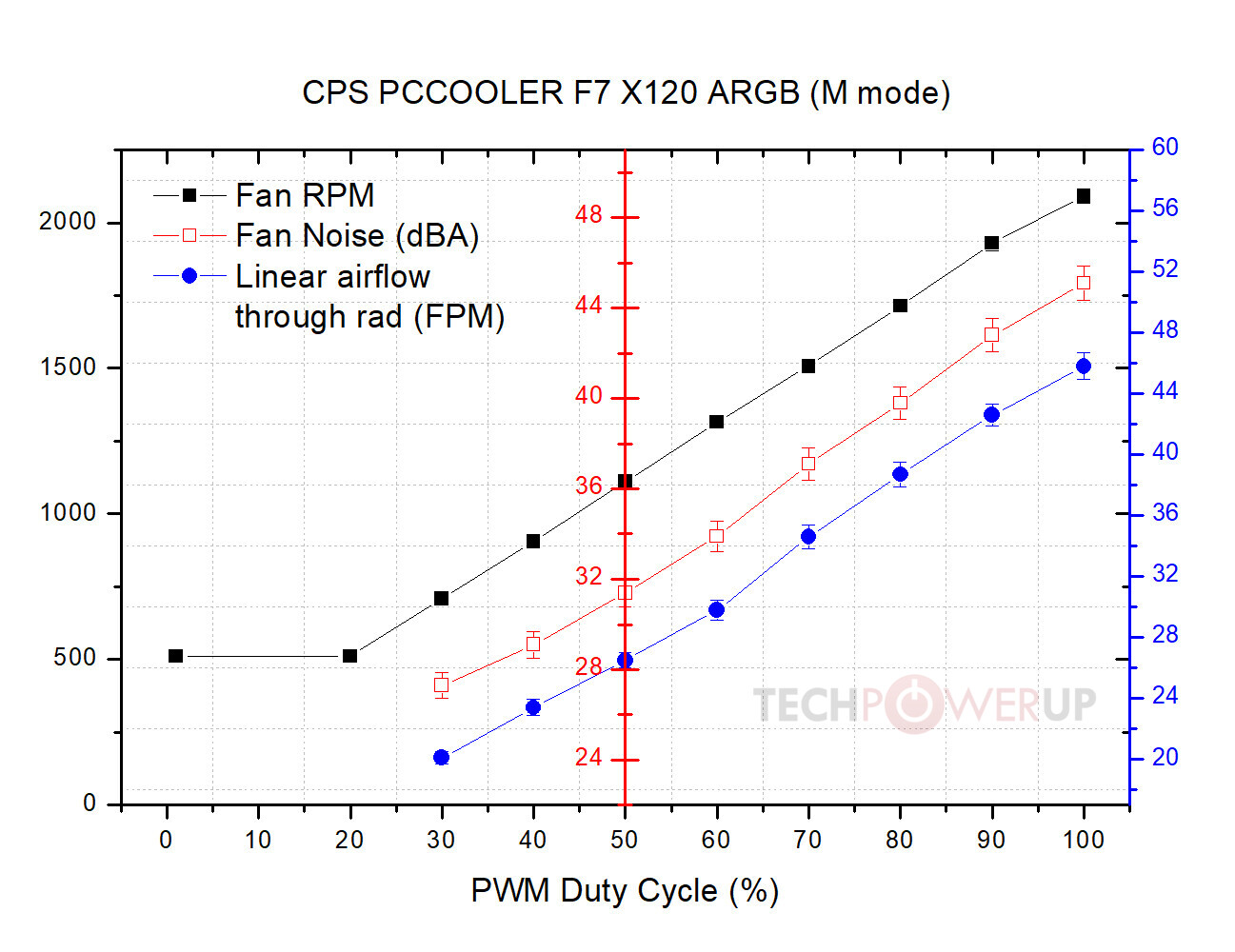
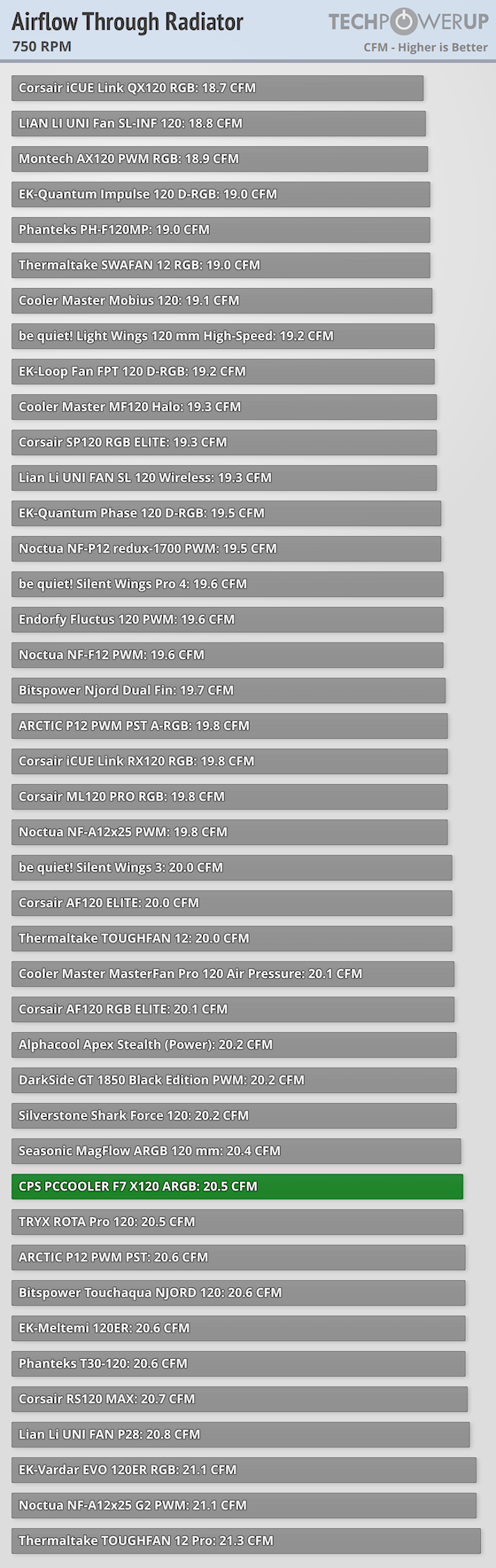
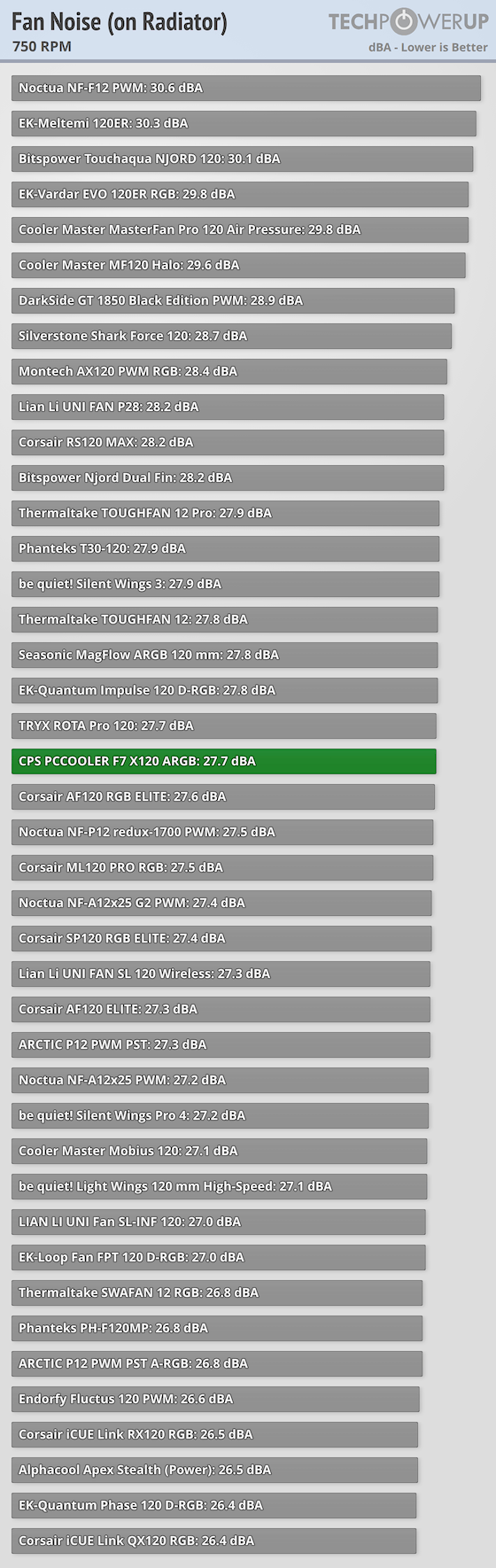
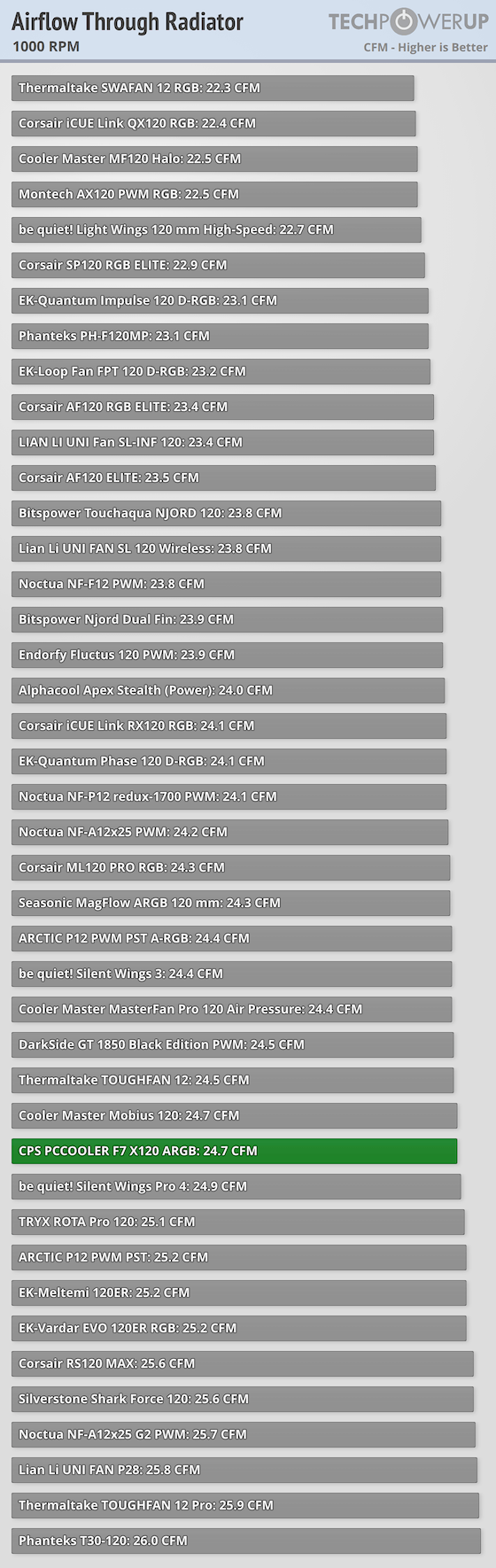
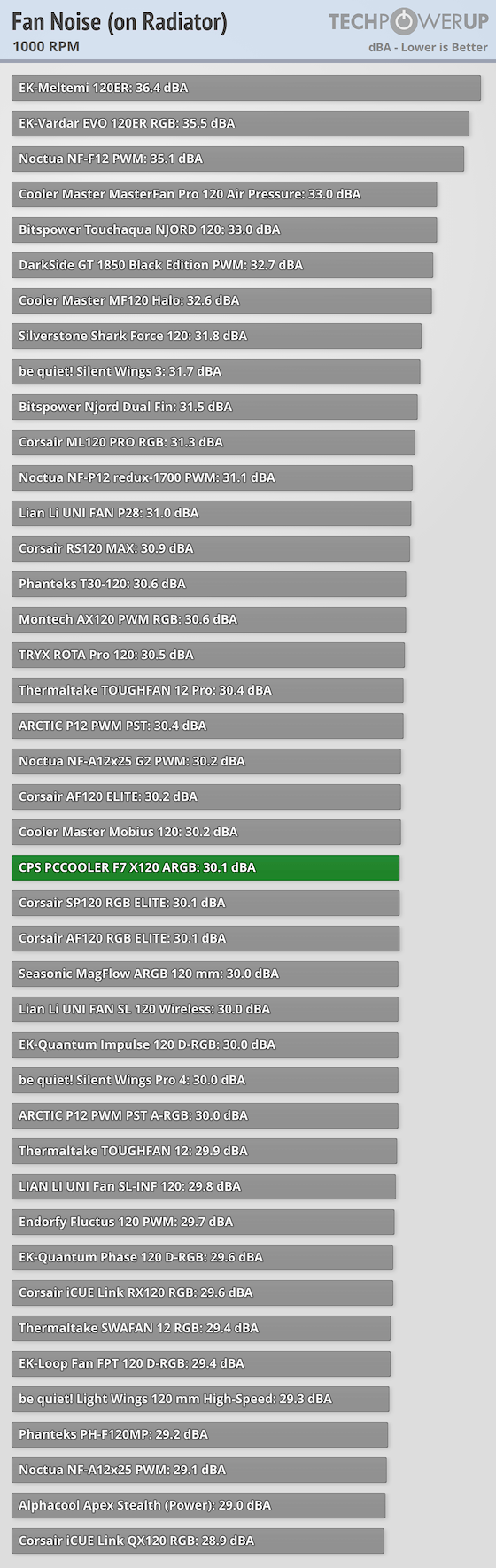
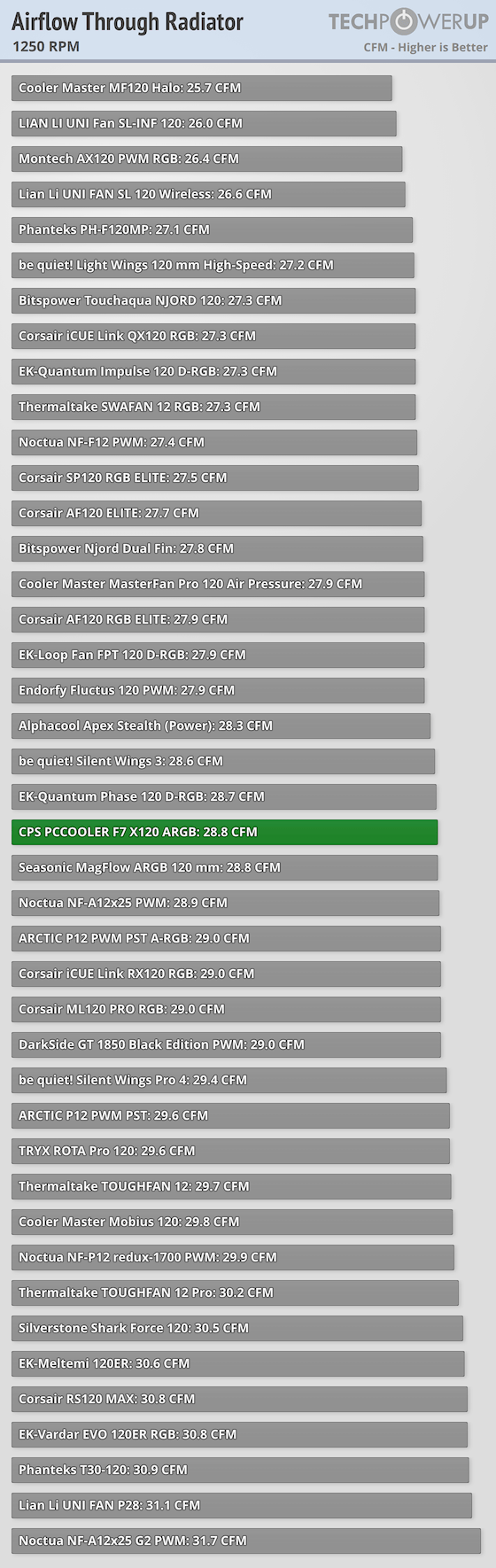
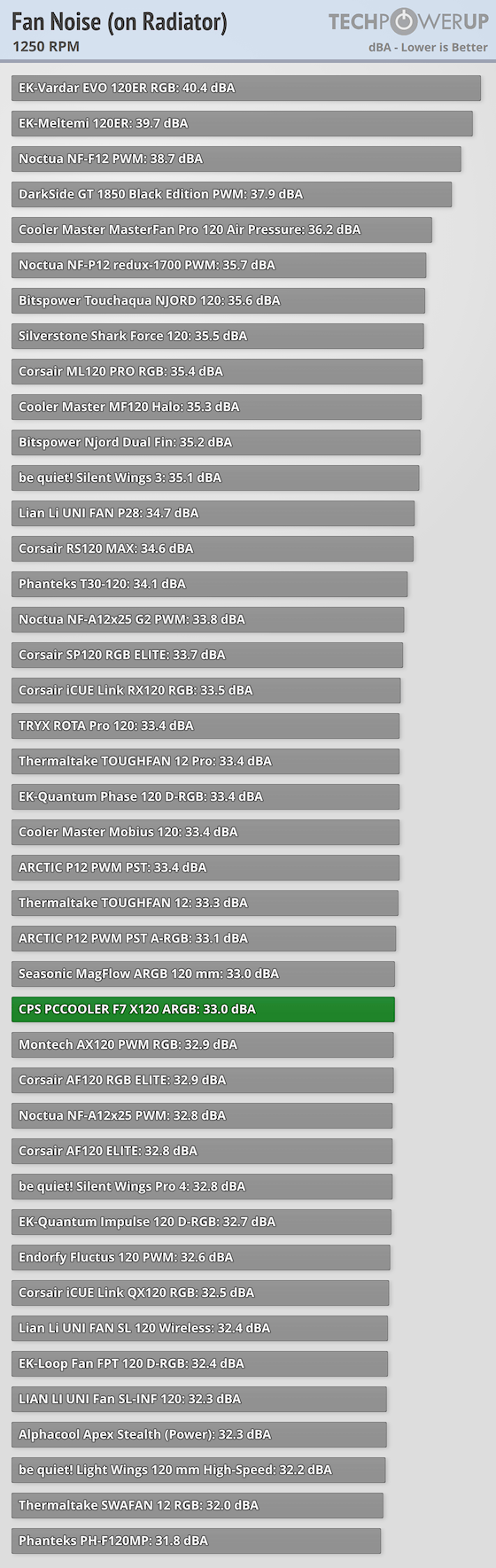
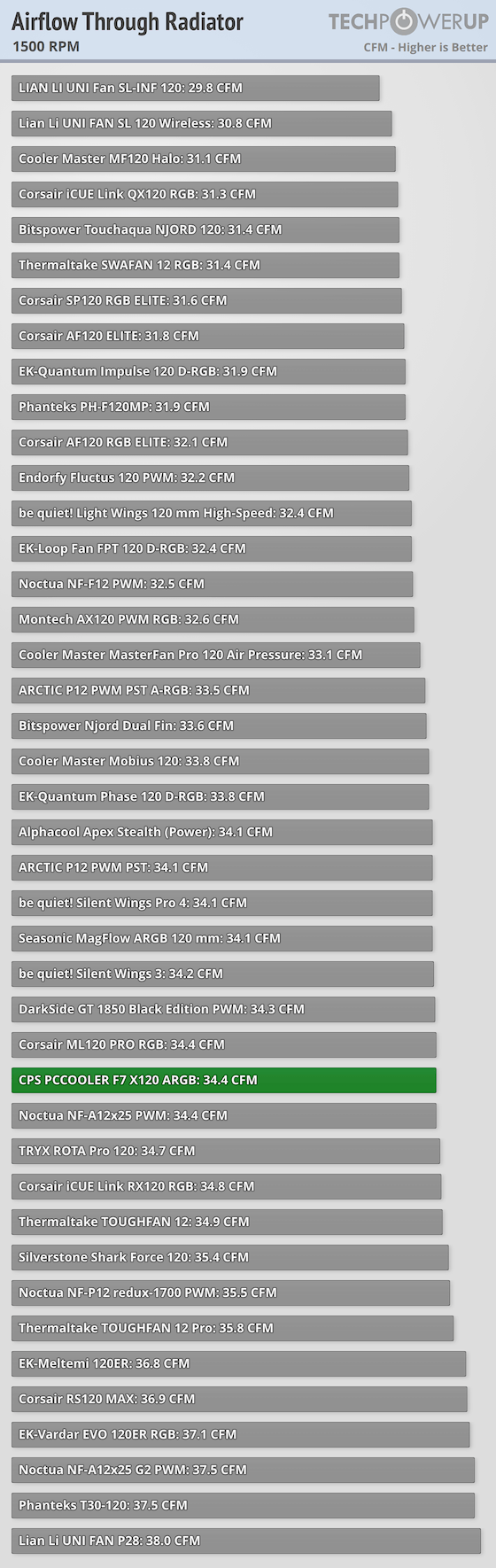
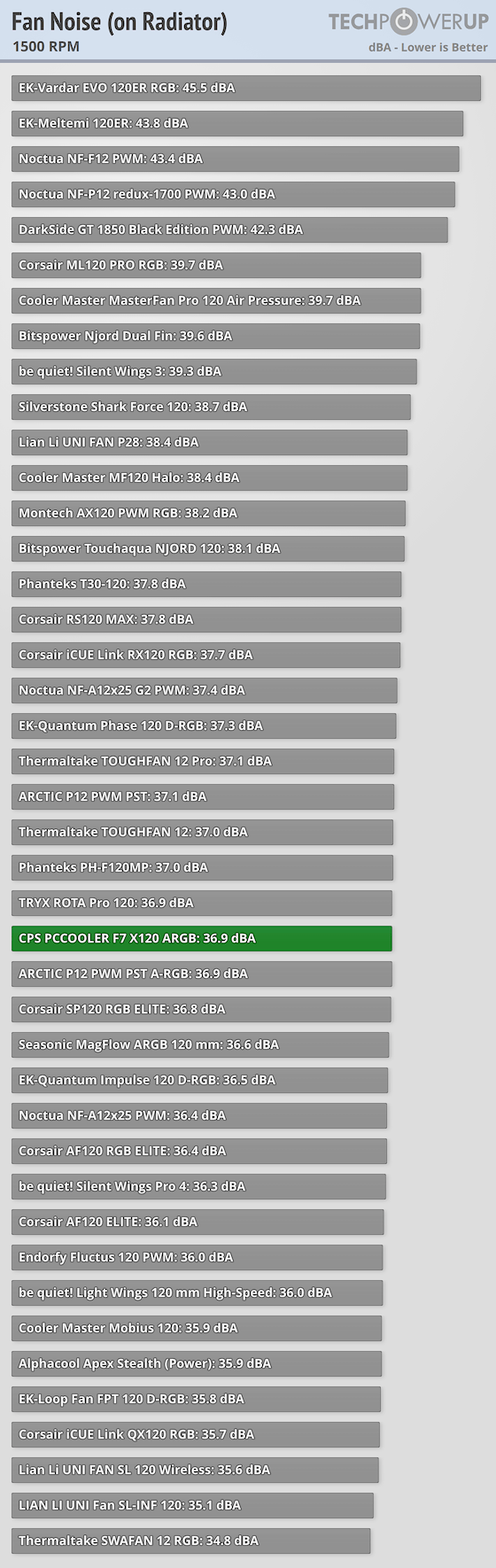
The charts above help put the CPS PCCOOLER F7 X120 ARGB in better context with the chosen RPM values, reflecting usage scenarios most popular with watercooling, although some fans go higher as is the case here. The charts are to be considered for comparison within this result set only and are not to be compared with results from another test elsewhere owing to different testing conditions. Note that these are average values for all samples of each fan and do not reflect any sample variation, and I also suggest looking at RGB fans separately from the others, given they tend to sacrifice some performance by having LEDs take up space where the rotor blades could have been pushing more air through. The good news is this is clearly a much better showing than typical RGB fans from a pure performance point of view, although that brings with it associated airflow noise. I also tested noise and airflow with the fan in M mode, which I feel covers the entire RPM range that anyone doing custom watercooling would be—should be—interested in. The use of LED rings in the frame and hub means the fan blades are not as short as typical of most RGB fans with a similar number of LEDs, and this helps the F7 X120 keep up with many non-RGB fans too. It scales decently as well, so the fans should also work for a wide range of applications including being case fans or air cooler fans. I will also confirm there was no perceived bearing or motor noise during testing, including at the lower fan speeds. This is where you will likely perceive a slight droning buzz from the airflow noise itself though.

Instead of having CFM/dBA charts that can potentially be taken for more than they really offer, I am going to show three other fans as a comparison for further context. These include the subject of this review—the CPS PCCOOLER F7 X120 ARGB—in addition to three other RGB fans currently sold on the market from competitors in the form of the Seasonic MagFlow ARGB, the be quiet! Light Wings 120, and the CORSAIR iCUE LINK QX120 RGB. The Seasonic offering came to mind before for comparison, given the nature of lighting here and the 28 mm thickness, and we also saw how these two fans performed very similarly in terms of noise and airflow at the chosen fan speed, too. This is not a bad thing at all since that Seasonic fan was one of my recommendations in terms of being an RGB fan that doesn't compromise on performance, and now we have one more option from CPS PCCOOLER. The other RGB fans here are not as good at pure performance, although that also means lower airflow noise too. This is why they aren't that far off from the F7 X120 ARGB in terms of performance/noise, although overall the edge goes to CPS PCCOOLER for this use case.
Nov 25th, 2026 08:31 CST
change timezone
Latest GPU Drivers
New Forum Posts
- Increasing Power Limit? (35)
- Claude credits purchased on or after Dec. 7 now have an expiry date (0)
- Ryzen Owners Zen Garden (8566)
- WarpCoreBench scores! (104)
- Sexy Hardware Close-Up Pic Clubhouse. (10344)
- {NA} 2026 Black November prices / deal (6)
- Smokin Hot Lappy (1)
- What is the latest game you finished or 100% (205)
- The time has come to upgrade...my desktop (20)
- Can you guess Which game it is? (358)
Popular Reviews
- ASRock X870E Challenger Wi-Fi White Review
- Microsoft Surface Laptop Ultra Review - The Next-gen Arm Laptop
- VZMORE AX9 Max Review
- Upcoming Hardware Launches 2027 (Updated Nov 2026)
- AMD Ryzen 7 9800X3D Review - The Best Gaming Processor
- AMD Zen 6 Technical Deep Dive
- Corsair RM1200e (Second Generation) Review
- Phantom Blade Zero Performance Benchmark Review - 35 GPUs Tested
- Pulsar Office Tour & First Look at P1 Dual-Sensor Mouse
- Ocypus lota P1000 Review
TPU on YouTube
Controversial News Posts
- Jensen Huang Reinstated as CEO of NVIDIA (557)
- NVIDIA Co-Founder and CEO Jensen Huang Officially Resigns (492)
- Report: Jensen Huang Eyes NVIDIA Comeback (281)
- Open Letter Asking NVIDIA to Reinstate Jensen Huang Passes 115,000 Signatures (184)
- OpenAI CEO Argues Home PCs Waste the World's Limited DRAM Supply (152)
- NVIDIA Launches Investigation Into Jensen Huang's Relationship With Suspected Chinese Spy (136)
- Intel "Raptor Lake Next" 16-Core and 20-Core CPUs Surface (130)
- Intel Razor Lake Gets a 12 P-Core bLLC Chip With No E-Cores, Per Leak (94)