 15
CPS PCCooler YS1200 Review
Value & Conclusion »Result Summary
| Full-Range Load Testing (230 V) | |||||||||
|---|---|---|---|---|---|---|---|---|---|
| All-rail Load | 12 V | 5 V | 3.3 V | Power (DC/AC) | Efficiency | Fan Speed | Noise Level | Power Factor | |
| 0 % | 0.00 A | 0.0 A | 0.0 A | 0.00 W | N/A | Fan Stop | 0.12 | ||
| 12.16 V | 5.43 V | 3.56 V | 4.67 W | ||||||
| 5 % | 1.68 A | 3.78 A | 5.85 A | 60.00 W | 81.41 % | Fan Stop | 0.76 | ||
| 12.16 V | 5.31 V | 3.42 V | 73.70 W | ||||||
| 10 % | 6.56 A | 3.78 A | 5.85 A | 120.00 W | 85.08 % | Fan Stop | 0.89 | ||
| 12.14 V | 5.30 V | 3.41 V | 141.05 W | ||||||
| 20 % | 16.52 A | 3.78 A | 5.85 A | 240.00 W | 90.41 % | Fan Stop | 0.94 | ||
| 12.12 V | 5.28 V | 3.40 V | 265.47 W | ||||||
| 30 % | 26.56 A | 3.80 A | 5.93 A | 360.00 W | 91.58 % | 788 RPM | 27.4 dBA | 0.95 | |
| 12.09 V | 5.26 V | 3.36 V | 393.09 W | ||||||
| 40 % | 36.80 A | 3.82 A | 5.97 A | 480.00 W | 91.82 % | 788 RPM | 27.4 dBA | 0.96 | |
| 12.08 V | 5.24 V | 3.34 V | 522.74 W | ||||||
| 50 % | 46.64 A | 3.84 A | 6.00 A | 600.00 W | 91.71 % | 788 RPM | 27.4 dBA | 0.97 | |
| 12.05 V | 5.22 V | 3.33 V | 654.22 W | ||||||
| 60 % | 57.36 A | 3.85 A | 6.03 A | 720.00 W | 91.40 % | 797 RPM | 28.0 dBA | 0.97 | |
| 12.02 V | 5.19 V | 3.32 V | 787.75 W | ||||||
| 70 % | 66.92 A | 3.87 A | 6.07 A | 840.00 W | 90.88 % | 942 RPM | 28.9 dBA | 0.97 | |
| 11.99 V | 5.17 V | 3.29 V | 924.32 W | ||||||
| 80 % | 77.88 A | 3.89 A | 6.11 A | 960.00 W | 90.37 % | 1080 RPM | 30.2 dBA | 0.98 | |
| 11.96 V | 5.16 V | 3.26 V | 1062.25 W | ||||||
| 90 % | 88.40 A | 3.90 A | 6.16 A | 1080.00 W | 89.76 % | 1208 RPM | 33.8 dBA | 0.98 | |
| 11.93 V | 5.12 V | 3.24 V | 1203.21 W | ||||||
| 100 % | 97.92 A | 3.91 A | 6.19 A | 1200.00 W | 89.22 % | 1440 RPM | 38.5 dBA | 0.98 | |
| 11.90 V | 5.11 V | 3.22 V | 1345.03 W | ||||||
| 110 % | 109.72 A | 3.93 A | 6.25 A | 1320.00 W | 88.26 % | 1791 RPM | 47.9 dBA | 0.98 | |
| 11.86 V | 5.08 V | 3.19 V | 1495.55 W | ||||||
Efficiency
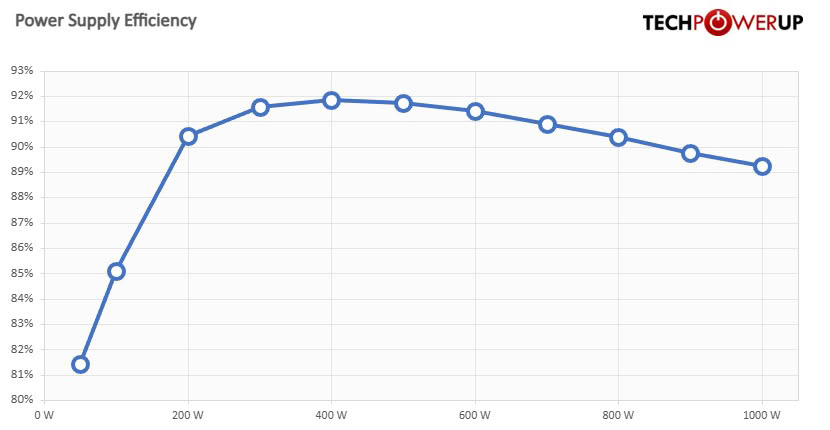
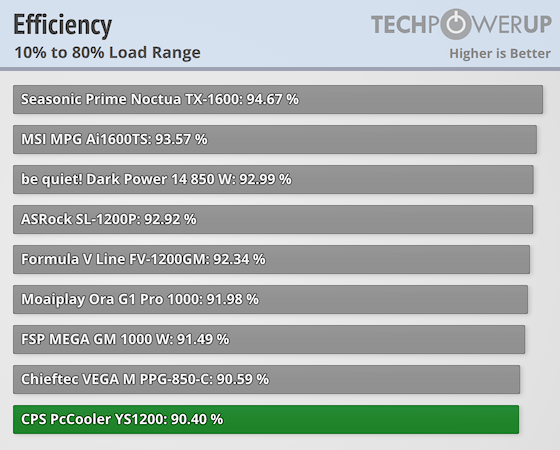
The efficiency peaks between 30-60%, hitting over 91% for the most part, which is where the supply will likely spend most of its life under real world use. It is only during the low and high extremes that the efficiency notably drops off.
| Rated Efficiency Validation (230 V) | ||||
|---|---|---|---|---|
| Certification: 80 Plus Gold | ||||
| Test Load | Required | Measured | Margin | Status |
| 20% | 90.00 % | 90.41 % | +0.41 % | Pass |
| 50% | 92.00 % | 91.71 % | -0.29 % | Fail |
| 100% | 89.00 % | 89.22 % | +0.22 % | Pass |
On our calibrated test bench, the 80 Plus Gold rating is marginally out of reach, with only the 50% load test coming in just under the requirement. This discrepancy can be caused by individual component tolerances in the PSU, such as MOSFET Rds, transformer winding quality, and even quantity of solder used; and I would say is within a margin to be acceptable.
Fan Noise
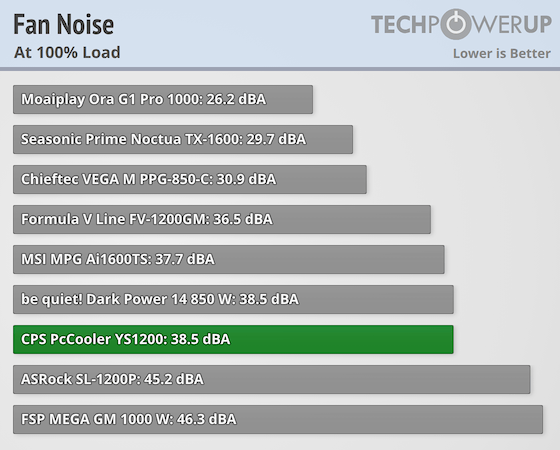
Under normal use, the fan should be essentially silent. Once it activates at 30%, it remains at very low speeds until around 60% where if the rest of your system and room is dead silent it may be noticeable.
Voltage Regulation
All ATX PSUs have a voltage regulation feedback loop, which increases the PWM duty cycle for each rail to account for voltage drop when current is drawn. However, most PSUs only measure voltage at the PSU output, rather than at the end of the cable going to the load. This means any voltage drop across the cable is not automatically adjusted for ATX 3.1 specification outlines a maximum allowed voltage drop at the load itself to ensure system stability,| Voltage Regulation & ATX 3.0 Compliance | |||||
|---|---|---|---|---|---|
| Test Load | Rail | Measured | ATX 3.0 Spec Limit | Margin | Status |
| Idle (0%) | +12V | 12.16 V | +5%/-8% | +1.34 % | Pass |
| +5V | 5.43 V | ±5% | +8.60 % | Fail | |
| +3.3V | 3.56 V | ±5% | +7.87 % | Fail | |
| 100% Load | +12V | 11.90 V | +5%/-8% | -0.84 % | Pass |
| +5V | 5.11 V | ±5% | +2.20 % | Pass | |
| +3.3V | 3.22 V | ±5% | -2.42 % | Pass | |
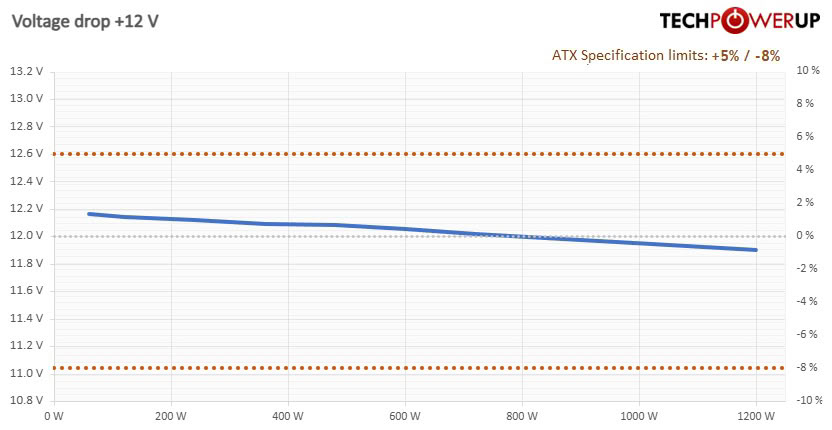
With the YS1200, the regulated voltage at the supply is a little high, possibly on purpose to compensate for voltage drop across the cables under load. This works out quite well for the 12 V rail, but at idle and low loads the 3.3 V and notably 5 V rail are actually above the allowed tolerance for ATX 3.1 spec.
Cable Quality
Although voltage regulation inside modern PSUs is extremely stable, voltage drop and thus power losses will occur across the cables as current is drawn through them. This results in a lower voltage available to the system components than what is actually measured at the PSU outputs. Thicker cables will cause less voltage drop and more power to the components. Any power lost across the cables is wasted as heat in the wire itself. By measuring the voltage drop at a known load, we can calculate the resistance of the cables.| Cable Losses at Full Load | |
|---|---|
| Applied 12 V Load | 97.92 A |
| Measured @ Supply | 12.16 V |
| Measured @ Load | 11.90 V |
| Power Lost in Cable | 25.46 W |
| Per-Cable Resistance | 79.66 mΩ |
| Cable Temperature | 32.2°C |
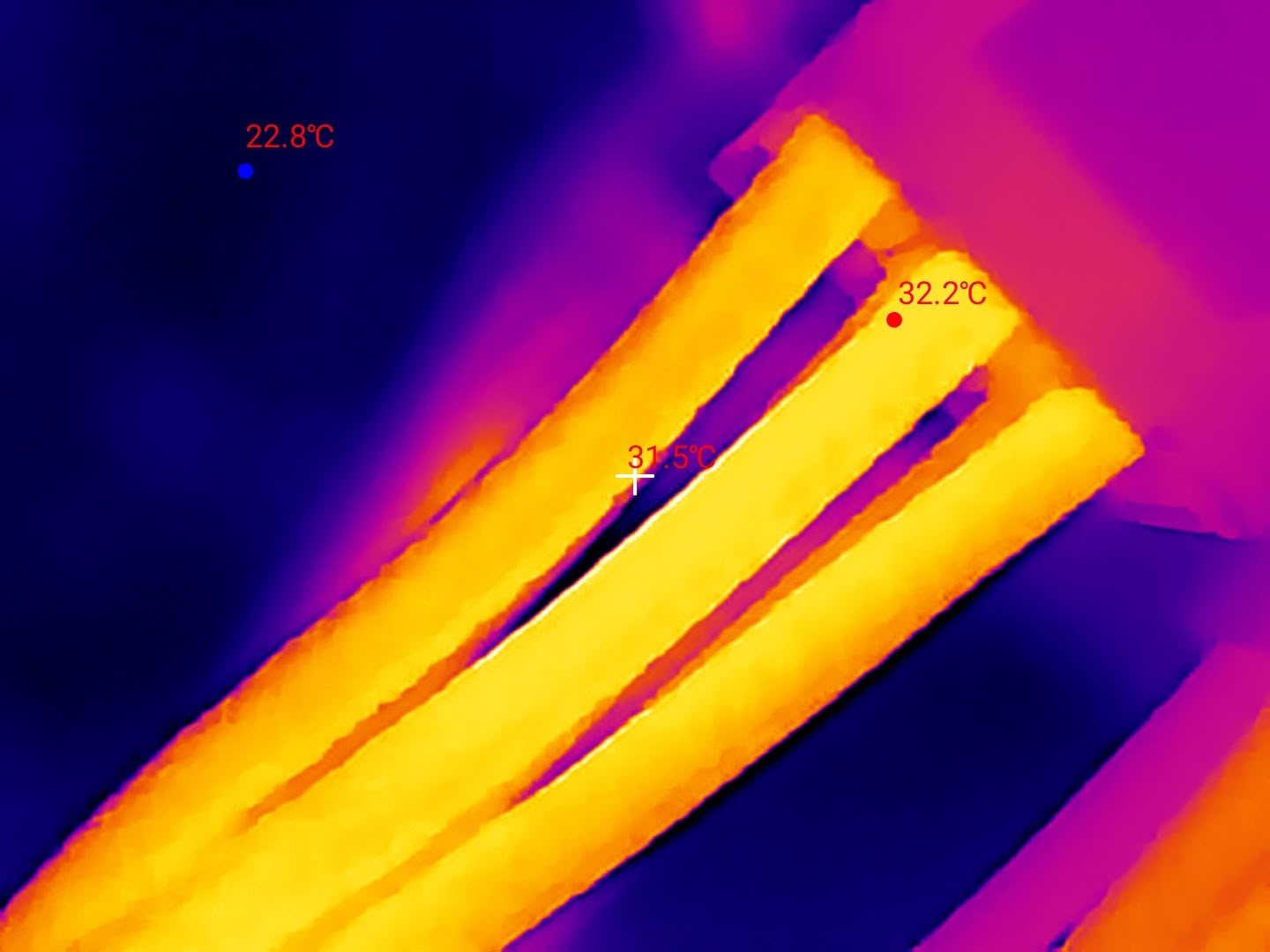
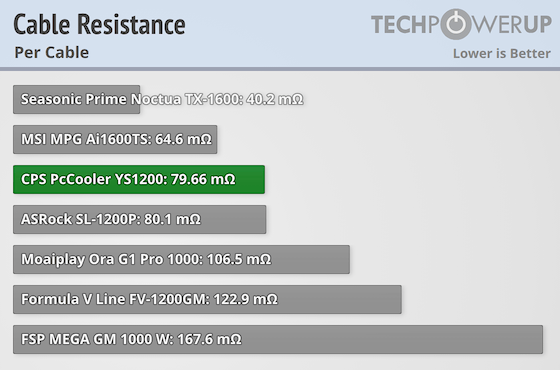
The YS1200 performs comfortably here, without too much power lost under a full artificial load.
Ripple
Ideally you want the DC voltage delivered by your power supply to be a completely flat line when looking through an oscilloscope. However, due to the switching nature of the ATX power supply and the less than ideal real world behavior of all the components involved, we get very small fluctuations in the voltage output, known as ripple and noise. The ATX spec allows a ripple of up to 120 mV for the +12 V rail and 50 mV for the minor rails.| Ripple (mV) | ||||
|---|---|---|---|---|
| Test Load | 12 V | 5 V | 3.3 V | Status |
| 5% | 14 mV | 9 mV | 11 mV | Pass |
| 10% | 15 mV | 10 mV | 11 mV | Pass |
| 20% | 16 mV | 11 mV | 13 mV | Pass |
| 30% | 18 mV | 13 mV | 14 mV | Pass |
| 40% | 19 mV | 13 mV | 15 mV | Pass |
| 50% | 21 mV | 14 mV | 17 mV | Pass |
| 60% | 22 mV | 15 mV | 18 mV | Pass |
| 70% | 24 mV | 16 mV | 19 mV | Pass |
| 80% | 26 mV | 18 mV | 21 mV | Pass |
| 90% | 28 mV | 20 mV | 23 mV | Pass |
| 100% | 29 mV | 21 mV | 24 mV | Pass |
| 110% | 32 mV | 23 mV | 26 mV | Pass |
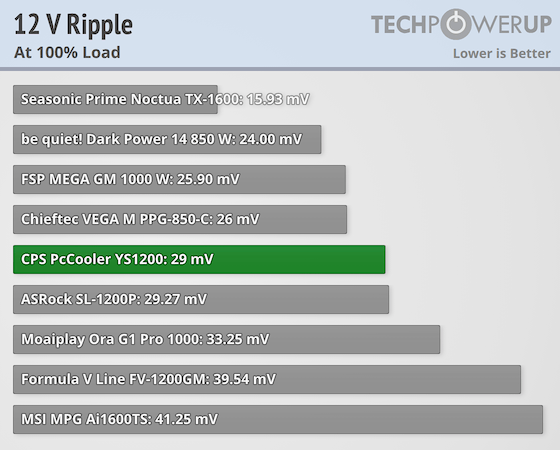
The ripple control is very well handled for the price, remaining very comfortably within ATX spec across the board.
Short Circuit Protection
Short circuit protection is one of the most fundamental and important protections for a power supply. If a short circuit is detected on any rails, the PSU should turn off and prevent damage to itself and other components.| Short Circuit Protection | |
|---|---|
| +12 V rail | Operational |
| +5 V rail | Operational |
| +3.3 V rail | Operational |
SCP was working as expected with the unit.
Nov 19th, 2026 16:14 CST
change timezone
Latest GPU Drivers
New Forum Posts
- Honestly, do you care about GTA VI? (164)
- Windows 11 General Discussion (7736)
- Current Sales, Bundles, Giveaways (10448)
- Last game you purchased? (1409)
- WarpCoreBench scores! (76)
- Got the EOL 32GB TridentZ 6000 CL26 1.4V (12)
- Dell Workstation Owners Club (3516)
- Making a game in Godot engine (4)
- DTS DCH Driver for Realtek HDA [DTS:X APO4 + DTS Interactive] (2815)
- Security Apps (2)
Popular Reviews
- Acemagic Retro X3 Review
- Ugreen NASync DXP4800 GT Review
- Upcoming Hardware Launches 2027 (Updated Nov 2026)
- Pulsar Office Tour & First Look at P1 Dual-Sensor Mouse
- AMD Zen 6 Technical Deep Dive
- Biwin Black Opal NV7400 2 TB Review
- Sapphire Radeon RX 7700 XT Pure Review
- Sapphire Radeon RX 7700 XT Pulse Review
- AMD Ryzen 7 9800X3D Review - The Best Gaming Processor
- Chieftec Iceberg PRO 360 DARK Review
TPU on YouTube
Controversial News Posts
- NVIDIA Co-Founder and CEO Jensen Huang Officially Resigns (489)
- Report: Jensen Huang Eyes NVIDIA Comeback (223)
- Open Letter Asking NVIDIA to Reinstate Jensen Huang Passes 115,000 Signatures (184)
- OpenAI CEO Argues Home PCs Waste the World's Limited DRAM Supply (152)
- NVIDIA Launches Investigation Into Jensen Huang's Relationship With Suspected Chinese Spy (136)
- Intel "Raptor Lake Next" 16-Core and 20-Core CPUs Surface (130)
- Legendary Game Studio BioWare Shuts Down Following EA Layoffs (104)
- Dell CEO Says the Memory Shortage Will Get Worse in 2027 (95)