 33
EK Fluid Works S5000 Workstation Review
(33 Comments) »Introduction

Founded in 2003, EK has since risen from its humble beginnings to become a dominant player in the PC water-cooling market. In fact, the brand is nearly synonymous with PC water-cooling itself. The company provides solutions to meet every need, be it cooling your CPU, motherboard VRM, or graphics cards. However, not content to rest on its laurels, the company has continued to expand into new markets, such as all-in-one liquid coolers and even powerful workstations. Needless to say, if you ever thought about water-cooling your computer, EK was likely one of the first companies to catch your eye.

Today's review will focus on the EK Fluid Works S5000 workstation. Rather than being known for just water cooling, EK is now on the path of providing complete, fully liquid-cooled workstations designed to handle any and all tasks. That isn't just bravado as the Studio series S5000 has some serious specifications to back it up. Our test system comes equipped with an AMD Ryzen Threadripper 3990X 64c/128t processor, 128 GB of DDR4 memory, and two NVIDIA GeForce RTX 3090 graphics cards. Add the custom liquid cooling and fancy chassis and you have a complete system that crunches serious numbers and looks damn good doing it without excess noise or heat. So let's get down to business and see what this behemoth of computing power can do!
| Specifications | |
|---|---|
| Manufacturer: | EK Fluid Works |
| Model: | Fluid Works S5000 |
| Chassis: | Lian Li V3000 1x Power switch 4x USB 3 Type-A 1x USB 3 Type-C 1x Headphone jack 1x Microphone jack |
| Processor: | AMD Threadripper 3990X 2.9 GHz Base (4.3 GHz Boost) |
| CPU Cooling: | Custom liquid-cooling loop |
| Motherboard: | AMD TRX40 ASRock TRX40 Creator |
| Operating System: | Windows 10 64-bit |
| Integrated Graphics: | none |
| Dedicated Graphics: | 2x Zotac GeForce RTX 3090 24 GB GDDR6X 3x DisplayPort 1x HDMI |
| Memory: | 128 GB (4x 32 GB) G.Skill Ripjaws CL 16-18-18-38 @ 3200 MHz DDR4 8x DIMM slots (4x occupied) |
| Storage: | 1 TB Samsung 980 PRO NVMe SSD 8x SATA ports 3x M.2 slots (1x occupied) |
| Optical Drive: | Not included |
| Rear I/O: | 2x Antenna ports 1x PS/2 mouse/keyboard port 1x Optical SPDIF Out port 2x USB 3.2 Gen2 Type-A ports (10 Gb/s) 1x USB 3.2 Gen2x2 Type-C port (20 Gb/s) 4x USB 3.2 Gen1 ports 2x RJ-45 LAN ports with LED 1x Clear CMOS button 1x BIOS Flashback button HD audio jacks: rear speaker, central, line in, front speaker, microphone; |
| Networking/Communication: | 1x Realtek Dragon RTL8125AG 2.5 GbE 1x AQUANTIA / Marvell AQC10710 10 GbE 1x Intel AX200 Wi-Fi 6 |
| Audio: | Realtek ALC4050H and ALC1220 |
| Input device: | USB mouse USB keyboard |
| Power: | EVGA SuperNOVA 1600 P2 1600 W 80 Plus Platinum |
| Warranty: | Three years |
| MSRP: | $15,761 |
Packaging and Contents
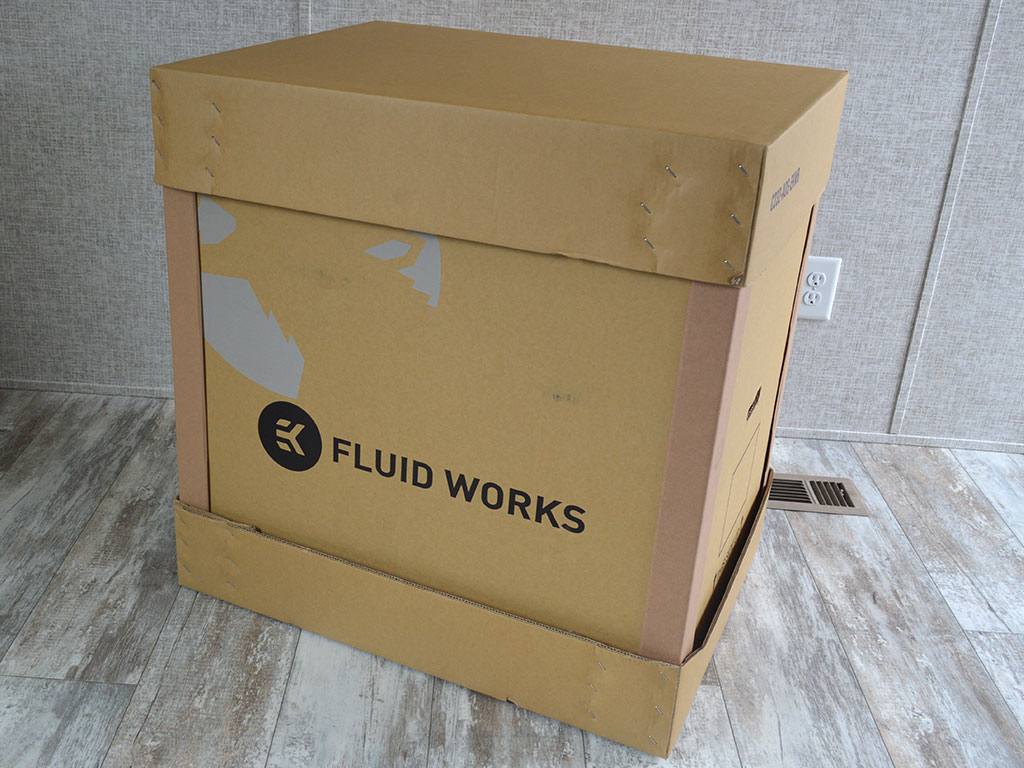
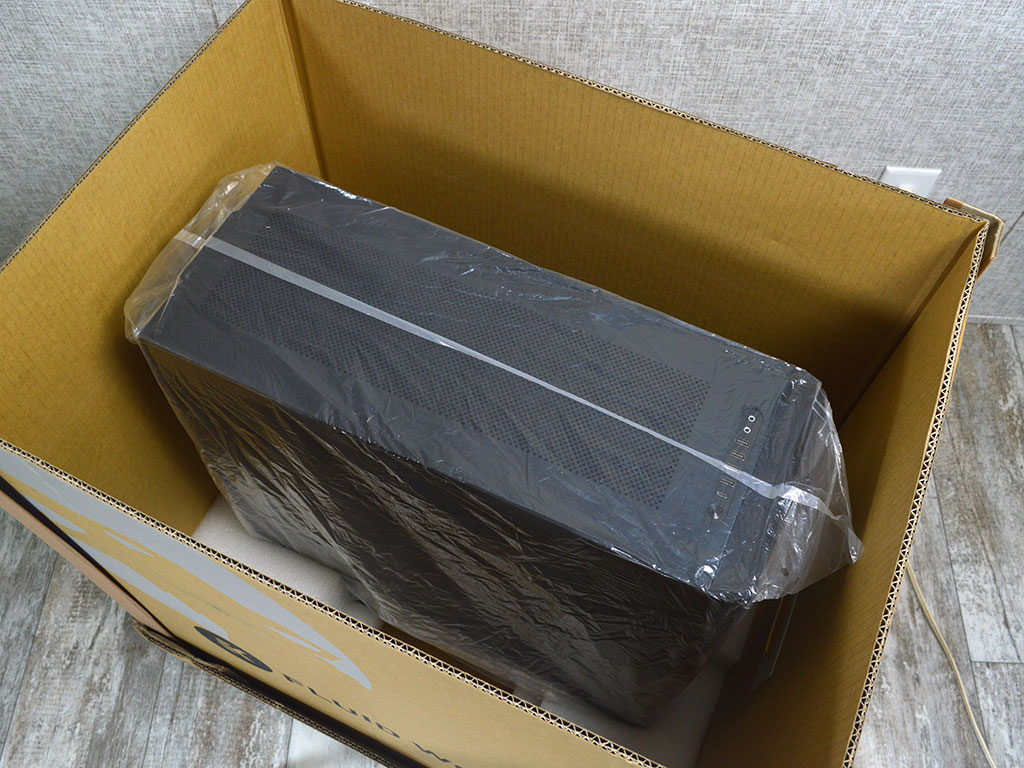
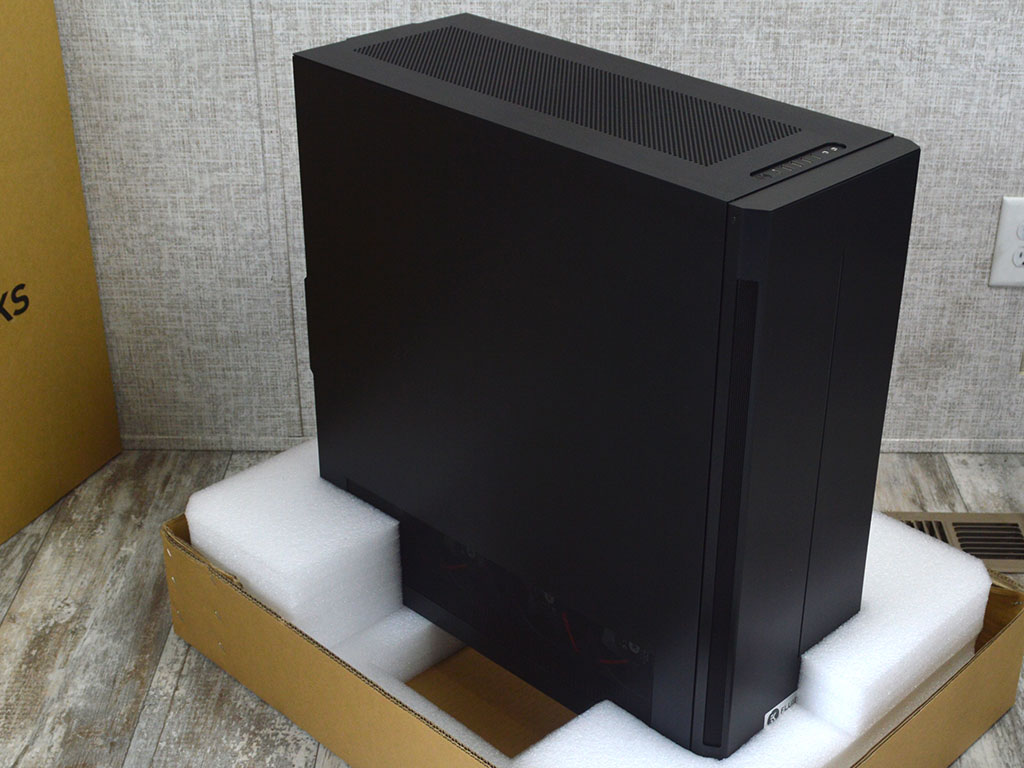
While the box isn't fancy or flashy, it is absolutely huge. I had to borrow a truck to pick it up at the drop-off point since it would not fit in my car. The outer cardboard layer is reinforced with cardboard ribs for added extra structural integrity, with massive foam blocks on the top and bottom cradling the system and keeping it firmly in place. EK has placed the system in a sealed bag to keep it clean and dry.
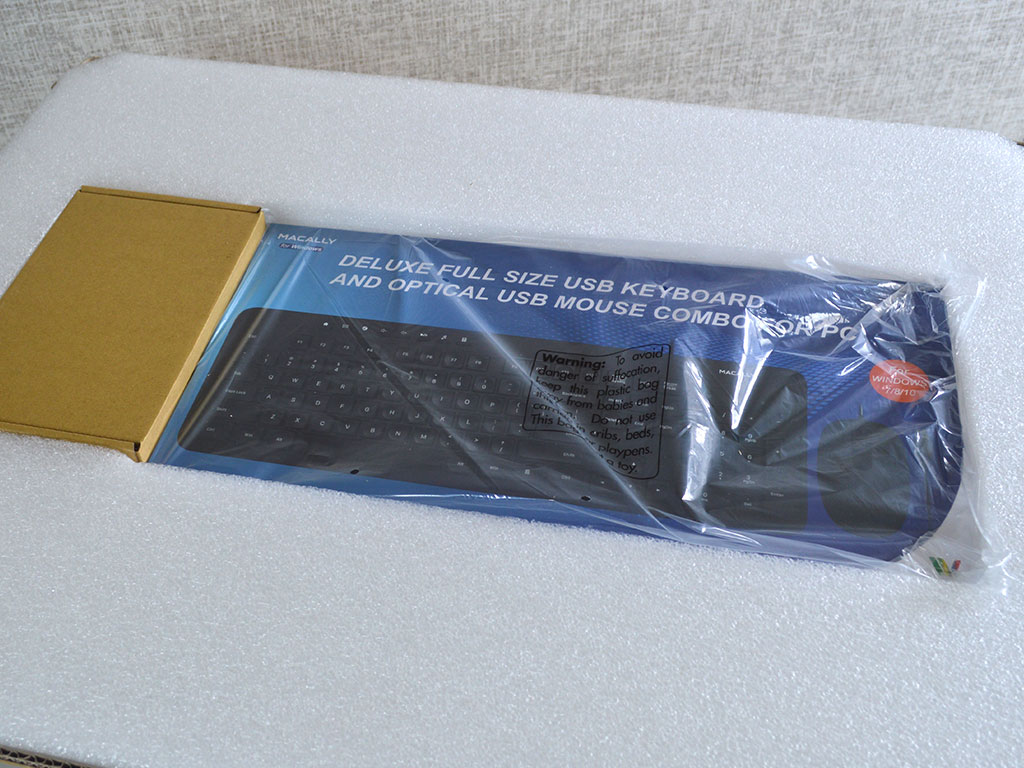
In terms of overall contents, it is a very spartan bundle. You get a power cord, WiFi antenna, USB keyboard, and mouse. That said, it is also all you will need to get the system up and running once connected to your monitor of choice.
- EK Fluid Works S5000
- Power cable
- Keyboard
- Mouse
- WiFi antenna
A Closer Look
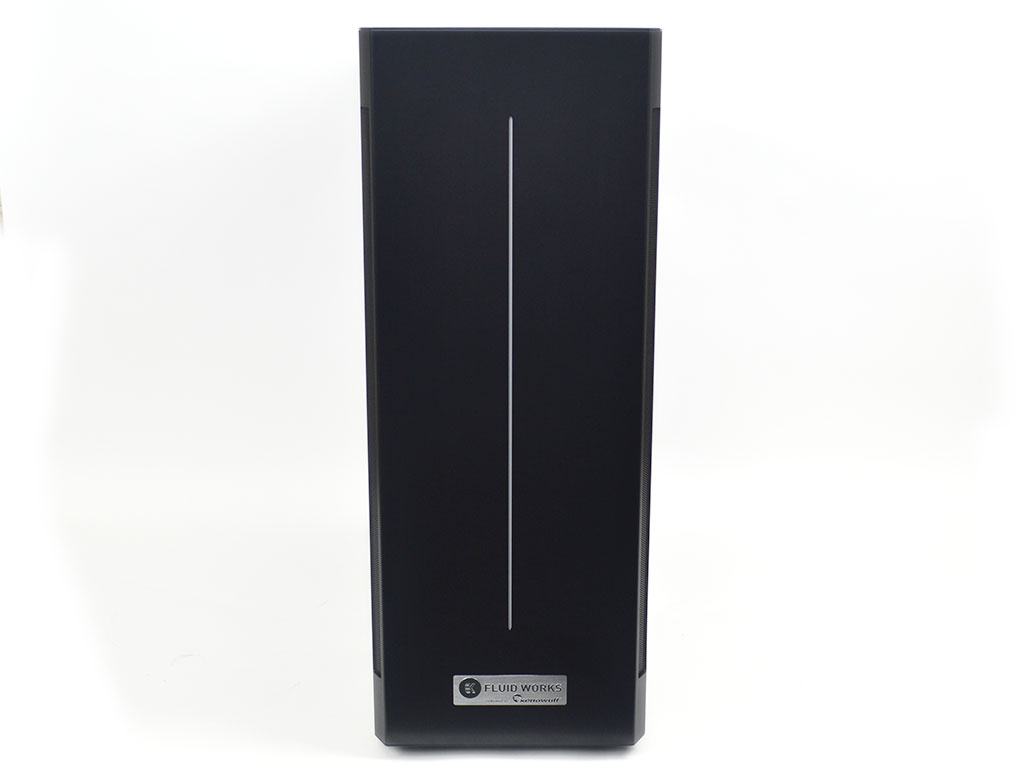

The front of the chassis has a lovely clean aesthetic with a single bright line down the middle adding a bit of contrast and visual interest along with the EK Fluid Works and Xenowulf logos. Meanwhile, the left side is a simple black brushed aluminium panel with a vent at the bottom that is used as an exhaust on the EK S5000.
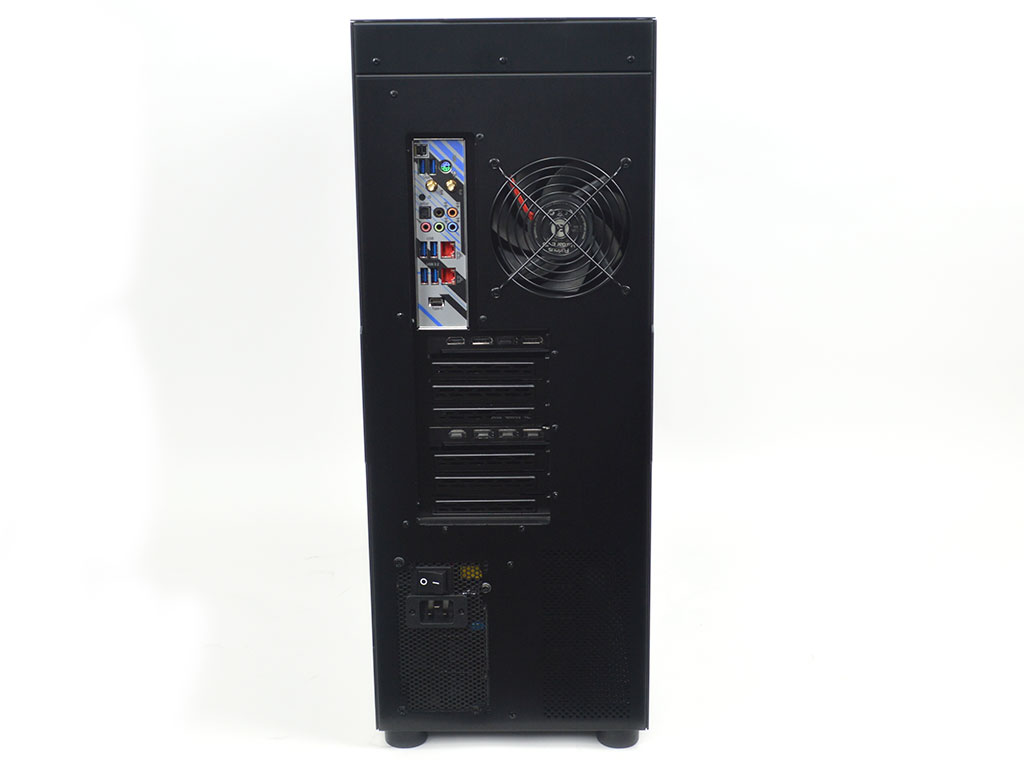

Much like the front, the back of the chassis is simple and clean with a single 120 mm exhaust fan. Overall, the chassis has eight expansion slots, but more interesting is the position of the power supply. It sits to the bottom left, thus providing space for the massive cooling system EK chose. Meanwhile, the right-hand side also has an enormous vent for fresh air to reach the radiator at the bottom of the chassis and the power supply. Other than that, it is clean and nondescript.
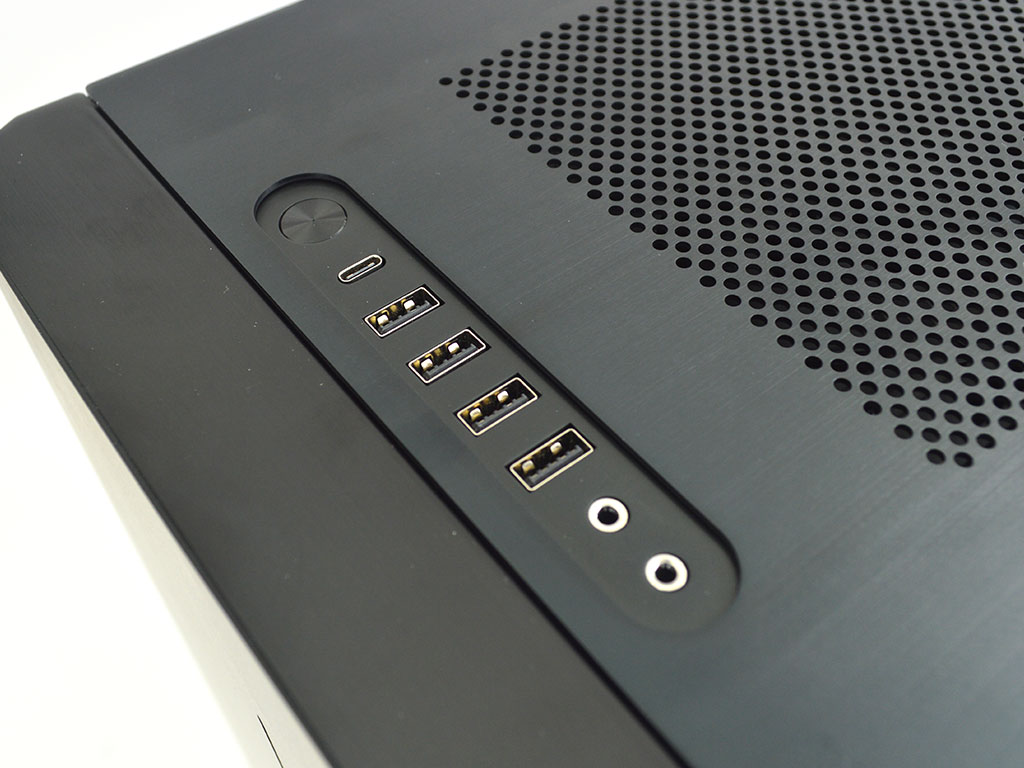

A closer look at the top reveals a plethora of connectivity options, including a USB Type-C and 4x USB Type-A, along with the power button, headphone, and microphone jacks. As for the top panel itself, it is vented for ample access to airflow for the top 480 mm radiator.
A Look Inside

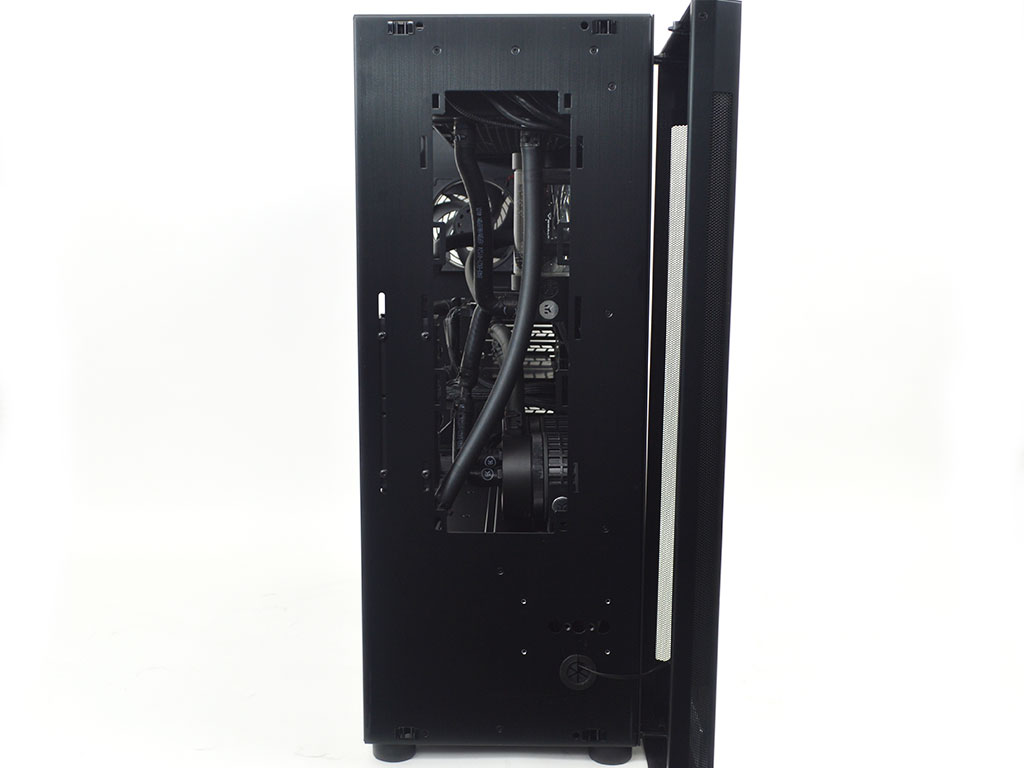
Getting into the system is relatively easy, but may be problematic for some because of how the panels are connected to the chassis. The case EK chose is based on the Lian Li V3000 and uses large metal push pins that secure all the panels. Thus, lifting up on them, you will encounter stiff resistance, but they will let go and remove cleanly. This is how EK managed such a clean look, as no screws are used. With the top panel removed, you can see the four EK Furious Vardar EVO fans, which have a maximum RPM of 3000. These fans blow air down across a 480 mm radiator that is 45 mm thick. Meanwhile, removing the front panel shows no fans in the front. While that could be seen as an issue due to the orientation of the liquid-cooling system, it is not a problem.


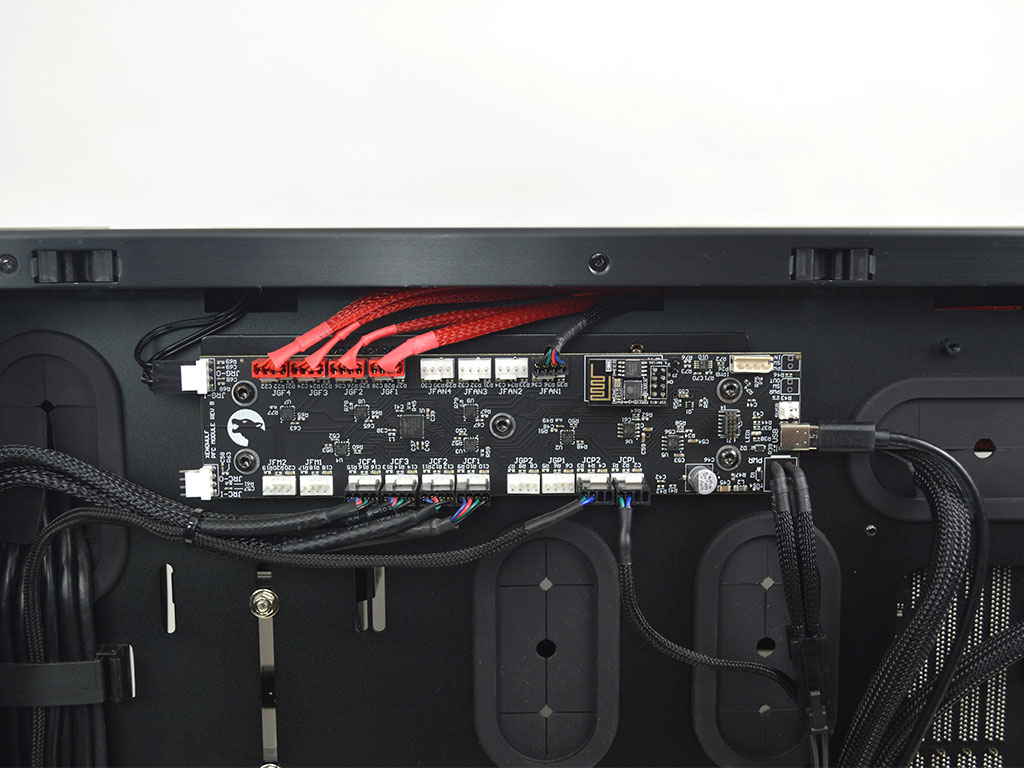
Removing the left side panel gives access to most of the system and is on the surface an easy task. However, the chassis has what I would consider a design fault. The panels use metal posts and plastic clips to secure them. Removal and re-installation of the panels can cause the plastic clips to break. This may prove problematic for future maintenance. The system's internals are clean, and the tubing runs nicely spaced. Considering the specifications of the system and its massive liquid-cooling loop, it's a nice surprise to see ample space to make upgrades rather easy. Flipping to the right side, I found the cable runs to be neat to where I felt a bit jealous considering the chaotic spaghetti wiring of my personal system. Suffice it to say, EK Fluid Works paid attention to the minor details with the Studio Series S5000. EK went with a separate fan control hub via the PCB mounted at the top to keep fan wiring under control, which is likely a good call since it makes cable management easier and allows for a simpler PWM control scheme. We see the EVGA SuperNOVA 1600 P2 power supply here as well. Considering the system's potential power draw, this 1600-watt monster should do just fine, as initial tests show the system having an Idle power draw of 240 watts at the wall and between 1000-1250 watts under intense load.

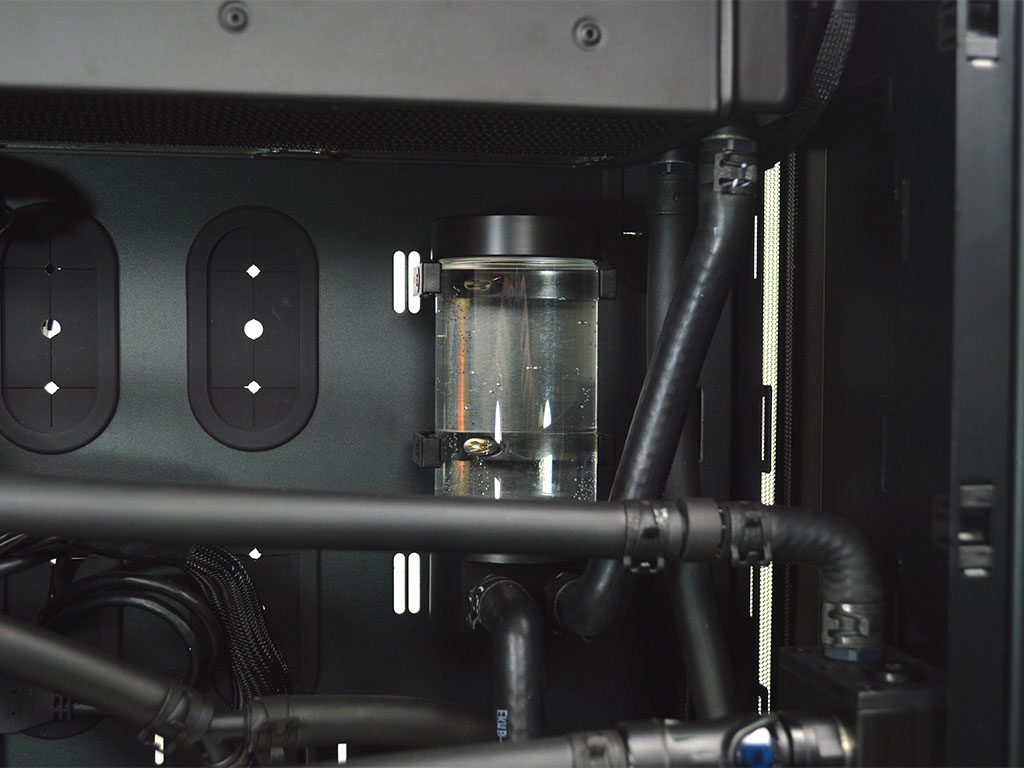
A closer look at the CPU block reveals it is from the EK Quantum Velocity lineup. Meanwhile, while nothing fancy, the system memory is more than suited for the job, with 128 GB installed in total. Furthermore, with four more open DIMM slots, it can easily be doubled to the maximum 256 GB if necessary. Finally, large heatsinks on the ASRock TRX40 Creator keep temperatures in check relatively easily. Moving towards the front of the chassis, EK has placed the reservoir with enough room for access without much trouble. Also note the barb and clamp fittings instead of the usual compression fittings on consumer systems.


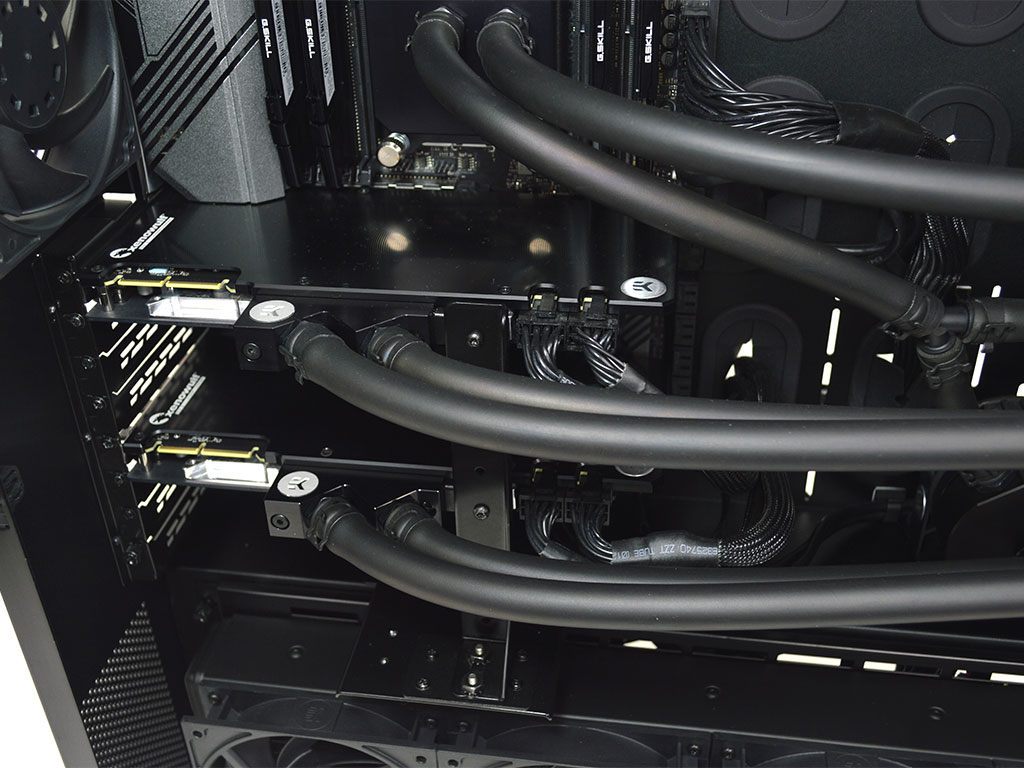
The distribution block is an interesting setup; it has some quick disconnect fittings that should help with overall maintenance, which is one of my primary concerns with a system like this. Thankfully, its location at the front with easy access should help immensely for future upgrades or expansion. As for the pumps, they are EK D5 units, and no, that isn't a typo. The system utilizes dual pumps, which should provide more pressure and flow along with a bit of security should a single pump fail, although I have yet to have a D5 pump fail. As for the two Zotac NVIDIA RTX 3090 24 GB graphics cards, they are cooled in parallel via the distribution block. Some quick disconnect fittings for the CPU block would have been nice, as that would make upgrades and a complete system teardown for maintenance even easier. To my surprise, the GPUs are supported by a metal bracket, which means no sag, and best of all, they will remain where they belong despite your favorite shipping firm's best efforts.


As for the back of the system, there are plenty of connectivity options with five USB and two LAN ports, WiFi, and more. While the connectivity isn't the best I have ever seen, it should prove more than enough for any real-world situation. A quick look at the "Furious" EK Vardar fan just because, and finally, the memory from G.Skill rated at DDR4-3200 CL 16-18-18-38.
Our Patreon Silver Supporters can read articles in single-page format.
Nov 27th, 2026 04:58 CST
change timezone
Latest GPU Drivers
New Forum Posts
- What's your main Black Friday / Cyber Monday purchase? (28)
- Wireless Internet sharing between PC and router both-ways, is it possible? (31)
- Mouse Pad advice - Shidenkai out of production? (8)
- Using sodimm+adapter instead of full size dimm DDR5? (103)
- SABRENT AIC's (no bifurcation) Black Friday deals (0)
- Found Out Why My FygoOS Transfers Were Stuck at 11 MB/s (0)
- X79 and/or rampage IV OC'ing thread for those of us still left.... (2461)
- Will zen 6 mobos have anything extra vs current ones? (63)
- Dell Dimension E510 Retro Gaming PC Upgrade & Modification (3)
- Gacha Games - Discussions, Pulls, Updates, etc. (1166)
Popular Reviews
- VZMORE AX9 Max Review
- Upcoming Hardware Launches 2027 (Updated Nov 2026)
- ASRock X870E Challenger Wi-Fi White Review
- AMD Ryzen 7 9800X3D Review - The Best Gaming Processor
- Microsoft Surface Laptop Ultra Review - The Next-gen Arm Laptop
- AMD Zen 6 Technical Deep Dive
- Montech CyberFlow ARGB 360 Review
- Phantom Blade Zero Performance Benchmark Review - 35 GPUs Tested
- Corsair RM1200e (Second Generation) Review
- ORICO Obook15 AI Review
TPU on YouTube
Controversial News Posts
- Jensen Huang Reinstated as CEO of NVIDIA (617)
- NVIDIA Co-Founder and CEO Jensen Huang Officially Resigns (492)
- Report: Jensen Huang Eyes NVIDIA Comeback (281)
- Open Letter Asking NVIDIA to Reinstate Jensen Huang Passes 115,000 Signatures (184)
- OpenAI CEO Argues Home PCs Waste the World's Limited DRAM Supply (152)
- NVIDIA Launches Investigation Into Jensen Huang's Relationship With Suspected Chinese Spy (136)
- Intel Razor Lake Gets a 12 P-Core bLLC Chip With No E-Cores, Per Leak (94)
- NVIDIA GeForce RTX 50-Series Scheduled for up to $500 Price Hike This Week (89)