 30
Endorfy Meta Review - Budget-friendly Gaming Chair
(30 Comments) »Value and Conclusion
- The Endorfy Meta is priced at €185 (available only in Europe)
- Overall build quality
- Basic comfort for users under 185 cm (6'1") tall
- Soft padding
- At best "fine" for users above 185 cm (6'1") tall
- Limited adjustability
- Narrow shoulder area
- Lower lifting capacity (120 kg/265 lbs) than competitors
- Limited material options (only fabric)
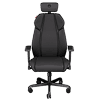
And so we've reached the final part of this review. However, I'd like to begin the summary of the Endorfy Meta review by asking a simple—yet not entirely obvious—question: are we really dealing with an ergonomic chair here, or rather a "regular" gaming chair? After all, the lack of adjustable lumbar support, backrest height adjustment, and the somewhat limited headrest adjustment don't exactly define a fully ergonomic design. So it's worth keeping in mind that while this model is partially marketed as ergonomic, in practice it feels more like a gaming chair that borrows a few features from truly ergonomic solutions.
With that said, let's go back to the very beginning. The chair arrived in a standard package, containing all the necessary accessories for assembly. The packaging itself did its job well—everything was properly secured, and there's really nothing to complain about here. The assembly process was generally straightforward, although at one stage it required a bit more force and some awkward positioning. Still, it remained within reasonable limits and shouldn't pose a major problem for most users.
The build quality of the individual components, already noticeable during assembly, left a positive impression. There were no visible post-production defects or similar issues. Once assembled, however, some minor play can be noticed in certain elements, such as the armrests or the headrest. That said, this is still within acceptable limits for this price range, so overall build quality can be considered good.
Looking at the individual parts from a practical standpoint, starting from the bottom, the base and casters perform without any issues, as does the gas lift. The tilt mechanism is slightly less impressive, mainly due to the noises it can produce when operating near the maximum positions. The seat, on the other hand, deserves praise—it is soft, comfortable and pleasant to the touch. The armrests also surprised me positively, thanks to their smooth and precise three-direction adjustment. Of course, there is a bit of play, but that is something commonly found even in more expensive chairs.
Another key component is the backrest, which has its strengths, particularly in terms of upholstery and padding. Unfortunately, the overall shape is less successful. The narrowing at shoulder level can cause discomfort, even for users who are not particularly broad-shouldered. Additionally, the lumbar support works well for users up to around 185 cm (6'1") tall, but becomes less effective for taller individuals.
Finally, the headrest—generally a solid element, though not without its flaws. The amount of play and the noises it can produce during adjustment or use are noticeable, and even considering the price, they are not something everyone will be willing to overlook.
Returning to the price, the Endorfy Meta is available in Europe for around €185, depending on the market. This is not an excessive amount, but the competition in this segment is quite strong. One of the most interesting alternatives is the Sharkoon OfficePal C20, which can be found for under €190. Compared to the Endorfy model, it stands out mainly due to its greater adjustability, including an adjustable lumbar section, which the Meta lacks. It also avoids the narrowing at shoulder height and offers a higher maximum load capacity (135 kg vs 120 kg/298 lbs vs 265 lbs). On the downside, its mech backrest makes it firmer, but overall it is a very compelling option with few clear disadvantages.
Another alternative in a similar price range is the Corsair TC100 Relaxed, representing a move traditional gaming chair design. It offers independent backrest recline, in addition to the standard tilt mechanism. Its biggest advantage is size—there is simply more room across the board, which translates into improved comfort. Despite its bucket-style design, it is less restrictive around the shoulders than the Endorfy Meta. It also offers a choice between fabric and leather upholstery, as well as more color options. On the downside, the armrests are only 2D adjustable, and support relies on separate lumbar and head cushions, limiting adjustability.
Lastly, there is another ergonomic alternative—the Sihoo M57, which can also be found for around €200. At first glance, it closely resembles the Sharkoon model mentioned earlier, and in many ways, it offers similar features. It includes adjustable lumbar support, 3D armrests, better headrest adjustment, and a higher declared weight capacity of up to 150 kg. However, its size and overall comfort may not suit taller users, making it a better choice for those under 180-185 cm (5'11"-6'1").
Taking everything into account, it's difficult to award the Endorfy Meta any special distinction. It is a chair with both strengths and weaknesses, but it doesn't particularly stand out in its price range—=especially when compared to the competitors like Sharkoon and Sihoo in the ergonomic category, or Corsair in the gaming segment. Is it a bad purchase? Not really. But depending on your expectations and priorities, you may find better value elsewhere.
That's it for this review. Thanks for reading, and see you in the next one. Stay healthy.
Nov 14th, 2026 03:23 CST
change timezone
Latest GPU Drivers
New Forum Posts
- Tell me about your favourite graphics card (39)
- Ryzen 7 8700G OC (7)
- What are you playing? (26217)
- Post your Cinebench R23 Score (3172)
- AI generated images... (225)
- 3D Printer Club (850)
- Browser Bechmark scores (132)
- MSI RTX 4090 SUPRIM X: FBPA5 training failure; seeking signed 20 GB VBIOS with 0x20 mask (0)
- Requesting original VBIOS for Gigabyte RX 5700 XT GAMING OC 8G Rev 2.0 (Micron) (1)
- no "PhysX" workable (9)
Popular Reviews
- AMD Zen 6 Technical Deep Dive
- Corsair HX1000i Shift Crystal Review
- NZXT C1200 Platinum Review
- ASUS ROG Strix B850-I Gaming Wi-Fi7 W Review
- Upcoming Hardware Launches 2027 (Updated Nov 2026)
- Montech King 95 3D PRO Review
- NZXT H7 RGB+ Review
- NZXT H5 Review
- Phantom Blade Zero Performance Benchmark Review - 35 GPUs Tested
- XPG NIMBUS PLUS Review - Mid-range Chair With Strong Competitors
TPU on YouTube
Controversial News Posts
- NVIDIA Co-Founder and CEO Jensen Huang Officially Resigns (382)
- OpenAI CEO Argues Home PCs Waste the World's Limited DRAM Supply (152)
- NVIDIA Launches Investigation Into Jensen Huang's Relationship With Suspected Chinese Spy (136)
- Intel "Raptor Lake Next" 16-Core and 20-Core CPUs Surface (130)
- Legendary Game Studio BioWare Shuts Down Following EA Layoffs (104)
- Dell CEO Says the Memory Shortage Will Get Worse in 2027 (95)
- NVIDIA GeForce RTX 50-Series Scheduled for up to $500 Price Hike This Week (89)
- Modder Fits RTX 5090 With Four 8-Pin Connectors, Halving Current per Wire (80)