 48
EVGA GeForce RTX 2080 Ti FTW3 Ultra 11 GB Review
(48 Comments) »Introduction

NVIDIA launched the GeForce RTX 20-series in September this year, with support for several new technologies like machine learning and RTX Raytracing. This feature is so big for NVIDIA that it has changed the naming of their GeForce cards from "GTX" to "RTX".
NVIDIA RTX is a near-turnkey real-time ray-tracing model for game developers that lets them fuse real-time ray-traced objects into 3D scenes that have been rasterized. Ray-tracing the whole scene in existence isn't quite possible yet, but the results with using RTX are still better-looking than anything rasterizing can achieve. To even get those few bits of ray tracing done right, an enormous amount of compute power is required. NVIDIA has hence deployed purpose-built hardware components on its GPUs that sit alongside all-purpose CUDA cores, called RT cores.

EVGA's RTX 2080 Ti FTW3 Ultra comes with a custom PCB design sporting a powerful 16-phase VRM for the GPU. Also included is a dual BIOS feature and a fan header that's synchronized with the GPU's fan speed, so you can run a case fan at higher speeds only when the card gets warm. EVGA has bumped the board power limit up to 300 W, which is the highest we've seen so far (matching the MSI RTX 2080 Ti Gaming X Trio). Cooling capabilities have also been improved a lot: the card features a triple-slot, triple fan cooler.
Priced at $1349, the card is not cheap—$150 more than the NVIDIA RTX 2080 Ti Founders Edition, but the EVGA RTX 2080 Ti FTW3 Ultra has 120 MHz higher Boost Clock.
| Price | Shader Units | ROPs | Core Clock | Boost Clock | Memory Clock | GPU | Transistors | Memory | |
|---|---|---|---|---|---|---|---|---|---|
| GTX 1070 | $390 | 1920 | 64 | 1506 MHz | 1683 MHz | 2002 MHz | GP104 | 7200M | 8 GB, GDDR5, 256-bit |
| RX Vega 56 | $400 | 3584 | 64 | 1156 MHz | 1471 MHz | 800 MHz | Vega 10 | 12500M | 8 GB, HBM2, 2048-bit |
| GTX 1070 Ti | $400 | 2432 | 64 | 1607 MHz | 1683 MHz | 2000 MHz | GP104 | 7200M | 8 GB, GDDR5, 256-bit |
| GTX 1080 | $470 | 2560 | 64 | 1607 MHz | 1733 MHz | 1251 MHz | GP104 | 7200M | 8 GB, GDDR5X, 256-bit |
| RX Vega 64 | $570 | 4096 | 64 | 1247 MHz | 1546 MHz | 953 MHz | Vega 10 | 12500M | 8 GB, HBM2, 2048-bit |
| GTX 1080 Ti | $675 | 3584 | 88 | 1481 MHz | 1582 MHz | 1376 MHz | GP102 | 12000M | 11 GB, GDDR5X, 352-bit |
| RTX 2070 | $499 | 2304 | 64 | 1410 MHz | 1620 MHz | 1750 MHz | TU106 | 10800M | 8 GB, GDDR6, 256-bit |
| RTX 2070 FE | $599 | 2304 | 64 | 1410 MHz | 1710 MHz | 1750 MHz | TU106 | 10800M | 8 GB, GDDR6, 256-bit |
| RTX 2080 | $699 | 2944 | 64 | 1515 MHz | 1710 MHz | 1750 MHz | TU104 | 13600M | 8 GB, GDDR6, 256-bit |
| RTX 2080 FE | $799 | 2944 | 64 | 1515 MHz | 1800 MHz | 1750 MHz | TU104 | 13600M | 8 GB, GDDR6, 256-bit |
| RTX 2080 Ti | $999 | 4352 | 64 | 1350 MHz | 1545 MHz | 1750 MHz | TU102 | 18600M | 11 GB, GDDR6, 352-bit |
| RTX 2080 Ti FE | $1199 | 4352 | 64 | 1350 MHz | 1635 MHz | 1750 MHz | TU102 | 18600M | 11 GB, GDDR6, 352-bit |
| EVGA RTX 2080 Ti FTW3 Ultra | $1349 | 4352 | 64 | 1350 MHz | 1755 MHz | 1750 MHz | TU102 | 18600M | 11 GB, GDDR6, 352-bit |
Architecture
On the 14th of September, we published a comprehensive NVIDIA "Turing" architecture deep-dive article including coverage of its three new silicon implementations and the new RTX Technology. Be sure to catch that article for more technical details.
The "Turing" architecture caught many of us by surprise because it wasn't visible on GPU architecture roadmaps until a few quarters ago. NVIDIA took this roadmap detour over carving out client-segment variants of "Volta" as it realized it had achieved sufficient compute power to bring its ambitious RTX Technology to the client segment. NVIDIA RTX is an all-encompassing, real-time ray-tracing model for consumer graphics, which seeks to bring a semblance of real-time ray tracing to 3D games.
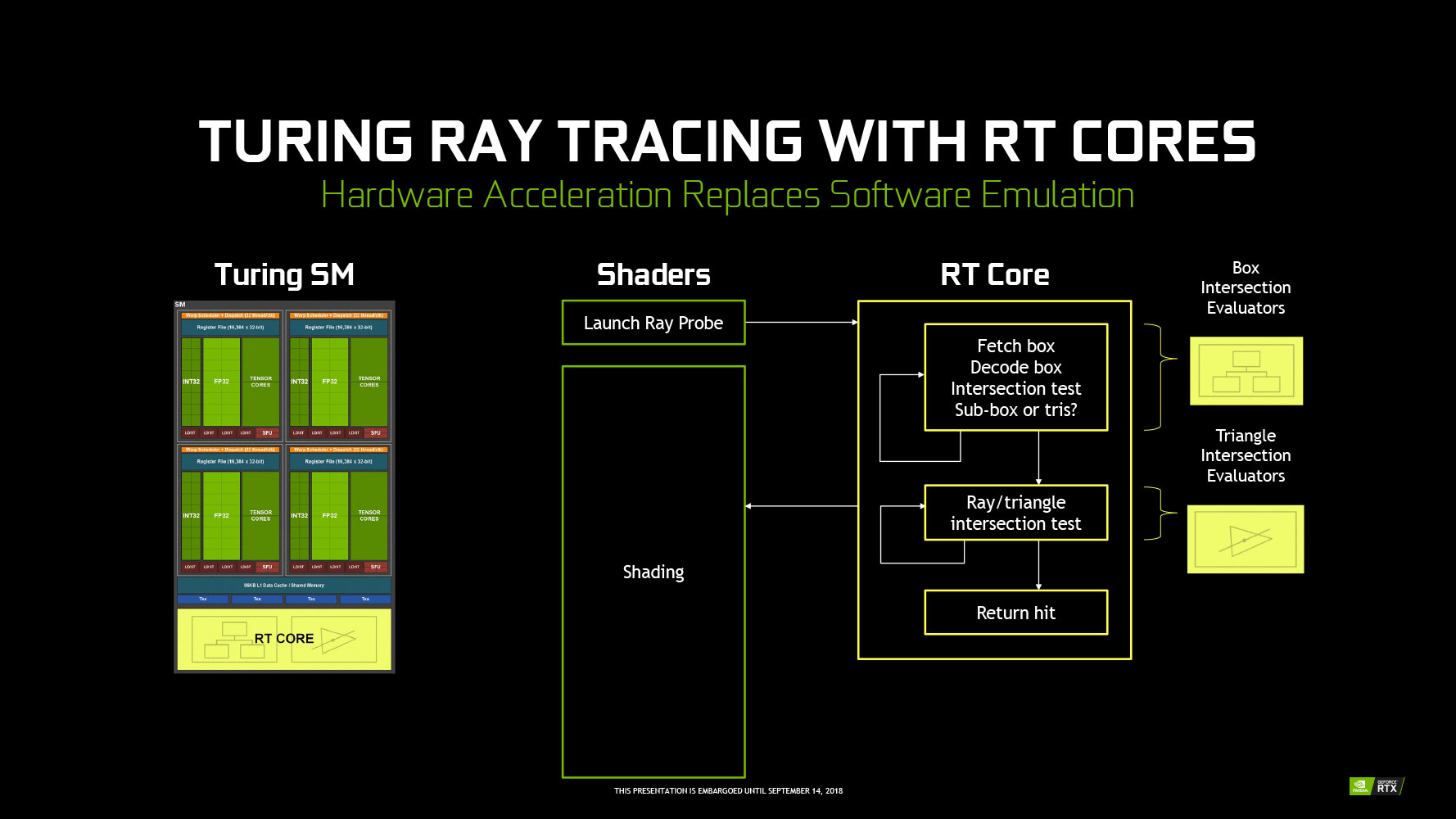
To enable RTX, NVIDIA has developed an all-new hardware component that sits next to CUDA cores, called the RT core. An RT core is a fixed-function hardware that does what the spiritual ancestor of RTX, NVIDIA OptiX, did over CUDA cores. You input the mathematical representation of a ray and it will transverse the scene to calculate the point of intersection with any triangle in the scene. This is a computationally heavy task that would have otherwise bogged down the CUDA cores.
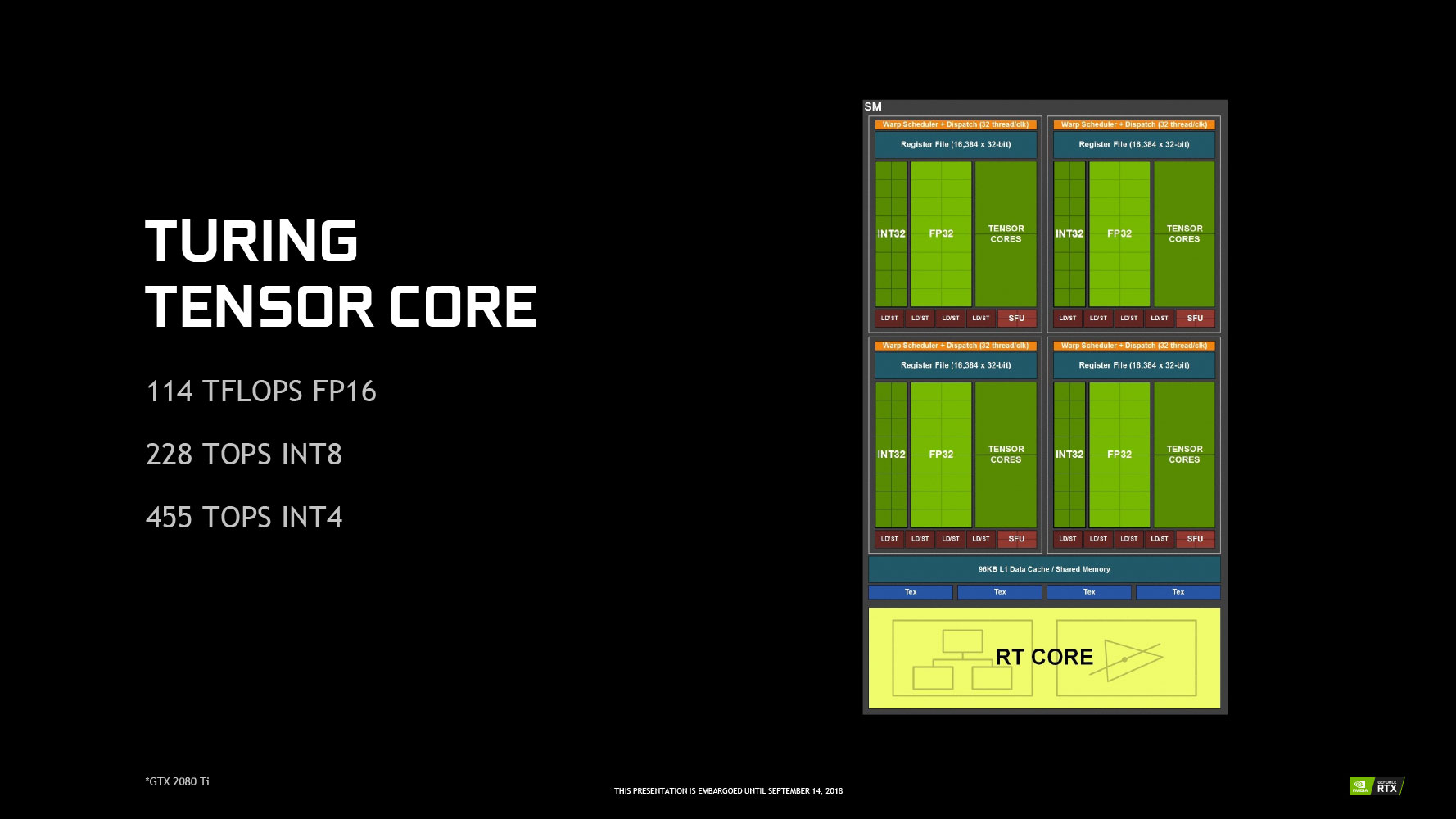
The other major introduction is the Tensor Core, which made its debut with the "Volta" architecture. These too are specialized components tasked with 3x3x3 matrix multiplication, which speeds up AI deep-learning neural net building and training. Its relevance to gaming is limited at this time, but NVIDIA is introducing a few AI-accelerated image-quality enhancements that could leverage Tensor operations.

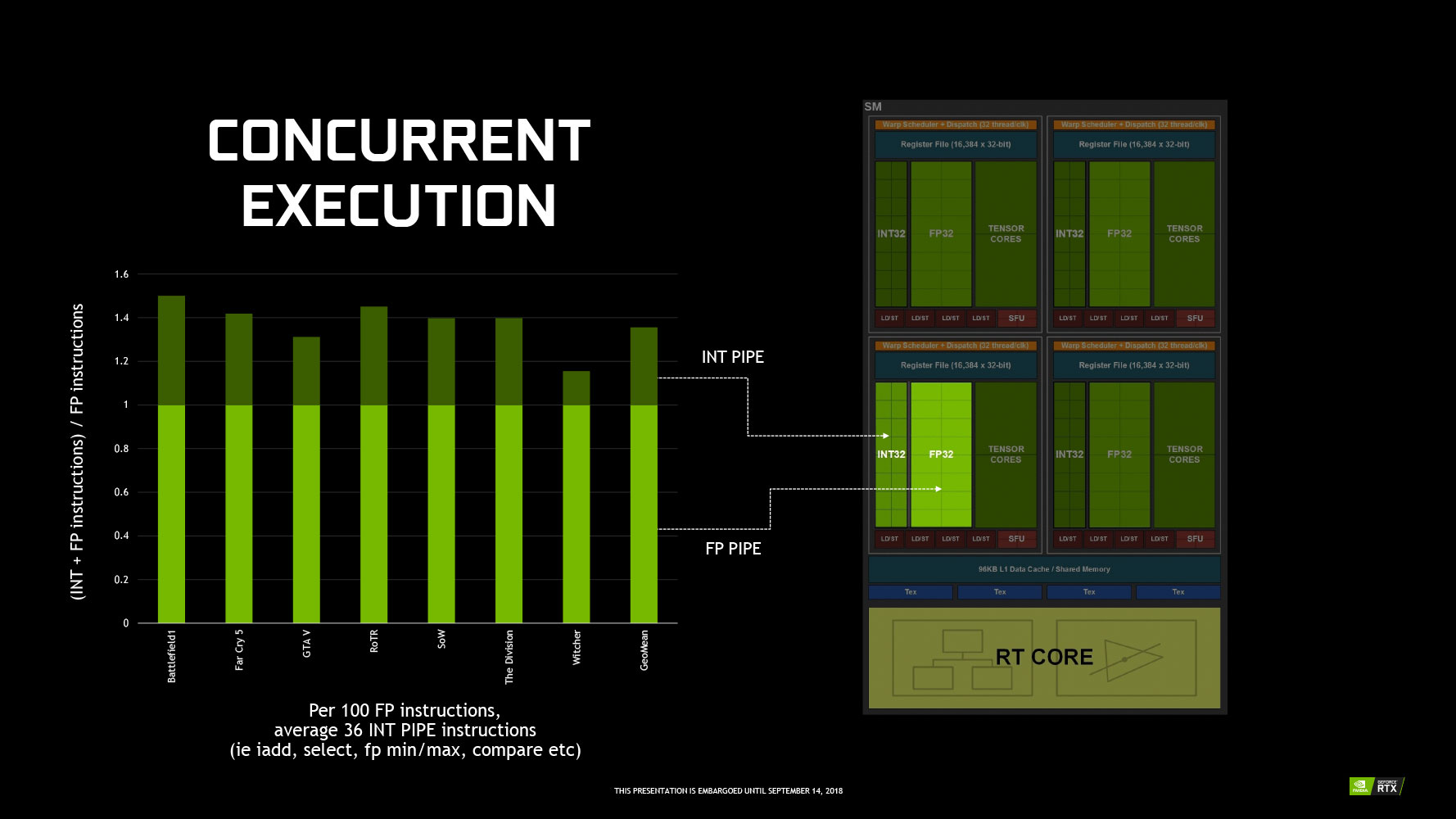
The component hierarchy of a "Turing" GPU isn't much different from its predecessors, but the new-generation Streaming Multiprocessor is significantly different. It packs 64 CUDA cores, 8 Tensor Cores, and a single RT core.
TU102 Graphics Processor

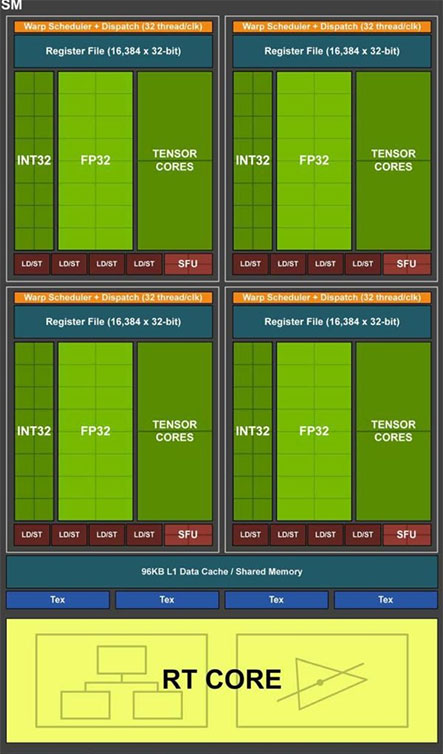
The TU102 is the largest silicon based on the "Turing" architecture and powers the GeForce RTX 2080 Ti. It's also the biggest GPU die NVIDIA ever built with over 18.6 billion transistors sitting on a 775 mm² die that has been fabricated on the 12 nanometer process by TSMC. As we mentioned earlier, the essential component hierarchy on the "Turing" architecture hasn't changed. What has changed, however, is that the Streaming Multiprocessor (SM), the indivisible sub-unit of the GPU, now packs CUDA cores, RT cores, and Tensor cores orchestrated by a new Warp Scheduler that supports concurrent INT and FP32 ops, which should improve the GPU's asynchronous compute performance.
At the topmost level, the GPU takes host connectivity from PCI-Express 3.0 x16, an NVLink interface, and connects to GDDR6 memory across a 384-bit wide memory bus. On the RTX 2080 Ti, the memory interface is narrowed to 352-bit and wired to 11 GB of memory. The GigaThread engine marshals load between six GPCs (graphics processing clusters). Each GPC has a dedicated raster engine and six TPCs (texture processing clusters). A TPC shares a PolyMorph engine between two SMs. Each SM packs 64 CUDA cores, 8 Tensor cores, and an RT core.
There are, hence, 768 CUDA cores, 96 Tensor cores, and 12 RT cores per GPC, and a grand total of 4,608 CUDA cores, 576 Tensor cores, and 72 RT cores across the TU102 silicon. The GeForce RTX 2080 Ti is carved out of the TU102 by disabling four SMs, resulting in 4,352 CUDA cores, 544 Tensor cores, and 68 RT cores. The GPU is endowed with 272 TMUs and 96 ROPs.

As we mentioned, the memory bus is narrowed down slightly to 352-bit, which holds 11 GB of GDDR6 memory clocked at 14 Gbps, resulting in a memory bandwidth of 616 GB/s.
Features
Again, we highly recommend you read our article from the 14th of September for intricate technical details about the "Turing" architecture feature set, which we are going to briefly summarize here.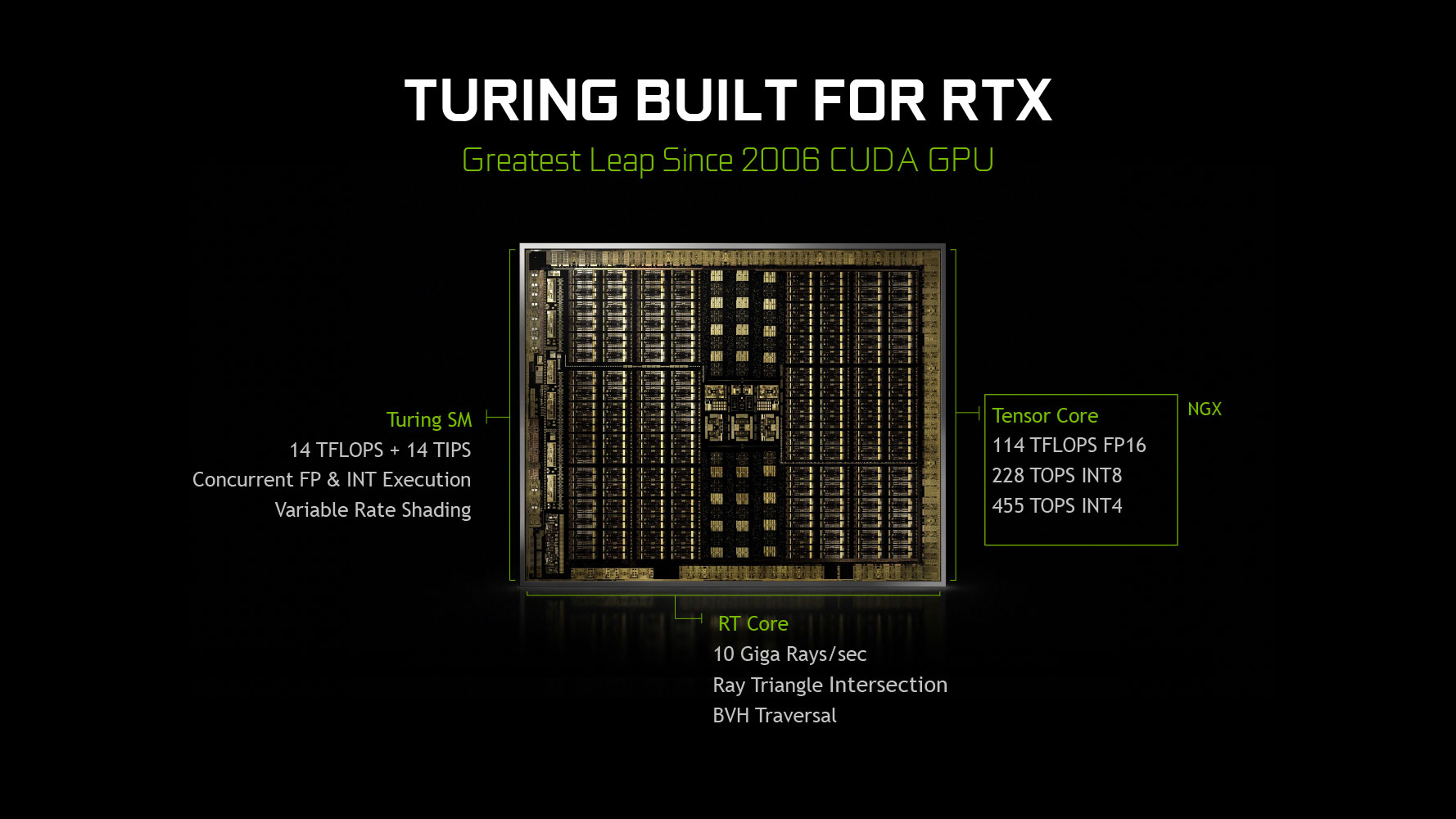
NVIDIA RTX is a brave new feature that has triggered a leap in GPU compute power, just like other killer real-time consumer graphics features, such as anti-aliasing, programmable shading, and tessellation. It provides a programming model for 3D scenes with ray-traced elements that improve realism. RTX introduces several turnkey effects that game developers can implement with specific sections of their 3D scenes, rather than ray-tracing everything on the screen (we're not quite there yet). A plethora of next-generation GameWorks effects could leverage RTX.

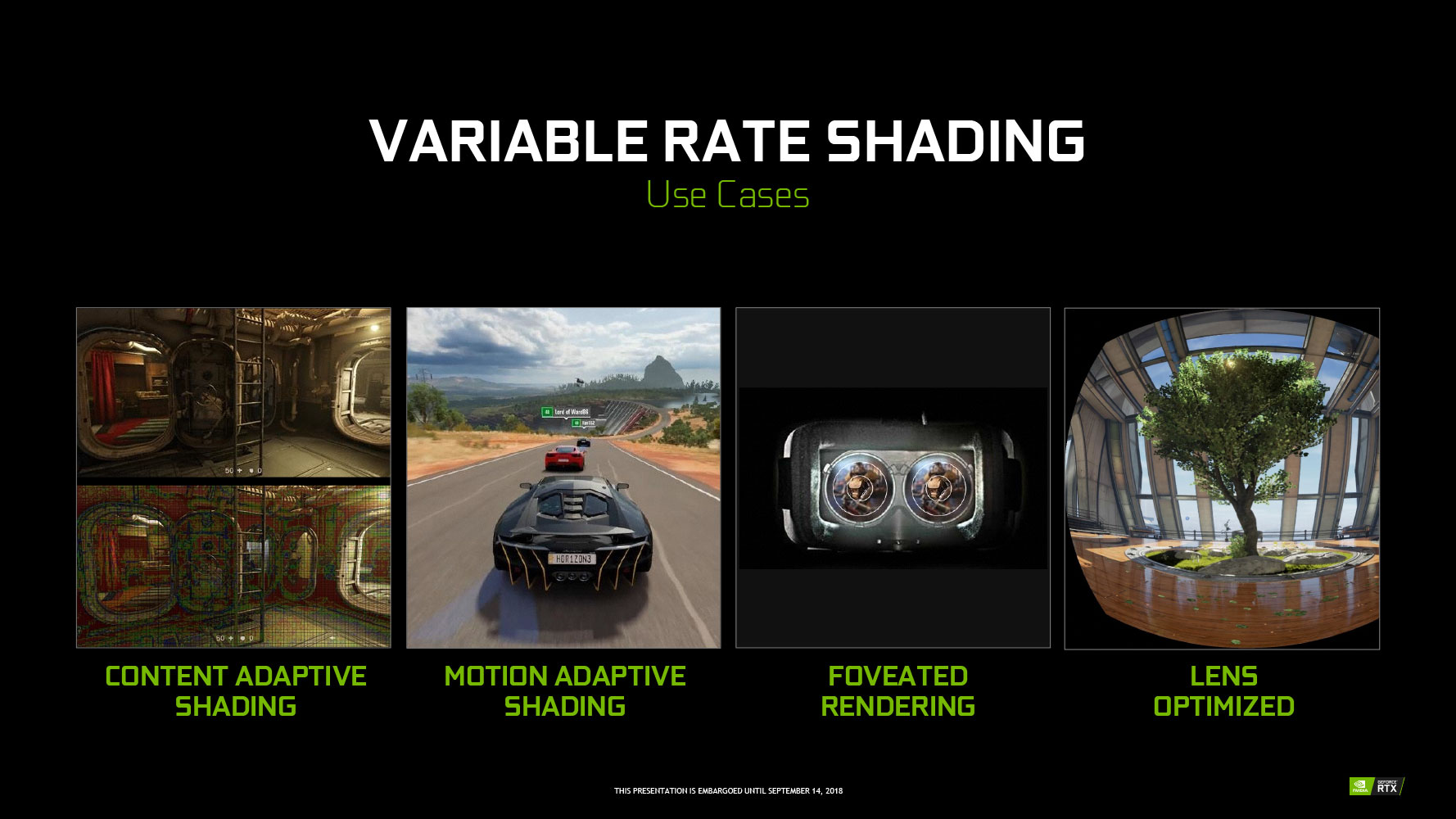
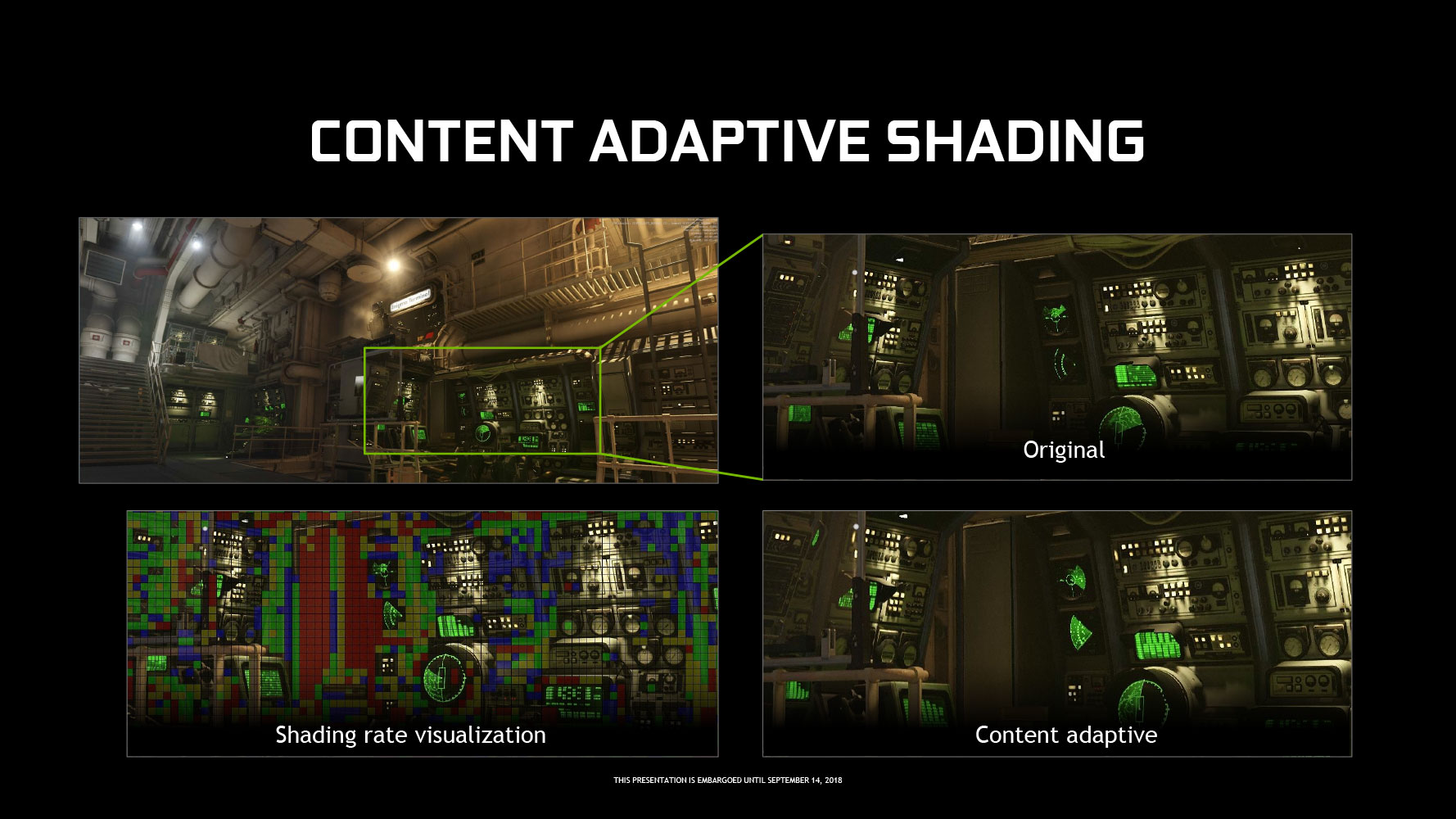
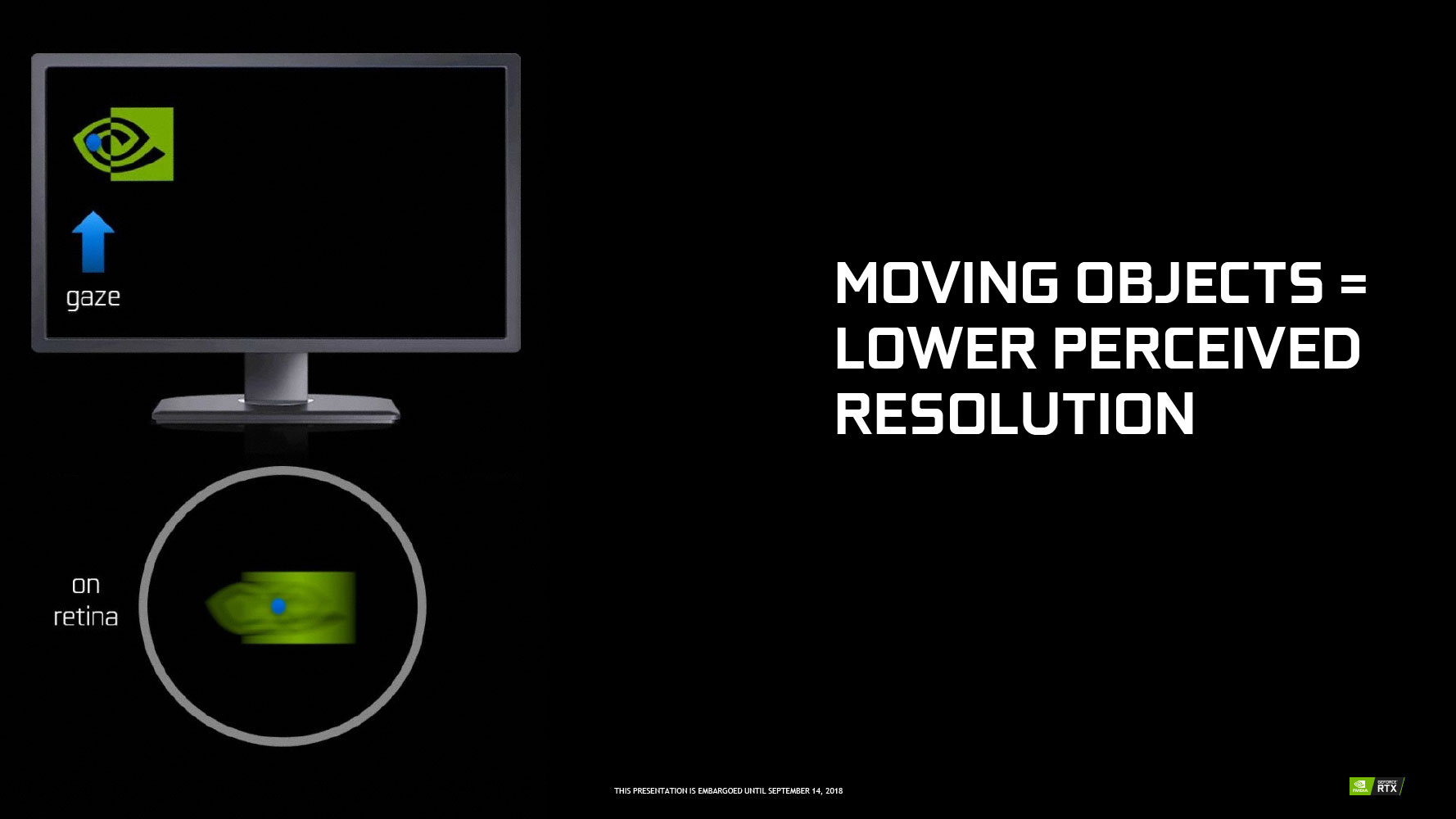
Perhaps more relevant architectural features to gamers come in the form of improvements to the GPU shaders. In addition to concurrent INT and FP32 operations in the SM, "Turing" introduces Mesh Shading, Variable Rate Shading, Content-Adaptive Shading, Motion-Adaptive Shading, Texture-Space Shading, and Foveated Rendering.

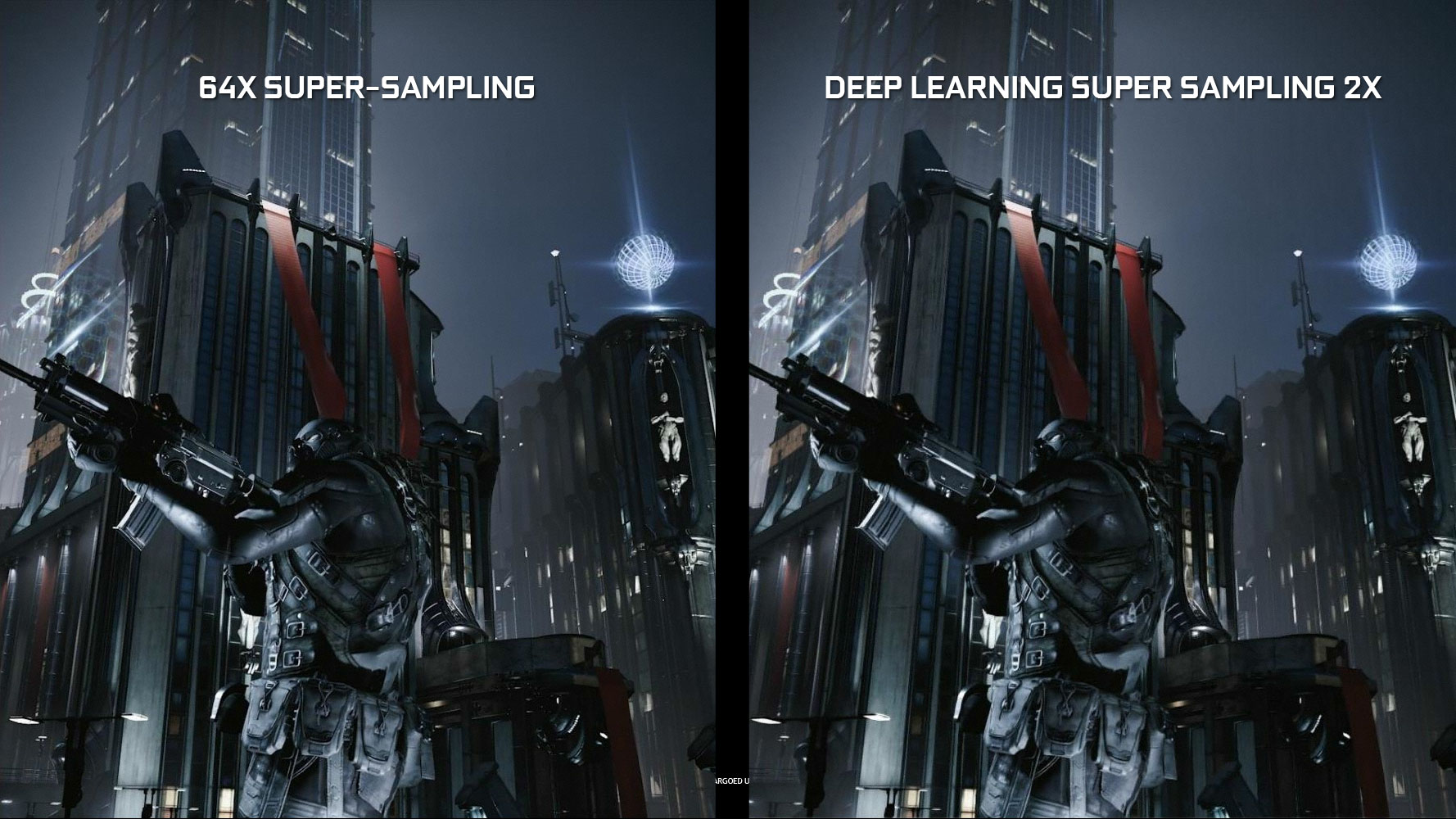
Deep Learning Anti-Aliasing (DLSS) is an ingenious new post-processing AA method that leverages deep-neural networks built ad hoc with the purpose of guessing how an image could look upscaled. DNNs are built on-chip, accelerated by Tensor cores. Ground-truth data on how objects in most common games should ideally look upscaled are fed via driver updates, or GeForce Experience. The DNN then uses this ground-truth data to reconstruct detail in 3D objects. 2x DLSS image quality is comparable to 64x "classic" super sampling.
Packaging and Contents

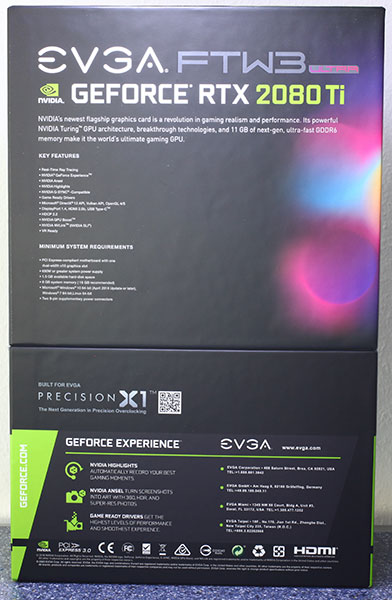

You will receive:
- Graphics card
- Documentation
- EVGA case badge
- DVI adapter
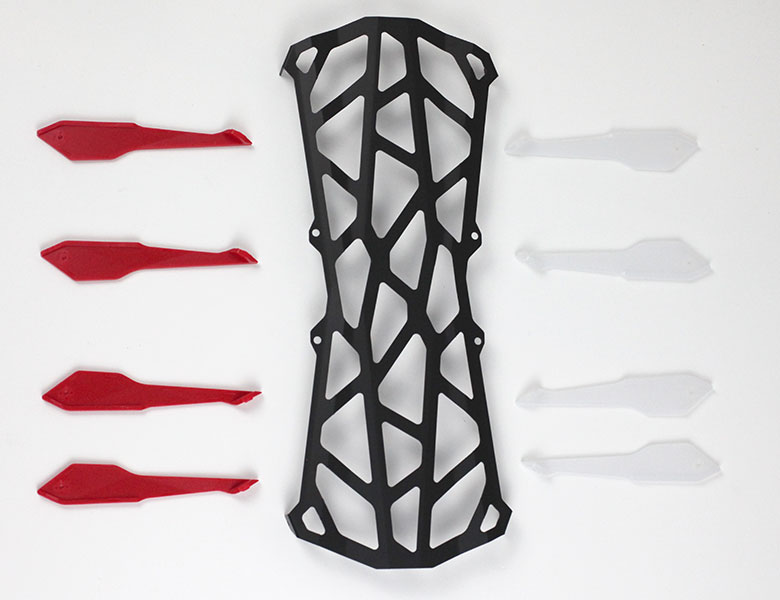


EVGA also sent us the optional trim kit and shield kit, which introduce additional options to customize the look of your card—without voiding the warranty.
Our Patreon Silver Supporters can read articles in single-page format.
Nov 15th, 2026 17:11 CST
change timezone
Latest GPU Drivers
New Forum Posts
- Local LLM General Discussion (691)
- WarpCoreBench scores! (54)
- What are you playing? (26223)
- Folding Pie and Milestones!! (10205)
- Asus Rog Maximus Z890 Extreme. (Various questions). (25)
- Power supply noise stops when I move the mouse (9)
- TPU's Nostalgic Hardware Club (22165)
- HP Office Jet 7740 Pro - Supply system problem with replacement cartridge (3)
- Recommendations Wanted - Affordable Enterprise SSD for Boot (9)
- What can the FX 8320 do today? Here is the answer. (59)
Popular Reviews
- AMD Zen 6 Technical Deep Dive
- ASUS ROG Strix B850-I Gaming Wi-Fi7 W Review
- Corsair HX1000i Shift Crystal Review
- Upcoming Hardware Launches 2027 (Updated Nov 2026)
- Montech King 95 3D PRO Review
- NZXT C1200 Platinum Review
- NZXT H7 RGB+ Review
- NZXT H5 Review
- Phantom Blade Zero Performance Benchmark Review - 35 GPUs Tested
- AMD Ryzen 7 9800X3D Review - The Best Gaming Processor
TPU on YouTube
Controversial News Posts
- NVIDIA Co-Founder and CEO Jensen Huang Officially Resigns (422)
- Open Letter Asking NVIDIA to Reinstate Jensen Huang Passes 115,000 Signatures (184)
- OpenAI CEO Argues Home PCs Waste the World's Limited DRAM Supply (152)
- NVIDIA Launches Investigation Into Jensen Huang's Relationship With Suspected Chinese Spy (136)
- Intel "Raptor Lake Next" 16-Core and 20-Core CPUs Surface (130)
- Legendary Game Studio BioWare Shuts Down Following EA Layoffs (104)
- Dell CEO Says the Memory Shortage Will Get Worse in 2027 (95)
- NVIDIA GeForce RTX 50-Series Scheduled for up to $500 Price Hike This Week (89)