 34
G.SKILL Trident Z5 RGB DDR5-6800 CL34 2x 16 GB Review
(34 Comments) »Introduction

G.SKILL is a renowned Taipei-based memory manufacturer with a history of producing performance-oriented products. The company has in recent years ventured into other PC markets, such as SSDs, AIO coolers, and peripherals, with gaming-oriented keyboards, mice, headsets, and more.
G.SKILL has multiple product lines to fit different markets with plenty of performance-oriented DDR4 options available. These SKUs include the Trident Z, Royal, Neo, Ripjaw and Elite series. With the launch of DDR5 in late 2021, G.SKILL brought forward the Trident Z and Ripjaws series. With AMD's new AM5 platform the following year, both the Flare X and Neo series made their DDR5 debut as well. Coming full circle, G.SKILL has released the next generation of DDR5 for PC enthusiasts using the newest Intel 13th generation processors. With eight independent lighting areas and 16 million color options, this G.SKILL Trident Z5 RGB kit also supports ASUS Aura, Gigabyte RGB Fusion, MSI Mystic Light, and ASRock Polychrome Sync software for maximum compatibility with different motherboard ARGB implementations.

In this review, we will be taking a closer look at the G.SKILL Trident Z5 RGB DDR5-6800 memory kit. Equipped with decent primary timings of 34-42-42-108 operating at 1.40 V for the 6800 MT/s X.M.P profile it brings higher bandwidth and considerable performance gains compared to the baseline JEDEC 4800 MT/s DDR5. Marketed towards PC enthusiasts, While it shares the same name as its predecessor, the memory kit reviewed today is strictly geared towards Intel Z790 based motherboards paired with 13th Generation Processors due to the high frequency XMP profile. Memory kit configurations for G.SKILL Trident Z5 include 32 GB (2x 16 GB) and 64 GB (2x 32 GB with binned frequencies ranging from 5200 MT/s to 8000 MT/s. With that out of the way, it's time to get into the review and do some heavy overclocking as well!
Specifications
| Specifications | |||
|---|---|---|---|
| Manufacturer: | G.SKILL | G.SKILL | |
| Model: | F5-6800J3445G16GX2-TZ5RK | F5-6800J3445G16GX2-TZ5RK | |
| XMP Profile: | XMP-1 | JEDEC | |
| Speed Rating: | DDR5-6800 MT/s | DDR5-4800 MT/s | |
| Rated Timings: | 34-42-42-108-127 | 40-40-40-77-117 | |
| Tested Capacity: | 32 GB (2x 16 GB) | 32 GB (2x 16 GB) | |
| Tested Voltage: | 1.40 V | 1.1 V | |
| Registered/Unbuffered: | Unbuffered | Unbuffered | |
| Error Checking: | ECC (resting) | ECC (resting) | |
| IC Manufacturer: | SK Hynix A | SK Hynix A | |
| Form Factor: | 288-pin DIMM | 288-pin DIMM | |
| Warranty: | Limited Lifetime | Limited Lifetime | |
Packaging


The G.SKILL packaging is black with accompanying silver and red accents around the sides. A picture of the memory is featured prominently on the front showing both the Metallic Sliver and Matte Black version. Above the image is a cutout to see the actual product inside. In the left-front corner is a giant "Intel XMP Ready" sticker along with the Trident Z5 RGB branding.
Flip the box around and each DIMM has the SKU number visible through the cutout. G.SKILL puts a quick blurb about the Trident Z5 memory at the top. Lastly, there's the barcode with the SKU, module densities, configuration, and operational frequency the XMP profile provides. Since these have RGB LEDs, ASUS Aura, Gigabyte RGB Fusion, MSI Mystic Light, and ASRock Polychrome Sync software, with a small badge across the bottom for each supported program.

Removing the memory from the box only requires cutting some tape—the memory sticks are secured and protected from minor damage with a clamshell inside the outer box.
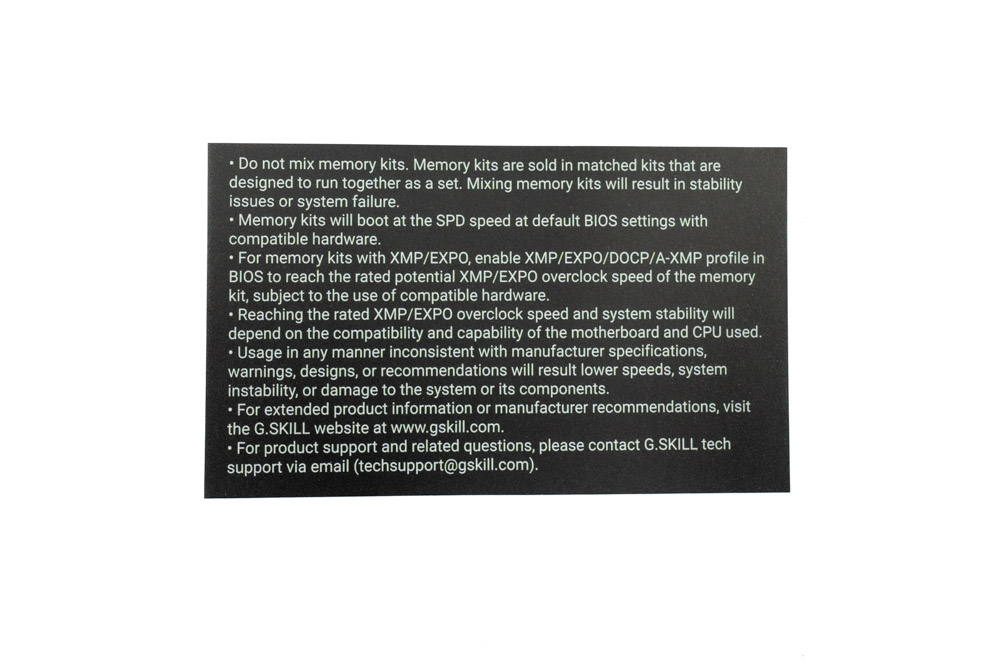
Inside is a piece of paper with information covering common questions and technical issues. While this is mostly just a nice way for G.Skill to say the consumer is on their own for any unsupported configurations, it's still helpful to keep misinformation from spreading, and these statements have some truth to them.
Some examples written on card:
- "Do not mix memory kits. Memory kits are sold in matched kits that are designed to run together as a set. Mixing memory kits will result in stability issues or system failure"
- "Memory kits will boot at the SPD speed at default BIOS settings with compatible hardware"
- "Reaching the rated XMP/EXPO overclock speed and system stability will depend on the compatibility and capability of the motherboard and CPU used."
Our Patreon Silver Supporters can read articles in single-page format.
Nov 14th, 2026 21:53 CST
change timezone
Latest GPU Drivers
New Forum Posts
- What can the FX 8320 do today? Here is the answer. (47)
- WarpCoreBench scores! (39)
- Tell me about your favourite graphics card (82)
- Recommendations Wanted - Affordable Enterprise SSD for Boot (3)
- Planning for Prolonged High Prices and Maintaining What You Already Have (71)
- [INTEL]-How To Update Your Microcode for Intel HX 13/14th Gen. CPUs Laptops/Mobile Easily. (260)
- [Intel AX1xx/AX2xx/AX4xx/AX16xx/BE2xx/BE17xx] Intel Modded Wi-Fi Driver with Intel® Killer™ Features (632)
- Optical Disc Drive owners club (208)
- Game Soundtracks You Love (1287)
- 9070 GRE 3.9ghz validation reached. (11)
Popular Reviews
- AMD Zen 6 Technical Deep Dive
- ASUS ROG Strix B850-I Gaming Wi-Fi7 W Review
- Corsair HX1000i Shift Crystal Review
- Upcoming Hardware Launches 2027 (Updated Nov 2026)
- Montech King 95 3D PRO Review
- NZXT C1200 Platinum Review
- NZXT H7 RGB+ Review
- NZXT H5 Review
- Phantom Blade Zero Performance Benchmark Review - 35 GPUs Tested
- AMD Ryzen 7 9800X3D Review - The Best Gaming Processor
TPU on YouTube
Controversial News Posts
- NVIDIA Co-Founder and CEO Jensen Huang Officially Resigns (408)
- OpenAI CEO Argues Home PCs Waste the World's Limited DRAM Supply (152)
- NVIDIA Launches Investigation Into Jensen Huang's Relationship With Suspected Chinese Spy (136)
- Intel "Raptor Lake Next" 16-Core and 20-Core CPUs Surface (130)
- Legendary Game Studio BioWare Shuts Down Following EA Layoffs (104)
- Dell CEO Says the Memory Shortage Will Get Worse in 2027 (95)
- NVIDIA GeForce RTX 50-Series Scheduled for up to $500 Price Hike This Week (89)
- Modder Fits RTX 5090 With Four 8-Pin Connectors, Halving Current per Wire (80)